




- Food Ingredients & Additives
- Patchouli Oil Market
Patchouli Oil Market Size, Share, Growth, and Regional Forecast, 2026 - 2033
Patchouli Oil Market is segmented by Product Type (Light patchouli oil and Dark patchouli oil), Nature (Organic and Conventional), End-user (Aromatherapy & Essential Oils, Cosmetics & Personal Care, Aromatherapy & wellness, Food & Beverage, Pharmaceutical, and Others), and Regional Analysis, 2026 - 2033

Patchouli Oil Market Share and Trends Analysis
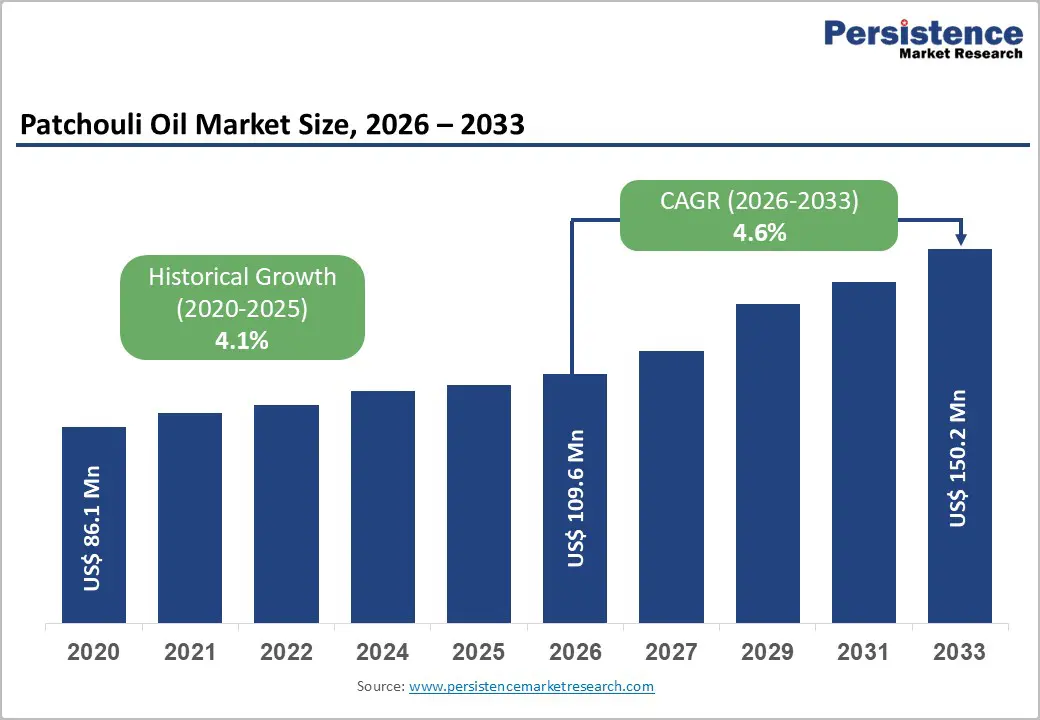
The global patchouli oil market size is expected to be valued at US$ 109.6 million in 2026 and projected to reach US$ 150.2 million by 2033, growing at a CAGR of 4.6% between 2026 and 2033 The market growth is propelled by the growing demand for natural and botanical ingredients in the luxury perfumery and clean-label cosmetic sectors.
This upward trajectory is further supported by the expanding application of oil in holistic wellness and traditional medicine across the Asia Pacific and Europe. Increased consumer awareness regarding the therapeutic benefits of Patchoulol, the primary active compound, has led to its integration into stress-relief and anti-inflammatory formulations. Furthermore, strategic initiatives by major players like Givaudan S.A. and Symrise AG to secure sustainable supply chains in Indonesia have stabilized production, ensuring that the market can meet the rising global demand for high-purity essential oils.
Key Industry Highlights:
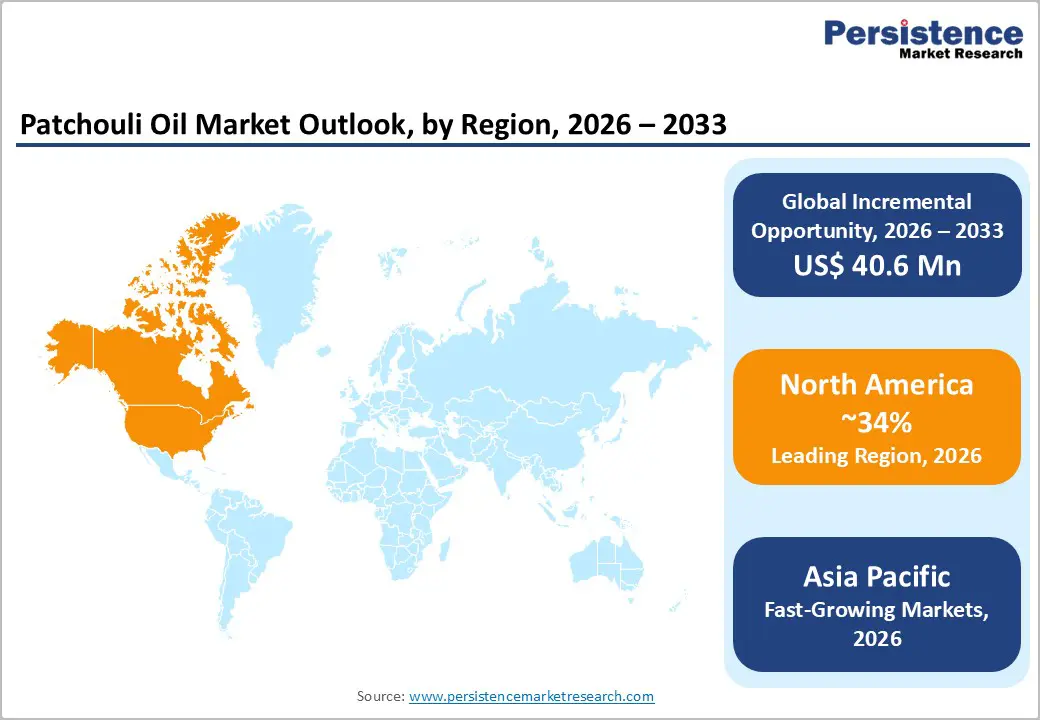
- Leading Region: North America held the largest market share of 34% in 2025, supported by a mature wellness culture and the global leadership of major essential oil brands.
- Fastest Growing Region: Asia Pacific is the fastest-growing region through 2033, fueled by its role as a primary production hub and rising middle-class consumption in India and China.
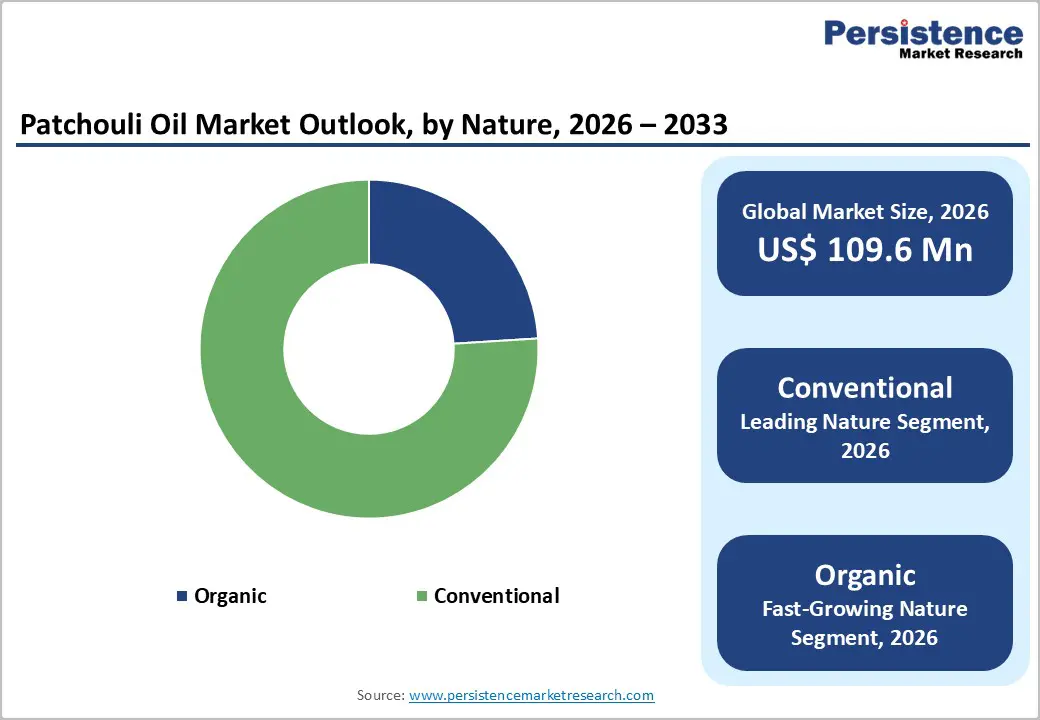
- Dominant Segment: Conventional nature products accounted for 76% of the market in 2025, benefiting from cost-efficiencies in large-scale cosmetic and household applications.
- Fastest Growing Segment: Organic patchouli oil is the fastest-growing nature category, driven by the clean beauty movement and the premiumization of the aromatherapy sector.
- Key Market Opportunity: The adoption of Supercritical CO2 Extraction provides a significant opportunity to produce high-margin, artisan-grade extracts for the luxury perfumery sector.
| Key Insights | Details |
|---|---|
|
Global Patchouli Oil Market Size (2026E) |
US$ 109.6 Mn |
|
Market Value Forecast (2033F) |
US$ 150.2 Mn |
|
Projected Growth (CAGR 2026 to 2033) |
4.6% |
|
Historical Market Growth (CAGR 2020 to 2025) |
4.1% |
Market Dynamics
Driver - Rising Demand for Natural Fragrances and Sustainable Perfumery
A fundamental driver of the Patchouli Oil Market is the structural shift in the fragrance industry away from synthetic aromachemicals toward complex, botanical base notes. Patchouli oil is highly valued as a natural fixative that provides depth and longevity to scents without the health concerns associated with phthalates. According to the International Fragrance Association (IFRA), there is a significant increase in the adoption of natural ingredients by luxury brands to meet the clean beauty standards of Gen Z and Millennial consumers. In 2025, nearly 54% of global demand was driven by the quest for naturality. Its ability to blend seamlessly with Bergamot, Lavender, and Sandalwood makes it an indispensable component for both artisanal and mainstream perfumers globally.
Restraints - Adulteration Challenges and Lack of Quality Standardization
Ensuring the purity of Patchouli oil remains a persistent challenge for the industry. Due to its high value, the oil is frequently subjected to adulteration with cheaper vegetable oils or synthetic additives. The presence of adulterants not only diminishes the therapeutic efficacy of the oil but also poses a risk to consumer safety, particularly in the Pharmaceutical and Cosmetics segments. While advanced analytical techniques like Gas Chromatography-Mass Spectrometry (GC-MS) are becoming standard for top-tier firms like IFF and Takasago, a lack of uniform global quality standards across small-scale producers often leads to inconsistent product grading. This variability can deter high-end buyers who require strict chemical profiles for their luxury formulations.
Opportunity - Surge in Organic Certification and Ethical Sourcing Demand
The rapidly growing Organic segment offers a significant revenue pocket as consumers demand greater transparency and ethical accountability in their products. There is an increasing willingness to pay for traceable, Fair Trade, and Regenerative Organic Certified oils. In North America, organic variants now account for roughly 27% of new product offerings. Strategic collaborations between fragrance houses and local farming cooperatives such as the Symrise AG initiative in Madagascar to support regenerative agriculture are becoming key differentiators. Brands that can provide verified supply chain traceability through Blockchain or similar technologies are well-positioned to capture the loyalty of the eco-conscious segment, which is projected to grow at a faster rate than the conventional market through 2033.
Category-wise Analysis
Product Type Insights
Light patchouli oil segment accounted for the highest market share, favored for its refined, clearer color and airier olfactory profile. This variety is often processed in stainless steel distillers to prevent the dark coloration caused by contact with iron, making it ideal for high-end skincare and clear cosmetic formulations. Conversely, the Dark patchouli oil segment remains a staple in the traditional incense and heavy base-note perfumery sectors. Valued for its intense, deep, and long-lasting aroma, dark oil often undergoes longer fermentation and is preferred by artisanal blenders. Growth in the Dark variety is currently being revitalized by the rise of niche and bespoke perfumery in Europe and the Middle East.
End-user Insights
Cosmetics & personal care segment represents the leading end-use application, driven by the oil's antimicrobial and anti-inflammatory benefits in skincare. It is a preferred ingredient in lotions and anti-aging creams for its ability to promote skin regeneration. Meanwhile, the Pharmaceutical segment is witnessing significant growth, particularly in the Asia Pacific region. Its use in traditional medicine systems like Ayurveda and Traditional Chinese Medicine (TCM) for treating gastrointestinal ailments and skin conditions is being validated by modern research into its anti-inflammatory and antifungal properties. Furthermore, the Food & Beverage industry is exploring patchouli as a novel flavoring agent in specialty herbal teas and alcoholic spirits.
Region-wise Insights
North America Patchouli Oil Market Trends and Insights
North America is the leading regional market, holding a 34% market share in 2025. This dominance is underpinned by a mature wellness ecosystem in the United States and a high concentration of major essential oil players like doTERRA International LLC and Young Living Essential Oils. The regional demand is heavily influenced by the plant-based beauty trend. The innovation ecosystem in the U.S. is focused on digital-first consumer engagement, with Online Retail accounting for over 22% of patchouli sales.
Regulatory compliance remains a priority, with manufacturers adhering to strict FDA guidelines on ingredient transparency. The region is also a hub for the aromatherapy-at-home movement, where consumers utilize high-purity oils for DIY skincare and home fragrance. The presence of a high-income demographic that prioritizes artisanal and exotic base notes ensures that the North American market remains the global engine for value growth.
Asia Pacific Patchouli Oil Market Trends and Insights
Asia Pacific is the fastest-growing regional market, projected to expand at a high CAGR through 2032. This growth is driven by the region's unique position as both a major production hub and an emerging consumption market. Indonesia and China are the world's leading producers, with Indonesia accounting for over 80% of global supply. Rapid urbanization in India and ASEAN countries, combined with a rising middle class, has led to increased spending on personal care and wellness products.
The regional market is also benefiting from the integration of patchouli into the Traditional Chinese Medicine and Ayurvedic sectors. In India, the government is actively encouraging the expansion of patchouli cultivation to reduce its dependence on imports and capitalize on domestic growth in the pharmaceutical industry. Manufacturing has advantages, such as proximity to raw materials and lower labor costs, allow local companies like Indesso Aroma and Van Aroma to maintain a competitive edge. The expansion of high-speed e-commerce networks across China and Southeast Asia is further accelerating the retail accessibility of premium essential oils.
Competitive Landscape
The patchouli oil market is a moderately fragmented landscape where traditional agricultural producers coexist with global fragrance and flavor conglomerates. Large-scale processing and distribution are dominated by firms like Givaudan S.A., Symrise AG, and IFF, who command nearly 35% of the high-value market share. These companies focus on vertical integration and strategic partnerships with local exporters to ensure a stable supply of high-purity oil.
Key differentiators in the market include technological expertise in vacuum and molecular distillation, as well as the ability to provide verified sustainability certifications. Emerging business models are increasingly focused on Direct-to-Business (D2B) partnerships, where fragrance houses work directly with farming cooperatives to improve crop yield and social impact.
Companies Covered in Patchouli Oil Market
- Givaudan S.A.
- Symrise AG
- IFF
- Takasago International Corporation
- Robertet SA
- doTERRA International LLC
- Young Living Essential Oils
- NOW Health Group Inc.
- Garden of Life
- Sensient Technologies Corporation
- Berje Inc.
- Others
Frequently Asked Questions
The global Patchouli Oil market is projected to be valued at US$ 109.6 Mn in 2026.
Rising Demand for Natural Fragrances and Sustainable Perfumery is driving demand for Patchouli Oil market.
The Global Patchouli Oil market is poised to witness a CAGR of 4.6% between 2026 and 2033.
Surge in Organic Certification and Ethical Sourcing Demand is key opportunity for key players in the market.
The market is led by global giants such as Givaudan S.A., Symrise AG, IFF, Takasago International Corporation, Robertet SA, doTERRA International LLC, and others.


