




- Medical Devices
- Myoelectric Prosthetics Market
Myoelectric Prosthetics Market Size, Share, and Growth Forecast 2026 - 2033
Myoelectric Prosthetics Market by Indication (Upper Limb Prosthetics, Lower Limb Prosthetics, Rehabilitation Technologies, Assistive Devices), by Component (Sensors, Actuators, Control Algorithms), by End-User (Hospitals, Prosthetic Clinics, Rehabilitation Centers, Ambulatory Surgery Centers, Others), by Regional Analysis, 2026-2033

Myoelectric Prosthetics Market Size and Trend Analysis
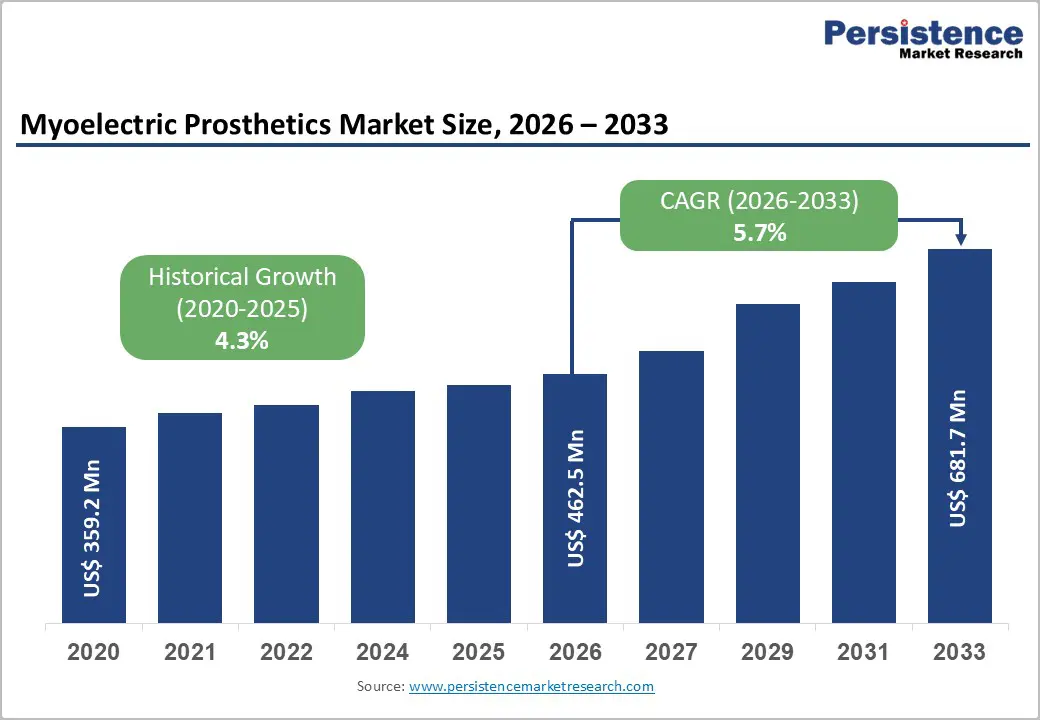
The global myoelectric prosthetics market size is expected to be valued at US$ 462.5 million in 2026 and projected to reach US$ 681.7 million by 2033, growing at a CAGR of 5.7% between 2026 and 2033.
Rising incidences of limb amputations due to trauma, diabetes, and vascular diseases drive this growth, with 57.7 million people worldwide living with traumatic limb loss as of recent estimates. Advancements in sensor technology and AI integration enhance prosthetic functionality, supported by increasing healthcare expenditures and rehabilitation focus. Government initiatives and aging populations further accelerate adoption, ensuring sustained demand.
Key Market highlights
- North America leads the myoelectric prosthetics market, supported by strong reimbursement systems, veteran programs, advanced clinics, and continuous technology innovation.
- Asia Pacific is the fastest-growing region, driven by rising amputation rates, expanding rehabilitation infrastructure, local manufacturing, and supportive government healthcare initiatives.
- Upper limb myoelectric prosthetics dominate product demand due to high dexterity requirements, multi-articulating hands, and superior functional outcomes in daily activities.
- AI-enabled sensors and actuators represent the fastest-growing technology segment, fueled by neural-interface research, adaptive control algorithms, and next-generation rehabilitation platforms.
| Key Insights | Details |
|---|---|
| Myoelectric Prosthetics Market Size (2026E) | US$ 7462.5 Mn |
| Market Value Forecast (2033F) | US$ 1,232.3 Mn |
| Projected Growth (CAGR 2026 to 2033) | 5.7% |
| Historical Market Growth (CAGR 2020 to 2025) | 4.3% |
Market Dynamics
Driver: Rising Incidence of Limb Amputations
Global limb-loss prevalence continues rising due to trauma, diabetes, vascular disease, and aging populations, directly expanding demand for advanced prosthetic technologies. Traumatic amputations affect tens of millions worldwide, with falls and accident-related injuries prominent in East Asia, South Asia, and high-income North America. Urbanization, traffic density, industrial activity, and conflict exposure further elevate amputation risk in developing and transitional economies. Simultaneously, diabetes-related lower-limb amputations are climbing sharply, particularly in Asia-Pacific and Latin America, where lifestyle changes and delayed diagnosis strain healthcare systems. These epidemiological shifts create a sustained clinical need for functional, responsive prosthetic solutions that restore mobility, dexterity, and daily independence.
Myoelectric prosthetics increasingly meet this requirement by translating muscle-generated electrical signals into precise limb movement, enabling natural grasp patterns, multi-articulating hands, and adaptive gait support. Compared with body-powered alternatives, these systems improve rehabilitation outcomes, reduce caregiver dependence, and enhance workforce reintegration. Health systems also recognize long-term economic benefits, as improved function lowers secondary complications, repeat hospital visits, and extended rehabilitation timelines. Consequently, hospitals, rehabilitation centers, and military-veteran programs are accelerating adoption, making rising amputation incidence the market’s most powerful and persistent growth catalyst.
Restraint: High Costs and Limited Insurance Coverage
Despite technological advantages, myoelectric prosthetics face adoption barriers from high upfront prices and inconsistent reimbursement frameworks. Advanced systems often cost several times more than mechanical alternatives due to sophisticated sensors, microprocessors, motors, and custom fitting requirements. For patients in low- and middle-income regions, these prices exceed out-of-pocket affordability, pushing clinicians to prescribe simpler devices even when myoelectric options offer superior outcomes. Insurance coverage remains uneven, with a significant portion of candidates reporting restrictions on device upgrades, replacements, or multi-articulating features. Public health programs frequently cap reimbursements, while private insurers may classify premium functions as non-essential, limiting patient choice. Ongoing maintenance expenses including battery replacements, recalibration, repairs, and software updates further increase lifetime ownership costs. Supply-chain limitations and shortages of trained prosthetists compound access challenges in rural or under-served areas. Together, pricing pressure, reimbursement gaps, and service infrastructure constraints slow penetration in emerging markets and temper growth in otherwise high-need populations, positioning affordability as the market’s most critical structural restraint.
Opportunity: Advancements in Rehabilitation Technologies
Rapid innovation in rehabilitation technologies presents a major growth avenue for the myoelectric prosthetics ecosystem. Artificial-intelligence-driven training software, virtual-reality therapy modules, and adaptive control algorithms are improving signal interpretation, shortening learning curves, and addressing phantom-limb pain. Defense- and research-agency funding for neural-interface development and motion-prediction platforms is accelerating clinical translation, while sensor miniaturization and wireless connectivity enhance patient comfort and reliability. Integration of these tools into post-surgical recovery programs expands device utilization beyond hardware alone, strengthening long-term patient engagement and outcomes.
Upper-limb systems already representing a substantial share of demand stand to benefit most from these advancements as rehabilitation platforms increasingly support dexterity training and task-specific re-learning. Growth in the global prosthetist workforce, coupled with hospital- and clinic-based adoption, improves service reach and fitting accuracy. Aging demographics and supportive access policies in developed regions further widen eligible patient pools. As rehabilitation solutions become embedded within comprehensive care pathways, manufacturers can unlock recurring revenue streams from software, upgrades, and therapy services, transforming clinical innovation into a powerful commercial opportunity.
Category-wise Insights
Indication Analysis
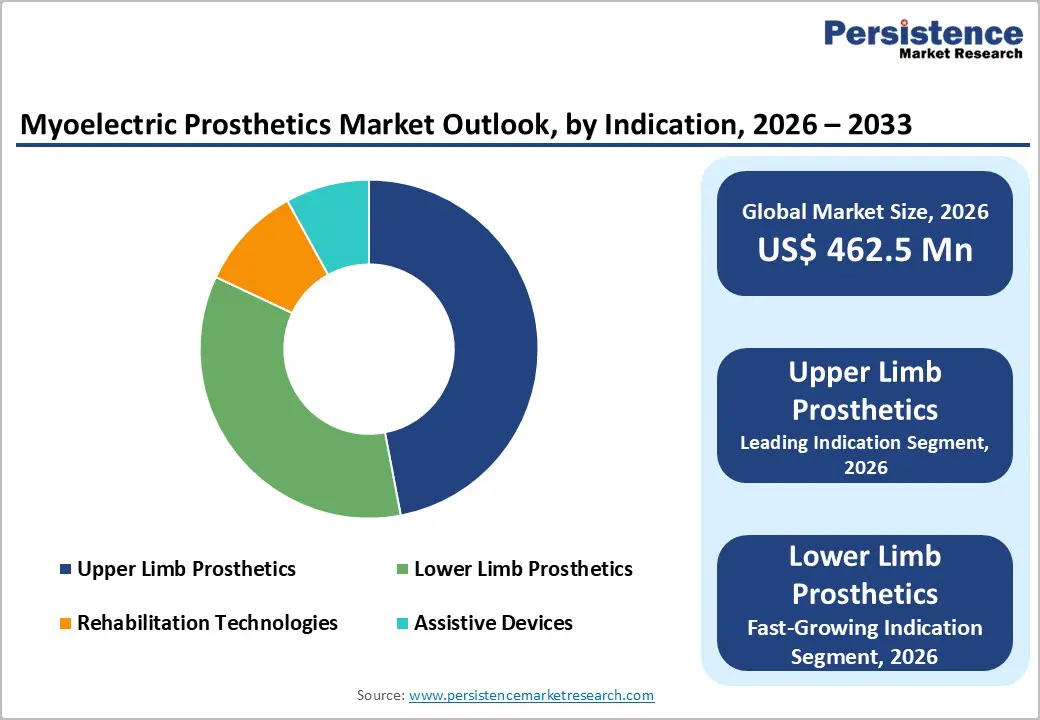
Upper limb myoelectric prosthetics remain the most significant indication segment in the myoelectric prosthetics market, accounting for a leading share (around 47% in 2025) thanks to strong demand for devices that enhance hand and arm functionality in daily life. Prosthetic hands and forearm systems deliver fine motor control and dexterity, which are crucial for activities such as eating, dressing, writing, and occupational tasks. Pattern-recognition control systems and multi-articulating mechanisms allow users to perform intuitive movements by interpreting muscle signals, narrowing the gap between natural and prosthetic limb use. Although specific utilization rates vary by amputation level and study, lower-level amputations such as trans-radial fittings tend to show higher overall prosthesis use due to greater residual muscle sites for reliable EMG signal capture and control, supporting broader adoption of sophisticated myoelectric hands. Technological progress and user preference for natural, responsive devices continue to drive upper limb dominance, especially in developed healthcare markets with supportive reimbursement structures.
Component Analysis
In myoelectric prosthetics, sensors are the dominant component, forming the essential interface between the user’s residual muscles and the prosthetic control system. These electromyography (EMG) sensors detect electrical signals generated by muscle contractions and convert them into accurate control commands for prosthetic movement, enabling high-fidelity pattern recognition and fine motor control. Innovations such as multi-channel EMG arrays and enhanced signal processing have increased accuracy and reliability, particularly benefiting upper limb prosthetics where nuanced gestures and grip patterns are required. This strong functional role keeps sensors as the largest revenue contributor within the component landscape.
Meanwhile, actuators are the fastest-growing component segment as manufacturers invest in advanced actuation technologies that support multi-digit precision, improved power efficiency, and more natural limb movement. Enhanced actuator designs, including compact motors and integrated joints, allow prosthetic hands and wrists to deliver responsive grasping, rotation, and load-bearing capabilities, improving user experience and expanding adoption across complex use cases.
Regional Insights
North America Myoelectric Prosthetics Market Trends and Insights
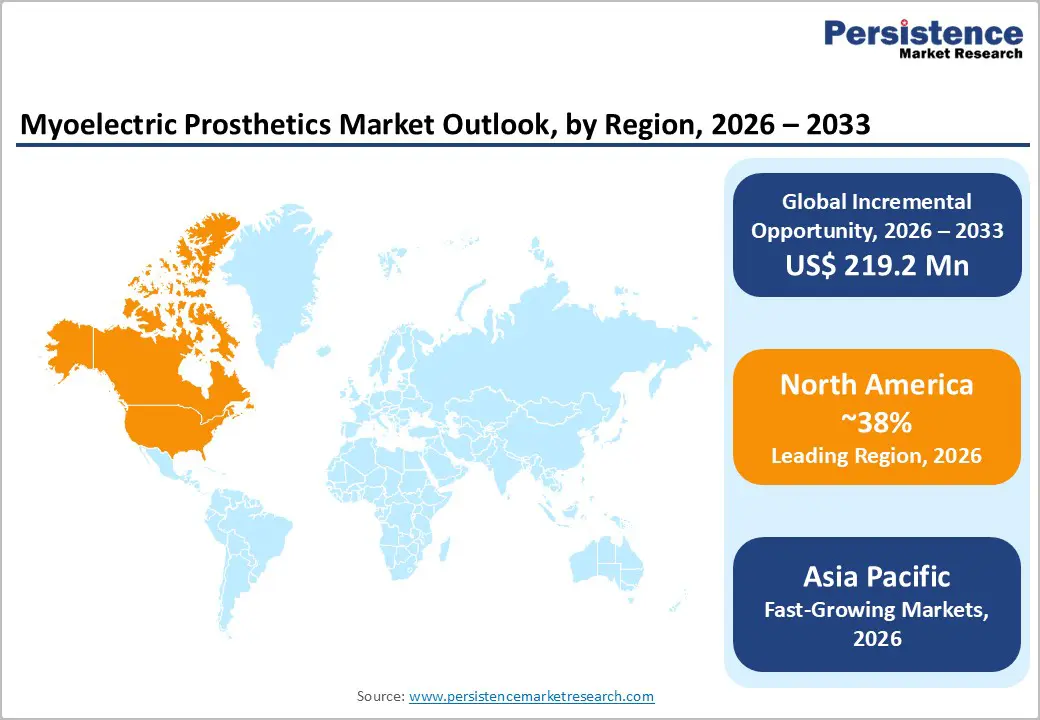
The North America myoelectric prosthetics market remains the largest regional segment globally, driven by advanced healthcare infrastructure, strong reimbursement frameworks, and high R&D investments supporting next-generation prosthetic technologies. A considerable portion of regional demand originates from the United States, where veteran healthcare programs, diabetes-related limb loss, and trauma rehabilitation spur adoption of myoelectric solutions. Specialized prosthetic clinics and rehabilitation centers, coupled with collaborative medical research initiatives, accelerate clinical integration and innovation, particularly for multi-articulating upper limb systems and AI-enhanced control interfaces. Market leadership is further sustained by generous healthcare expenditure and favorable regulatory environments that expedite product approvals and clinical availability.
Looking ahead, North America is expected to maintain steady growth as the region continues to embrace cutting-edge myoelectric prosthetics, including developments in sensor technology, neural control interfaces, and personalized fittings. Partnerships between manufacturers, academic institutions, and healthcare systems are expanding the technology’s reach, while increasing awareness of improved long-term functional outcomes boosts clinician and patient confidence.
Asia Pacific Myoelectric Prosthetics Market Trends and Insights
The Asia Pacific myoelectric prosthetics market is characterized by rapid growth and emerging adoption across China, India, Japan, South Korea, and other developing economies. While overall market share still trails North America and Europe, the region is projected to register one of the highest compound annual growth rates worldwide, fueled by rising limb amputation cases tied to diabetes, road accidents, and industrial injuries. Rising disposable incomes, expanding healthcare infrastructure, and increased government focus on rehabilitation services and assistive technologies contribute to broader accessibility of advanced prosthetic solutions. Local manufacturers are also entering this space with cost-competitive devices aimed at expanding penetration in underserved areas.
Technological advancements such as improved EMG sensor systems, AI-driven control algorithms, and localized production are further accelerating adoption in Asia Pacific. Public healthcare initiatives in China and India are increasingly subsidizing prosthetic fittings, while partnerships between international OEMs and regional distributors support product availability across urban and semi-urban settings. Overall, Asia Pacific’s dynamic economic growth and healthcare modernization point toward sustained expansion of the myoelectric prosthetics market.
Competitive Landscape
Market Structure Analysis
The myoelectric prosthetics market is moderately consolidated, with leading manufacturers focusing on technological innovation to strengthen global product portfolios. Companies increasingly invest in advanced sensors, AI-enabled control systems, lightweight materials, and multi-articulating designs to differentiate offerings and improve patient outcomes. Strategic partnerships with rehabilitation centers, defense organizations, and academic institutions are common, accelerating clinical validation and technology adoption. Market participants also pursue distribution agreements, joint development programs, and regional alliances to expand geographic presence and customer reach. Mergers, acquisitions, and licensing deals further support portfolio expansion and competitive positioning, enabling suppliers to increase market share in both mature and emerging healthcare markets.?
Key Market Developments
- In July 2025, Boulder-based startup Point Designs announced that it had entered into an agreement for a forthcoming acquisition by Hanger, Inc., a leading provider of orthotic and prosthetic (O&P) patient care services and solutions.
Companies Covered in Myoelectric Prosthetics Market
- Virginia Prosthetics & Orthotics Inc.
- Endolite India
- Ottobock
- College Park Industries
- Leimkuehler, Inc.
- Touch Bionics Inc. (Össur hf)
- Fillauer LLC
- COAPT LLC
- Össur
- FAULHABER
- Others
Frequently Asked Questions
The global myoelectric prosthetics market is expected to reach US$ 462.5 million in 2026.
Rising amputations, diabetes prevalence, aging populations, technological advances, better rehabilitation outcomes, military programs, and expanding reimbursement coverage drive adoption globally.
North America leads with 38% share in 2025.
AI-enabled rehabilitation platforms, neural interfaces, affordable designs, emerging-market expansion, subscription software, and hospital partnerships offer strong growth opportunities for companies.
Leaders include Virginia Prosthetics & Orthotics Inc., Endolite India, Ottobock, College Park Industries, and Leimkuehler, Inc.


