




- Medical Devices
- Neuroprosthetics Market
Neuroprosthetics Market Size, Share, and Growth Forecast, 2026 - 2033
Neuroprosthetics Market By Product Type (Motor Prosthetics, Cochlear Implants, Cognitive Prosthetics, Retinal Implants), Others), Application (Motor Neuron Disorders, Physiological Disorders, Cognitive Disorders), and Regional Analysis for 2026 - 2033

Neuroprosthetics Market Size and Trends Analysis
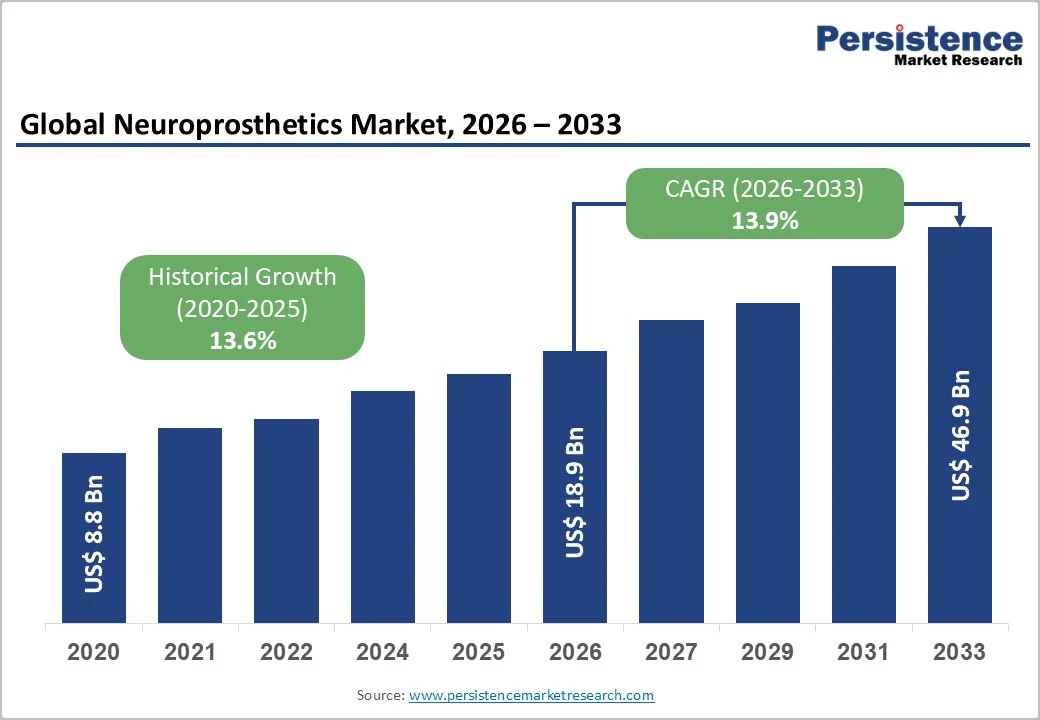
The global neuroprosthetics market size is likely to be valued at US$18.9 billion in 2026. It is expected to reach US$46.9 billion by 2033, growing at a CAGR of 13.9% from 2026 to 2033, driven by the rising prevalence of neurological disorders, breakthrough advances in brain-computer interfaces, and increasing adoption of cochlear and retinal implants.
The rising need to restore lost sensory and motor functions is driving strong adoption of neuroprosthetics across diverse patient groups. Advancements in deep brain and spinal cord stimulation, especially minimally invasive and wireless technologies, are further accelerating market growth.
Increasing recognition of neuroprosthetics as transformative, high-impact interventions, particularly within advanced healthcare systems, continues to shape and strengthen the overall market trends.
Key Industry Highlights:
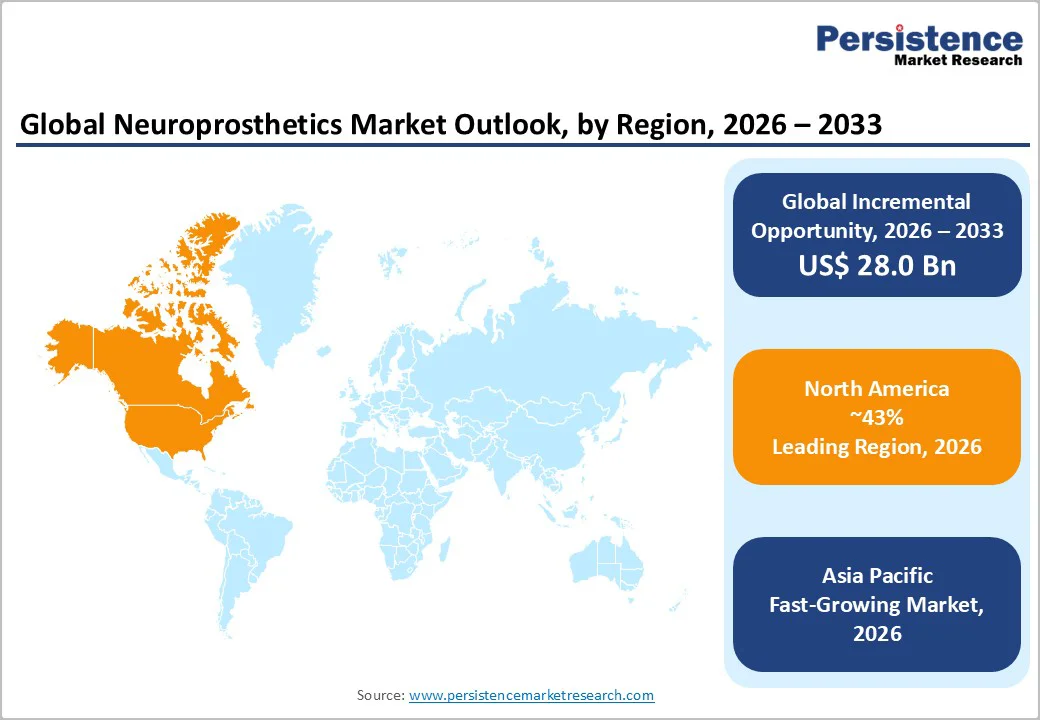
- Leading Region: North America is anticipated to lead, accounting for 43% market share in 2026, driven by advanced neurology centers, high prevalence of Parkinson’s & epilepsy, and strong FDA approvals in the U.S.
- Fastest-growing Region: Asia Pacific, fueled by rising healthcare investments, increasing aging population, and growing awareness of cochlear implants in China and India.
- Dominant Product Type: Cochlear Implants, holding approximately 45% of market share, due to widespread treatment of hearing loss.
- Leading Technology: Deep Brain Stimulation (DBS) is projected to account for over 35% of the market revenue, driven by Parkinson’s therapy.
- Leading Application: Motor neuron disorders are expected to account for nearly 50% of market revenue, driven by paralysis restoration.
- Key Market Driver: The rising incidence of neurological conditions and the demand for brain-machine interfaces are accelerating the adoption of neuroprosthetics globally.
- Market Opportunity: Integration of AI and wireless connectivity creates strong opportunities for next-generation cognitive and motor prosthetics.
| Key Insights | Details |
|---|---|
| Neuroprosthetics Market Size (2026E) | US$18.9 Bn |
| Market Value Forecast (2033F) | US$46.9 Bn |
| Projected Growth (CAGR 2026 to 2033) | 13.9% |
| Historical Market Growth (CAGR 2020 to 2025) | 13.6% |
Market Factors - Growth, Barriers, and Opportunity Analysis
Rising Prevalence of Neurological Disorders and Demand for Functional Restoration
The growing global burden of neurological disorders is a major catalyst for the neuroprosthetics market. Rising cases of Parkinson’s disease, stroke, ALS, spinal cord injuries, and hearing or vision impairments, driven by aging populations, lifestyle risks, and improved diagnostic capabilities, are increasing the need for effective functional-restoration solutions.
These conditions often cause motor, sensory, or cognitive impairments, creating a strong demand for advanced interventions. Neuroprosthetic devices such as deep brain stimulators, cochlear implants, spinal cord stimulators, motor prostheses, and retinal implants help restore movement, sensory perception, or cognitive function, supporting rehabilitation and enhancing patient independence.
Increasing awareness among patients and healthcare professionals about the advantages of advanced neural therapies is driving higher demand for neuroprosthetics. Healthcare systems across both developed and emerging markets are investing more in neurotechnology to manage chronic neurological conditions.
The convergence of rising disease prevalence, patient demand for enhanced mobility and sensory function, and supportive healthcare infrastructure is accelerating the global growth of the neuroprosthetics market, underscoring its vital role in functional restoration and long-term patient care.
High Development and Surgical Implantation Costs
The high costs associated with the development and surgical implantation of neuroprosthetics pose a significant restraint. Designing and manufacturing neuroprosthetic devices, such as cochlear implants, deep brain stimulators, and advanced exoskeletons, requires cutting-edge technology, precision engineering, and extensive research and development.
The integration of sensors, neural interfaces, wireless communication, and AI algorithms further adds to production costs. Rigorous preclinical and clinical testing is required to meet regulatory standards, ensuring device safety, efficacy, and compliance, and this process involves substantial financial investment and extended timelines.
Beyond device costs, surgical implantation is complex and expensive, requiring highly skilled neurosurgeons, specialized operating rooms, and advanced imaging and monitoring equipment. Postoperative care, programming, and long-term maintenance of the devices contribute further to overall treatment expenses.
These high costs can restrict access, especially in emerging markets with limited healthcare funding, and may lead to slower adoption despite clinical benefits.
Advancements in AI-Integrated and Wireless Neuroprosthetics
Advancements in AI-integrated and fully wireless neuroprosthetics present major growth opportunities. AI-enabled neuroprosthetic devices can analyze neural signals in real time, allowing adaptive responses that improve motor control, sensory perception, and cognitive support.
For instance, AI algorithms in brain-computer interface (BCI) systems can predict user intent, enabling more precise control of prosthetic limbs or exoskeletons. Wireless connectivity further enhances usability by eliminating cumbersome cables, reducing infection risk, and allowing remote monitoring and device adjustments by clinicians. Rechargeable and wireless systems improve patient convenience, adherence, and long-term therapy effectiveness.
AI-driven data analytics allow personalized treatment plans, continuous optimization of stimulation parameters, and predictive maintenance of devices, increasing safety and reliability. These technological advancements also facilitate integration with smartphones, cloud platforms, and rehabilitation software, creating a more holistic patient management ecosystem.
AI and wireless innovations are accelerating the adoption of neuroprosthetics across regions, expanding applications from motor restoration to cognitive enhancement, sensory rehabilitation, and pain management.
Category-wise Analysis
Product Type Insights
Cochlear implants are likely to dominate the market, with a 45% share in 2026, driven by proven clinical effectiveness, strong reimbursement support, and the growing global population experiencing profound hearing loss. These devices bypass damaged inner ear structures and directly stimulate the auditory nerve, enabling clearer sound perception compared to conventional hearing aids.
Cochlear Ltd.’s Nucleus® Implant System offers features such as SmartSound® technology and direct smartphone streaming, helping children and adults achieve improved speech recognition in noisy environments, reinforcing their status as the preferred solution for severe-to-profound hearing loss.
Motor prosthetics is the fastest-growing segment, driven by growing research into paralysis treatment and higher adoption among patients with spinal cord injuries. Advances such as powered exoskeletons, robotic limbs, and neural bypass technologies are significantly improving mobility, muscle activation, and rehabilitation outcomes.
These innovations enable patients to regain functional movement and independence, making motor prosthetics a preferred solution in advanced neuro-rehabilitation. Strong demand in North America and the Asia Pacific, supported by expanding healthcare investments, growing clinical trials, and rising awareness, continues to accelerate the adoption and broaden the use of these devices across hospitals, rehabilitation centers, and home-care settings.
Technology Insights
Deep Brain Stimulation (DBS) is expected to lead the neuromodulation market with a 35% share in 2026, driven by its long-standing success in treating Parkinson’s disease, essential tremor, and dystonia. Its ability to deliver targeted electrical stimulation to specific brain regions allows clinicians to personalize therapy based on symptom severity, resulting in improved motor control and reduced medication dependence.
Ongoing innovations such as directional leads, closed-loop stimulation, and MRI-compatible systems continue to strengthen clinical confidence and expand applications. Medtronic’s Percept™ PC Neurostimulator offers BrainSense™ technology that tracks brain signals in real time, enabling more tailored and responsive therapy.
Spinal Cord Stimulation (SCS) is the fastest-growing neuromodulation technology, driven by rising demand for non-opioid chronic pain management and expanding clinical indications, including failed back surgery syndrome and neuropathic pain. Modern systems offer improved patient comfort through rechargeable batteries, minimally invasive implantation, and wireless connectivity for easy therapy adjustments.
These innovations enhance long-term pain relief, making SCS a preferred option in pain clinics and rehabilitation centers. Abbott’s Proclaim™ XR SCS System uses BurstDR™ stimulation to deliver natural pain relief with extended battery life, allowing patients to manage symptoms more effectively and reduce reliance on medications.
Application Insights
Motor neuron disorders are anticipated to lead the market, accounting for approximately 50% market share in 2026, due to the rising prevalence of ALS, stroke-related paralysis, and spinal cord injuries, which significantly impact mobility. Neuroprosthetic systems such as motor restoration implants and advanced exoskeletons help patients regain movement and improve daily functioning, making them highly preferred in rehabilitation settings.
Continuous investments in assistive robotics and neural bypass technologies further strengthen demand. The Mayo Clinic’s brain-controlled arm movement trials for patients with spinal cord injury highlight how motor neuroprosthetics are transforming patient independence and driving market dominance.
Cognitive disorders are likely to be the fastest-growing segment, driven by increasing research on Alzheimer’s disease, dementia, and cognitive impairment therapies. Advances in brain-computer interfaces (BCIs) and memory-restoration implants are accelerating clinical trials and attracting funding from governments and biotech firms.
These technologies support cognitive enhancement, early diagnosis, and patient rehabilitation. Neuralink’s early-stage BCI trials exploring improvements in memory and mental function demonstrate strong momentum in this field. As demand for cognitive restoration solutions rises, innovation in neural therapies continues to expand rapidly.
Regional Insights
North America Neuroprosthetics Market Trends
North America is likely to dominate the market, accounting for 43% of the market share in 2026, largely due to cutting-edge research, innovation, and advanced healthcare infrastructure in the U.S. The U.S. market benefits from robust National Institutes of Health (NIH) funding, world-class neurology centers, and streamlined FDA pathways for neuroprosthetic devices, enabling faster commercialization of advanced therapies.
High prevalence of neurological disorders such as Parkinson’s disease and hearing loss, coupled with strong Medicare and private insurance coverage, drives demand for deep brain stimulation (DBS) systems, cochlear implants, and other neural devices.
The proliferation of brain-computer interface (BCI) startups, enhanced supply chain networks, and continuous technological innovation further reinforce market growth, positioning the U.S. as the global leader in neuroprosthetic development.
Emerging trends include retinal implants for visual restoration, propelled by an aging population and rising awareness of sensory rehabilitation, underscoring North America and Western Europe as innovation-driven growth hubs.
Europe Neuroprosthetics Market Trends
Europe is expected to hold 25% market share in 2026, reflecting its strong position in research, innovation, and clinical adoption of neural devices. Growth in the region is supported by substantial European Union research funding and collaborative initiatives that promote the development of advanced neurotechnologies.
Leading countries such as Germany, France, and Switzerland contribute significantly by investing in neural engineering, rehabilitation technologies, and public awareness campaigns focused on sensory restoration.
Programs such as Horizon Europe provide critical support for brain-computer interface (BCI) projects, fostering innovation in both academic and commercial settings. Companies such as MED-EL Medical Electronics are actively developing advanced cochlear implant systems, enhancing auditory rehabilitation, and improving patients quality of life.
The region’s emphasis on high-quality healthcare services and life-quality standards strengthens consistent adoption of neuroprosthetic solutions across Western Europe. Coupled with an aging population and increasing prevalence of neurological disorders, these factors create a stable yet growing market environment.
Asia Pacific Neuroprosthetics Market Trends
Asia Pacific is likely to be the fastest-growing market for neuroprosthetics in 2026, driven by the rising prevalence of neurological disorders and ongoing modernization of healthcare infrastructure, particularly in major markets such as China and India.
In China, rapid expansion is fueled by domestic manufacturers such as ZHEJIANG NUROTRON, which are investing in cost-effective cochlear implants and other neural devices, making advanced treatments more accessible to a larger population. India is experiencing a surge in demand due to a growing middle class, higher awareness of hearing loss, and increased prevalence of auditory and neurological disorders.
Government-backed healthcare initiatives, such as subsidies for medical devices and programs promoting early diagnosis, further support adoption, while medical tourism attracts international patients seeking advanced neuroprosthetic treatments.
The adoption of deep brain stimulation (DBS) therapies and the growing focus on motor function restoration are creating new avenues for device manufacturers. Technological advancements, including minimally invasive procedures and improved device reliability, are enhancing patient outcomes and driving market expansion.
Competitive Landscape
The global neuroprosthetics market is highly competitive, led by established companies such as Medtronic, Cochlear Ltd., and Abbott, which benefit from strong R&D capabilities, extensive clinical networks, and trusted brands. In the Asia Pacific, firms such as ZHEJIANG NUROTRON are gaining traction by offering cost-effective solutions suited to emerging markets.
Competition is heightened by rapid advances in wireless technology and AI integration, prompting companies to pursue partnerships, mergers, and acquisitions to expand capabilities and reach. This fast-evolving environment drives continual product innovation, accelerates adoption, and rewards manufacturers that combine technological strength with strategic agility.
Key Developments
- In July 2025, Cochlear Limited launched the Nucleus Nexa Implant, the first cochlear implant with updatable firmware, enabling continuous feature enhancements and future innovations. This initiative positions the company to deliver lifelong hearing performance, improve patient outcomes, and strengthen its leadership in advanced, technology-driven auditory solutions by combining implant and processor updates while ensuring cochlear health.
- In March 2023, Nevro initiated a full U.S. market launch of its HFX iQ spinal cord stimulation (SCS) system following a successful limited market release, expanding nationwide access to its advanced chronic pain treatment solutions.
Companies Covered in Neuroprosthetics Market
- Medtronic
- LivaNova PLC
- Cochlear Ltd.
- Abbott
- Boston Scientific Corporation
- Nevro Corp
- Sonova
- Science Corporation
- Advanced Bionics AG
- MED-EL Medical Electronics
- ZHEJIANG NUROTRON BIOTECHNOLOGY CO., LTD
Frequently Asked Questions
The global neuroprosthetics market is projected to reach US$18.9 billion in 2026.
The rising prevalence of neurological disorders and demand for functional restoration are the key drivers.
The neuroprosthetics market is poised to witness a CAGR of 13.9% from 2026 to 2033.
Advancements in AI-integrated and wireless neuroprosthetics present major opportunities.
Medtronic, Cochlear Ltd., Abbott, Boston Scientific Corporation, and Nevro Corp are the key players.


