Micronized Wax Market Size, Trends, Share, and Growth Forecast 2025 - 2032

Micronized Wax Market by Product Type (Synthetic, Natural), Form (Powder, Pellets, Liquid Dispersions), Industry (Automotive, Rigid Packaging & Flexible Packaging, Construction & Building Materials), and Regional Analysis 2025 - 2032

ID: PMRREP20971
Calendar

November 2025

181 Pages

Author : Satender Singh

Key Market Highlights

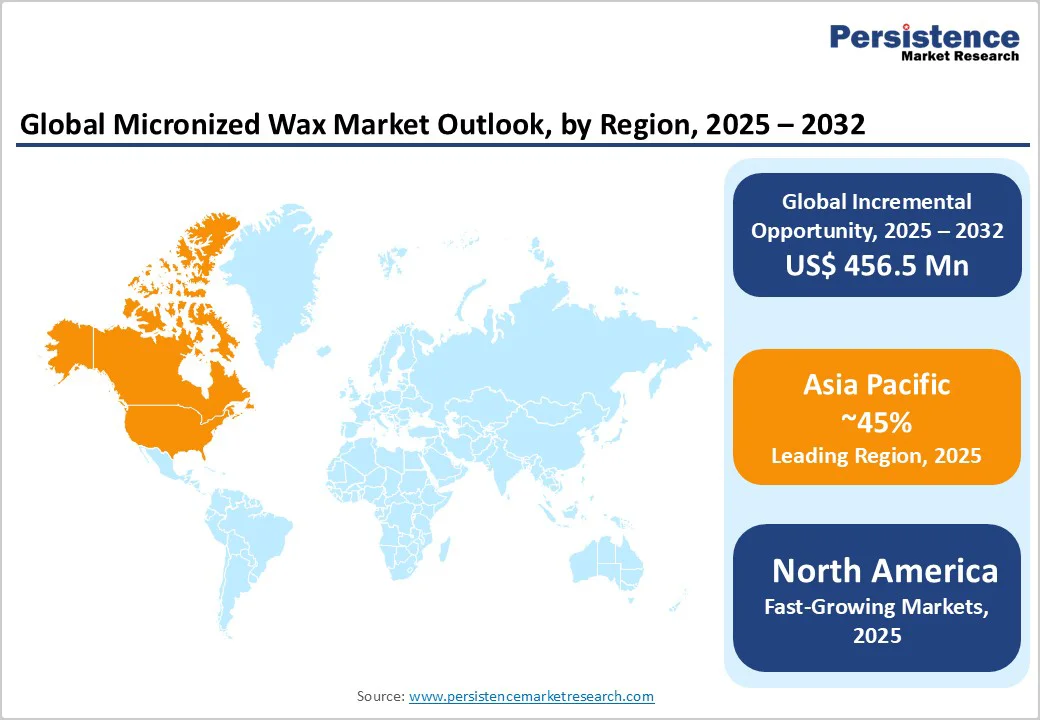
  • Leading region: Asia Pacific dominates the micronized wax market, holding 45% share driven by industrial growth in China and India.
  • Fastest growing region: South Asia Pacific exhibits the highest CAGR, fueled by expanding packaging and coatings sectors in emerging economies.
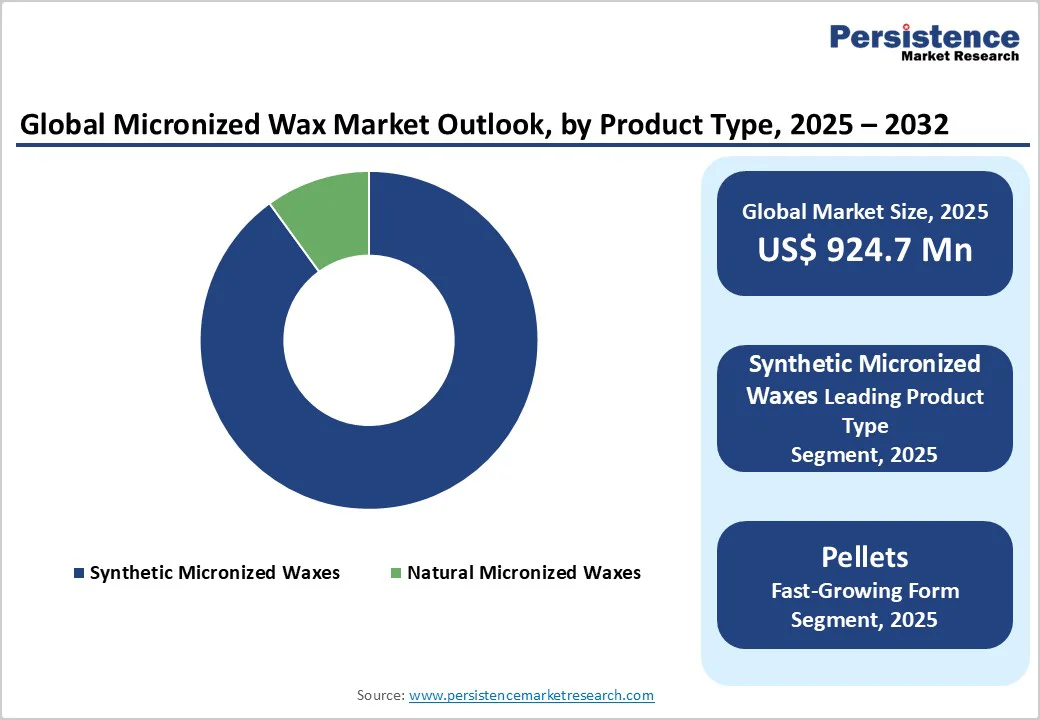
  • Dominant segment: Synthetic Micronized Waxes lead with approximately 90% revenue share, led by PE wax applications in coatings and inks.
  • Fastest growing segment: Nano-Micronized wax powders (< 5 µm) for advanced 3D printing resins and electronics packaging are poised for the highest growth.
  • Key Market Opportunity: Expansion of bio-based Micronized wax solutions in personal care, food packaging, and green building materials sectors.
Key Insights Details
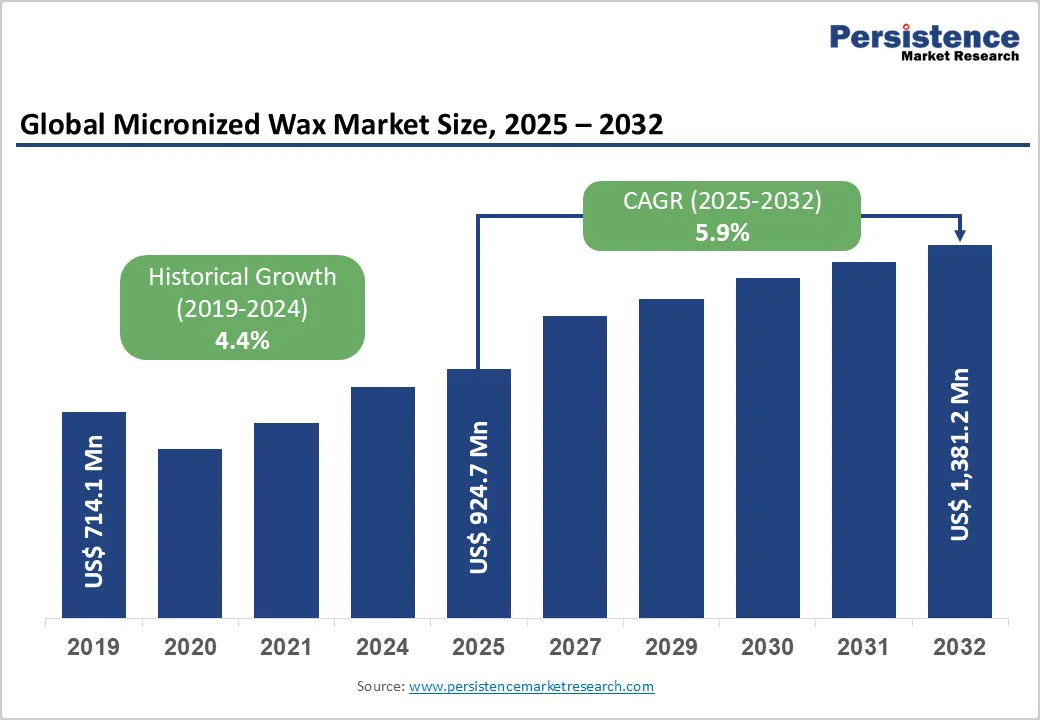
Micronized Wax Powder Market Size (2025E) US$ 924.7 million
Market Value Forecast (2032F) US$ 1,381.2 million
Projected Growth CAGR (2025-2032) 5.9%
Historical Market Growth (2019-2024) 4.4%

global-micronized-wax-market-size-2025-2032

Market Dynamics

Driver - Surging Demand in Coatings and Inks

The automotive, construction, and packaging industries are propelling demand for micronized wax additives, which now account for nearly 50% of global usage in coatings and inks due to their ability to improve scratch resistance, surface finish, and anti-blocking properties.

Global automotive production grew by 6% in 2024, driving formulators to adopt synthetic micronized wax powders particularly PE and PP, within clearcoats and primers to meet stringent quality standards and durability requirements. These wax additives reduce coefficient of friction and enhance gloss retention, key prerequisites for automotive OEMs seeking to differentiate their vehicles in competitive markets.

Regulatory Push for Eco-friendly Additives

Stringent environmental regulations in North America and Europe are accelerating the shift toward bio-based micronized wax solutions. Initiatives targeting a 30% reduction in VOC emissions by 2026 under various regional directives have compelled formulators to incorporate natural wax powders such as carnauba, beeswax, and rice bran that deliver water-repellency and anti-blocking performance without harmful solvents.

Government incentives and subsidies for green chemistry R&D have further encouraged specialty chemical manufacturers to expand bio-wax dispersion portfolios, aligning with sustainability goals and corporate ESG commitments.

Restraint - Raw Material Price Volatility

Crude oil price fluctuations directly influence production costs for petroleum-based micronized waxes (PE, PP, FT), resulting in input cost variability of up to 20% year-on-year. Such volatility can pressure profit margins for wax manufacturers and lead to pricing instability for end-use formulators, who may face cost pass-through challenges.

Moreover, supply chain disruptions exacerbated by geopolitical tensions have occasionally caused raw material shortages, prompting companies to seek alternative feedstock and hedging strategies to mitigate risk.

Competition from Alternative Additives

Emerging competitors such as silica nanoparticles, polymeric flow modifiers, and fluoropolymer powders are gaining traction in coatings and printing ink applications. These alternatives offer comparable surface modification and rheology control at competitive price points, posing a threat to traditional micronized wax demand.

For instance, surface-modified silica is used to achieve anti-settling effects similar to wax powders, compelling wax producers to invest in innovation and product differentiation to maintain their market share.

Market Opportunities

Innovation in Nano-micronization Technologies

Advancements in jet milling, spray-chilling, and cryogenic grinding are enabling the production of sub-5 µm wax particles with narrow size distributions. These nano-Micronized wax powders unlock novel applications in high-precision 3D printing resins, advanced electronics packaging, and microfluidic devices.

The global 3D printing materials market is expected to grow at 12% CAGR through 2032, presenting wax producers an opportunity to supply specialized additives that improve adhesion, flow, and surface quality in additive manufacturing processes.

Expansion of Personal Care Applications

The personal care & cosmetics sector is increasingly adopting PTFE, PA, and bio-wax microspheres to enhance texture, stability, and sensory profiles of creams, lotions, lipsticks, and mascaras. Forecasts indicate a 7% annual growth in specialty additives for cosmetics, driven by consumer demand for smooth, non-greasy formulations and “clean beauty” credentials.

Companies are developing Micronized wax dispersions that confer matte finishes, improved slip, and water-resistance, opening new revenue streams for wax suppliers partnering with majors in the personal care segment.

Category-wise Insights

By Product Type Analysis

By Product Type, synthetic micronized waxes dominate, capturing approximately 90% of total market revenue. Polyethylene (PE) micronized wax leads with a 45% share of this synthetic segment, due to its versatile performance in coatings, plastics, and rubber applications as a slip and anti-blocking agent.

Fischer-Tropsch wax and polypropylene wax also register significant usage, particularly in hot-melt adhesives and ink formulations. Synthetic wax market growth is underpinned by continuous process optimization and cost-effective feedstock sourcing, enabling manufacturers to deliver consistent high-quality powders at scale.

Natural Micronized waxes including carnauba, beeswax, and candelilla, account for the remaining 10%, driven by sustainability mandates and consumer preferences. Carnauba wax, renowned for its hardness and gloss enhancement, is the leading bio-wax, especially in food-grade coatings and high-end cosmetics. Ongoing R&D aimed at reducing particle size and improving dispersion stability is expected to bolster the natural wax market over the forecast period.

By Form Analysis

By Form category, Powder form leads with roughly 70% of global consumption. Powders offer superior ease of handling and dispersion in solvent-based coatings, inks, and paints, delivering precise rheology control, enhanced surface finish, and consistent performance across diverse formulations. Powdered micronized wax additives are extensively used in automotive clearcoats, industrial coatings, and flexible packaging inks.

The pellets form comprising extruded wax granules accounts for 20% share, favored in hot-melt adhesives and masterbatch applications due to ease of metering and minimal dust generation. Liquid dispersions, representing the remaining 10%, are gaining traction in water-based and UV-cured formulations, enabling formulators to incorporate Micronized wax without dust concerns and aligning with eco-friendly solvent-free trends.

By Industry Analysis

The rigid packaging & flexible packaging segment leads among end-use industries with 35% share, driven by rising demand for grease- and moisture-barrier coatings in food, pharmaceutical, and e-commerce packaging. Micronized wax dispersions enhance barrier performance and machinability of films, contributing to shelf-life extension and product protection. Growth in global e-commerce, which rose 20% in 2024, further propels the need for advanced packaging solutions incorporating wax additives.

The automotive sector follows closely, with around a 25% share, leveraging wax powders for scratch-resistant clearcoats, interior coatings, and plastic component lubricity. The personal care & cosmetics segment represents 10% of demand, growing swiftly due to “clean” formulation trends and consumer interest in bio-wax textures.
global-micronized-wax-market-outlook-by-product-type-2025-2032

Regional Insights

North America Micronized Wax Trends

North America is expected to account for a 25% share in 2025, underpinned by the U.S.’s leadership in specialty chemicals R&D and Canada’s automotive OEM ecosystem. EPA’s tightened VOC regulations and TSCA revisions have incentivized formulators to adopt bio-based micronized wax dispersions, boosting growth in natural wax market applications. Partnerships between wax manufacturers and US automakers focus on developing low-VOC clearcoats incorporating micronized wax additives for electric vehicle exteriors, improving durability and aesthetic appeal.

Industry collaborations in Michigan and Ontario are advancing novel wax milling techniques and proprietary dispersion technologies, while government grant programs support pilot projects for sustainable wax production. The region’s strong logistics infrastructure facilitates the rapid delivery of wax powders to major paints and coatings hubs.

Europe Micronized Wax Trends

Europe commands a 20% share, driven by harmonized environmental frameworks (REACH, ECHA guidelines) that promote sustainable additive adoption. German automotive OEMs are integrating Micronized wax additives in corrosion-resistant and self-healing coatings, leveraging partnership projects with specialty wax producers. The U.K.’s cosmetics sector is innovating with carnauba dot polymer hybrid wax dispersions for eco-certified personal care products, reflecting consumer demand for natural ingredients.

France and Spain offer government incentives for green chemistry R&D, spurring development of bio-based wax dispersions and novel particle engineering. Collaborative research initiatives under the EU’s Horizon Europe program target low-energy micronization methods and circular economy integration, supporting regional leadership in sustainable wax technologies.

Asia Pacific Micronized Wax Trends

Asia Pacific’s leadership 45% share is anchored in China and India. China’s coating and packaging industries are rapidly incorporating PE Micronized wax powders to meet rising automotive output and flexible packaging demands. Government stimulus for manufacturing modernization and infrastructure projects has increased consumption of wax additives in construction-grade coatings.

India’s pharmaceutical cold-chain packaging sector is adopting wax dispersions for moisture and grease barriers, while 3D printing adoption in Japan and South Korea is driving demand for nano-Micronized wax powders in resin formulations. ASEAN markets Vietnam, Thailand, Indonesia are emerging production hubs for specialty wax micropowders, leveraging lower labor costs and favorable export policies to serve global formulators.
global-micronized-wax-market-outlook-by-region-2025-2032

Competitive Landscape

The global micronized wax market is fragmented, with the top ten players collectively accounting for 45% of global revenue. Leading companies focus on capacity expansions, strategic alliances, and targeted R&D in sustainable and high-performance wax technologies.

Differentiation strategies include proprietary micronization processes, customized particle size distributions, and application-specific formulations. Emerging business models involve toll milling services and co-development partnerships with end-use formulators, enabling smaller wax producers to access global distribution networks and specialized expertise.

Key Market Developments:

  • June 2025: BASF SE launched a novel sub-5 µm PE Micronized wax for advanced 3D printing applications.
  • March 2025: Sasol commissioned a new jet-milling line in South Africa to increase production capacity by 25%.
  • November 2024: The Lubrizol Corporation acquired a specialty wax dispersion unit in Germany to enhance its European footprint.

Companies Covered in Micronized Wax Market

  • BASF SE
  • Sasol
  • MÜNZING Corporation
  • MPI
  • Sika AG
  • Shanghai Jiaoer Wax
  • Innospec
  • The Lubrizol Corporation
  • Jiangxi Longhai Chemical
  • Westlake Corporation
  • Honeywell International Inc.
  • PCL
  • Clariant AG
  • Deuteron
  • Kinshan Xinkui Chem
  • Ceronas GmbH
  • Micro Powders Inc.
  • Shamrock Technologies
Frequently Asked Questions

The global Micronized Wax Market is forecast to reach US$ 1,381.2 million by 2032.

Rising demand for high-performance coatings and printing inks in automotive and construction sectors is the primary growth driver.

The Synthetic Micronized Waxes segment leads, accounting for approximately 90% of total revenue.

Asia Pacific dominates with a regional share of around 45%, driven by industrial growth in China and India.

Development and expansion of bio-based Micronized wax solutions in personal care and food packaging applications.

BASF SE, Sasol, and MÜNZING Corporation are among the top players based on revenue, portfolio strength, and innovation capabilities.

Global Micronized Wax Report Scope
Report Attribute Details
Historical Data/Actuals 2019 - 2024
Forecast Period 2025 - 2032
Market Analysis Units Value: US$ Mn/Bn; Volume: As Applicable
Geographical Coverage
  • North America
  • Europe
  • East Asia
  • South Asia Pacific
  • Latin America
  • Middle East and Africa
Segmental Coverage
  • Product Type
  • Form
  • Industry
  • Region
Competitive Analysis
  • BASF SE
  • Sasol
  • MÜNZING Corporation
  • MPI
  • Sika AG
  • Shanghai Jiaoer Wax
  • Innospec
  • The Lubrizol Corporation
  • Jiangxi Longhai Chemical
  • Westlake Corporation
  • Honeywell International Inc.
  • PCL
  • Clariant AG
  • Deuteron
  • Kinshan Xinkui Chem
  • Ceronas GmbH
  • Micro Powders Inc.
  • Shamrock Technologies
Report Highlights
  • Market Forecast and Trends
  • Competitive Intelligence & Share Analysis
  • Growth Factors and Challenges
  • Strategic Growth Initiatives
  • Pricing Analysis & Technology Roadmap
  • Future Opportunities and Revenue Pockets
  • Market Analysis Tools
Market Segmentation

By Product Type

  • Synthetic Micronized Waxes
    • PE Micronized Wax
    • PP Micronized Wax
    • FT Micronized Wax
    • PTFE Micronized Wax
    • PA Micronized Wax
    • Others
  • Natural Micronized Waxes
    • Carnauba
    • Beeswax
    • Candelilla
    • Rice Bran
    • Soy
    • Other Bio-based

By Form

  • Powder
  • Pellets
  • Liquid Dispersions

By Industry

  • Automotive
  • Rigid Packaging & Flexible Packaging
  • Construction & Building Materials
  • Printing & Publishing
  • Consumer Goods & Appliances
  • Personal Care & Cosmetics
  • Pharmaceuticals & Healthcare
  • Textiles
  • Industrial Manufacturing
  • Others

By Region

  • North America
  • Latin America
  • Europe
  • East Asia
  • South Asia Pacific
  • Middle East and Africa

Related Reports

  1. Executive Summary
    1. Global Micronized Wax Market Snapshot 2025 and 2032
    2. Market Opportunity Assessment, 2025-2032, US$ Mn
    3. Key Market Trends
    4. Industry Developments and Key Market Events
    5. Demand Side and Supply Side Analysis
    6. PMR Analysis and Recommendations
  2. Market Overview
    1. Market Scope and Definitions
    2. Value Chain Analysis
    3. Macro-Economic Factors
      1. Global GDP Outlook
      2. Global Construction Industry Overview
      3. Global Automotive Industry Overview
    4. Forecast Factors - Relevance and Impact
    5. COVID-19 Impact Assessment
    6. PESTLE Analysis
    7. Porter's Five Forces Analysis
    8. Geopolitical Tensions: Market Impact
    9. Regulatory and Technology Landscape
  3. Market Dynamics
    1. Drivers
    2. Restraints
    3. Opportunities
    4. Trends
  4. Price Trend Analysis, 2019 - 2032
    1. Region-wise Price Analysis
    2. Price by Segments
    3. Price Impact Factors
  5. Global Micronized Wax Market Outlook: Historical (2019 - 2024) and Forecast (2025 - 2032)
    1. Key Highlights
    2. Global Micronized Wax Market Outlook: By Product Type
      1. Introduction/Key Findings
      2. Historical Market Size (US$ Mn) and Volume (Units) Analysis by By Product Type, 2019-2024
      3. Current Market Size (US$ Mn) and Volume (Units) Forecast, by By Product Type, 2025-2032
        1. Synthetic Micronized Waxes
          1. Polyethylene (PE) Micronized Wax
          2. Polypropylene (PP) Micronized Wax
          3. Fischer-Tropsch (FT) Micronized Wax
          4. Polytetrafluoroethylene (PTFE) Micronized Wax
          5. Polyamide (PA) Micronized Wax
          6. Others
        2. Natural Micronized Waxes
          1. Carnauba Micronized Wax
          2. Beeswax Micronized Wax
          3. Candelilla Micronized Wax
          4. Rice Bran Micronized Wax
          5. Soy Micronized Wax
          6. Other Bio-based Micronized Waxes
      4. Market Attractiveness Analysis: By Product Type
    3. Global Micronized Wax Market Outlook: By Form
      1. Introduction/Key Findings
      2. Historical Market Size (US$ Mn) and Volume (Units) Analysis by By Form, 2019-2024
      3. Current Market Size (US$ Mn) and Volume (Units) Forecast, by By Form, 2025-2032
        1. Powder
        2. Pellets
        3. Liquid dispersions
      4. Market Attractiveness Analysis: By Form
    4. Global Micronized Wax Market Outlook: By Industry
      1. Introduction/Key Findings
      2. Historical Market Size (US$ Mn) and Volume (Units) Analysis by By Industry, 2019-2024
      3. Current Market Size (US$ Mn) and Volume (Units) Forecast, by By Industry, 2025-2032
        1. Automotive
        2. Packaging & Flexible Packaging
        3. Construction & Building Materials
        4. Printing & Publishing
        5. Consumer Goods & Appliances
        6. Personal Care & Cosmetics
        7. Pharmaceuticals & Healthcare
        8. Textiles
        9. Industrial Manufacturing
        10. Others
      4. Market Attractiveness Analysis: By Industry
  6. Global Micronized Wax Market Outlook: Region
    1. Key Highlights
    2. Historical Market Size (US$ Mn) and Volume (Units) Analysis by Region, 2019-2024
    3. Current Market Size (US$ Mn) and Volume (Units) Forecast, by Region, 2025-2032
      1. North America
      2. Europe
      3. East Asia
      4. South Asia & Oceania
      5. Latin America
      6. Middle East & Africa
    4. Market Attractiveness Analysis: Region
  7. North America Micronized Wax Market Outlook: Historical (2019 - 2024) and Forecast (2025 - 2032)
    1. Key Highlights
    2. Pricing Analysis
    3. North America Market Size (US$ Mn) and Volume (Units) Forecast, by Country, 2025-2032
      1. U.S.
      2. Canada
    4. North America Market Size (US$ Mn) and Volume (Units) Forecast, by By Product Type, 2025-2032
      1. Synthetic Micronized Waxes
        1. Polyethylene (PE) Micronized Wax
        2. Polypropylene (PP) Micronized Wax
        3. Fischer-Tropsch (FT) Micronized Wax
        4. Polytetrafluoroethylene (PTFE) Micronized Wax
        5. Polyamide (PA) Micronized Wax
        6. Others
      2. Natural Micronized Waxes
        1. Carnauba Micronized Wax
        2. Beeswax Micronized Wax
        3. Candelilla Micronized Wax
        4. Rice Bran Micronized Wax
        5. Soy Micronized Wax
        6. Other Bio-based Micronized Waxes
    5. North America Market Size (US$ Mn) and Volume (Units) Forecast, by By Form, 2025-2032
      1. Powder
      2. Pellets
      3. Liquid dispersions
    6. North America Market Size (US$ Mn) and Volume (Units) Forecast, by By Industry, 2025-2032
      1. Automotive
      2. Packaging & Flexible Packaging
      3. Construction & Building Materials
      4. Printing & Publishing
      5. Consumer Goods & Appliances
      6. Personal Care & Cosmetics
      7. Pharmaceuticals & Healthcare
      8. Textiles
      9. Industrial Manufacturing
      10. Others
  8. Europe Micronized Wax Market Outlook: Historical (2019 - 2024) and Forecast (2025 - 2032)
    1. Key Highlights
    2. Pricing Analysis
    3. Europe Market Size (US$ Mn) and Volume (Units) Forecast, by Country, 2025-2032
      1. Germany
      2. Italy
      3. France
      4. U.K.
      5. Spain
      6. Russia
      7. Rest of Europe
    4. Europe Market Size (US$ Mn) and Volume (Units) Forecast, by By Product Type, 2025-2032
      1. Synthetic Micronized Waxes
        1. Polyethylene (PE) Micronized Wax
        2. Polypropylene (PP) Micronized Wax
        3. Fischer-Tropsch (FT) Micronized Wax
        4. Polytetrafluoroethylene (PTFE) Micronized Wax
        5. Polyamide (PA) Micronized Wax
        6. Others
      2. Natural Micronized Waxes
        1. Carnauba Micronized Wax
        2. Beeswax Micronized Wax
        3. Candelilla Micronized Wax
        4. Rice Bran Micronized Wax
        5. Soy Micronized Wax
        6. Other Bio-based Micronized Waxes
    5. Europe Market Size (US$ Mn) and Volume (Units) Forecast, by By Form, 2025-2032
      1. Powder
      2. Pellets
      3. Liquid dispersions
    6. Europe Market Size (US$ Mn) and Volume (Units) Forecast, by By Industry, 2025-2032
      1. Automotive
      2. Packaging & Flexible Packaging
      3. Construction & Building Materials
      4. Printing & Publishing
      5. Consumer Goods & Appliances
      6. Personal Care & Cosmetics
      7. Pharmaceuticals & Healthcare
      8. Textiles
      9. Industrial Manufacturing
      10. Others
  9. East Asia Micronized Wax Market Outlook: Historical (2019 - 2024) and Forecast (2025 - 2032)
    1. Key Highlights
    2. Pricing Analysis
    3. East Asia Market Size (US$ Mn) and Volume (Units) Forecast, by Country, 2025-2032
      1. China
      2. Japan
      3. South Korea
    4. East Asia Market Size (US$ Mn) and Volume (Units) Forecast, by By Product Type, 2025-2032
      1. Synthetic Micronized Waxes
        1. Polyethylene (PE) Micronized Wax
        2. Polypropylene (PP) Micronized Wax
        3. Fischer-Tropsch (FT) Micronized Wax
        4. Polytetrafluoroethylene (PTFE) Micronized Wax
        5. Polyamide (PA) Micronized Wax
        6. Others
      2. Natural Micronized Waxes
        1. Carnauba Micronized Wax
        2. Beeswax Micronized Wax
        3. Candelilla Micronized Wax
        4. Rice Bran Micronized Wax
        5. Soy Micronized Wax
        6. Other Bio-based Micronized Waxes
    5. East Asia Market Size (US$ Mn) and Volume (Units) Forecast, by By Form, 2025-2032
      1. Powder
      2. Pellets
      3. Liquid dispersions
    6. East Asia Market Size (US$ Mn) and Volume (Units) Forecast, by By Industry, 2025-2032
      1. Automotive
      2. Packaging & Flexible Packaging
      3. Construction & Building Materials
      4. Printing & Publishing
      5. Consumer Goods & Appliances
      6. Personal Care & Cosmetics
      7. Pharmaceuticals & Healthcare
      8. Textiles
      9. Industrial Manufacturing
      10. Others
  10. South Asia & Oceania Micronized Wax Market Outlook: Historical (2019 - 2024) and Forecast (2025 - 2032)
    1. Key Highlights
    2. Pricing Analysis
    3. South Asia & Oceania Market Size (US$ Mn) and Volume (Units) Forecast, by Country, 2025-2032
      1. India
      2. Southeast Asia
      3. ANZ
      4. Rest of SAO
    4. South Asia & Oceania Market Size (US$ Mn) and Volume (Units) Forecast, by By Product Type, 2025-2032
      1. Synthetic Micronized Waxes
        1. Polyethylene (PE) Micronized Wax
        2. Polypropylene (PP) Micronized Wax
        3. Fischer-Tropsch (FT) Micronized Wax
        4. Polytetrafluoroethylene (PTFE) Micronized Wax
        5. Polyamide (PA) Micronized Wax
        6. Others
      2. Natural Micronized Waxes
        1. Carnauba Micronized Wax
        2. Beeswax Micronized Wax
        3. Candelilla Micronized Wax
        4. Rice Bran Micronized Wax
        5. Soy Micronized Wax
        6. Other Bio-based Micronized Waxes
    5. South Asia & Oceania Market Size (US$ Mn) and Volume (Units) Forecast, by By Form, 2025-2032
      1. Powder
      2. Pellets
      3. Liquid dispersions
    6. South Asia & Oceania Market Size (US$ Mn) and Volume (Units) Forecast, by By Industry, 2025-2032
      1. Automotive
      2. Packaging & Flexible Packaging
      3. Construction & Building Materials
      4. Printing & Publishing
      5. Consumer Goods & Appliances
      6. Personal Care & Cosmetics
      7. Pharmaceuticals & Healthcare
      8. Textiles
      9. Industrial Manufacturing
      10. Others
  11. Latin America Micronized Wax Market Outlook: Historical (2019 - 2024) and Forecast (2025 - 2032)
    1. Key Highlights
    2. Pricing Analysis
    3. Latin America Market Size (US$ Mn) and Volume (Units) Forecast, by Country, 2025-2032
      1. Brazil
      2. Mexico
      3. Rest of LATAM
    4. Latin America Market Size (US$ Mn) and Volume (Units) Forecast, by By Product Type, 2025-2032
      1. Synthetic Micronized Waxes
        1. Polyethylene (PE) Micronized Wax
        2. Polypropylene (PP) Micronized Wax
        3. Fischer-Tropsch (FT) Micronized Wax
        4. Polytetrafluoroethylene (PTFE) Micronized Wax
        5. Polyamide (PA) Micronized Wax
        6. Others
      2. Natural Micronized Waxes
        1. Carnauba Micronized Wax
        2. Beeswax Micronized Wax
        3. Candelilla Micronized Wax
        4. Rice Bran Micronized Wax
        5. Soy Micronized Wax
        6. Other Bio-based Micronized Waxes
    5. Latin America Market Size (US$ Mn) and Volume (Units) Forecast, by By Form, 2025-2032
      1. Powder
      2. Pellets
      3. Liquid dispersions
    6. Latin America Market Size (US$ Mn) and Volume (Units) Forecast, by By Industry, 2025-2032
      1. Automotive
      2. Packaging & Flexible Packaging
      3. Construction & Building Materials
      4. Printing & Publishing
      5. Consumer Goods & Appliances
      6. Personal Care & Cosmetics
      7. Pharmaceuticals & Healthcare
      8. Textiles
      9. Industrial Manufacturing
      10. Others
  12. Middle East & Africa Micronized Wax Market Outlook: Historical (2019 - 2024) and Forecast (2025 - 2032)
    1. Key Highlights
    2. Pricing Analysis
    3. Middle East & Africa Market Size (US$ Mn) and Volume (Units) Forecast, by Country, 2025-2032
      1. GCC Countries
      2. South Africa
      3. Northern Africa
      4. Rest of MEA
    4. Middle East & Africa Market Size (US$ Mn) and Volume (Units) Forecast, by By Product Type, 2025-2032
      1. Synthetic Micronized Waxes
        1. Polyethylene (PE) Micronized Wax
        2. Polypropylene (PP) Micronized Wax
        3. Fischer-Tropsch (FT) Micronized Wax
        4. Polytetrafluoroethylene (PTFE) Micronized Wax
        5. Polyamide (PA) Micronized Wax
        6. Others
      2. Natural Micronized Waxes
        1. Carnauba Micronized Wax
        2. Beeswax Micronized Wax
        3. Candelilla Micronized Wax
        4. Rice Bran Micronized Wax
        5. Soy Micronized Wax
        6. Other Bio-based Micronized Waxes
    5. Middle East & Africa Market Size (US$ Mn) and Volume (Units) Forecast, by By Form, 2025-2032
      1. Powder
      2. Pellets
      3. Liquid dispersions
    6. Middle East & Africa Market Size (US$ Mn) and Volume (Units) Forecast, by By Industry, 2025-2032
      1. Automotive
      2. Packaging & Flexible Packaging
      3. Construction & Building Materials
      4. Printing & Publishing
      5. Consumer Goods & Appliances
      6. Personal Care & Cosmetics
      7. Pharmaceuticals & Healthcare
      8. Textiles
      9. Industrial Manufacturing
      10. Others
  13. Competition Landscape
    1. Market Share Analysis, 2024
    2. Market Structure
      1. Competition Intensity Mapping
      2. Competition Dashboard
    3. Company Profiles
      1. BASF SE
        1. Company Overview
        2. Product Portfolio/Offerings
        3. Key Financials
        4. SWOT Analysis
        5. Company Strategy and Key Developments
      2. Sasol
      3. Munzing Corporation
      4. MPI
      5. Sika AG
      6. Shanghai Jiaoer Wax
      7. Innospec
      8. The Lubrizol Corporation
      9. Jiangxi Longhai Chemical
      10. Westlake Corporation
      11. Honeywell International Inc.
      12. PCL
      13. Clariant AG
      14. Deuteron
      15. Kinshan Xinkui Chem
  14. Appendix
    1. Research Methodology
    2. Research Assumptions
    3. Acronyms and Abbreviations

Research Methodology Framework for Market Research Excellence

At Persistence Market Research, we implement a comprehensive, validated, and multi-dimensional approachto market analysis that delivers actionable insights across complex market landscapes. Our methodology combines the analytical rigor of leading consulting firms with innovative research techniques, ensuring robust market assessments that guide strategic decision-making with confidence.

Core Research Philosophy

Our methodology is built on four foundational pillars:

Research Philosophy Image

At Persistence Market Research, our methodology is designed to transcend conventional market studies by combining analytical rigor, multi-source validation, and future-focused insights.

We integrate advanced research frameworks, robust data collection strategies, cutting-edge analytics, and innovative technologies to deliver a 360-degree view of complex markets.

We integrate advanced research frameworks, robust data collection strategies, cutting-edge analytics, and innovative technologies to deliver a 360-degree view of complex markets.

Each stage spanning from strategic scoping and hypothesis-building to competitive intelligence, quality validation, and actionable recommendations is engineered to provide clients with unmatched clarity, precision, and confidence in decision-making.

By embedding innovation and technology at the core, our approach ensures that insights are not only comprehensive but also predictive, empowering businesses to seize opportunities, mitigate risks, and achieve sustainable growth

Research Philosophy Image

Capturing Key Information and Events

During this phase, key research objectives focus on essential information and data points for assessing the market, including:

Research Philosophy Image

TAM-SAM-SOM Framework Implementation

We employ both top-down and bottom-up approaches to ensure accurate market sizing.

Top-Down Market SizingBottom-Up Market Sizing
Universe Definition: Total global/regional market identificationUnit Economics: Average transaction values, purchase frequencies, customer lifecycle
Segmentation Filters: Geographic, demographic, and behavioral constraintsCustomer Segmentation: Detailed buyer persona development and sizing
Market Share Analysis: Competitive landscape assessment and share allocationPenetration Analysis: Market penetration rates by segment and geography
Growth Rate Application: Historical trends and forward-looking growth assumptionsScaling Methodology: Extrapolation techniques with confidence intervals

Validation & Cross-Verification

  • Triangulation: Comparing top-down and bottom-up results for consistency
  • Sensitivity Analysis: Testing key assumptions and parameter variations
  • Peer Benchmarking: Comparison with analogous markets and industry benchmarks
  • Expert Review: External validation through industry specialist consultation

Research Philosophy Image

Forecasting & Projection Modeling

Our proprietary forecasting models incorporate multiple variables and scenarios.

Forecasting Components

  • Historical Trend Analysis: 10-year historical growth patterns and cyclical variations
  • Driver-Based Modeling: Economic indicators, demographic shifts, technology adoption
  • Scenario Planning: Base case, optimistic, and conservative projections
  • Monte Carlo Simulations: Probability-weighted outcomes and risk assessments

Model Validation

  • Back-Testing: Historical accuracy assessment over 3–5-year periods
  • Cross-Validation: Multiple modeling approaches for result comparison
  • External Benchmarking: Comparison with established market forecasts
  • Continuous Calibration: Quarterly model updates based on new data

Comprehensive Data Collection Strategy

Our secondary research phase establishes a robust knowledge base utilizing diverse, credible sources.

Secondary Data Sourcess

  • Industry Publications & Reports
  • Government & Regulatory Data
  • Financial Intelligence (filings & reports)
  • Academic Research & Digital Intelligence

Quality Assurance Protocol

  • Source credibility assessment and publication date validation
  • Data consistency checks across multiple sources
  • Bias identification and neutralization techniques
  • Information gap tracking for primary research prioritization

Research Philosophy Image

Primary Research Excellence

Our primary research methodology employs best-in-class techniques to capture unique market insights.

Quantitative Research Methods

  • Large-Scale Surveys: Statistically representative samples with 95% confidence intervals
  • Survey Methodology: Multi-channel deployment (online, telephone, in-person)
  • Question Architecture and Response Optimization

Qualitative Research Methods

  • Executive Interviews
  • Focus Groups
  • Expert Consultations

Quality Assurance & Validation Framework

Multi-Stage Validation Process

  • Source Verification and Consistency Testing
  • Outlier Detection and Bias Assessment
  • Peer Review Process and External Validation
  • Sensitivity Analysis and Confidence Intervals

Research Philosophy Image

Methodology Validation & Credibility

Our research methodology has been extensively validated through:

  • Academic Partnerships: Collaborations with top-tier business schools and research institutions
  • Client Success Stories: Documented case studies demonstrating research impact and ROI
  • Continuous Benchmarking: Performance comparison with leading global research firms

This comprehensive methodology framework positions Persistence Market Research at the forefront of market intelligence, combining the analytical sophistication of top-tier consulting firms with innovative research techniques. Our approach ensures that every market assessment delivers precise, actionable, and strategically valuable insights that drive business success in competitive market environments.

Ready to unlock your market potential? Contact our research experts to discuss how our validated methodology can transform your strategic decision-making with data-driven market intelligence.

Copyright © 2026 Persistence Market Research. All Rights Reserved

Connect With Us -