




- Food Ingredients & Additives
- Mezcal Market
Mezcal Market Size, Share, Growth, and Regional Forecast, 2026 to 2033
Mezcal Market by Product Type (Joven, Reposado, Añejo, Tobalá, Others), Source (Espadín, Tobalá, Tepeztate, Arroqueño, Others), Sales Channel (On Trade, Off Trade), and by Regional Analysis, 2026 - 2033

Mezcal Market Share and Trends Analysis
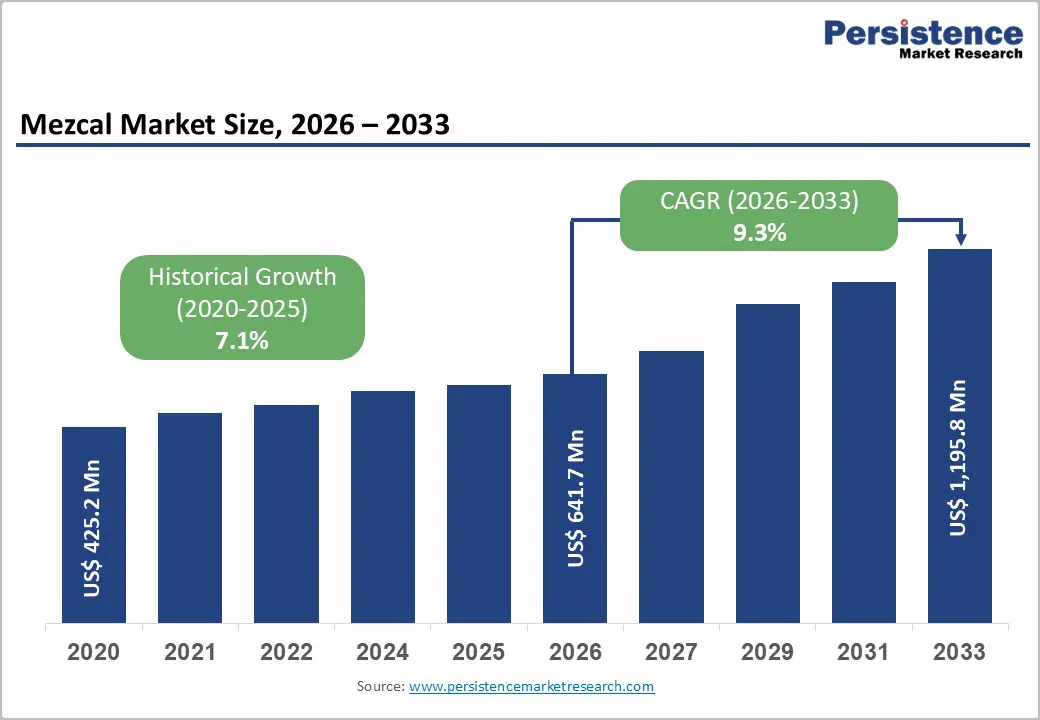
The global mezcal market size is expected to be valued at US$ 641.7 million in 2026 and projected to reach US$ 1,195.8 million by 2033, growing at a CAGR of 9.3% between 2026 and 2033.
The global market is currently undergoing a period of robust expansion driven by the escalating consumer demand for artisanal, heritage-driven spirits that offer distinct flavor profiles compared to mass-produced alternatives. This growth is predominantly anchored in the North American and European markets, where a sophisticated millennial demographic is trading up for premium agave-based products that emphasize traditional production methods and ethical sourcing. According to reports from the Distilled Spirits Council of the United States (DISCUS), the category has outperformed traditional spirits segments due to its strong association with cultural authenticity and the burgeoning craft cocktail movement in major urban centers.
Key Industry Highlights:
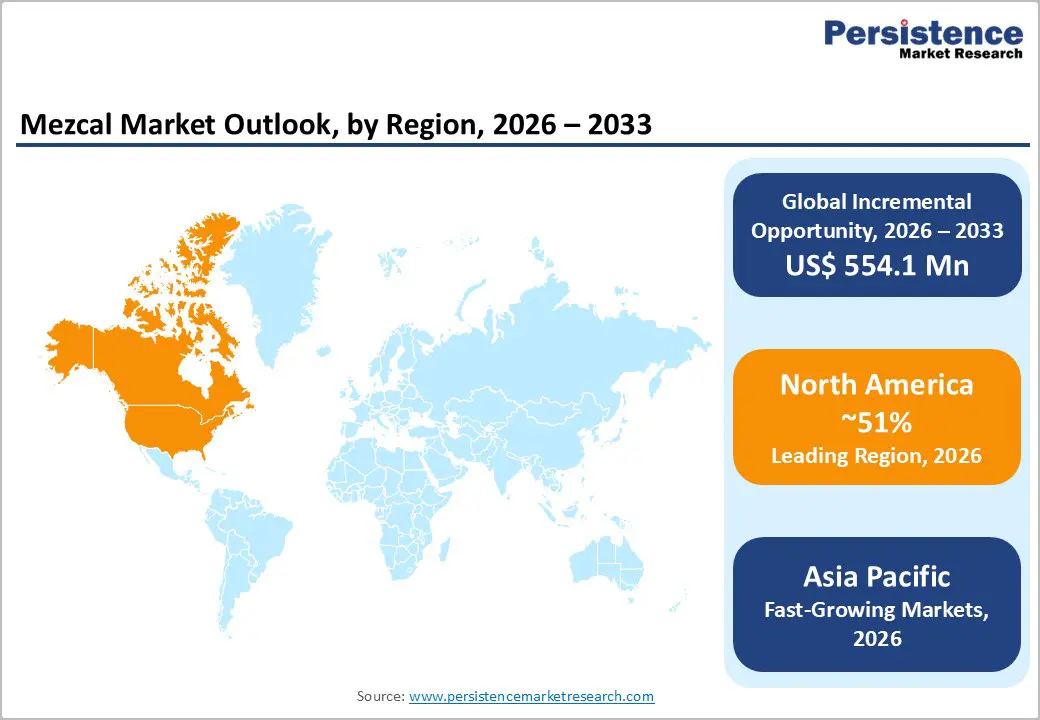
- Leading Region: North America dominates the global mezcal market with a 51% share in 2025, supported by a mature cocktail culture, strong premium spirits spending, and deep consumer engagement through mixology-led on-trade education.
- Fastest-Growing Region: Asia Pacific is the fastest-growing region, driven by expanding luxury nightlife scenes, rising disposable incomes, and growing demand for exotic, craft-positioned spirits across China, Japan, India, and Southeast Asia.
- Fastest-Growing Product Type Segment: Tobalá mezcal is emerging as the fastest-growing product type, fueled by limited wild agave availability, collector appeal, and rising demand for rare, small-batch expressions among affluent consumers.
- Market Drivers: Premiumization and the “drink better, not more” mindset are accelerating demand for artisanal, small-batch mezcal that emphasizes provenance, traditional production, and cultural storytelling.
- Opportunities: Sustainable agave farming, regenerative sourcing, certified organic production, and socially responsible branding offer strong differentiation opportunities while addressing long-term raw material constraints.
- Key Developments: In September 2025, Bacardi received the Hecho en Mexico seal for PATRÓN and CAZADORES; in June 2025, 400 Conejos Espadín Joven won Mezcal of the Year at IBSA 2025; in April 2025, Volcan de mi Tierra secured three Gold Medals at The Spirits Business Tequila & Mezcal Masters 2025.
| Global Market Attributes | Key Insights |
|---|---|
| Global Mezcal Market Size (2026E) | US$ 641.7 Mn |
| Market Value Forecast (2033F) | US$ 1,195.8 Mn |
| Projected Growth (CAGR 2026 to 2033) | 9.3% |
| Historical Market Growth (CAGR 2020 to 2025) | 7.1% |
Market Dynamics
Driver - Rising Consumer Inclination Toward Premium and Artisanal Spirits
The structural shift in consumer behavior toward "drinking better, not more," a trend widely defined as premiumization, catalyzes the growth in the mezcal market. Unlike Tequila, which has witnessed a significant industrialization, Mezcal retains an image of handcrafted exclusivity, often produced in small batches by family-owned distilleries in Oaxaca and other protected regions. This artisanal appeal resonates strongly with high-net-worth individuals and young professionals who value the "farm-to-bottle" narrative. Data from IWSR indicates that the status spirits have witnessed a CAGR of more than 35% since 2019 in the U.S., where Mezcal sales also grew fast from a low base.
Restraints - Acute Raw Material Scarcity and Long Growth Cycles of Wild Agave
A significant barrier to market expansion is the inherent biological limitation of the agave plant. While the most common variety, Espadín, takes approximately 6 to 8 years to reach maturity, wild varieties such as Tobalá and Tepeztate can require 15 to 25 years before they are suitable for harvest. The sudden surge in global demand has placed immense pressure on these wild populations, leading to localized shortages and rising procurement costs. According to the Consejo Regulador del Mezcal (CRM), over-harvesting threatens the genetic diversity and long-term sustainability of the industry. This scarcity forces producers to implement strict rationing or increase retail prices, which may alienate budget-conscious consumers and limit the market's ability to scale rapidly during periods of peak demand.
Opportunity - Development of Sustainable and Socially Responsible Brand Portfolios
Sustainability and ethical production are becoming critical purchasing criteria for global consumers, offering a significant opportunity for market participants to differentiate their brands. Companies that invest in regenerative agave farming, water conservation, and fair-trade labor practices can appeal to the eco-conscious "Green Consumer" segment. For instance, the Tequila Regulatory Council (CRT) recently set a target of 100% deforestation-free production by 2027, a trend likely to follow in the Mezcal sector. Brands that implement Certified Organic or Biodynamic certifications and utilize sustainable packaging, such as recycled glass bottles, are seeing increased shelf velocity. This strategic focus not only mitigates supply chain risks associated with agave depletion but also enhances brand equity, thereby justifying premium pricing while contributing to the preservation of Oaxacan biodiversity and local community welfare.
Category-wise Analysis
By Product Type Insights
The joven segment held the leading position in the Mezcal Market in 2025, accounting for a dominant 48% market share. This segment’s leadership is attributed to its unaged, "blank" profile, which captures the purest expression of the agave plant and its terroir. Joven (or Blanco) Mezcal is the preferred choice for both traditional sippers and high-volume cocktail applications due to its brighter, more vibrant flavor profile and relative affordability compared to aged variants. Justification for its market dominance is also supported by the shorter production cycle, allowing distillers to bring products to market without the years of barrel-aging required for Reposado or Añejo. However, the Tobalá segment is identified as the fastest-growing product type, as affluent consumers increasingly seek out rare, small-batch wild agave expressions that offer unmatched complexity and "collector" status.
By Sales Channel Insights
The on trade segment accounts for approximately 53% of the total revenue in 2025. The high concentration of sales in this channel is driven by the "education-heavy" nature of the spirit; most consumers first experience Mezcal through curated cocktail programs or guided tastings led by professional bartenders. Establishments such as those under the HORECA umbrella are vital for building brand awareness and justifying the high price points associated with artisanal production. Meanwhile, the Off Trade segment, particularly Online Retail, is the fastest-growing sales channel. The pandemic-led acceleration of e-commerce and the rise of specialized online spirits platforms like ReserveBar have made rare Mezcals more accessible to home enthusiasts, facilitating a surge in direct-to-consumer delivery and subscription-based "Mezcal Clubs."
Region-wise Insights
North America Mezcal Market Trends
North America is the preeminent region in the global landscape, commanding 51% share in 2025. The market leadership is almost entirely driven by the United States, which has become the largest consumer of Mezcal outside of Mexico. High disposable income and a mature cocktail culture have turned Mezcal into a staple spirit in metropolitan areas. Regulatory frameworks in the U.S. have evolved to support the category, with increased TBB labeling approvals for artisanal classifications.
Innovation in the U.S. market is focused on celebrity-backed brands and "craft-premium" positioning. Major companies like Constellation Brands Inc. and Diageo plc have heavily invested in Oaxacan distilleries to secure their supply chains. Furthermore, the region is seeing a surge in "Agave Tourism" and tasting festivals, which foster deeper consumer connection. The presence of a massive Mexican-American population also provides a robust cultural foundation for continued category growth.
Asia Pacific Mezcal Market Trends and Insights
Asia Pacific is the fastest-growing market for Mezcal globally, with a projected high CAGR of 10.6% between 2025 and 2032. This rapid expansion is driven by the surging nightlife and bar culture in China, Japan, and India. As urban centers like Shanghai and Mumbai see a rise in high-end specialty bars, the demand for "exotic" premium spirits has skyrocketed. The region also benefits from a manufacturing advantage in terms of high-speed glass production and competitive logistics for the regional distribution of bottled goods.
China, in particular, represents a massive frontier; the rising middle class views premium agave spirits as status symbols similar to high-end Cognac. In Japan, the appreciation for craftsmanship and artisanal production resonates deeply with the local "quality-first" consumer mindset. Government investments in tourism and hospitality infrastructure across Southeast Asia are further facilitating the entry of global Mezcal brands into 5-star hotel bars. The proliferation of e-commerce platforms in the region is also making boutique artisanal brands more accessible to a geographically diverse consumer base.
Competitive Landscape
The mezcal market is currently characterized by a "fragmented-consolidated" structure. At the production level, the market remains highly fragmented with thousands of small-scale artisanal "Palenqueros" (distillers) in rural Mexico. However, the distribution and branding landscape is increasingly consolidated among a few global beverage giants. Companies like Diageo plc, Pernod Ricard, and Bacardi Limited have aggressively pursued an acquisition-led growth strategy, buying majority stakes in popular artisanal brands to leverage their massive global distribution networks. Key differentiators employed by market leaders include the ability to secure long-term agave supply contracts and achieving "Ancestral" production certifications. Emerging business models are focusing on "Direct-to-Distillery" partnerships that ensure more revenue reaches the local producers while maintaining the high quality and authenticity that global consumers demand.
Key Developments:
- In September 2025, Bacardi received the official Hecho en Mexico (Made in Mexico) seal for its tequila brands PATRÓN and CAZADORES, reinforcing compliance with denomination-of-origin standards and strengthening brand authenticity.
- In June 2025, 400 Conejos Espadín Joven was awarded Mezcal of the Year at the 7th Annual International Bartender Spirits Awards (IBSA) 2025.
- In April 2025, Volcan de mi Tierra secured three Gold Medals at The Spirits Business Tequila & Mezcal Masters 2025. Supported by the Gallardo family and LVMH, the achievement highlights accelerating demand for ultra-premium, terroir-driven tequilas within global luxury spirits portfolios.
Companies Covered in Mezcal Market
- Diageo plc
- Pernod Ricard
- Constellation Brands Inc.
- Campari Group
- Bacardi Limited
- LVMH Moët Hennessy
- Heaven Hill Brands
- Nayaá
- Amarás
- Mezcal Vago
- Mezcal Mitre
- Others
Frequently Asked Questions
The global mezcal market is expected to be valued at approximately US$ 641.7 million in 2026, growing steadily at a CAGR of 9.3%.
The primary driver is the rising consumer demand for Artisanal and Premium spirits, fueled by millennials seeking authenticity and a complex smoky flavor profile in craft cocktails.
The global Mezcal market is poised to witness a CAGR of 9.3% between 2026 and 2033.
Significant opportunities lie in the expansion into Asia Pacific emerging markets and the development of Sustainable/Ethical production portfolios to meet green consumer trends.
The industry features global giants such as Diageo plc, Pernod Ricard, Constellation Brands Inc., and Campari Group, alongside prominent artisanal brands like Mezcal Vago and Amarás.


