




- Nutraceuticals & Functional Foods
- Healthy Aging Supplement Market
Healthy Aging Supplement Market Size, Share, Growth, and Regional Forecast, 2026 to 2033
Healthy Aging Supplement Market is segmented by Product Type (Vitamins, Minerals, Omega-3 Fatty Acids, Collagen & Hyaluronic Acid, Coenzyme Q10, Protein & Amino Acids, and Others), by Form (Capsules & Softgels, Liquid/Oil, Powder & Granules, Tablets, and Gummies), Sales Channel, and Regional Analysis, 2026 - 2033

Healthy Aging Supplement Market Share and Trends Analysis
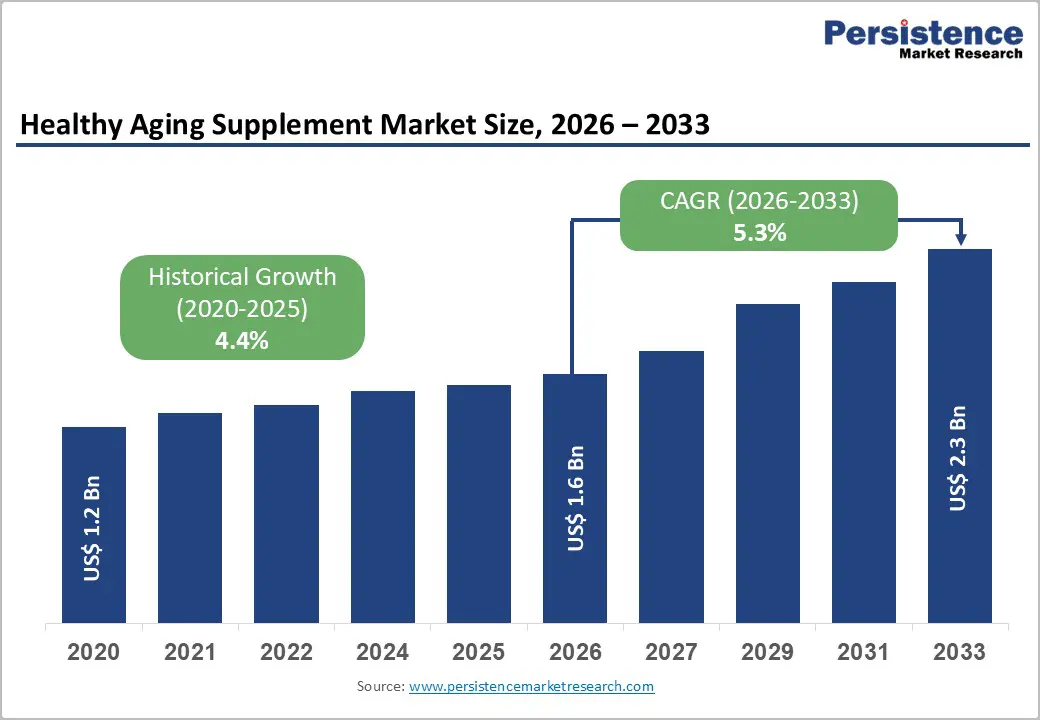
The global healthy aging supplement market is expected to be valued at US$ 1.6 billion in 2026 and projected to reach US$ 2.3 billion by 2033, growing at a CAGR of 5.3% between 2026 and 2033.
The market is fundamentally driven by the structural shift in global demographics toward an aging society and the rising adoption of preventive healthcare strategies among younger cohorts. Increased life expectancy and a heightened focus on healthspan rather than just lifespan have propelled the demand for science-backed nutritional interventions that support cellular health and metabolic resilience. Furthermore, innovations in bioavailability technologies and the integration of Artificial Intelligence (AI) for personalized supplement recommendations are significant tailwinds that enable manufacturers to offer highly targeted solutions, ensuring sustained market expansion throughout the forecast period.
Key Industry Highlights:
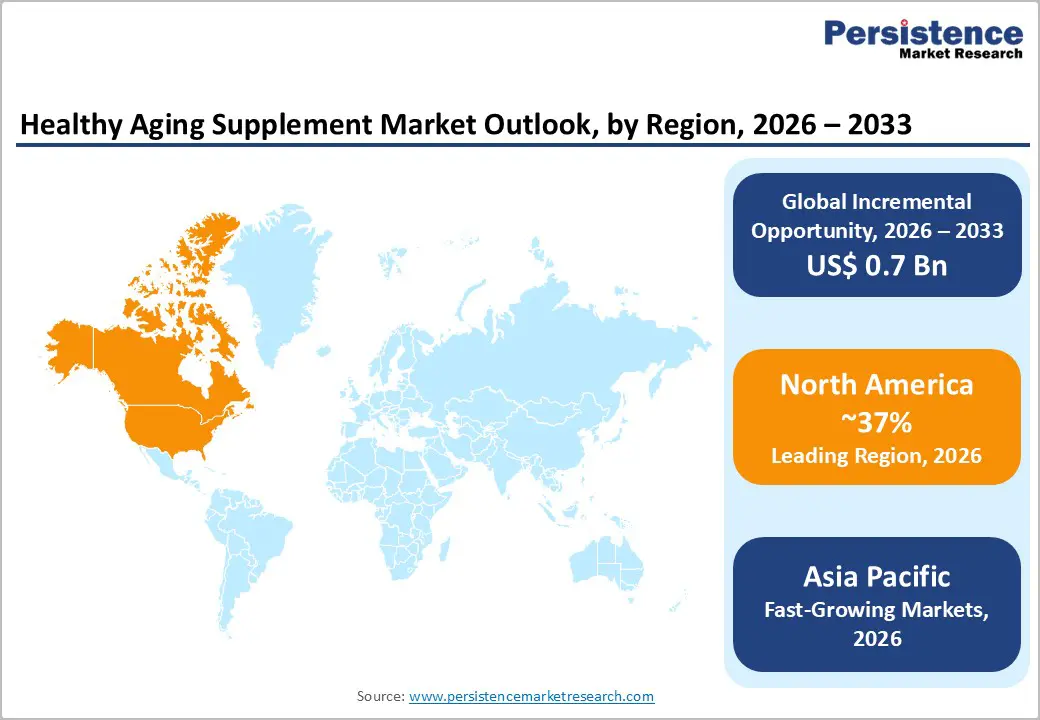
- Leading Region: North America dominated the market in 2025 with a 37% share, driven by a strong wellness culture and high consumer adoption of dietary supplements for longevity.
- Fastest-Growing Region: Asia Pacific is the fastest-growing region through 2033, fueled by the rapidly aging demographics in Japan and China, and a rising middle-class focus on preventive health.
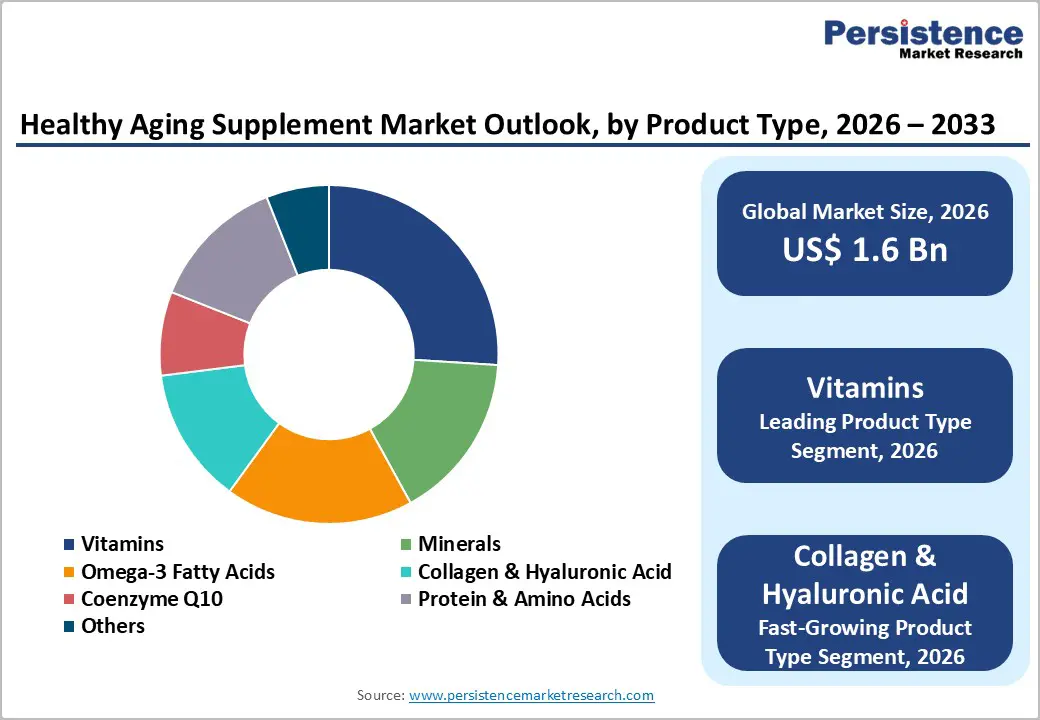
- Dominant Segment: Vitamins remained the leading product type in 2025 with a 26% share, as multivitamins and energy boosting Vitamin C continue to be staple products for older consumers.
- Fastest Growing Segment: Collagen & Hyaluronic Acid is the fastest growing category, benefiting from the global trend of beauty from within and the increasing demand for bone and joint health solutions.
- Key Market Opportunity: The integration of AI for personalized supplement recommendations based on real-time vital signs from wearable devices represents a significant avenue for future market expansion.
| Key Insighst | Details |
|---|---|
| Healthy Aging Supplement Market Size (2026E) | US$ 1.6 Bn |
| Market Value Forecast (2033F) | US$ 2.5 Bn |
| Projected Growth (CAGR 2026 to 2033) | 6.4% |
| Historical Market Growth (CAGR 2020 to 2025) | 5.3% |
Market Dynamics
Driver - Rising Global Aging Population and Longevity Focus
The primary catalyst for the healthy aging supplement market is the accelerating demographic shift toward an older population worldwide. According to the World Health Organization (WHO), the number of people aged 60 years and older is projected to increase from 1.1 billion in 2023 to 1.4 billion by 2030. This demographic transition creates a permanent demand base for products that mitigate age-related physiological decline, such as bone density loss and cognitive wear. In 2025, the Population Reference Bureau noted that the share of the population aged 65 and above is rising sharply in developed economies, supporting a culture where staying active and healthier for longer is a top priority. Consequently, consumers are proactively seeking supplements that target cellular vitality and physical resilience.
Restraints - High Cost of Premium and Science-Backed Ingredients
A major barrier to mass market adoption is the high price point associated with premium, clinically validated longevity ingredients. Specialized compounds such as NMN, high purity Resveratrol, and advanced Marine Collagen formulas require expensive extraction and stabilization processes. According to online sources from 2025, the production and distribution of these high-purity actives often require specialized cold-chain logistics and controlled stability conditions, which substantially increase manufacturing costs. These expenses are often passed on to consumers, making high-end healthy aging solutions less affordable in price-sensitive emerging markets. While affluent segments drive value, broader market growth is constrained by cost sensitivity and a lack of consumer education about the long-term value of investing in premium supplements.
Opportunity - Personalized Nutrition & DNA-Based Supplementation
Personalized nutrition and DNA-based supplementation represent a high-value growth frontier in the healthy aging supplement market. As consumers shift from generalized wellness to precision health, demand is rising for products tailored to genetic markers, metabolic profiles, and lifestyle data. Advances in nutrigenomics and at-home diagnostic testing now enable brands to formulate supplements aligned with individual needs, such as inflammation control, mitochondrial support, cognitive resilience, and bone density preservation. This data-driven approach enhances efficacy perception and strengthens consumer trust, supporting premium pricing models.
For an aging population managing chronic conditions or aiming to extend healthspan, personalization reduces trial-and-error purchasing and increases long-term adherence. Integration with wearable devices, AI-driven health platforms, and subscription-based delivery further deepens engagement. Companies that combine validated biomarkers, transparent clinical backing, and digital health ecosystems will capture disproportionate value, positioning personalized supplementation as a cornerstone of preventive longevity strategies rather than a niche add-on.
Category-wise Analysis
Product Type Insights
Vitamins remained the leading segment, commanding a 26% market share. Their dominance is rooted in long-standing consumer trust in multivitamins and in the vital roles of Vitamin D, Vitamin C, and B-vitamins in general wellness and immune support. However, Collagen & Hyaluronic Acid is identified as the fastest-growing segment. This growth is propelled by the surging interest in joint health and nutricosmetics, where marine-derived peptides are valued for their high bioavailability. Additionally, newer ingredients like Coenzyme Q10 and Protein & Amino Acids are seeing increased uptake among the elderly to manage sarcopenia and heart health, reflecting a broader trend toward targeted nutrition that addresses specific age-related concerns.
Form Insights
Capsules & Softgels lead the market in 2025, favored for their stability, ease of swallowing, and ability to house complex liquid and oil-based nutrients like Omega-3. This traditional form remains the gold standard for clinical-grade supplements. Conversely, Gummies are the fastest-growing form for 2026-2033. Pill fatigue has led consumers across all age groups to seek more enjoyable delivery methods. In 2025, the launch of beauty-focused gummies demonstrated that flavor and convenience are now key purchase drivers. Powder & Granules also maintain a strong presence, especially in the Protein & Amino Acids segment, as they enable higher dosing and are easily integrated into smoothies and functional beverages.
Regional Insights
North America Healthy Aging Supplement Market Trends and Insights
North America is the dominant regional market, holding a 37% share in 2025. The United States leads this demand, characterized by a well-established supplement culture and high consumer spending on wellness. According to a 2025 survey by Persistence Market Research, nearly 65% of Americans take dietary supplements, with motivations shifting toward longevity and cellular health. The region benefits from a robust, innovative ecosystem where companies like Life Extension and GNC Holdings leverage advanced R&D to launch multifunctional blends.
Regulatory frameworks in the U.S., governed by the DSHEA of 1994, provide a stable environment for product diversity, while the increasing prevalence of lifestyle diseases such as obesity and diabetes drives demand for preventive solutions. In 2026, the integration of digital tools for tracking vitals has further accelerated the adoption of longevity supplements among biohackers and health-conscious professionals. The presence of major e-commerce hubs and a high concentration of health practitioners who recommend supplementation ensures that North America remains the primary engine of value growth in the global landscape.
Asia Pacific Healthy Aging Supplement Market Trends and Insights
Asia Pacific is the fastest-growing region, with a high CAGR projected through 2032. This growth is underpinned by the rapidly aging populations in Japan, China, and South Korea. In Japan, where nearly 30% of the population is aged 65 or older, the demand for geriatric-specific nutrition is already well established. China is emerging as the fastest scaling market in the region, driven by rising disposable incomes and a growing middle class that is increasingly aware of the benefits of preventive healthcare.
The regional market is also benefiting from a blend of traditional botanical ingredients and modern nutraceutical science. In India, the rising middle class and the growing focus on a healthy lifestyle are boosting demand for vitamins and minerals. Manufacturing advantages in the region allow for cost-effective production of diverse supplement forms, while the boom in mobile shopping is making these products accessible to a vast urban population. As regional governments invest in nutrition science and microbiome research, Asia Pacific is expected to become a global hub for personalized, healthy-aging innovations.
Competitive Landscape
The global healthy aging supplement market exhibits a moderate level of concentration, featuring a mix of large established food and beverage conglomerates and specialized longevity startups. Major global players like Nestlé Health Science and Haleon maintain dominance through extensive distribution networks and the acquisition of innovative boutique firms. These leaders focus on building brand equity through clinical trials and medical professional endorsements.
Key differentiators in the industry include the use of advanced bioavailability technologies, such as liposomal delivery, and a focus on clean label transparency. Emerging business model trends show a significant pivot toward subscription-based services and AI driven personalization. While the market is competitive, a notable shift toward multifunctional formulations combining vitamins, collagen, and antioxidants is allowing brands to capture multiple consumer need states with a single product, thereby increasing the value per customer and securing long-term retention in a fast-moving international environment.
Key Developments:
- In February 2026, GNC announced a new partnership with High Level Science®, aimed at strengthening its science-backed supplement portfolio and accelerating innovation across performance nutrition and targeted wellness categories.
- In January 2026, Songji Biotech Enterprise Co., Ltd. commercially launched standardized 1,000-Dalton marine collagen peptides, validated for anti-aging efficacy through a collaborative clinical study with Hualien Tzu Chi Hospital, marking a significant advancement in clinically substantiated marine bioactive ingredients.
- In November 2025, the Global Organization for EPA and DHA Omega-3s (GOED) announced that it will host its Biennial Global Omega-3 Conference in Singapore in March 2026, reinforcing Asia’s strategic importance in omega-3 innovation, regulatory dialogue, and global supply chain collaboration.
- In November 2025, Niagen Bioscience, Inc. launched Tru Niagen® Beauty, marking the first beauty-focused supplement in the U.S. formulated with its patented nicotinamide riboside (NR), expanding its footprint in the cellular health and beauty-from-within category.
- In October 2025, Prenetics Global Limited introduced Daily Ultimate Longevity under its fast-growing IM8 Health brand, co-founded by David Beckham, strengthening its position in the premium longevity and performance nutrition segment.
Companies Covered in Healthy Aging Supplement Market
- Nestlé S.A.
- Abbott Laboratories
- Haleon PLC
- Bayer AG
- Amway Corporation
- Glanbia plc
- Otsuka Pharmaceutical
- Nature's Bounty Co.
- Solgar Inc.
- Life Extension
- Blackmores
- NOW Foods
- Swisse Wellness
- Others
Frequently Asked Questions
The global healthy Aging Supplement market is projected to be valued at US$ 1.6 Bn in 2026.
Rising Global Aging Population and Longevity Focus is driving demand for Healthy Aging Supplement market.
The Global Healthy Aging Supplement market is poised to witness a CAGR of 6.4% between 2026 and 2033.
Personalized Nutrition & DNA-Based Supplementation is a key opportunity for market players.
The healthy aging supplement market is led by global giants such as Nestlé S.A., Abbott Laboratories, Haleon PLC, Bayer AG, Amway Corporation, Glanbia plc, Otsuka Pharmaceutical, and others.


