Foodservice Packaging Market Size, Share, and Growth Forecast for 2025 - 2032

Foodservice Packaging Market By Product Type (Plates, Trays, Cups, Bowls, Pizza Boxes), By Material (Aluminium, Paperboard, Moulded Fibres, Plastic, Polystyrene), By End Use (Foodservice Outlets, Institutional Foodservice, Online Food Ordering) and Regional Analysis

ID: PMRREP22354
Calendar

April 2025

201 Pages

Author : Sayali Mali

Foodservice Packaging Market Outlook (2025-2032)

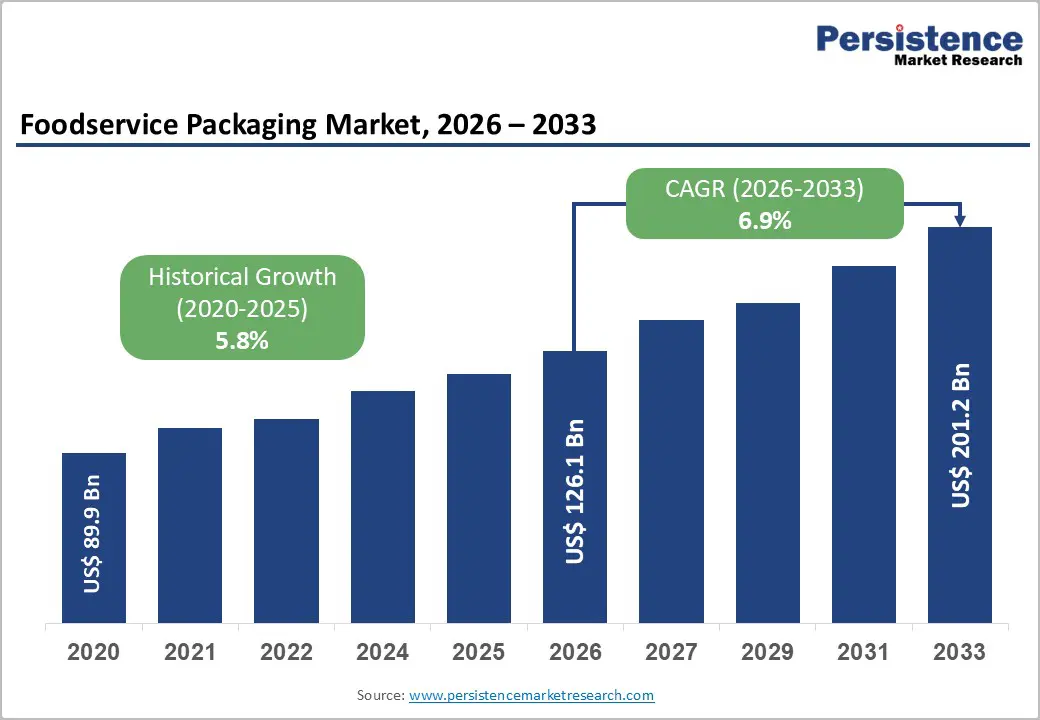
According to Persistence Market Research, the foodservice packaging market generated a revenue of US$ 366.3 Billion in 2025. The demand for foodservice packaging will accelerate, with the top market players holding a prominent share of the foodservice packaging market. The global market for foodservice packaging is expected to reach US$ 522.4 Billion by 2032, growing at a 5.2% CAGR from 2025 to 2032.

global-foodservice-packaging-market-size-2025–2032

Global Market Attribute Key Insights

Global Foodservice Packaging Market Size (2025E)

US$ 366.3 Billion

Projected Sales of Foodservice Packaging Market (2032F)

US$ 522.4 Billion

Value CAGR (2025 to 2032)

5.2%
Historical Market Growth (CAGR 2019 to 2024) 4.9%

According to different geographical locations, a number of trends are fuelling the expansion of the global packaging sector. In China, India, Brazil, Russia, and other emerging nations, rising urbanisation, housing and construction investment, the growth of retail chains, and the booming healthcare and cosmetics industries are driving packaging demand.

Food manufacturers are constantly searching for packaging that may provide customers more convenience and a longer shelf life at a cheaper cost than their current packaging, making the food service packaging market dynamic and fiercely competitive. The food industry is fully aware that consumer’s desire novelty and innovation, thus the packaging sector must advance or remain stagnant.

In emerging countries, rising living standards and individual disposable money encourage consumers to purchase a wide variety of items, which in turn drives up packaging demand.

Foodservice Packaging Market Analysis from 2019 to 2024 Vs Market Outlook for 2025 to 2032

Manufacturers in the fast-paced food and beverage sector must constantly not only meet rising consumer expectations, but also follow the newest patterns and provide new products to keep consumers interested. Customers prefer businesses and goods that use "clean-label" branding because it increases brand transparency and fosters consumer confidence. The term describes goods that are natural or organic and don't contain any artificial substances.

This messaging is being incorporated into packaging materials by brand owners, design studios, and packaging producers more frequently. Weight reduction and package recycling are now crucial due to the sustainability goal. Packaging needs to be flexible, varied, and complex.

How Consumer Inclination Toward Ready-To-Eat And On-The-Go Food Amplifying Sales?

Foodservice disposables' increased demand around the globe is also attributed to a number of practical qualities like its low cost, hygienic design, simple & convenient storage, and ready-to-use attributes. Companies involved in the foodservice industry provide a wide range of services to give clients an alternative. This is accelerating the expansion of the global foodservice packaging market as well as the market for foodservice disposables. These food consumption patterns are anticipated to become the "new normal" over the world due to an increase in the number of people working and urbanisation. Over the next five years, it is anticipated that this would dramatically increase demand for foodservice disposables.

Due to changing lifestyle trends, rising disposable income, and the rapid urbanisation of many nations, consumers' appetite for takeout or prepared foods is rising. Additionally, an increasing number of working people, particularly the younger generation, choose pre-packaged or on-the-go food, which is accelerating the growth of the foodservice packaging business. Over the course of the projection period, it is expected that the global market for foodservice packaging will grow at a CAGR of over 5.2%.

How is Changing Business Model of Food & Beverage Service Providers Aiding the Market’s Growth? 

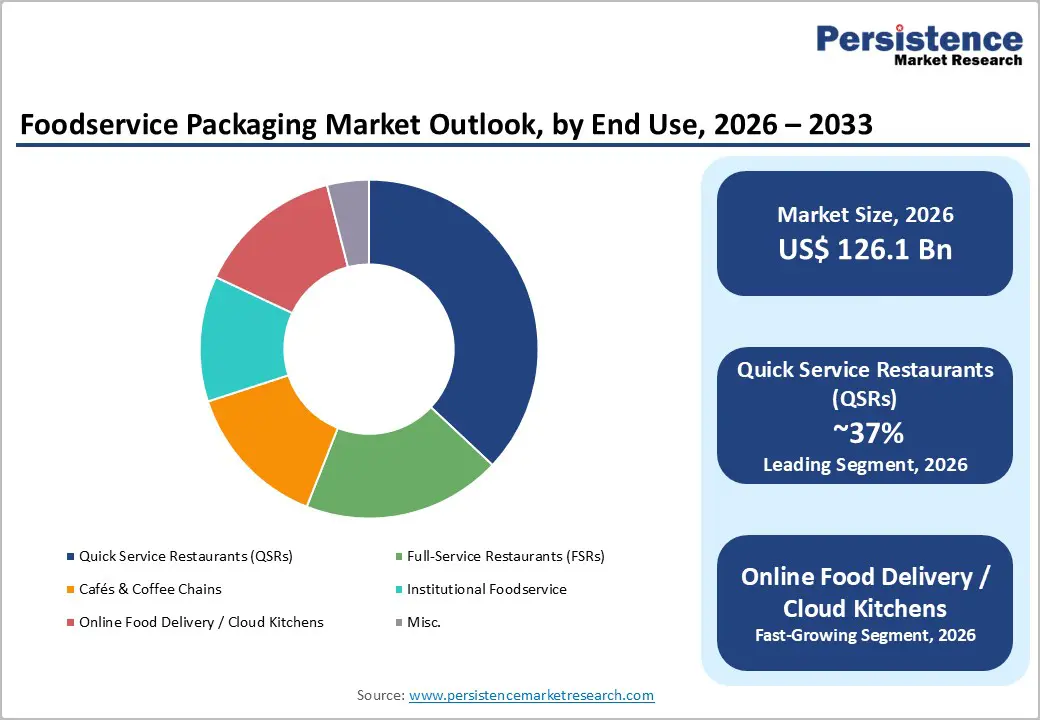
Globally, there is a rising demand for foodservice packaging solutions due to the increasing number of global QSRs, or quick service restaurants, like KFC and McDonald's. This enables these QSR chain owners and operators cut labour expenses and employ available resources for improving the quality of service and better offering customer assistance. These QSRs typically do not show any desire in investing in resources for maintenance and cleaning of business containers.

Similar business strategies are being adopted by several local and regional businesses all around the world, which is further boosting the demand for foodservice packaging solutions. In addition, the demand for food packaging solutions is increasing quickly due to global food industrialisation. Players have been able to develop and provide foodservice packaging solutions to a wide range of end users operating in the food sectors thanks to flexibility in production proficiencies.

Country-wise Analysis

How is the Foodservice Packaging Market Striving in the U.S.?

In the North America region US has emerged as one of the prominent market for foodservice packaging market, the market is expected to grow with a CARG of 6.5%, external threats exist in the United States and have an impact on investments in packing machinery. A weakening of the world economy, a strengthening of the dollar, and possible tightening of monetary policy are all potential dangers. However, overall growth will promote capital investments.

Additionally, as businesses look to lock in funding at reduced rates, the recent decline in interest rates has sparked an increase in capital investment. Some American and Canadian businesses have stated their intention to relocate their manufacturing operations to Mexico, where they can obtain duty-free goods and cheaper labour.

What is the State of Foodservice Packaging Market in China?

In the East Asia region China has emerged as one of the primary market for foodservice packaging the market is expected to grow with a CAGR value of 4.2%. Productivity gains will be necessary for China's economy to grow. In order to increase production, the Chinese government announced its intention to modernise the industrial sector with a focus on switching to sophisticated machinery.

The two biggest issues facing Chinese machinery makers right now are their continuous reliance on foreign technology and their inability to innovate. Small businesses will be shut down as part of the planned industry reorganisation in order to consolidate the machinery market. By providing tax benefits for the import of componentry, it also hastens the development of sophisticated machinery.

What is the Scope of Foodservice Packaging Market in India?

In the South Asia region, India has dominated the market of foodservice packaging, the market is expected to grow with a CAGR value of 5.2%. India's packaging industry is now rated 11th in the world. Packaged processed food has the largest market share in the packaging sector (48%), followed by personal care packaging (27%) and pharmaceutical packaging (6%).

The market for foodservice packaging is being driven by the rise in convenience food consumption. The food packaging market's two primary growth drivers are aesthetic appeal and practicality. The advancement of food processing has also increased the need for advancements in food packaging technology. Food packing is essential.

Category-wise Insights

Why is Polyethylene Terephthalate Packaging Gaining Traction?

The desire for sustainable products is driving growth in the packaging business. PET's ability to be recycled will spur expansion in the packaging sector. This market sector has a predicted CAGR of about 6.3%. The world's most popular recycled plastic packaging at the moment is PET bottles. Food service packaging companies are using the shift toward recyclable materials to increase their market share and boost their growth prospects as worries about plastic waste grow.

In the Material Type Segment Which Category is expected to drive the Market?

In the material type segment, aluminium is expected to dominate the market, the market for aluminium is expected to grow with a CAGR of 6.5%. Aluminium is a popular choice for food packaging because of its greater recyclability and special physical and chemical properties which are suitable for food products, in place of other materials like plastics and glass.

It is infinitely recyclable in comparison to plastic and paper, while it is also studier and lighter. It is one of the most malleable and adaptable substances known to mankind, it can be easily molded, it is resistant to organic acids, and a great conductor of heat, which makes it the go-to material for packing food products. Additionally, it is one of the most abundant elements in the crust of the Earth, making it widely accessible.

How is Online Food Ordering Increasing at Rapid Rate?

The market for online food ordering is expected to grow with a CAGR value of 7.3%. The procedure of delivering meals has changed as a result of the development of digital technologies. Customers are now placing their orders online and through restaurant apps rather than physically coming to the establishment. Restaurants, for their part, guarantee convenience and openness in their services. The restaurant fulfils an online order by making sure the food is delivered to the customer's home.

In recent years, the food business has undergone a considerable upheaval. Customers may now quickly and simply buy food online, and it will be delivered to their houses as soon as feasible.

Competition Landscape

Players in the market employ a variety of tactics to maintain their competitiveness and grow their market shares in the sector, including collaborations, mergers and acquisitions, and the creation of new products.

For Instance:

  • The launch of BRANDMYDISPO's free bespoke mylar bag design services was announced in 2022. The business is committed to offering top-notch printed packaging solutions to all sectors of the economy, including the food and beverage sector.

Companies Covered in Foodservice Packaging Market

  • Dart Container Corporation
  • Georgia-Pacific LLC
  • Anchor Packaging Inc.
  • Pactiv LLC
  • D&W Fine Pack
  • Gold Plast SPA
  • Berry Global Group Inc.
  • DOpla S.p.A.
  • Smurfit Kappa Group
  • WestRock Company
  • Huhtamäki Oyj
  • New WinCup Holdings, Inc.
  • Linpac Packaging Ltd
  • Graphic Packaging Holding Company
  • Other Players (As Requested)
Frequently Asked Questions

The global foodservice packaging market reached a valuation of US$ 366.3 Billion  at the end of 2025.

Between 2019 and 2024, global sales of foodservice packaging increased at 4.9% CAGR.

North America leads the global market and accounted for highest share in 2025.

Some of the leading manufacturers of Foodservice Packaging are Dart Container Corporation, Georgia-Pacific LLC, Anchor Packaging Inc., Pactiv LLC, D&W Fine Pack, Gold Plast SPA, Berry Global Group Inc., Dopla S.p.A., Smurfit Kappa Group, WestRock Company, Huhtamäki Oyj, New WinCup Holdings, Inc., Linpac Packaging Ltd, Graphic Packaging Holding Company among others.

The global market for foodservice packaging is expected to expand at 5.2% CAGR through 2032.

Foodservice Packaging Industry Report Scope

Attribute

Details

Forecast Period

2025 - 2032

Historical Data Available for

2019 - 2024

Market Analysis

Value: US$ Bn/Mn, Volume: As applicable

Key Regions Covered

  • North America
  • Latin America
  • Europe
  • East Asia
  • South Asia
  • Oceania
  • MEA

Key Countries Covered

  • United States
  • Canada
  • Brazil
  • Mexico
  • Germany
  • U.K.
  • France
  • Spain
  • Italy
  • Russia
  • South Africa
  • Northern Africa
  • GCC Countries
  • China
  • Japan
  • South Korea
  • India
  • Thailand
  • Malaysia
  • Indonesia
  • Australia
  • New Zealand

Key Market Segments Covered

  • Product type
  • Material
  • Fabrication Process
  • End Use
  • Region

Key Companies Profiled

  • Dart Container Corporation
  • Georgia-Pacific LLC
  • Anchor Packaging Inc.
  • Pactiv LLC
  • D&W Fine Pack
  • Gold Plast SPA
  • Berry Global Group Inc.
  • Dopla S.p.A.
  • Smurfit Kappa Group
  • WestRock Company
  • Huhtamäki Oyj
  • New WinCup Holdings, Inc.
  • Linpac Packaging Ltd
  • Graphic Packaging Holding Company
  • Others (on request)

Customization & Pricing

Available upon Request

Key Segments Covered in Foodservice Packaging Industry Research

By Product Type

  • Plates
  • Trays
  • Cups
  • Bowls
  • Pizza Boxes
  • Straws
  • Single serve Portion Packs
  • Clamshell
  • Lids for Cups
  • Stirrers
  • Cutlery (Knives, Forks, Spoons)

By Material

  • Aluminium
  • Paperboard
  • Moulded Fibres
  • Plastic
  • Polystyrene
  • Polypropylene
  • Polyethylene
  • Polyethylene Terephthalate
  • Poly Lactic Acid
  • Wood

By Fabrication Process

  • Thermoforming
  • Die Cutting
  • Injection Moulding

By End Use

  • Foodservice Outlets
  • Institutional Foodservice
  • Online Food Ordering

By Region

  • North America
  • Latin America
  • Europe
  • East Asia
  • South Asia
  • Oceania
  • Middle East Africa

Related Reports

1. Executive Summary

    1.1. Global Market Overview

    1.2. Summary of Key Statistics

    1.3. Summary of Key Findings

    1.4. Product Evolution Analysis

    1.5. PMR Analysis and Recommendations

2. Market Overview

    2.1. Market Coverage/Taxonomy

    2.2. Market Definition/Scope/Limitations

3. Key Market Trends

    3.1. Key Trends Impacting the Market

        3.1.1. Innovations and Portfolio Extensions Leading to Product Premiumization

        3.1.2. Cost-effectiveness of food service packaging

        3.1.3. Rising demand for convenience food

        3.1.4. Smart Technology in packaging Goes Next Level

        3.1.5. Growing trend of online purchase has significant impact on foodservice packaging

    3.2. Product Innovation Trends

    3.3. Future Prospects of the Foodservice Packaging Industry

        3.3.1. Factors Fuelling the Growth

        3.3.2. Influx of Brands

        3.3.3. Innovative Distribution and Marketing Strategies

4. Global Foodservice Packaging Market Outlook, 2019 - 2032

    4.1. Historical Market Volume ('000 Units) Analysis, 2019-2023

    4.2. Current and Future Market Volume ('000 Units) Projections, 2024-2032

    4.3. Y-o-Y Growth Trend Analysis

5. Global Foodservice Packaging Market - Pricing Analysis

    5.1. Pricing Analysis By Product Type

    5.2. Global Average Pricing Analysis Benchmark

6. Global Foodservice Packaging Market Outlook, 2019 - 2032

    6.1. Historical Market Value (US$ Bn) Analysis, 2019-2023

    6.2. Current and Future Market Value (US$ Bn) Projections, 2024-2032

        6.2.1. Y-o-Y Growth Trend Analysis

        6.2.2. Absolute $ Opportunity Analysis

7. Market Background

    7.1. Global Packaging industry Outlook

        7.1.1. Perception of Packaging

        7.1.2. Top Foodservice Packaging products in the market

        7.1.3. Top 10 Foodservice Packaging Companies in the World

    7.2. Macro-Economic Factors

        7.2.1. GDP Growth Outlook

        7.2.2. Consumer Spending Outlook

        7.2.3. GDP Growth Rate Analysis

        7.2.4. Internet Penetration Rate Outlook

        7.2.5. Income Group Population Overview

        7.2.6. Per Capita Disposable Income

    7.3. Forecast Factors - Relevance & Impact

        7.3.1. Top Companies Historical Growth

        7.3.2. Increasing number of Students across the world.

        7.3.3. Urbanization Growth Outlook

        7.3.4. Others

    7.4. PESTLE Analysis of Global Foodservice Packaging Market

    7.5. Investment Feasibility Matrix of Foodservice Packaging Market

    7.6. Porter’s Five Forces Analysis of Global Foodservice Packaging Market

    7.7. Market Dynamics

        7.7.1. Drivers

        7.7.2. Restraints

        7.7.3. Opportunity Analysis

8. Global Foodservice Packaging Market Outlook, 2019 - 2032 , By Product Type

    8.1. Introduction / Key Findings

    8.2. Historical Market Size (US$ Bn) Analysis By Product Type, 2019-2023

    8.3. Current and Future Market Size (US$ Bn) Analysis and Forecast By Product Type, 2024-2032

        8.3.1. Plates

        8.3.2. Trays

        8.3.3. Cups

        8.3.4. Bowls

        8.3.5. Pizza Boxes

        8.3.6. Straws

        8.3.7. Single serve Portion Packs

        8.3.8. Clamshell

        8.3.9. Lids for Cups

        8.3.10. Stirrers

        8.3.11. Cutlery (Knives, Forks, Spoons)

    8.4. Market Attractiveness Analysis By Product Type

9. Global Foodservice Packaging Market Outlook, 2019 - 2032 , by Material

    9.1. Introduction / Key Findings

    9.2. Historical Market Size (US$ Bn) and Volume Analysis By Material, 2019-2023

    9.3. Current and Future Market Size (US$ Bn) and Volume Analysis and Forecast By Material, 2024-2032

        9.3.1. Aluminium

        9.3.2. Paperboard

        9.3.3. Moulded Fibres

        9.3.4. Plastic

        9.3.5. Polystyrene

        9.3.6. Polypropylene

        9.3.7. Polyethylene

        9.3.8. Polyethylene Terephthalate

        9.3.9. Poly Lactic Acid

        9.3.10. Wood

    9.4. Market Attractiveness Analysis By Material

10. Global Foodservice Packaging Market Outlook, 2019 - 2032 , by Fabrication Process

    10.1. Introduction / Key Findings

    10.2. Historical Market Size (US$ Bn) and Volume Analysis By Fabrication Process, 2019-2023

    10.3. Current and Future Market Size (US$ Bn) and Volume Analysis and Forecast By Fabrication Process, 2024-2032

        10.3.1. Thermoforming

        10.3.2. Die Cutting

        10.3.3. Injection Moulding

    10.4. Market Attractiveness Analysis By Fabrication Process

11. Global Foodservice Packaging Market Outlook, 2019 - 2032 , by End Use

    11.1. Introduction / Key Findings

    11.2. Historical Market Size (US$ Bn) and Volume Analysis By End Use, 2019-2023

    11.3. Current and Future Market Size (US$ Bn) and Volume Analysis and Forecast By End Use, 2023 – 2033

        11.3.1. Foodservice Outlets

        11.3.2. Institutional Foodservice

        11.3.3. Online Food Ordering

    11.4. Market Attractiveness Analysis By End Use

12. Global Foodservice Packaging Market Outlook, 2019 - 2032 , by Region

    12.1. Introduction

    12.2. Historical Market Size (US$ Bn) and Volume (‘000 Units) Analysis by Region, 2019-2023

    12.3. Current Market Size (US$ Bn) and Volume (‘000 Units) Analysis and Forecast by Region, 2024-2032

        12.3.1. North America

        12.3.2. Latin America

        12.3.3. Europe

        12.3.4. East Asia

        12.3.5. South Asia

        12.3.6. Oceania

        12.3.7. Middle East and Africa (MEA)

    12.4. Market Attractiveness Analysis by Region

13. North America Foodservice Packaging Market Outlook, 2019 - 2032

    13.1. Introduction

    13.2. Pricing Analysis

    13.3. Historical Market Size (US$ Bn) and Volume Trend Analysis By Market Taxonomy, 2019-2023

    13.4. Market Size (US$ Bn) and Volume Forecast By Market Taxonomy, 2024-2032

        13.4.1. By Country

            13.4.1.1. U.S.

            13.4.1.2. Canada

        13.4.2. By Product Type

        13.4.3. By Material

        13.4.4. By Fabrication Process

        13.4.5. End Use

    13.5. Market Attractiveness Analysis

        13.5.1. By Country

        13.5.2. By Product Type

        13.5.3. By Material

        13.5.4. By Fabrication Process

        13.5.5. End Use

14. Latin America Foodservice Packaging Market Outlook, 2019 - 2032

    14.1. Introduction

    14.2. Pricing Analysis

    14.3. Historical Market Size (US$ Bn) and Volume Trend Analysis By Market Taxonomy, 2019-2023

    14.4. Market Size (US$ Bn) and Volume Forecast By Market Taxonomy, 2024-2032

        14.4.1. By Country

            14.4.1.1. Brazil

            14.4.1.2. Mexico

            14.4.1.3. Rest of Latin America

        14.4.2. By Product Type

        14.4.3. By Material

        14.4.4. By Fabrication Process

        14.4.5. End Use

    14.5. Market Attractiveness Analysis

        14.5.1. By Country

        14.5.2. By Product Type

        14.5.3. By Material

        14.5.4. By Fabrication Process

        14.5.5. End Use

15. Europe Foodservice Packaging Market Outlook, 2019 - 2032

    15.1. Introduction

    15.2. Pricing Analysis

    15.3. Historical Market Size (US$ Bn) and Volume Trend Analysis By Market Taxonomy, 2019-2023

    15.4. Market Size (US$ Bn) and Volume Forecast By Market Taxonomy, 2024-2032

        15.4.1. By Country

            15.4.1.1. Germany

            15.4.1.2. Italy

            15.4.1.3. France

            15.4.1.4. U.K.

            15.4.1.5. Spain

            15.4.1.6. Rest of Europe

        15.4.2. By Product Type

        15.4.3. By Material

        15.4.4. By Fabrication Process

        15.4.5. End Use

    15.5. Market Attractiveness Analysis

        15.5.1. By Country

        15.5.2. By Product Type

        15.5.3. By Material

        15.5.4. By Fabrication Process

        15.5.5. End Use

16. South Asia Foodservice Packaging Market Outlook, 2019 - 2032

    16.1. Introduction

    16.2. Pricing Analysis

    16.3. Historical Market Size (US$ Bn) and Volume Trend Analysis By Market Taxonomy, 2019-2023

    16.4. Market Size (US$ Bn) and Volume Forecast By Market Taxonomy, 2024-2032

        16.4.1. By Country

            16.4.1.1. India

            16.4.1.2. Thailand

            16.4.1.3. Indonesia

            16.4.1.4. Malaysia

            16.4.1.5. Rest of South Asia

        16.4.2. By Product Type

        16.4.3. By Material

        16.4.4. By Fabrication Process

        16.4.5. End Use

    16.5. Market Attractiveness Analysis

        16.5.1. By Country

        16.5.2. By Product Type

        16.5.3. By Material

        16.5.4. By Fabrication Process

        16.5.5. End Use

17. East Asia Foodservice Packaging Market Outlook, 2019 - 2032

    17.1. Introduction

    17.2. Pricing Analysis

    17.3. Historical Market Size (US$ Bn) and Volume Trend Analysis By Market Taxonomy, 2019-2023

    17.4. Market Size (US$ Bn) and Volume Forecast By Market Taxonomy, 2024-2032

        17.4.1. By Country

            17.4.1.1. China

            17.4.1.2. Japan

            17.4.1.3. South Korea

        17.4.2. By Product Type

        17.4.3. By Material

        17.4.4. By Fabrication Process

        17.4.5. End Use

    17.5. Market Attractiveness Analysis

        17.5.1. By Country

        17.5.2. By Product Type

        17.5.3. By Material

        17.5.4. By Fabrication Process

        17.5.5. End Use

18. Oceania Foodservice Packaging Market Outlook, 2019 - 2032

    18.1. Introduction

    18.2. Pricing Analysis

    18.3. Historical Market Size (US$ Bn) and Volume Trend Analysis By Market Taxonomy, 2019-2023

    18.4. Market Size (US$ Bn) and Volume Forecast By Market Taxonomy, 2024-2032

        18.4.1. By Country

            18.4.1.1. Australia

            18.4.1.2. New Zealand

        18.4.2. By Product Type

        18.4.3. By Material

        18.4.4. By Fabrication Process

        18.4.5. End Use

    18.5. Market Attractiveness Analysis

        18.5.1. By Country

        18.5.2. By Product Type

        18.5.3. By Material

        18.5.4. By Fabrication Process

        18.5.5. End Use

19. Middle East and Africa Foodservice Packaging Market Outlook, 2019 - 2032

    19.1. Introduction

    19.2. Pricing Analysis

    19.3. Historical Market Size (US$ Bn) and Volume Trend Analysis By Market Taxonomy, 2019-2023

    19.4. Market Size (US$ Bn) and Volume Forecast By Market Taxonomy, 2024-2032

        19.4.1. By Country

            19.4.1.1. GCC Countries

            19.4.1.2. Northern Africa

            19.4.1.3. South Africa

            19.4.1.4. Rest of Middle East and Africa

        19.4.2. By Product Type

        19.4.3. By Material

        19.4.4. By Fabrication Process

        19.4.5. End Use

    19.5. Market Attractiveness Analysis

        19.5.1. By Country

        19.5.2. By Product Type

        19.5.3. By Material

        19.5.4. By Fabrication Process

        19.5.5. End Use

20. Key Countries’ Foodservice Packaging Market Analysis 2024-2032

    20.1. Introduction

        20.1.1. Market Value Proportion Analysis, By Key Countries

        20.1.2. Global Vs. Country Growth Comparison

    20.2. U.S. Foodservice Packaging Market Analysis

        20.2.1. By Product Type

        20.2.2. By Material

        20.2.3. By Fabrication Process

        20.2.4. End Use

    20.3. Canada Foodservice Packaging Market Analysis

    20.4. Mexico Foodservice Packaging Market Analysis

    20.5. Brazil Foodservice Packaging Market Analysis

    20.6. Germany Foodservice Packaging Market Analysis

    20.7. Italy Foodservice Packaging Market Analysis

    20.8. U.K. Foodservice Packaging Market Analysis

    20.9. China Foodservice Packaging Market Analysis

    20.10. Japan Foodservice Packaging Market Analysis

    20.11. S. Korea Foodservice Packaging Market Analysis

    20.12. India Foodservice Packaging Market Analysis

    20.13. Australia and New Zealand Foodservice Packaging Market Analysis

    20.14. South Africa Foodservice Packaging Market Analysis

21. Market Structure Analysis

    21.1. Market Analysis by Tier of Companies (Foodservice Packaging)

    21.2. Market Concentration

    21.3. Market Share Analysis of Top Players

    21.4. Market Presence Analysis

        21.4.1. By Regional footprint of Players

        21.4.2. Product foot print by Players

        21.4.3. Channel Foot Print by Players

22. Competition Analysis

    22.1. Competition Dashboard

    22.2. Pricing Analysis by Competition

    22.3. Competition Benchmarking

    22.4. Competition Deep Dive

        22.4.1. Dart Container Corporation

            22.4.1.1. Overview

            22.4.1.2. Product Portfolio

            22.4.1.3. Profitability by Market Segments (Product/Channel/Region)

            22.4.1.4. Sales Footprint

            22.4.1.5. Strategy Overview

                22.4.1.5.1. Marketing Strategy

                22.4.1.5.2. Product Strategy

                22.4.1.5.3. Channel Strategy

        22.4.2. Georgia-Pacific LLC

        22.4.3. Anchor Packaging Inc.

        22.4.4. Pactiv LLC

        22.4.5. D&W Fine Pack

        22.4.6. Gold Plast SPA

        22.4.7. Berry Global Group Inc.

        22.4.8. DOpla S.p.A.

        22.4.9. Smurfit Kappa Group

        22.4.10. WestRock Company

        22.4.11. Huhtamäki Oyj

        22.4.12. New WinCup Holdings, Inc.

        22.4.13. Linpac Packaging Ltd

        22.4.14. Graphic Packaging Holding Company

23. Assumptions and Acronyms Used

24. Research Methodology


Research Methodology Framework for Market Research Excellence

At Persistence Market Research, we implement a comprehensive, validated, and multi-dimensional approachto market analysis that delivers actionable insights across complex market landscapes. Our methodology combines the analytical rigor of leading consulting firms with innovative research techniques, ensuring robust market assessments that guide strategic decision-making with confidence.

Core Research Philosophy

Our methodology is built on four foundational pillars:

Research Philosophy Image

At Persistence Market Research, our methodology is designed to transcend conventional market studies by combining analytical rigor, multi-source validation, and future-focused insights.

We integrate advanced research frameworks, robust data collection strategies, cutting-edge analytics, and innovative technologies to deliver a 360-degree view of complex markets.

We integrate advanced research frameworks, robust data collection strategies, cutting-edge analytics, and innovative technologies to deliver a 360-degree view of complex markets.

Each stage spanning from strategic scoping and hypothesis-building to competitive intelligence, quality validation, and actionable recommendations is engineered to provide clients with unmatched clarity, precision, and confidence in decision-making.

By embedding innovation and technology at the core, our approach ensures that insights are not only comprehensive but also predictive, empowering businesses to seize opportunities, mitigate risks, and achieve sustainable growth

Research Philosophy Image

Capturing Key Information and Events

During this phase, key research objectives focus on essential information and data points for assessing the market, including:

Research Philosophy Image

TAM-SAM-SOM Framework Implementation

We employ both top-down and bottom-up approaches to ensure accurate market sizing.

Top-Down Market SizingBottom-Up Market Sizing
Universe Definition: Total global/regional market identificationUnit Economics: Average transaction values, purchase frequencies, customer lifecycle
Segmentation Filters: Geographic, demographic, and behavioral constraintsCustomer Segmentation: Detailed buyer persona development and sizing
Market Share Analysis: Competitive landscape assessment and share allocationPenetration Analysis: Market penetration rates by segment and geography
Growth Rate Application: Historical trends and forward-looking growth assumptionsScaling Methodology: Extrapolation techniques with confidence intervals

Validation & Cross-Verification

  • Triangulation: Comparing top-down and bottom-up results for consistency
  • Sensitivity Analysis: Testing key assumptions and parameter variations
  • Peer Benchmarking: Comparison with analogous markets and industry benchmarks
  • Expert Review: External validation through industry specialist consultation

Research Philosophy Image

Forecasting & Projection Modeling

Our proprietary forecasting models incorporate multiple variables and scenarios.

Forecasting Components

  • Historical Trend Analysis: 10-year historical growth patterns and cyclical variations
  • Driver-Based Modeling: Economic indicators, demographic shifts, technology adoption
  • Scenario Planning: Base case, optimistic, and conservative projections
  • Monte Carlo Simulations: Probability-weighted outcomes and risk assessments

Model Validation

  • Back-Testing: Historical accuracy assessment over 3–5-year periods
  • Cross-Validation: Multiple modeling approaches for result comparison
  • External Benchmarking: Comparison with established market forecasts
  • Continuous Calibration: Quarterly model updates based on new data

Comprehensive Data Collection Strategy

Our secondary research phase establishes a robust knowledge base utilizing diverse, credible sources.

Secondary Data Sourcess

  • Industry Publications & Reports
  • Government & Regulatory Data
  • Financial Intelligence (filings & reports)
  • Academic Research & Digital Intelligence

Quality Assurance Protocol

  • Source credibility assessment and publication date validation
  • Data consistency checks across multiple sources
  • Bias identification and neutralization techniques
  • Information gap tracking for primary research prioritization

Research Philosophy Image

Primary Research Excellence

Our primary research methodology employs best-in-class techniques to capture unique market insights.

Quantitative Research Methods

  • Large-Scale Surveys: Statistically representative samples with 95% confidence intervals
  • Survey Methodology: Multi-channel deployment (online, telephone, in-person)
  • Question Architecture and Response Optimization

Qualitative Research Methods

  • Executive Interviews
  • Focus Groups
  • Expert Consultations

Quality Assurance & Validation Framework

Multi-Stage Validation Process

  • Source Verification and Consistency Testing
  • Outlier Detection and Bias Assessment
  • Peer Review Process and External Validation
  • Sensitivity Analysis and Confidence Intervals

Research Philosophy Image

Methodology Validation & Credibility

Our research methodology has been extensively validated through:

  • Academic Partnerships: Collaborations with top-tier business schools and research institutions
  • Client Success Stories: Documented case studies demonstrating research impact and ROI
  • Continuous Benchmarking: Performance comparison with leading global research firms

This comprehensive methodology framework positions Persistence Market Research at the forefront of market intelligence, combining the analytical sophistication of top-tier consulting firms with innovative research techniques. Our approach ensures that every market assessment delivers precise, actionable, and strategically valuable insights that drive business success in competitive market environments.

Ready to unlock your market potential? Contact our research experts to discuss how our validated methodology can transform your strategic decision-making with data-driven market intelligence.

Copyright © 2026 Persistence Market Research. All Rights Reserved

Connect With Us -