




- Marine
- Fishing Boats Market
Fishing Boats Market Size, Share, and Growth Forecast, 2026 - 2033
Fishing Boats Market by Product Type (Deep-V Boat, Multi Species Boat, Bass Boat, Others), Size (<14 Feet, 14-16 Feet, >16 Feet), Engine Type (<200 HP, 200-300 HP, >300 HP), and Regional Analysis for 2026 - 2033

Fishing Boats Market Size and Trends Analysis
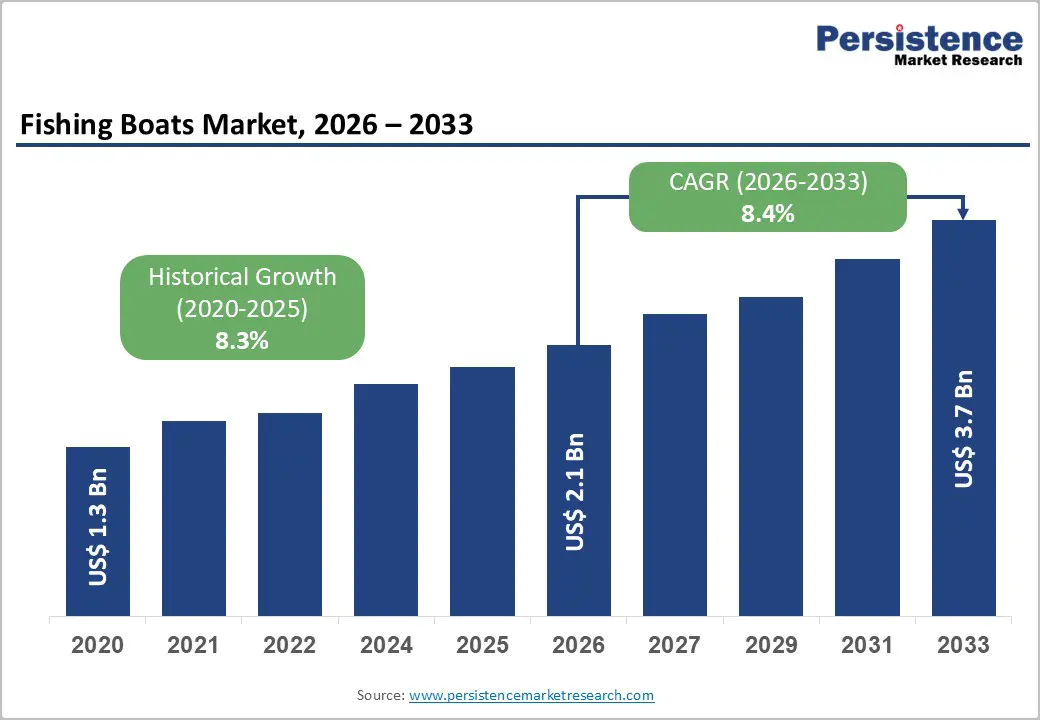
The global fishing boats market size is likely to be valued at US$2.1 billion in 2026, and is expected to reach US$3.7 billion by 2033, growing at a CAGR of 8.4% during the forecast period from 2026 to 2033, driven by the increasing prevalence of recreational fishing activities, rising demand for multi-functional boats with advanced engines, and advancements in lightweight, fuel-efficient fishing boat designs.
Growing demand for versatile, durable fishing boats, especially multi-species boats and bass boat models, is accelerating adoption across recreational users. Advances in >300 HP engine types and fiberglass materials are further boosting uptake by offering better speed and maneuverability. Increasing recognition of fishing boats as critical for leisure and sport fishing in emerging outdoor markets remains a major driver of market growth.
Key Industry Highlights:
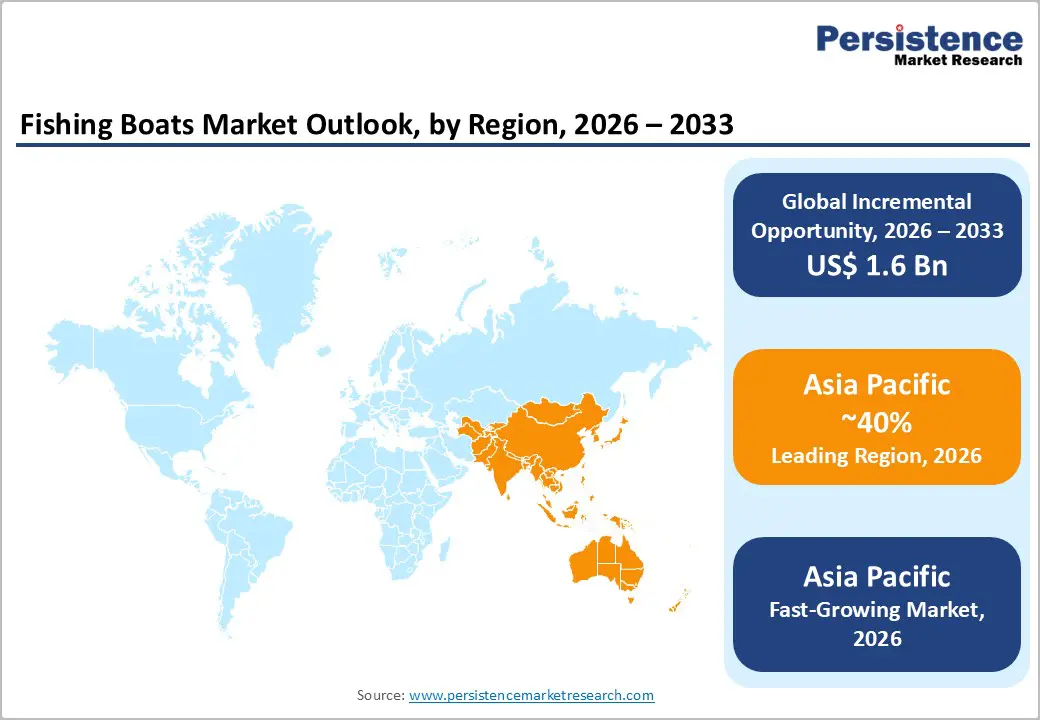
- Leading Region: Asia Pacific is anticipated to dominate, accounting for a 40% market share in 2026, fueled by rising disposable incomes, expanding tourism, and growing investments in leisure boating in China and India.
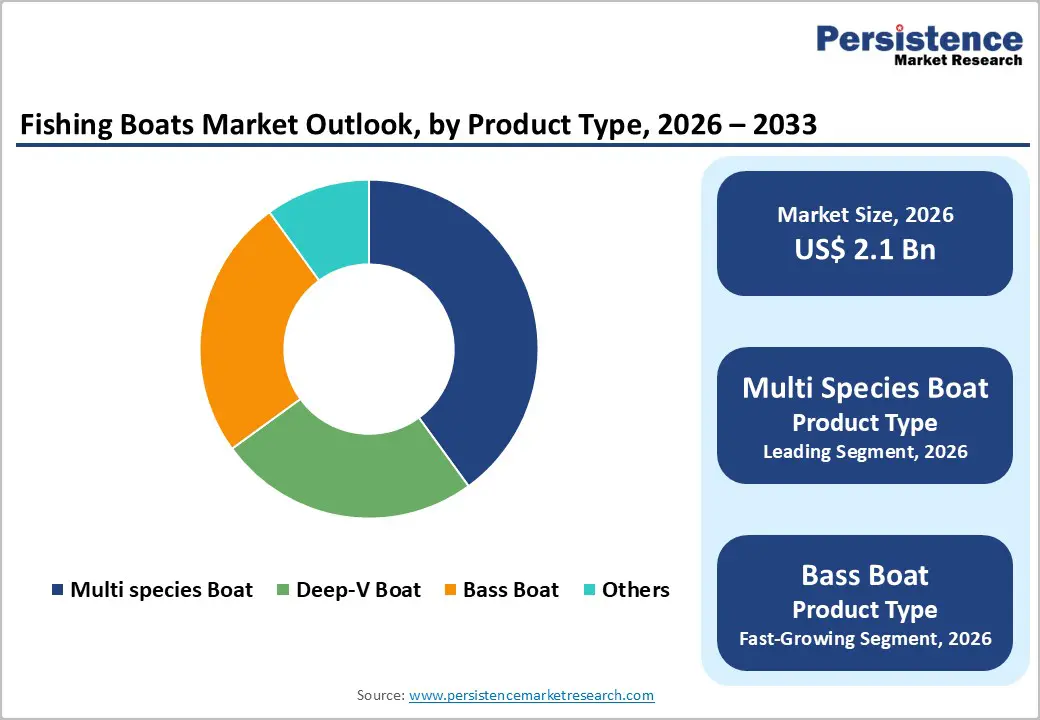
- Dominant Product Type: Multi-species boat, to hold approximately 45% of the market share, as it offers versatility for various fishing styles.
- Leading Size: 14-16 feet is anticipated to account for over 50% of market revenue, due to a balance of portability and recreational use capacity.
- Leading Engine Type: 200-300 HP, to contribute nearly 40% of the market revenue, due to optimal power for mid-size boats.
| Key Insights | Details |
|---|---|
| Fishing Boats Market Size (2026E) | US$2.1 Bn |
| Market Value Forecast (2033F) | US$3.7 Bn |
| Projected Growth (CAGR 2026 to 2033) | 8.4% |
| Historical Market Growth (CAGR 2020 to 2025) | 8.3% |
Market Factors - Growth, Barriers, and Opportunity Analysis
Rising Demand for Recreational Fishing Activities and Multi-Functional Boats
The recreational boating and marine industry is experiencing significant growth driven by the rising popularity of recreational fishing and multifunctional boats. Consumers are increasingly seeking leisure activities that combine relaxation with sport, and recreational fishing has emerged as a preferred outdoor pastime across diverse age groups and regions. This trend is fueled by higher disposable incomes, flexible work lifestyles, and a desire for experiential outdoor hobbies. Families, young professionals, and retirees are investing in boats that allow them to enjoy fishing while also accommodating social gatherings, water sports, and exploration.
Multi-functional boats, designed for multiple purposes such as fishing, cruising, and water sports, are gaining traction for their versatility, convenience, and value for money. These vessels are often equipped with modern features such as adjustable seating, advanced storage, navigational aids, and enhanced safety systems, making them attractive for both casual and serious boating enthusiasts. The integration of eco-friendly propulsion systems and modular accessories further enhances their appeal by aligning with environmental consciousness and personalized recreational needs.
High Development and Material Costs
High development and material costs remain a major obstacle for companies pursuing next-generation fishing boats and innovative vessel designs. Creating advanced solutions, such as high-strength fiberglass hulls, lightweight aluminum frameworks, or hybrid multi-species boats, demands extensive research, specialized molding processes, and sophisticated composite technologies that are significantly more expensive than those used in conventional models.
Ensuring durability adds another layer of complexity. Many advanced variants, including corrosion-resistant and performance-enhanced designs, are highly susceptible to UV exposure, impact damage, and saltwater corrosion. To guarantee long-term reliability, manufacturers must invest heavily in optimization, prolonged prototype testing, and premium resins, all of which substantially increase R&D costs.
Compliance with strict regulatory requirements for emissions, safety, and production consistency requires multiple validation studies across diverse operating conditions and hull configurations. These requirements lengthen development cycles and raise expenses. Scaling production further intensifies the challenge, as it requires controlled shipyard environments, specialized tooling, and robust quality-assurance systems. For smaller boat builders in particular, these financial and technical hurdles can restrict feature innovation or significantly delay market entry.
Advancements in Lightweight and Hybrid Delivery Platforms
Advancements in lightweight and hybrid delivery platforms for fishing boats are transforming the global leisure marine landscape by addressing two major challenges: fuel-efficiency barriers and performance limits. Lightweight platforms are engineered to achieve reduced displacement, reducing reliance on heavy engines and enabling faster speeds. Innovations, such as carbon fiber hulls, foam-core sandwich construction, variable geometry, and modular designs, significantly improve maneuverability and reduce fuel consumption, thereby lowering operational costs for users and recreational campaigns.
Progress in hybrid platforms, including electric-assisted propulsion, solar-integrated decks, battery-powered outboards, and diesel-electric systems, supports more eco-conscious boating by minimizing emissions, the boat’s first line of defense against regulations. These formats eliminate noise pollution, enhance range, and allow versatile use without refueling constraints, making them highly suitable for mass sport fishing programs. New technologies such as bio-adhesive coatings and AI-optimized trim further enhance durability and response.
Category-wise Analysis
Product Type Insights
Multi-species boats dominate the market, accounting for approximately 45% of the total market share in 2026. Their leadership is driven by their versatility, all-terrain capability, and strong family appeal, making them a preferred choice for recreational fishing. These boats offer multi-functionality, enhanced stability, and broad usability, making them well-suited for large-scale leisure and promotional activities. Alumacraft’s multi-species models, such as the Voyageur, Classic, and Escape, are engineered to perform across diverse fishing environments, whether targeting walleye in lakes, bass in rivers, or trout in reservoirs. Featuring stable, lightweight aluminum hulls, generous storage, integrated livewells, and adaptable deck layouts, these boats support a wide range of fishing styles while remaining suitable for family outings, cruising, and general recreational use.
Bass boats represent the fastest-growing segment of the market, fueled by their emphasis on speed and increasing adoption in tournament fishing. Their specialized design enables more efficient, targeted angling by minimizing time spent on the water. Ongoing advancements in hull engineering continue to enhance performance, accelerating demand across North America and Europe as competitive fishing gains popularity. Ranger’s 2026 Z521R Ultra bass boat illustrates this trend, showcasing how modern bass boats are optimized for high-level competition. With an advanced hull design, refined ergonomics, including heated seating and touchscreen controls, and the ability to accommodate powerful outboard engines up to 300 HP, the Z521R Ultra allows anglers to cover greater distances quickly, reach prime fishing locations faster, and perform more effectively in tournament settings.
Size Insights
The 14-16 feet segment is anticipated to lead the market, holding approximately 50% of the market share in 2026, driven by balanced portability, large-family programs, and strong global demand for trailered boats. Their dominance continues as users expand day trips. The rising adoption of <14 feet compact and expanded >16 feet luxury campaigns highlights the growing focus on size diversity. A 16-foot aluminum center console fishing boat rib with a fiberglass floor, this 16-foot aluminum fishing and recreational boat is representative of the 14-to 16-foot segment that appeals to recreational anglers and families alike. Boats in this size range are easy to tow on a trailer, offer sufficient space for passengers and gear, and can be used for day trips, fishing outings, and general leisure cruising, which is why nearly 50% of the market share is held by boats in this size range in 2026.
The 16-foot segment is the fastest-growing, driven by strong momentum in spacious designs and expanding inclusion in group fishing. The growing shift toward luxury platforms, along with greater capacity, is accelerating adoption. Advancements in cabin integration and the continued progress of multi-engine entering consumer trials drive market growth. Lund SSV-16 is a 16-foot aluminum fishing and recreational boat that has gained strong market traction for its versatile, performance-oriented design and ability to serve multiple purposes, including fishing with friends, family outings, and light cruising.
Engine Type Insights
The 200-300 HP segment leads the market, accounting for nearly 40% of revenue in 2026, as it remains the preferred power range for mid-sized vessels, large recreational applications, and versatile boats that require a balance of performance and speed. Their strong integration, trained users, and the ability to handle high-volume or multi-purpose blends drive higher consumption. 200-300 HP sectors are leading outboard rollouts and administering emerging inboard trials. Honda BF250 Outboard Motor and similar models, such as the DF250 Outboard Motor (250 HP). These engines are widely used on mid-sized recreational boats, center consoles, and multi-purpose fishing and leisure vessels that require balanced speed, strong performance, and versatility for a range of boating activities.
The 300 HP segment is the fastest-growing, driven by its strong high-speed performance and expanding role in offshore fishing. They offer convenient, quick, and accessible power, attracting users who prefer robust, low-effort settings. Increased outreach programs, tournament focus, and wider availability of routine and premium engines further accelerate uptake, boosting rapid adoption across both coastal and inland areas. The Yamaha 300 HP outboard line, especially models such as the F300XA and LF300 series, delivers 300 horsepower from a robust 4.2-liter V6 platform, providing exceptional acceleration, torque, and reliability for larger offshore fishing boats, center console vessels, and high-speed recreational craft. These engines are engineered for offshore performance, longer runs, and challenging marine environments, making them highly attractive for users who demand quick, accessible power without sacrificing efficiency or durability.
Regional Insights
North America Fishing Boats Market Trends
Growth in North America is fueled by the region’s high recreational fishing culture, strong marine infrastructure, and high public interest in leisure boating. Distribution systems in the U.S. and Canada provide extensive support for boat programs, ensuring wide accessibility to fishing boats across multi-species, bass boat, and deep-v populations. Increasing demand for 200-300 HP, convenient, and easy-to-trailer forms is further accelerating adoption, as these formats improve accessibility and reduce barriers associated with large vessels.
Innovation in fishing boat technology, including stable, lightweight hulls, improved hybrid propulsion, and targeted performance enhancements, is attracting significant investment from both public and private sectors. Government initiatives and NMMA campaigns continue to promote use against fuel costs, environmental concerns, and emerging leisure threats, creating sustained market demand. The growing focus on >16-foot grades and specialty use, particularly for tournaments and other events, is expanding the target applications for fishing boats.
Europe Fishing Boats Market Trends
Europe is supported by increasing awareness of leisure benefits, strong regulatory systems, and government-led marine programs. Countries such as Germany, France, and the U.K. have well-established boating frameworks that support routine fishing and encourage the adoption of innovative boat delivery methods, including fishing boats. These versatile formulations are particularly appealing for multi-species populations, regulation-conscious operators, and tournament users, improving performance and coverage rates.
Technological advancements in fishing boats, such as enhanced hybrid propulsion, application-targeted delivery, and improved lightweight grades, are further boosting market potential. European authorities are increasingly supporting research and trials for boats against both routine and specialized needs, strengthening market confidence. The growing emphasis on convenient, eco-friendly options is aligned with the region’s focus on preventive sustainability and reducing emissions. Public awareness campaigns and promotion drives are expanding reach in both urban and rural areas, while suppliers are investing in hulls and novel variants to increase efficacy.
Asia Pacific Fishing Boats Market Trends
Asia Pacific is anticipated to dominate and is likely to be the fastest-growing market, accounting for over 40% share in 2026, fueled by rising leisure awareness, increasing government initiatives, and expanding application programs across the region. Countries such as India, China, Japan, and Southeast Asian nations are actively promoting boat campaigns to address recreation growth and emerging tourism needs. Fishing boats are particularly attractive in these regions due to their scalable administration, ease of use, and suitability for large-scale leisure drives in both coastal and inland populations.
Technological advancements are enabling the development of stable, effective, and easy-to-operate fishing boats that can withstand challenging water conditions and minimize maintenance requirements. These innovations are critical for reaching remote facilities and improving the overall boating coverage. The growing demand for multi-species boats, bass boats, and deep-v applications is driving market expansion. Public-private partnerships, increased leisure expenditure, and rising investments in marine research and manufacturing capacity are further accelerating growth. The convenience of boat delivery, combined with improved performance and reduced failure risk, positions fishing boats as a preferred choice.
Competitive Landscape
The global fishing boats market features competition between established marine leaders and emerging recreational providers. In North America and Europe, Brunswick Corporation and BRP Inc. lead through strong R&D, distribution networks, and industry ties, bolstered by innovative multi species and bass programs. In Asia Pacific, Yamaha Motor Company Ltd. advances with localized solutions, enhancing accessibility. Hybrid delivery boosts efficiency, cuts fuel risks, and enables mass integrations across regions. Strategic partnerships, collaborations, and acquisitions merge expertise, expand portfolios, and speed commercialization. Lightweight formulations solve weight issues, aiding penetration in performance-focused areas.
Key Industry Developments
- In January 2026, Brunswick Corporation, the world’s largest marine technology company, returned to the Consumer Electronics Show (CES) with its most extensive showcase of marine innovation to date. The company unveiled a wide range of breakthrough technologies, reinforcing its ACES strategy (Autonomous/Assisted, Connected, Electrified, Shared) as a fully realized and commercially viable ecosystem.
- In December 2025, Yamaha Rightwaters strengthened its collaboration with the Hubbs-SeaWorld Research Institute (HSWRI) by renewing its partnership for an additional three years. Under the agreement, HSWRI will receive two new Yamaha outboards to support its marine research and marine mammal rescue operations in Florida and California. A 115-horsepower Yamaha outboard will power the institute’s primary Marine Mammal Stranding Team response vessel, while a 50-horsepower outboard will be used on the HSWRI skiff servicing offshore white seabass net pens. Yamaha Rightwaters has served as HSWRI’s official outboard partner since June 2023.
Companies Covered in Fishing Boats Market
- Brunswick Corporation
- BRP Inc.
- Yamaha Motor Company Ltd.
- Smoker Craft Inc.
- Correct Craft Holding Co. LLC
- Telwater
- White River Marine Group
- BPS Direct LLC
- Legend boats
- UMS Boats
Frequently Asked Questions
The global fishing boats market is projected to reach US$2.1 billion in 2026.
The rising prevalence of recreational fishing activities and demand for multi-functional boats are the key drivers.
The fishing boats market is poised to witness a CAGR of 8.4% from 2026 to 2033.
Advancements in lightweight and hybrid delivery platforms are key opportunities.
Brunswick Corporation, BRP Inc., Yamaha Motor Company Ltd., Smoker Craft Inc., and Telwater are the key players.


