




- Food Ingredients & Additives
- Desiccated Coconut Powder Market
Desiccated Coconut Powder Market Size, Share, Trends, Growth, and Regional Forecast, 2026 to 2033
Desiccated Coconut Powder Market by Product Type (Extra Fine Grade, Fine Grade, Medium Grade, and Coarse Grade), Fat Content (High Fat Content and Low Fat Content), Application (Bakery & Confectionery, Dairy & Frozen Desserts, Beverages, Snacks & Ready-to-Eat Foods, and Health & Nutrition Products) Distribution Channel (Hypermarkets, Convenience Stores, Specialty Stores, Independent Retailers, and Online Retail), and Regional Analysis from 2026 to 2033

Desiccated Coconut Powder Market Share and Trend Analysis
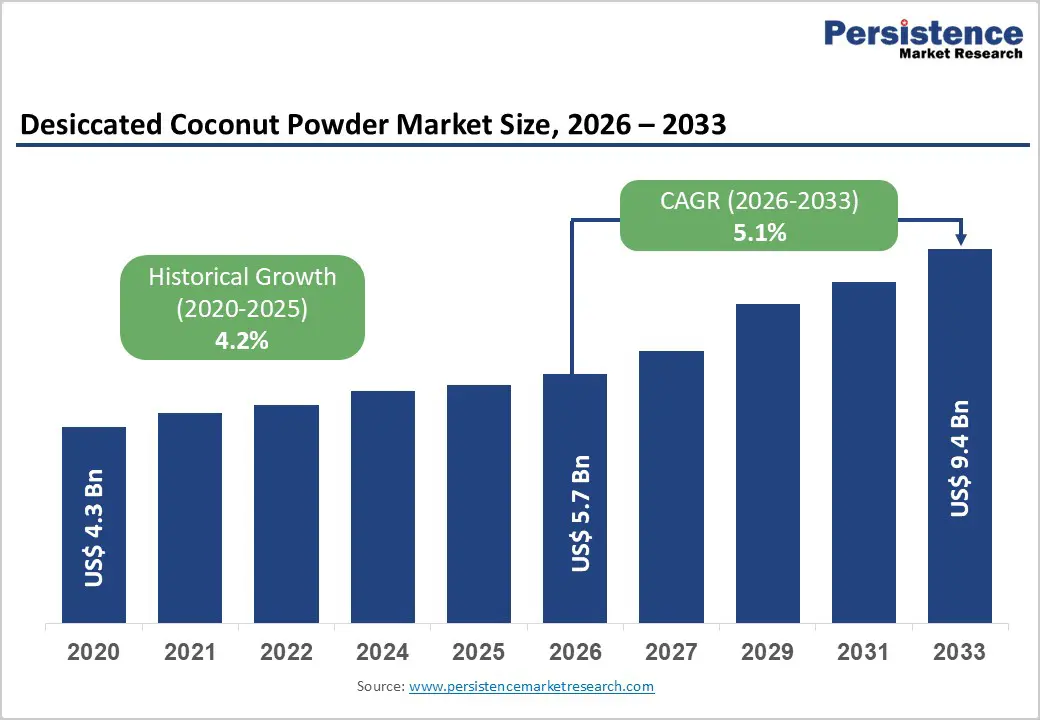
The global desiccated coconut powder market size is estimated to grow from US$ 5.7 billion in 2026 to US$ 9.4 billion by 2033. The market is projected to record a CAGR of 5.1% during the forecast period from 2026 to 2033. Global consumption of desiccated coconut powder continues to expand, supported by rising incorporation of natural ingredients across packaged foods, bakery products, snacks, and dessert applications.
Food manufacturers increasingly prefer coconut-based ingredients for their flavor enhancement, texture functionality, and extended shelf stability, aligning well with clean-label product development. Growing interest in plant-based eating patterns and dairy alternatives is further strengthening demand, as coconut powder delivers richness without animal-derived inputs. Expansion of organized retail, online grocery platforms, and international food trade has improved accessibility across both developed and developing economies. Urban lifestyles and higher consumption of ready-to-eat and convenience foods are encouraging steady ingredient usage among industrial processors. In addition, rising home baking trends and demand for premium confectionery products are supporting retail sales. Improvements in drying technologies, quality standardization, and export-oriented production capabilities are enhancing global supply reliability. Increasing consumer willingness to spend on natural and minimally processed food ingredients, combined with innovation in organic and specialty grades, continues to reinforce long-term market momentum.
Key Industry Highlights:
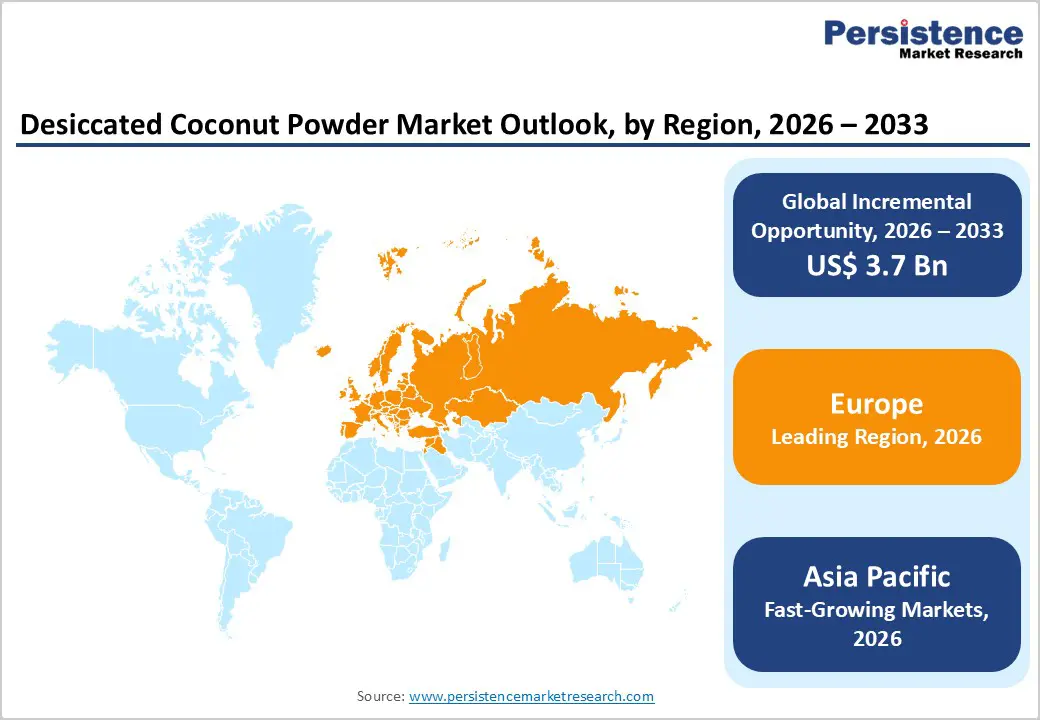
- Leading Region: Europe accounts for the largest share at 46.7%, driven by high import dependence for coconut-based ingredients, strong demand from bakery and confectionery industries, increasing adoption of clean-label and plant-derived food components, advanced food processing capabilities, and extensive supermarket and specialty retail networks supporting consistent consumption.
- Fastest-Growing Region: Asia Pacific is witnessing the fastest expansion due to rapid urbanization, rising disposable incomes, strong culinary familiarity with coconut ingredients, expanding processed food industries, and increasing penetration of modern retail formats and e-commerce platforms across emerging economies.
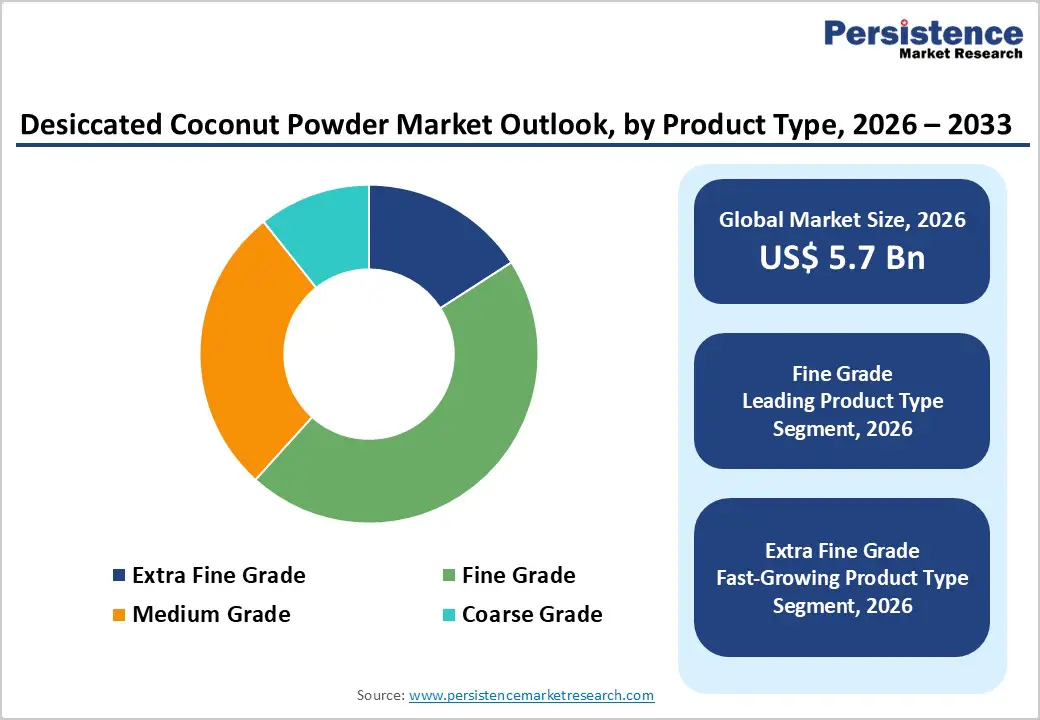
- Leading Product Type Segment: Fine grade dominates the market due to familiar taste profiles, smooth mouthfeel, strong consumer acceptance, and suitability for regular consumption.
- Fastest-Growing Product Type Segment: Extra fine grade is growing rapidly as manufacturers demand smoother textures for premium desserts, nutritional products, and value-added food formulations.
- Leading Fat Content Segment: High fat content remains dominant, driven by superior flavor intensity, improved mouthfeel, and strong preference in indulgent bakery and confectionery applications.
- Fastest-Growing Fat Content Segment: Low-fat content variants are expanding quickly as food brands introduce lighter, health-oriented recipes aligned with calorie-conscious consumer preferences.
| Key Insights | Details |
|---|---|
| Desiccated Coconut Powder Market Size (2026E) | US$ 5.7 Bn |
| Market Value Forecast (2033F) | US$ 9.4 Bn |
| Projected Growth (CAGR 2026 to 2033) | 5.1 % |
| Historical Market Growth (CAGR 2020 to 2025) | 4.2 % |
Market Dynamics
Driver - Expanding Demand for Natural Ingredients and Growth of Processed Food Consumption
Rising preference for minimally processed and naturally derived food ingredients is significantly strengthening demand across coconut-based ingredient categories. Consumers are increasingly scrutinizing product labels and favoring recognizable plant-origin components over synthetic additives, encouraging food manufacturers to incorporate coconut derivatives into mainstream formulations. Desiccated coconut powder offers functional benefits, including flavor enhancement, texture improvement, and extended shelf stability, making it highly suitable for bakery, confectionery, snack, and dessert applications. Rapid urbanization and changing eating habits have accelerated the consumption of packaged and ready-to-eat foods, directly increasing ingredient procurement volumes among large-scale processors.
The growing popularity of plant-based diets and dairy alternatives has also widened the application scope, as coconut ingredients provide richness and mouthfeel without animal-derived inputs. Expansion of café culture, premium bakery chains, and artisanal dessert brands further supports consistent usage. Additionally, strong export demand from developed markets encourages scaling up production in coconut-producing countries. Improved processing technologies, better drying methods, and standardized quality specifications are enabling manufacturers to meet global food safety requirements, positioning coconut powder as a reliable ingredient within modern food manufacturing ecosystems.
Restraints - Raw Material Price Volatility and Supply Chain Dependence on Climatic Conditions
Market expansion faces structural limitations primarily linked to fluctuations in coconut production and agricultural dependency. Coconut yields are highly sensitive to weather variability, pest outbreaks, and changing rainfall patterns, which can disrupt raw material availability and create pricing instability for processors. Seasonal supply inconsistencies often lead to cost pressures across the value chain, affecting profit margins for manufacturers and exporters. Smaller processing companies, in particular, struggle to maintain consistent output during periods of reduced harvest.
In addition, post-harvest handling and drying require strict moisture control to maintain product quality, demanding investment in specialized infrastructure and quality assurance systems. Variations in oil content, particle uniformity, and microbial stability can impact acceptance among international buyers. Logistics challenges, including transportation delays and export regulations, further complicate supply continuity. Competition from alternative coconut formats, such as coconut milk powder, flakes, and shredded coconut, also influences food processors' purchasing decisions. These operational and agricultural uncertainties collectively create barriers to predictable pricing, long-term contracts, and stable expansion despite growing global demand.
Opportunity - Premiumization, Product Diversification, and Expansion into Emerging Food Applications
Shifting consumer lifestyles are opening new avenues for value-added coconut ingredients beyond traditional confectionery usage. Manufacturers are increasingly developing organic, low-fat, and specialty-grade variants to meet rising demand for health-oriented and clean-label products. Premium bakery items, plant-based desserts, functional snacks, and gluten-free formulations present strong opportunities for ingredient diversification. As consumers experiment with global cuisines and home baking trends continue to expand, retail demand for convenient coconut ingredients is rising steadily.
Innovation in processing technology is enabling finer textures, improved solubility, and enhanced flavor retention, allowing broader adoption across beverage mixes and nutritional products. Emerging economies are also creating new growth prospects as rising disposable incomes encourage consumption of packaged foods and Western-style baked goods. Digital retail platforms provide smaller brands with direct consumer access, accelerating category awareness and trial purchases. Sustainability initiatives, including ethical sourcing and environmentally responsible processing, are gaining importance among buyers and multinational food companies. Together, these developments position coconut powder suppliers to capture long-term growth through differentiation, premium positioning, and diversification into evolving food categories.
Category-wise Analysis
Product Type Insights
Fine-grade desiccated coconut powder is anticipated to hold the largest share of the global market in 2026, accounting for 45.8% of total revenue. Its dominance stems from strong adoption across bakery, confectionery, and processed food manufacturing, where uniform particle size and stable moisture absorption are essential for product consistency. Fine-grade powder blends easily into doughs, fillings, coatings, and dessert formulations, delivering balanced flavor distribution without altering product structure. Food processors prefer this grade due to predictable functional performance during mixing, baking, and storage. Additionally, its versatility supports both sweet and savory applications, allowing manufacturers to standardize production across multiple product lines. Growing demand for packaged baked goods and premium confectionery products further reinforces consumption. Export-oriented suppliers also favor fine-grade variants because they meet international quality specifications and processing standards, enabling broader acceptance among large-scale food manufacturers worldwide.
Application Insights
The bakery & confectionery segment is projected to lead the global desiccated coconut powder market in 2026, representing 40.6% of overall revenue. Strong usage in cakes, biscuits, chocolates, fillings, and traditional sweets continues to anchor demand globally. Desiccated coconut powder enhances texture, flavor richness, and visual appeal, making it a preferred ingredient in both industrial-scale and artisanal production. Its long shelf life and low moisture content improve storage stability, supporting large-volume manufacturing and export-oriented bakery operations. Rising consumption of packaged snacks and ready-to-eat desserts across urban markets further strengthens segment growth. Manufacturers increasingly incorporate coconut ingredients into premium and indulgent product launches to cater to evolving consumer preferences for natural flavors. In addition, the expansion of café chains, bakery outlets, and private-label confectionery brands has accelerated ingredient procurement volumes. The ingredient’s compatibility with plant-based and clean-label formulations also supports its continued dominance across modern food applications.
Distribution Channel Insights
Hypermarkets are expected to account for 36.2% of global desiccated coconut powder sales in 2026, maintaining their position as the leading distribution channel. Large-format retail stores provide extensive shelf space, enabling multiple brands and packaging formats to reach diverse consumer groups. High footfall and organized merchandising encourage impulse purchases, particularly among households engaged in home cooking and baking. Consumers benefit from price comparisons, promotional discounts, and bundled offerings, which increase purchase frequency. From a supplier perspective, hypermarkets deliver consistent demand volumes and efficient inventory turnover across metropolitan and suburban regions. Retail chains also support private-label expansion, further increasing category penetration. While online channels are gaining traction, physical retail remains important for ingredient-based purchases where consumers prefer direct product evaluation. The availability of both premium organic variants and affordable bulk packs within hypermarkets ensures broad accessibility, sustaining channel dominance in both developed and emerging economies.
Regional Insights
Europe Desiccated Coconut Powder Market Trends
Europe is projected to hold the leading position in the global desiccated coconut powder market, accounting for 46.7% value share in 2026, supported by its status as the largest importer of coconut-based ingredients. The region’s mature bakery, confectionery, and breakfast cereal industries rely heavily on imported coconut derivatives to meet consistent production requirements. Consumers increasingly favor plant-based, natural, and minimally processed ingredients, encouraging manufacturers to incorporate coconut powder into reformulated products.
Strict food quality regulations and transparency standards further strengthen demand for high-quality imported supplies. The growth of vegan desserts, premium snacks, and private-label bakery products continues to drive procurement volumes across Germany, the U.K., France, Italy, and the Nordic countries. Well-established retail chains and specialty organic stores ensure widespread availability, reinforcing Europe’s leadership as the primary consumption hub globally.
North America Desiccated Coconut Powder Market Trends
North America remains a significant but secondary market, supported by sustained demand for clean-label bakery products, plant-based foods, and premium snack formulations. Food manufacturers across the United States and Canada increasingly incorporate desiccated coconut powder into gluten-free baked goods, dairy alternatives, confectionery fillings, breakfast cereals, and specialty desserts to enhance texture and natural flavor profiles. The region remains heavily import-dependent due to limited domestic coconut cultivation, creating stable long-term sourcing relationships with suppliers in Asia Pacific.
Rising consumer preference for natural ingredients, allergen-friendly formulations, and minimally processed food components further supports adoption across retail and foodservice channels. The growth of vegan lifestyles and increased experimentation with global cuisines has also expanded the use of coconut ingredients beyond traditional applications. Strong purchasing power enables premium positioning for organic and sustainably sourced variants, while established supermarket chains and e-commerce grocery platforms ensure broad product availability. Although demand remains consistent, market expansion is comparatively moderate as category penetration is already mature, with growth largely driven by product innovation and premiumization rather than new consumer adoption.
Asia Pacific Desiccated Coconut Powder Market Trends
The Asia Pacific desiccated coconut powder market is forecast to register a CAGR of around 7.0% between 2026 and 2033, reflecting rapid structural changes in food consumption patterns across China, India, Japan, and South Korea. Increasing urbanization and rising disposable incomes are driving higher spending on packaged foods, bakery products, and ready-to-eat snacks that often contain coconut ingredients. The region also benefits from proximity to major coconut-producing countries, ensuring cost-efficient access to raw materials and strong export potential.
Traditional culinary familiarity with coconut-based recipes provides a natural advantage for market expansion, supporting both household and industrial demand. Growth of modern retail chains and digital commerce platforms is improving accessibility across metropolitan and tier-2 cities. Regional manufacturers are investing in processing upgrades and value-added product formats to meet international quality standards. Government initiatives supporting food processing industries further strengthen production capacity, positioning Asia Pacific as the fastest-growing regional market globally.
Competitive Landscape
The global desiccated coconut powder market is highly competitive, with strong participation from Kore Agro, Briofeed Private Limited, KrishnaIndia, Vishnu Spices, Thenarasu Organics, and Geewin Exim Pvt Ltd. These players leverage extensive export networks, retail distribution channels, and strong sourcing capabilities while focusing on product quality, standardized particle size, moisture control, and improved processing technologies to meet evolving food industry requirements.
Rising demand for natural ingredients, plant-based foods, and clean-label formulations is accelerating innovation. Manufacturers are expanding organic product portfolios, strengthening supply chains, investing in advanced drying and processing methods, and increasing presence in international markets to support growing bakery, confectionery, and functional food applications.
Key Industry Developments:
- In February 2026, Vietnam and Algeria strengthened bilateral trade cooperation during Spring Fair 2026, emphasizing expansion of agricultural and processed food exports. The initiative supports greater international movement of coconut-based ingredients, including desiccated coconut powder, by improving market access, encouraging cross-border partnerships, and diversifying supply chains between Southeast Asia and North Africa, thereby creating new export opportunities for coconut processors and ingredient manufacturer
- In January 2022, Tamil Nadu Chief Minister inaugurated a INR16-crore coconut value-addition center at Shenbhagaramanpudur, Tamil Nadu via videoconference to strengthen the farm economy. The facility includes units for producing desiccated coconut powder, dry coconut, virgin coconut oil, coconut charcoal, and packaged coconut-based products, along with refrigeration and processing infrastructure.
Companies Covered in Desiccated Coconut Powder Market
- Kore Agro
- Briofeed Private Limited
- KrishnaIndia
- Vishnu Spices
- Thenarasu Organics
- Geewin Exim Pvt Ltd
- Kovai Agro Foods
- Malpani Spices
- Syenah Agro Products
- Eveerdry
- Narialwaala
- Meghana coconut Industry
- Mohan Impex
- Dhan Laxmi Traders
- Zamorin and Gama
- Others
Frequently Asked Questions
The global desiccated coconut powder market is projected to be valued at US$ 5.7 Bn in 2026.
Rising demand for bakery, confectionery, and plant-based food products, along with increasing use of natural and clean-label ingredients, is driving the global desiccated coconut powder market.
The global desiccated coconut powder market is poised to witness a CAGR of 5.1%between 2026 and 2033.
Expansion of vegan foods, functional beverages, and premium organic food segments presents significant growth opportunities in the global desiccated coconut powder market.
Kore Agro, Briofeed Private Limited, KrishnaIndia, Vishnu Spices, Thenarasu Organics, and Geewin Exim Pvt Ltd are some of the key players in the desiccated coconut powder market.


