




- Industrial Machinery
- Dal Mill Machine Market
Dal Mill Machine Market Size, Share, and Growth Forecast, 2026 - 2033
Dal Mill Machine Market by Machine Type (Automated Dal Mill Machines, Semi-Automated Dal Mill Machines, Mini Dal Mill Machines, Others), Motor Power (3.5 HP, 5 HP, 7.5 HP, 10 HP), and Regional Analysis for 2026 - 2033

Dal Mill Machine Market Size and Trends Analysis
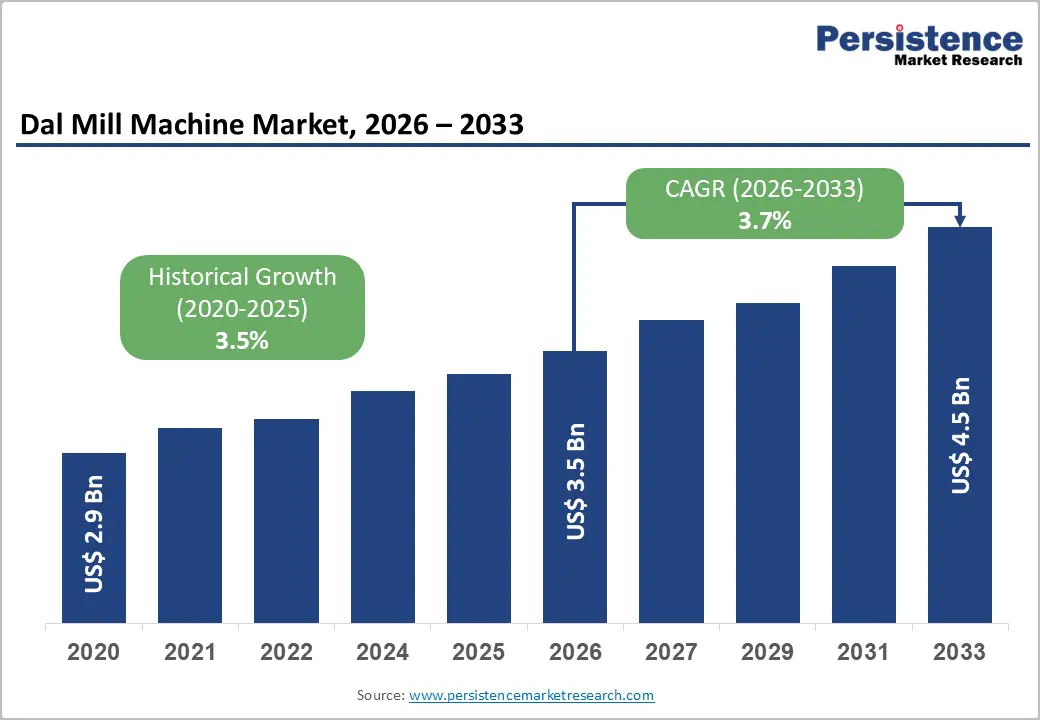
The global dal mill machine market size is likely to be valued at US$3.5 billion in 2026 and is expected to reach US$4.5 billion by 2033, growing at a CAGR of 3.7% during the forecast period from 2026 to 2033, driven by the rising need for efficient pulse processing infrastructure across both developing and developed economies. Expansion in pulse cultivation, increasing consumption of protein-rich diets, and the modernization of agro-processing systems are collectively strengthening market demand.
Growing urbanization and evolving dietary preferences toward plant-based nutrition have encouraged higher processing volumes, thereby increasing reliance on mechanized milling solutions. Improved awareness among small and medium-scale processors about yield optimization, reduced post-harvest losses, and enhanced grain quality has accelerated the adoption of semi-automated and fully automated dal milling systems. Technological advancements, such as enhanced efficiency and precision grading systems, are improving processing accuracy and output quality.
Key Industry Highlights:
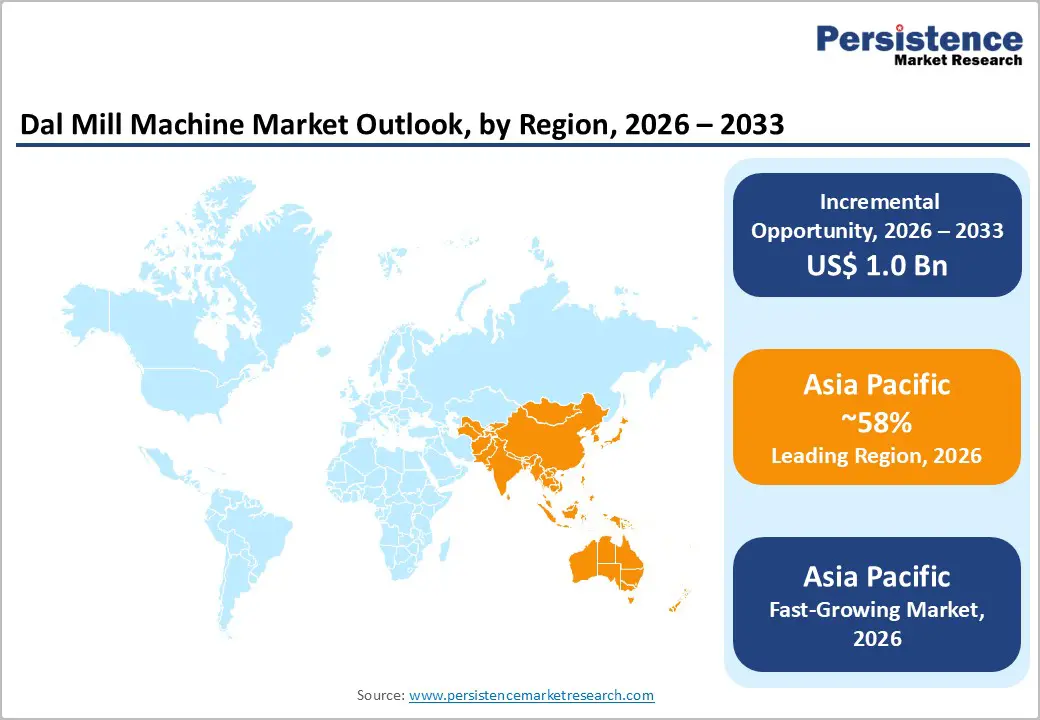
- Leading Region: Asia Pacific, accounting for a market share of 58% in 2026, driven by strong pulse production, manufacturing advantages, and favorable government initiatives.
- Fastest-growing Region: Asia Pacific, supported by strong domestic demand and favorable government support for food processing infrastructure.
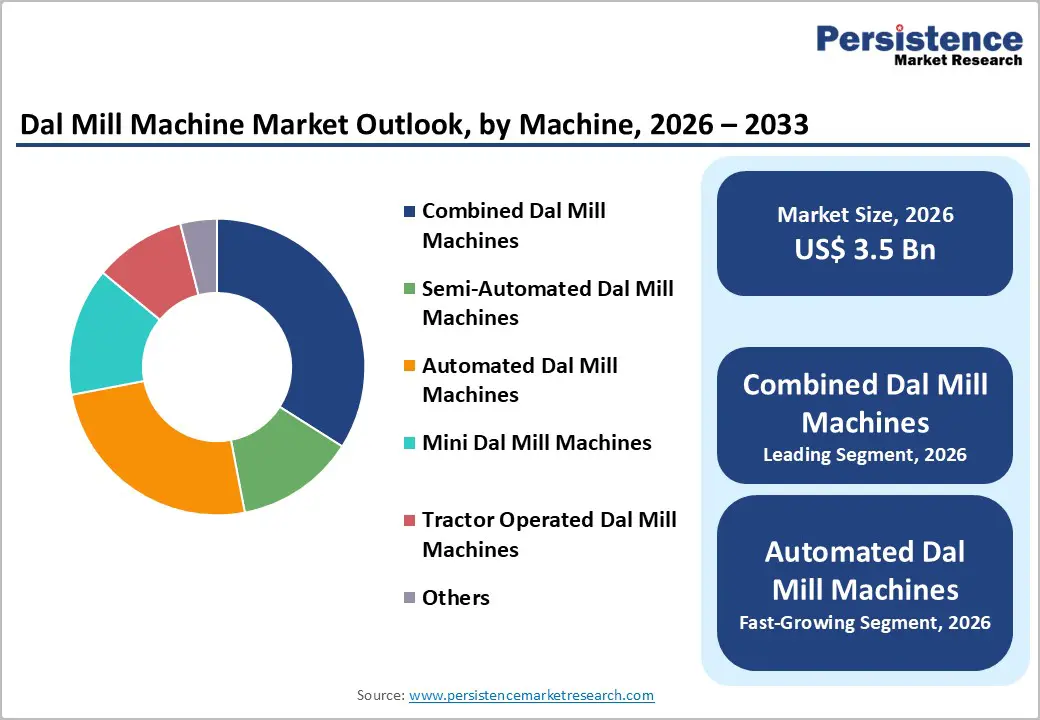
- Leading Machine Type: Combined dal mill machines, accounting for 41% of the revenue share, driven by their integrated multi-process functionality, higher operational efficiency, and strong adoption among medium-to-large pulse processing units.
- Leading Motor Power: The 7.5 HP segment, accounting for over 36% of the revenue share in 2026, supported by its optimal balance of processing capacity, energy efficiency, and suitability for small-to-medium scale dal mills.
| Key Insights | Details |
|---|---|
|
Dal Mill Machine Market Size (2026E) |
US$3.5 Bn |
|
Market Value Forecast (2033F) |
US$4.5 Bn |
|
Projected Growth (CAGR 2026 to 2033) |
3.7% |
|
Historical Market Growth (CAGR 2020 to 2025) |
3.5% |
Market Factors - Growth, Barriers, and Opportunity Analysis
Growth Analysis-Rising Demand for Processed Pulses and Nutritional Foods
Growing awareness of plant-based nutrition is significantly boosting demand for processed pulses, directly supporting the dal mill machine market. Pulses are widely recognized as affordable, protein-rich staples essential for food security, particularly in Asia and Africa. Rapid urbanization and changing consumption patterns have increased reliance on packaged, hygienically processed dal products. Organized retail expansion and e-commerce distribution channels strengthen demand for consistent quality and large-scale processing. As food manufacturers require uniform splitting, polishing, and grading standards, modern dal mill machinery becomes essential for meeting volume requirements and maintaining product quality across domestic and export markets.
Institutional buyers such as hotels, restaurants, and food processing companies are driving bulk demand for cleaned and graded pulses. Consumers increasingly prefer branded and ready-to-cook pulse products that ensure safety and convenience, pushing processors to upgrade machinery. Export-oriented markets also require strict quality compliance and traceability, encouraging the adoption of automated systems. Rising middle-class populations and improved purchasing power in emerging economies contribute to steady consumption growth.
Technological Advancements in Milling Efficiency and Automation
Modern machines integrate advanced dehusking mechanisms, precision grading systems, and automated polishing units that reduce breakage and enhance output quality. Energy-efficient motors and optimized airflow systems lower operational costs while maintaining higher throughput. Automation reduces manual intervention, minimizing errors and improving hygiene standards. Real-time monitoring features and improved material handling systems help processors maintain consistent performance. These advancements enable medium and large-scale mills to achieve better recovery rates, making investment in upgraded machinery increasingly attractive across pulse-producing regions.
Automation also supports scalability, allowing processors to expand capacity without proportionally increasing labor costs. Integrated control panels and digital monitoring systems provide operational transparency and maintenance efficiency. Equipment manufacturers are focusing on modular designs that simplify installation and upgrades. Enhanced durability and reduced downtime improve return on investment for mill owners. As food safety standards become stricter, technologically advanced dal mills ensure compliance and product uniformity.
Barrier Analysis - Skilled Labor Shortages in Rural Processing Hubs
A significant restraint in the dal mill machine market is the shortage of skilled labor in rural and semi-urban pulse processing hubs. Although automation is increasing, machine operation, calibration, and maintenance still require trained technicians. Many rural regions face gaps in technical training infrastructure, limiting the effective utilization of advanced milling systems. Improper handling and maintenance can reduce efficiency and increase downtime, discouraging small operators from investing in high-end machinery. Limited awareness about preventive maintenance practices affects machine lifespan, creating operational challenges that slow widespread adoption across emerging markets.
Migration of skilled workers to urban centers reduces the availability of experienced operators in agricultural regions. Training costs and time requirements add financial pressure on small-scale mill owners. Without adequate technical expertise, processors may rely on basic or semi-automated systems rather than fully automated solutions. This restricts productivity improvements and modernization efforts. Equipment suppliers often need to provide after-sales technical support, increasing service complexity.
Competition from Traditional and Manual Milling Practices
Many local processors rely on conventional methods due to lower upfront investment requirements and familiarity with established practices. Manual or semi-mechanized systems may appear cost-effective for small production volumes, limiting immediate adoption of advanced equipment. Cultural preferences and established supply chains also support traditional operations in certain regions. This competitive presence slows the pace of modernization, especially where capital access and financial support remain limited.
Small operators often hesitate to upgrade machinery due to concerns about return on investment and fluctuating pulse prices. Informal processing units may operate with minimal regulatory oversight, reducing pressure to adopt standardized equipment. In price-sensitive markets, traditional mills maintain competitiveness by offering lower-cost processing services. This dynamic creates pricing pressure for equipment manufacturers and slows penetration of automated systems. Expanding awareness about long-term efficiency gains and providing financing solutions are critical to encouraging the transition from traditional milling toward modern, productivity-enhancing dal mill machinery.
Opportunity Analysis - Policy-Driven Modernization and Export Oriented Growth
Many countries are prioritizing food security, value addition, and rural industrialization through subsidies, tax incentives, and capital assistance schemes. Policies encouraging the establishment of food processing clusters and integrated agro-industrial parks create favorable conditions for machinery demand. Export promotion programs drive modernization, as international markets require standardized, high-quality processed pulses. Compliance with hygiene and packaging regulations pushes processors to adopt advanced milling systems, expanding opportunities for equipment manufacturers.
Trade agreements and infrastructure development enhance cross-border pulse trade, supporting investment in higher-capacity processing units. Financial institutions increasingly provide credit-linked support for agro-machinery purchases, reducing entry barriers. Policy frameworks emphasizing local manufacturing also stimulate domestic production of dal mill machines, strengthening supply chains. Export-oriented growth strategies combined with supportive regulatory environments position the dal mill machine market for steady expansion in emerging and established pulse-producing regions.
Small-Scale Dal Mills Driven by Rural Entrepreneurship and Subsidies
Rising rural entrepreneurship is creating significant opportunities for small-scale dal mill installations. Government subsidy programs and micro-financing schemes encourage farmers and local entrepreneurs to establish processing units near cultivation areas. Decentralized milling reduces transportation costs and post-harvest losses while improving farmer income. Compact and mini dal mill machines are gaining popularity due to affordability and ease of operation. These systems empower rural communities to participate in value addition, strengthening local economies and supporting inclusive growth in agricultural regions.
Increasing awareness of agribusiness opportunities is motivating youth participation in agro-processing ventures. Skill development programs and startup incentives promote small-scale industrial activity in rural areas. Equipment manufacturers are responding with user-friendly, energy-efficient models designed for lower capacity operations. This segment benefits from growing domestic consumption and localized supply chains. Rural entrepreneurship expands, and financial support mechanisms remain accessible, small-scale dal mills will continue contributing to market growth, offering manufacturers a stable and scalable demand base across developing economies.
Category-wise Analysis
Machine Type Insights
Combined dal mill machines are expected to lead the dal mill machine market, accounting for approximately 41% of revenue in 2026, driven by integrated functionality, as these machines perform dehusking, splitting, polishing, and grading within a single system, reducing the need for multiple standalone units. This integration enhances operational efficiency, improves recovery rates, and ensures consistent output quality, making it highly suitable for medium and large-scale processing facilities. For example, large commercial dal mills in India widely adopt combined systems to streamline multi-stage processing while optimizing floor space and reducing operational complexity, reinforcing their strong market leadership.
Automated dal mill machines are likely to represent the fastest-growing segment, supported by rising labor costs and increasing demand for standardized processing. Automation enhances precision, reduces human intervention, and ensures uniform quality, which is critical for export-oriented processors. Advanced features such as digital control panels, automated feeding systems, and real-time monitoring improve productivity and hygiene compliance. For example, export-focused processing units upgrading to fully automated lines to meet strict quality standards illustrate how automation is accelerating growth in this segment across both domestic and international markets.
Motor Power Insights
The 7.5 HP category is projected to lead the market, capturing around 36% of the revenue share in 2026, supported by its strong suitability for small-to-medium scale dal mills. This motor capacity provides an optimal balance between processing efficiency and energy consumption, making it ideal for widespread use in regional processing hubs. Processors favor this rating because it delivers reliable performance without requiring large infrastructure investments. For example, many small and mid-sized dal milling units in Southeast Asia operate 7.5 HP machines to efficiently process staple pulses while ensuring cost-effective daily operations, strengthening their dominant market position.
The 10 HP motor category is likely to be the fastest-growing motor power, driven by expanding production capacities and export-oriented scaling. Higher motor power enables greater throughput and supports integration with automated processing lines, making it attractive for larger industrial setups. As processors aim to handle increased volumes and meet institutional demand, higher-capacity machines become essential. Growing modernization in agro-processing clusters contributes to this trend. For example, large commercial dal processors upgrading facilities to accommodate higher volume contracts often adopt 10 HP systems to improve productivity and operational efficiency, highlighting the segment’s accelerating growth trajectory.
Regional Insights
North America Dal Mill Machine Market Trends
North America is likely to be a significant market in 2026, driven by well-established food-processing infrastructure and evolving dietary trends favoring plant-based proteins and pulse consumption. The U.S. and Canada are key contributors to regional demand, driven by rising awareness of the health benefits of pulses and expanding use of lentils, chickpeas, and peas in packaged and gluten-free foods. For example, Bühler Group has been actively supplying high-efficiency pulse processing systems tailored to North American food manufacturers, enabling them to optimize output and maintain consistent product standards.
The market also benefits from strategic agricultural support programs that enhance local processing capacity and the modernization of equipment. Advanced dal mill machines with digital control systems and energy-efficient designs are gaining traction among industrial food processors aiming to reduce operational costs and improve throughput. Strong emphasis on sustainability and food innovation encourages upgrades to machines that support diversified pulse applications, including flour and snack ingredients.
Europe Dal Mill Machine Market Trends
Europe is also witnessing significant market growth, due to rising consumer interest in plant-based diets, sustainability, and strict food safety standards. The region accounts for a meaningful portion of the market as processors and food manufacturers increasingly focus on producing high-quality, nutritionally rich pulse products for both domestic consumption and export. For example, Ocrim S.p.A., a key European manufacturer, supplies a range of pulse dehulling, splitting, and polishing equipment across more than 50 countries, demonstrating the region’s focus on high-reliability solutions tailored to local and export markets.
Another trend shaping the European market is sustainability and innovation, where manufacturers and processors seek energy-efficient and environmentally responsible dal mill machines. With growing emphasis on reducing carbon footprints and adopting eco-friendly practices, European operators are prioritizing equipment that lowers energy consumption while maintaining throughput and product quality. Pulse consumption is rising due to healthy lifestyle trends, and this has translated into greater demand for machinery capable of processing diverse pulse varieties at consistent standards.
Asia Pacific Dal Mill Machine Market Trends
The Asia Pacific region is anticipated to be the leading region, accounting for a market share of 58% in 2026, driven by the region’s dominant position in pulse production and consumption. Mechanization in the pulse processing sector is being adopted more widely to improve efficiency, reduce manual labor, and enhance yield quality. For example, Deccan Farm Equipment has actively supplied tailored dal mill solutions across rural and semi-urban markets in India, offering machines that balance capacity with ease of operation for small and medium enterprises.
Another key trend in the Asia Pacific region is the influence of government initiatives and supportive policies that encourage agro-industrial modernization. Many nations are implementing subsidy programs, credit support, and infrastructure development schemes to promote the establishment of dal mill units near cultivation areas. This helps lower transportation costs for farmers while increasing local processing activities and creating more job opportunities. There is also increased interest from investors and equipment manufacturers in setting up greenfield projects and technology centers to serve growing demand.
Competitive Landscape
The global dal mill machine market exhibits a moderately fragmented structure, driven by the presence of numerous regional and international equipment manufacturers competing on technology, price, customization, and service capabilities. Major players vary from established names to specialized regional suppliers, with competition sharpened by rising demand for automated and energy-efficient milling solutions across diverse end-use sectors.
With key leaders including Buhler Group, SATAKE, Mill Master Machinery Private Limited, Zhengzhou Taizy Machinery Co., Ltd, and Alvan Blanch Development Company, the competitive landscape reflects a mix of high-tech enterprises and cost-competitive regional producers. These players compete through continuous product innovation, strategic partnerships, expanding distribution networks, and after-sales support services that strengthen customer relationships and build brand loyalty.
Key Industry Developments:
- In January 2026, Hi-Tech Agro Industries announced the launch of its advanced 7.5 HP Dal Mill Machine, strengthening its position in the high-capacity pulse processing equipment segment. The newly introduced machine, featured on leading B2B marketplace Aajjo, is designed to deliver efficient and continuous milling performance, capable of processing approximately 700-800 kg of pulses per hour. The equipment targets medium and large-scale dal processors seeking improved productivity, consistent grain splitting, and reduced processing losses.
- In May 2025, Taizy successfully shipped a T3-B maize grits milling machine to a corn processing company in Cape Verde, strengthening its footprint in the West African agro-processing market. The customer, engaged in producing maize grits and corn flour for the local food industry, invested in the equipment to enhance production efficiency and ensure uniform grit size and consistent product quality. The T3-B model, designed for durable and continuous operation, offers a processing capacity of around 400 kg per hour and is equipped with multiple motors and a cyclone system for efficient performance.
Companies Covered in Dal Mill Machine Market
- Zhengzhou Taizy Machinery Co., Ltd
- HiTech
- Rising Industries
- Mill Master Machinery Private Limited
- SATAKE
- Deccan Farm Equipments
- Puspak
- Buhler Group
- Alvan Blanch Development Company
- Laxmi En-Fab Pvt. Ltd.
- Forsberg Agritech
- Flour Tech Engineers Pvt. Ltd.
- Jas Enterprises
- Shri Viratra Engineering Pvt. Ltd.
Frequently Asked Questions
The global dal mill machine market is projected to reach US$3.5 billion in 2026.
The dal mill machine market is driven by the rising demand for processed pulses, increasing mechanization in agro-processing, and growing adoption of efficient and automated milling technologies.
The dal mill machine market is expected to grow at a CAGR of 3.7% from 2026 to 2033.
Key market opportunities lie in automation upgrades, government-supported agro-processing modernization, expansion of small-scale rural mills, and growing export demand for processed pulses.
Zhengzhou Taizy Machinery Co., Ltd, Taizy, HiTech, Rising Industries, Mill Master Machinery Private Limited, and Deccan Farm Equipments are the leading players.


