




- Healthcare
- Cryotherapy Spray Systems Market
Cryotherapy Spray Systems Market Size, Share, and Growth Forecast 2026 - 2033
Cryotherapy Spray Systems Market by Product Type (Portable Sprays, Stationary Sprays, Spray Kits, Others), by Application (Sports & Recovery, Pain Management, Skin Treatments, Others), by End User (Hospitals & Clinics, Sports Facilities / Gyms, Spas & Wellness Centers, Home Users), by Regional Analysis, 2026-2033

Market Overview
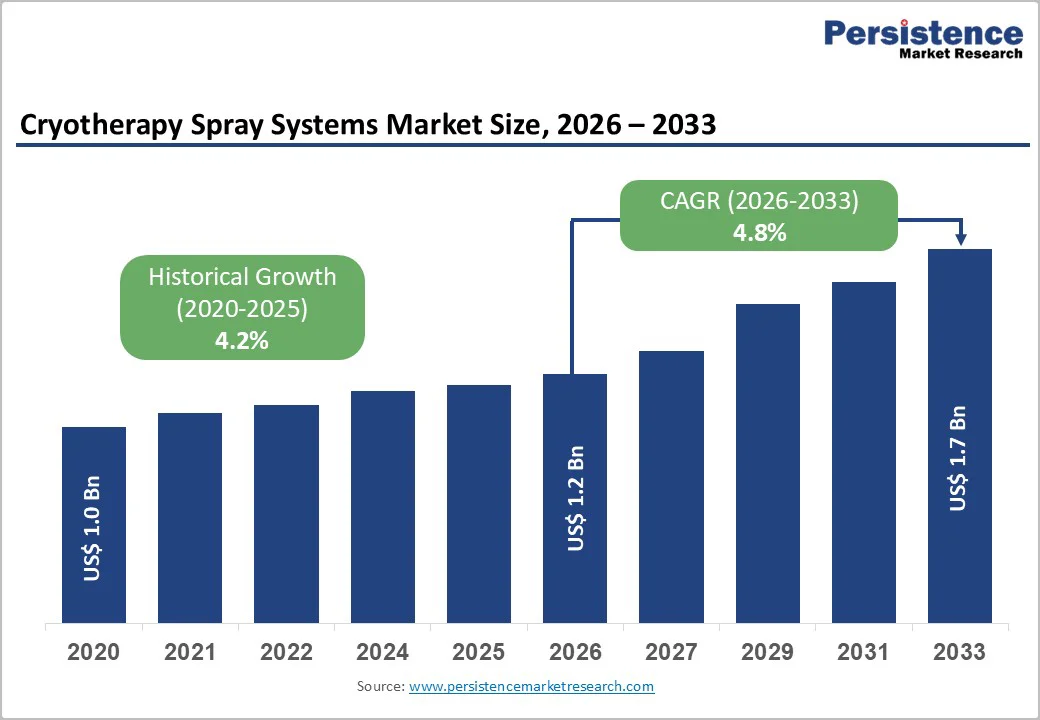
The global cryotherapy spray systems market size is expected to be valued at US$ 1.2 billion in 2026 and projected to reach US$ 1.7 billion by 2033, growing at a CAGR of 4.8% between 2026 and 2033.
Market expansion is fundamentally driven by escalating adoption of cryotherapy spray systems across sports medicine, pain management, and dermatological applications, offering non-invasive, rapid treatment solutions. The growing emphasis on athlete recovery and fitness optimization has substantially elevated demand for portable and stationary spray systems enabling immediate pain relief and reduced inflammation management. According to clinical research, whole-body and localized cryotherapy reduce delayed-onset muscle soreness in approximately 80% of treated athletes and improve perceived overall performance in 70% of users, thereby substantially supporting market expansion across professional sports, fitness facilities, and wellness centers. Technological advancements in spray delivery mechanisms, including portable cryosurgery devices that utilize medical-grade norflurane gas and advanced temperature control systems, continue to expand the application range and market accessibility across diverse geographic regions and customer segments.
Key Market Highlights
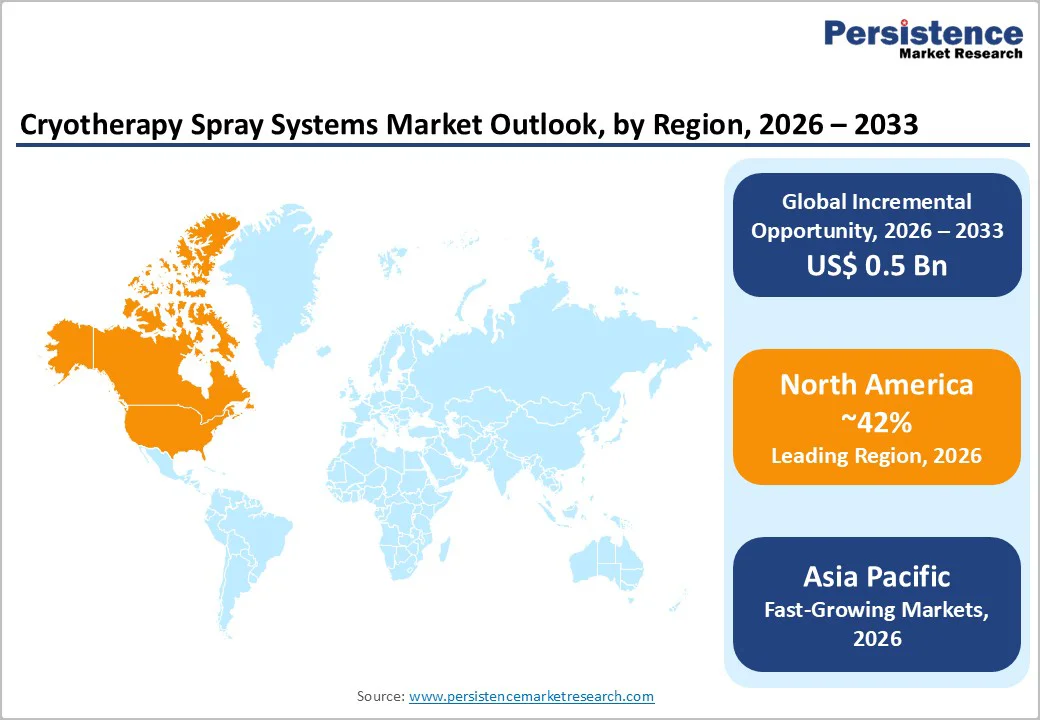
- Leading Region: North America leads the global cryotherapy spray systems market with approximately 42% share in 2025, supported by sophisticated healthcare infrastructure, extensive adoption in professional sports, and robust fitness facility penetration, driving continuous market expansion.
- Fastes-Growing Region: Asia Pacific is the fastest-growing region, expected to post approximately 5.6% CAGR through 2032, driven by healthcare infrastructure development, expanding sports medicine adoption, and emerging market demand for accessible treatment solutions.
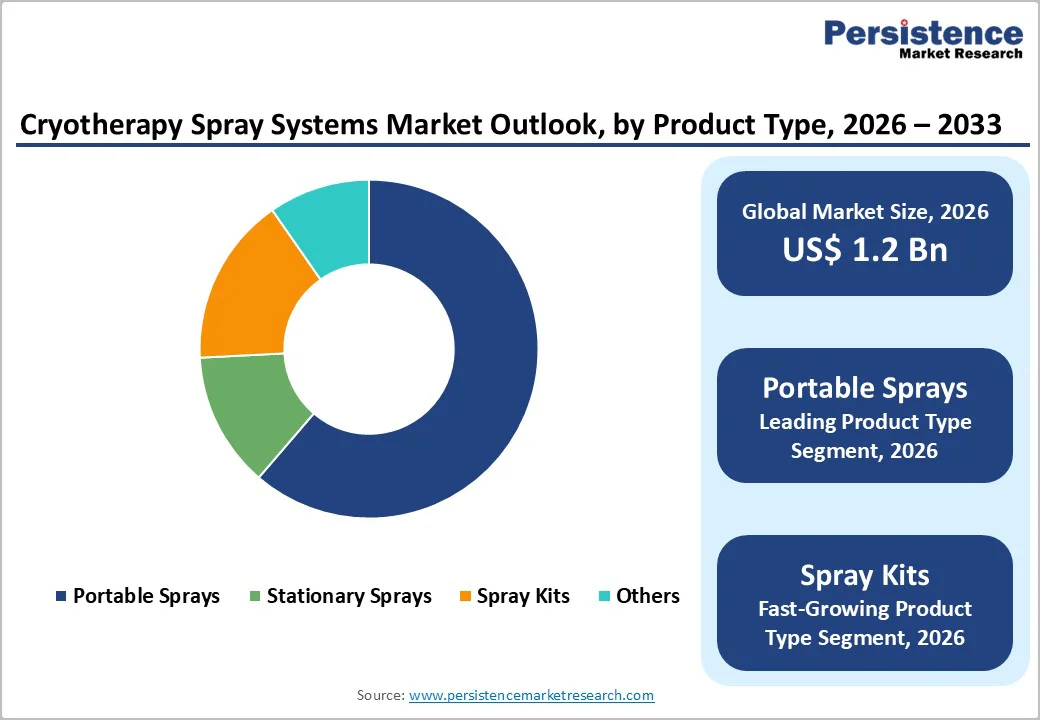
- Dominant Segment from Product Type: Portable Sprays dominate with roughly 57% share in 2025, reflecting widespread adoption across professional sports, athletic training facilities, and mobile healthcare applications requiring field-deployable treatment capabilities.
- Fastest Growing Segment from Product Type: Spray Kits is the fastest-growing segment, with estimated 6.9% CAGR (2025-2032), fueled by consumer demand for convenient home-based treatments and cost-effective solutions enabling broader market accessibility.
- Key Market Opportunity: Development of cost-effective portable spray kit solutions for home users and emerging market applications offers a significant opportunity for establishing competitive differentiation and expanding addressable market segments.
| Global Market Attributes | Key Insights |
|---|---|
| Cryotherapy Spray Systems Market Size (2026E) | US$ 1.2 billion |
| Market Value Forecast (2033F) | US$ 1.7 billion |
| Projected Growth CAGR (2026-2033) | 4.8% |
| Historical Market Growth (2020-2025) | 4.2% |
Market Dynamics
Market Growth Drivers
Escalating Adoption in Sports Medicine and Athletic Recovery Applications
The exponential growth in cryotherapy adoption within professional sports, collegiate athletics, and fitness facilities represents the most significant market growth driver for spray system expansion. According to sports medicine literature, athletic organizations increasingly integrate cryotherapy spray systems into training protocols, recognizing superior efficacy in reducing post-exercise muscle soreness, accelerating recovery timelines, and supporting injury prevention strategies. Professional sports teams across basketball, football, soccer, and hockey extensively deploy portable spray systems for immediate on-site treatment of acute injuries and muscle strains, as well as post-competition recovery. The Frontiers in Physiology publication documented that whole-body cryotherapy enhances anti-inflammatory barriers and accelerates recovery following intensive training, thereby supporting widespread adoption among elite athletes and coaching staff. Fitness facility operators increasingly recognize that cryotherapy spray systems differentiate premium wellness offerings, attracting performance-conscious consumers willing to invest in advanced recovery modalities. The evidence demonstrating rapid pain reduction, improved joint flexibility, and diminished re-injury risk supports sustained demand expansion across diverse athletic demographics.
Growing Emphasis on Non-Invasive Pain Management and Chronic Disease Treatment
The substantial clinical benefits of cryotherapy spray systems for pain management and inflammation reduction represent a transformational growth driver for market expansion. According to epidemiological data, musculoskeletal disorders affect approximately 30% of the European Union population, with over 60 million adults experiencing persistent back or neck pain and 63 million dealing with osteoarthritis. Healthcare systems increasingly recognize cryotherapy as a non-pharmacological, drug-free pain management approach addressing opioid dependency concerns while providing rapid relief for acute and chronic conditions. Clinical studies demonstrate that portable cryosurgery spray systems including Hydrozid portable devices deliver effective treatment with 47.4% complete lesion disappearance and 79.3% of patients achieving greater than 50% symptom reduction without requiring anesthesia or extensive post-treatment wound care. Healthcare providers are expanding adoption of cryotherapy for arthritis management, postoperative pain control, and soft-tissue injury treatment, substantially increasing institutional procurement of specialized spray systems. Government healthcare initiatives promoting innovative pain management solutions are driving expanded reimbursement coverage and facilitating market penetration across institutional healthcare settings.
Market Restraints
High Equipment Acquisition Costs and Maintenance Complexity
Cryotherapy spray systems require substantial capital investment in initial equipment acquisition, specialized installation infrastructure, and ongoing maintenance. Advanced portable and stationary spray systems command premium pricing, creating barriers to adoption for smaller clinics, independent sports facilities, and individual practitioners with limited capital budgets. The complexity of system maintenance, specialized refrigerant handling, safety compliance requirements, and technical expertise needs creates ongoing operational cost burdens, constraining widespread adoption among resource-constrained organizations. Regulatory requirements governing cryogen storage, handling, and disposal elevate operational complexity and costs for institutional users.
Limited Reimbursement Coverage and Inconsistent Regulatory Recognition
Cryotherapy spray system treatments face limited insurance reimbursement coverage in many geographic markets, creating financial barriers for patient access and constraining institutional procurement decisions. Regulatory recognition varies substantially across jurisdictions, with inconsistent FDA clearance status for specific indications limiting institutional adoption and clinical integration. The absence of standardized treatment protocols and outcome metrics across diverse applications creates clinical uncertainty regarding efficacy and safety, constraining mainstream medical adoption despite emerging clinical evidence supporting therapeutic benefits.
Market Opportunities
Development of Portable Spray Kits for Home and Professional Use
Significant growth opportunities exist for manufacturers developing user-friendly, cost-effective portable spray kit solutions optimized for home users, athletes, and independent practitioners. According to market analysis, spray kits are the fastest-growing product segment, with a CAGR of approximately 6.9% (2025-2032), driven by consumer demand for convenient, self-administered cryotherapy treatments and professional applications in mobile treatment settings. Manufacturers investing in compact, lightweight spray kits featuring simplified operation, integrated safety mechanisms, and comprehensive user education support can establish strong market positions across emerging consumer segments. The development of portable kits enabling personal injury management, home-based recovery protocols, and travel-friendly applications supports market expansion beyond institutional healthcare settings. Strategic marketing targeting individual athletes, fitness enthusiasts, and home healthcare users can rapidly expand addressable markets in high-growth consumer segments.
Expansion into Asian Markets and Emerging Healthcare Infrastructure Development
Substantial growth opportunities exist for cryotherapy spray manufacturers expanding distribution into rapidly developing Asia-Pacific markets, as healthcare infrastructure investment accelerates and sports medicine adoption grows. Regional analysis indicates that Asia-Pacific markets are experiencing a CAGR of approximately 5.6%, driven by expanding middle-class populations, rising sports participation, and government emphasis on advanced medical treatments. China’s sports industry expansion and India’s growing prevalence of musculoskeletal disorders create substantial demand for accessible cryotherapy treatment options. Manufacturers developing cost-optimized spray systems meeting Asian market requirements while maintaining quality standards can establish competitive positions, capturing emerging market demand. Strategic partnerships with regional healthcare providers, sports academies, and fitness facility operators facilitate market penetration in developing economies with expanding wellness infrastructure. Localization of treatment protocols and development of simplified operation training programs support rapid adoption in emerging markets requiring accessible, effective pain management solutions.
Category-wise Insights
Product Type Analysis
Within the product type category, portable sprays dominate the market with 57% market share in 2025, reflecting widespread adoption across professional sports teams, athletic training facilities, and mobile healthcare practitioners requiring field-deployable treatment capabilities. Portable spray systems offer exceptional flexibility, enabling immediate on-site treatment of acute injuries, muscle strains, and post-competition recovery without requiring specialized facility infrastructure. The lightweight design, user-friendly operation, and rapid treatment delivery support the dominance of portable spray across diverse athletic and clinical applications. Major manufacturers, including CoolTech, MediCryo, and Krione, have established market leadership through reliable portable system platforms supporting high-volume clinical deployment. The fastest-growing product type segment is Spray Kits, projected to grow at approximately 6.9% CAGR (2025-2032), driven by consumer demand for convenient home-based treatment options, emerging professional applications requiring multi-unit deployments, and cost-effective solutions that enable broader market accessibility.
Application Analysis
By application, Pain Management represents the leading segment, capturing approximately 46% market share in 2025, reflecting extensive adoption across healthcare institutions, rehabilitation clinics, and specialty pain management practices. Cryotherapy spray systems demonstrate substantial efficacy in reducing inflammatory pain associated with arthritis, musculoskeletal injuries, and post-operative conditions, supporting widespread clinical adoption. Healthcare providers increasingly recognize cryotherapy as a non-pharmacological pain management approach addressing opioid dependency concerns while providing rapid, safe relief. The fastest-growing application segment is Sports & Recovery, expected to grow at approximately 5.8% CAGR (2025-2032), driven by escalating adoption of professional sports, integration of fitness facilities, and consumer demand for advanced recovery modalities to optimize athletic performance.
Regional Insights
North America Cryotherapy Spray Systems Market Trends
North America commands approximately 42% global market share in 2025, supported by sophisticated healthcare infrastructure, extensive adoption within professional sports organizations, and robust cryotherapy facility penetration across fitness and wellness sectors. The United States represents the dominant market with substantial institutional adoption across NBA, NFL, MLB, and NHL professional sports teams integrating cryotherapy spray systems into athletic training programs. Major manufacturers including CoolTech, CryoInnovations, and Gronk Fitness Products maintain significant North American operations supporting continuous product innovation and market leadership.
North American regulatory frameworks including FDA clearance pathways for cryotherapy devices support institutional deployment and insurance reimbursement expansion. Clinical research demonstrating treatment efficacy across multiple indications is accelerating healthcare system integration and institutional procurement. The region’s emphasis on athlete performance optimization and wellness investment creates sustained demand for advanced cryotherapy spray technologies, supporting market expansion through professional sports adoption and consumer fitness trends.
Asia Pacific Cryotherapy Spray Systems Market Trends
Asia Pacific emerges as the fastest-growing regional market, projected to expand at approximately 5.6% CAGR (2025-2032), driven by healthcare infrastructure modernization, expanding adoption of sports medicine, and government emphasis on innovative medical treatments that support athletic development. China and India represent the largest regional markets, with accelerating disease prevalence, growing healthcare investment, and expanding sports industry. According to regional analysis, government-backed sports development programs are driving the adoption of cryotherapy in athletic academies and training centers across China, creating substantial demand for accessible spray systems.
Manufacturing capabilities across Asia-Pacific support cost-effective spray system production, with companies establishing strong regional market positions through localized operations. The rapid expansion of fitness facilities, wellness centers, and sports recovery establishments throughout the region creates substantial addressable markets for accessible cryotherapy solutions. Strategic localization efforts, development of simplified operational training programs, and pricing strategies aligned with emerging market requirements facilitate accelerated regional market penetration.
Competitive Landscape
Market Structure Analysis
The global cryotherapy spray systems market exhibits moderate fragmentation among specialized device manufacturers and emerging wellness technology companies competing through differentiated product offerings and application focus. Key differentiators include clinical evidence demonstration, ease of operation, treatment time efficiency, and pricing strategies aligned with diverse customer segments. The market increasingly recognizes value in portable systems offering field-deployable capabilities and home-user accessibility supporting competitive positioning across diverse end-user categories.
Key Market Developments
- In September 2024, CSA Medical raised $53 million in Series D equity financing to advance the commercialisation of its RejuvenAir cryotherapy system for the treatment of chronic bronchitis. The proceeds were intended to support the US Food and Drug Administration (FDA) premarket approval (PMA) process and fund the company’s commercialisation strategy for the US launch of the RejuvenAir system.
Companies Covered in Cryotherapy Spray Systems Market
• Gronk Fitness Products
• CoolTech
• MediCryo
• Krione
• Cryo Innovations
• CryoSkin
• Celerity
• Body Frost
• Cold Rush
• Zeal Wellness
• CryoConcepts LP
• Brymill Cryogenic Systems
Frequently Asked Questions
The global Cryotherapy Spray Systems Market is projected to reach US$ 1.2 billion in 2026, up from US$ 1.0 billion in 2020, with expansion driven by escalating adoption in sports medicine and athletic recovery, growing emphasis on non-invasive pain management solutions, and technological advancement in portable spray delivery systems.
Key demand drivers include escalating adoption in professional sports organizations and fitness facilities recognizing superior efficacy in reducing muscle soreness and accelerating recovery, growing healthcare system emphasis on non-pharmacological pain management approaches addressing opioid dependency concerns, and technological advancement in portable spray systems enabling field-deployable clinical applications across diverse therapeutic domains.
North America currently leads with approximately 42% market share in 2025, supported by sophisticated healthcare infrastructure, extensive professional sports adoption across NBA, NFL, MLB, and NHL organizations, and robust cryotherapy facility penetration across fitness and wellness sectors.
Development of cost-effective portable spray kit solutions optimized for home users and emerging market applications represents the most attractive opportunity, with spray kits representing the fastest-growing product segment at approximately 6.9% CAGR, offering substantial revenue expansion potential.
Key players include Brymill Cryogenic Systems, CryoSkin, CoolTech, MediCryo, Krione, Cryo Innovations, Gebauer, Therabody, and Gronk Fitness Products, among others.


