




- Industrial Machinery
- Cotton Ginning Machine Market
Cotton Ginning Machine Market Size, Share, and Growth Forecast, 2026 - 2033
Cotton Ginning Machine Market by Feeding Type (Automatic, Manual), Product Type (Single Roller, Double Roller, Saw Ginning, Rotobar), Plant Capacity (Small Scale, Medium Scale, Large Scale), and Regional Analysis for 2026 - 2033

Cotton Ginning Machine Market Size and Trends Analysis
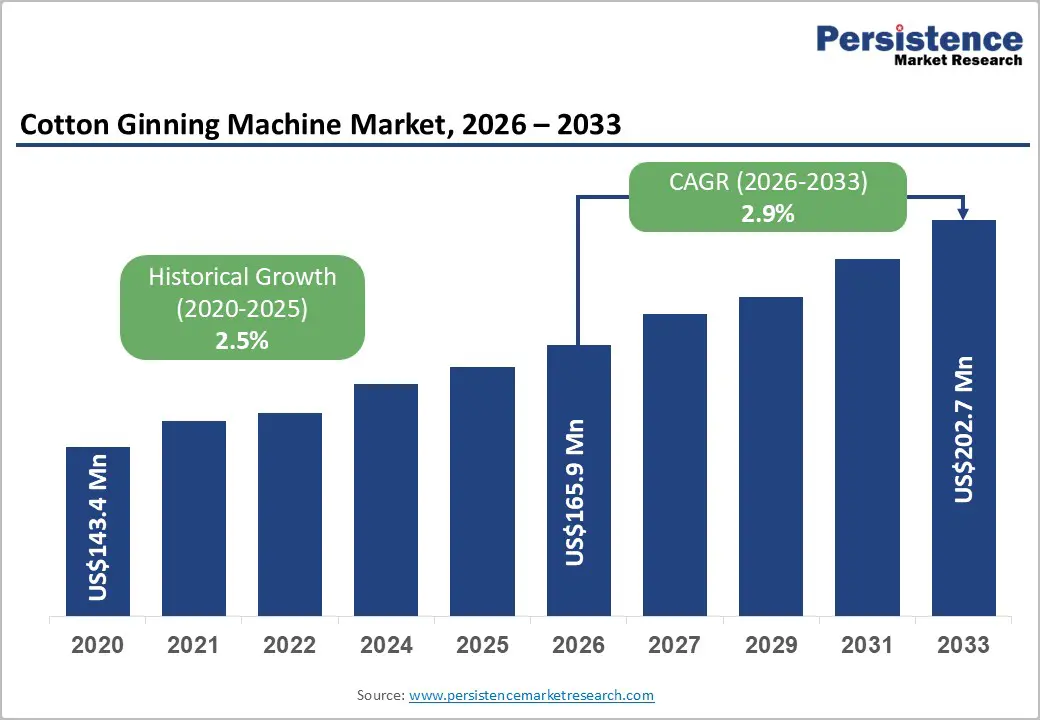
The global cotton ginning machine market size is likely to be valued at US$165.9 million in 2026, and is expected to reach US$202.7 million by 2033, growing at a CAGR of 2.9% during the forecast period from 2026 to 2033, driven by the increasing prevalence of mechanized cotton processing, rising demand for efficient fiber separation in major producing nations, and advancements in double roller and saw ginning technologies.
Growing demand for high-capacity, low-maintenance cotton ginning machines, particularly automatic feeding systems and large-scale plants, is driving adoption globally. Advances in roller and saw designs are further boosting uptake by offering better fiber quality and yield. Growing recognition of cotton ginning machines as key value-adding tools in cotton supply chains further drives market growth.
Key Industry Highlights:
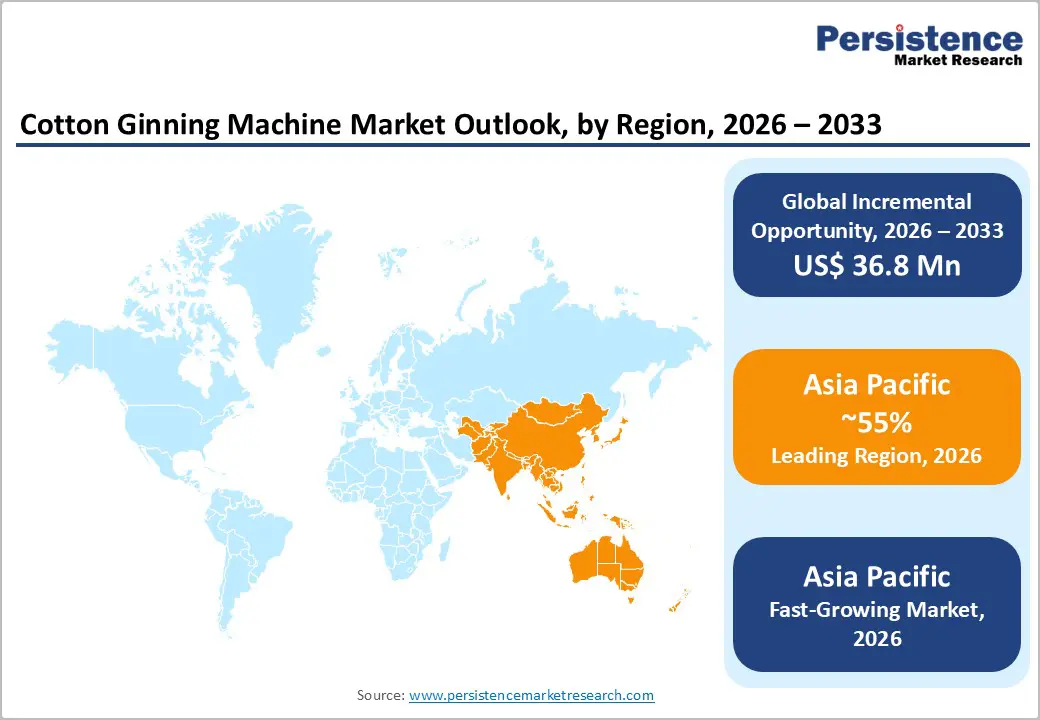
- Leading Region: Asia Pacific, anticipated to account for a 55% market share in 2026, driven by dominant cotton production, government mechanization subsidies, and high ginning demand in India and China.
- Fastest-growing Region: Asia Pacific, fueled by expanding textile industries, rising labor costs, and growing investments in modern ginning facilities.
- Dominant Feeding Type: Automatic, to hold approximately 60% of the market share, as it provides higher throughput and reduced labor dependency.
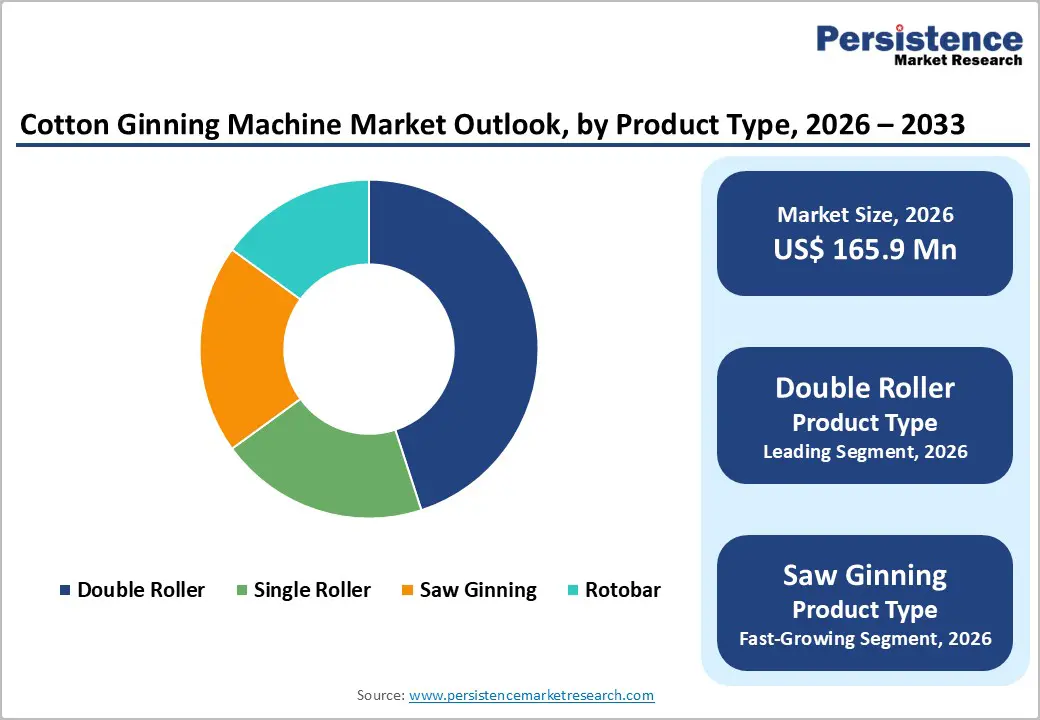
- Leading Product Type: Double roller, accounting for over 45% of market revenue, due to superior fiber quality and gentleness on seeds.
- Leading Plant Capacity: Large scale, to contribute nearly 40% of the market revenue, due to economies of scale in high-volume processing.
| Key Insights | Details |
|---|---|
|
Cotton Ginning Machine Market Size (2026E) |
US$165.9 Mn |
|
Market Value Forecast (2033F) |
US$202.7 Mn |
|
Projected Growth (CAGR 2026 to 2033) |
2.9% |
|
Historical Market Growth (CAGR 2020 to 2025) |
2.5% |
Market Factors - Growth, Barriers, and Opportunity Analysis
Rising of Mechanized Cotton Processing
The cotton ginning machine market is exhibiting steady growth, supported by compelling data and agricultural trends. Traditionally dependent on manual and semi-manual systems, cotton ginning has increasingly shifted toward mechanized operations to improve efficiency, consistency, and scalability. As global cotton production grows and textile manufacturers demand uniform fiber quality, ginneries are investing in modern, high-capacity machines that reduce contamination, minimize fiber damage, and enhance lint recovery.
Mechanized cotton processing enables faster throughput and better-quality control, which is critical for supplying large textile and apparel manufacturers. Government-backed modernization initiatives and private investments have accelerated this transition, particularly in major cotton-producing regions. For example, according to the U.S. Department of Agriculture (USDA), 14.1 million running bales were processed in U.S. cotton gins during the 2024 season, representing a 20 % increase compared to the previous season. This highlights the scale and efficiency of fully mechanized ginning operations in developed markets. Beyond productivity gains, mechanization also addresses labor shortages and rising rural wages while improving worker safety and environmental compliance. Automated feeding, cleaning, and lint separation systems reduce dependence on manual labor and enable continuous operations.
High Maintenance and Operating Costs
High development and maintenance costs present a significant barrier for companies advancing next-generation cotton ginning machines and novel systems. Developing innovative grades such as high-speed double roller, automated saw ginning, or energy-efficient rotobar requires extensive research, specialized steel components, and advanced automation technologies that are far more expensive than basic models. Durability is an even greater challenge: many refined variants, high-throughput lots, and low-lint products are sensitive to wear, dust, and vibration, requiring rigorous optimization to ensure they remain reliable throughout seasons. Achieving long-term performance often requires costly field trials, sophisticated testing, and high-grade bearings, significantly increasing R&D expenditures.
Rising energy prices directly increase production costs, reducing profit margins for ginners. Advanced machines also require skilled technicians for calibration, troubleshooting, and preventive maintenance. In many cotton-growing regions, the limited availability of trained personnel leads to higher labor costs or downtime when technical support is unavailable. Maintenance expenses further increase due to the need for dust control systems, safety mechanisms, and compliance with environmental and workplace regulations. These systems must be regularly monitored and serviced to ensure smooth operations and regulatory adherence.
Innovations in Automated and Energy-Efficient Delivery Platforms
Innovations in automated and energy-efficient cotton ginning machine delivery platforms are transforming the global cotton processing landscape by addressing two major challenges: labor dependency and energy consumption barriers. Automated platforms are engineered to achieve continuous feeding, reducing reliance on manual labor and enabling 24/7 operations in large plants. Innovations, such as sensor-based controls, AI lint monitoring, robotic cleaning, and variable speed drives, significantly improve throughput and reduce downtime, lowering operational costs for ginners and processing campaigns.
Progress in energy-efficient platforms, including low-power motors, heat recovery systems, eco-friendly lubrication, and modular designs, supports more sustainable ginning by minimizing electricity use, the industry’s first line of defense against rising costs. These formats eliminate waste heat, enhance longevity, and allow versatile use without frequent maintenance, making them highly suitable for mass production programs. New technologies such as solar integration, bio-adhesive components, and VLP-based monitoring further enhance sustainability and response.
Category-wise Analysis
Feeding Type Insights
The automatic segment is expected to dominate, accounting for approximately 60% of revenue in 2026. Its dominance is driven by labor savings, high throughput, and scalability, making it preferred for large-scale operations. Automatic feeding systems provide continuous operation, ensure consistency, and improve efficiency, making them suitable for large-scale ginning campaigns. Bajaj Steel Industries Ltd. further illustrates this trend by offering fully automatic ginning plants featuring automatic feeding, overflow handling, and conveyor systems that synchronize key process stages via PLC controls. These automated systems ensure uniform processing, minimize human error, and support year-round operations with reduced labor requirements, making them ideal for large ginning campaigns.
The manual segment is expected to be the fastest-growing segment, driven by its affordability and increasing adoption among small-scale farms. Its low-cost nature makes it well-suited for entry-level and targeted operations, helping reduce capital investment barriers. Ongoing improvements in ergonomic design are further enhancing usability and acceptance, supporting rapid adoption in emerging regions where demand for cost-effective cotton ginning solutions is rising. Small-model manual cotton ginning machines with saw teeth, commonly supplied by equipment manufacturers serving smallholder farmers, exemplify these budget-friendly, entry-level solutions. Priced well below automated systems, these machines enable small farms and cooperatives to separate cotton fibers from seeds without requiring significant capital investment or complex infrastructure, making them particularly attractive for rural operations with limited financial resources.
Product Type Insights
Double roller is anticipated to lead, holding approximately 45% of the revenue share in 2026, driven by superior fiber quality, low seed damage, and strong global demand in premium markets. Their dominance continues as buyers expand quality focus. The rising adoption of saw ginning and expanded rotobar campaigns highlights the growing focus on high-volume alternatives. Bajaj’s double roller gins are engineered with precision-machined rollers and components that gently separate fiber from seed while preserving staple length, a key quality parameter for high-value textile applications. Over 100,000 double roller ginning machines from Bajaj are reported to be in operation across India and international markets, reflecting strong global demand for this technology in quality-centric segments.
Saw ginning is expected to be the fastest-growing segment, supported by strong demand for high-throughput systems and their expanding adoption in industrial-scale operations. The industry’s shift toward faster processing platforms with higher capacity is accelerating adoption, while advancements in saw blade technology and the ongoing development of hybrid ginning models undergoing production trials are further contributing to market growth. Manufacturers such as Bajaj offer a wide range of saw ginning machines, including the 201 Saw Gin Cotton Ginning Machine, engineered for large-volume industrial processing. This model can produce up to 25 bales per hour, underscoring the significant capacity advantage of saw ginning systems over alternative ginning technologies. Equipped with precision-engineered saw blades and robust feeding mechanisms, these machines enable continuous, high-speed separation of cotton fiber from seed, making them well-suited for large ginneries and industrial facilities focused on maximizing throughput and operational efficiency.
Plant Capacity Insights
The large-scale segment is expected to dominate the market, contributing nearly 40% of revenue in 2026, due to remaining the primary hub for economies of scale, large processing programs, and the management of high-volume cotton, which requires advanced machines. Their strong integration, trained operators, and ability to handle high-capacity or automated blends drive higher consumption. Large-scale plants are leading automated rollouts and administering emerging hybrid trials. Karunanand specializes in fully automatic cotton ginning and pressing plants that are engineered for large-scale industrial operations, with processing capacities ranging from 50 to 500 tons of cotton per day. These turnkey solutions include integrated systems such as pre-cleaners, automatic feeders, lint cleaners, and PLC-controlled bale presses designed to maximize throughput, quality, and operational efficiency in commercial ginning facilities.
The medium-scale segment is expected to be the fastest-growing, driven by its balance of cost efficiency and increasing adoption among mid-sized farms. These systems offer convenient and scalable processing capacity, appealing to operators seeking flexible solutions without the high investment required for large-scale installations. Greater emphasis on modernization initiatives, expanded outreach programs, and improved availability of both standard and premium machine models are further accelerating adoption across developed and emerging regions. Manufacturers such as Bajaj Steel Industries offer cotton ginning machines with medium processing capacity, including the Bajaj 4 Tons Cotton Ginning Machine, well-suited for medium-scale operations. These machines deliver an optimal balance between throughput and affordability, making them ideal for regional processing centers and mid-sized farms that require higher capacity than small units but do not warrant the investment in large commercial systems.
Regional Insights
North America Cotton Ginning Machine Market Trends
North America’s market growth is driven by the region’s advanced agricultural infrastructure, strong R&D capabilities, and high awareness of efficiency benefits. Cotton processing systems in the U.S. and Canada provide extensive support for ginning programs, ensuring widespread access to both large-scale and automated cotton ginning machines. Rising demand for double-roller and easy-to-maintain models is further boosting adoption, as these designs enhance yield and address challenges posed by outdated equipment.
Technological innovations in cotton ginning machines, such as stable automatic feeding, optimized saw delivery, and targeted improvements in energy efficiency, are attracting substantial investment from both the public and private sectors. Government initiatives and farm modernization programs continue to encourage adoption to tackle labor shortages, improve fiber quality, and address sustainability concerns, sustaining long-term market demand. The increasing focus on medium-scale machines and specialty applications, including textile-specific uses, is broadening the range of end-user opportunities for cotton ginning equipment.
Europe Cotton Ginning Machine Market Trends
Europe’s market growth is supported by rising awareness of quality benefits, robust textile infrastructure, and government-led sustainability initiatives. Countries such as Germany, France, and the U.K. have well-established processing frameworks that facilitate routine ginning and promote the adoption of advanced cotton ginning machines. These efficient systems are particularly attractive to textile manufacturers, quality-focused operators, and export-oriented users, enhancing fiber yield and coverage rates.
Technological innovations in cotton ginning machines, such as improved double roller systems, application-specific delivery, and energy-efficient designs, are further strengthening market potential. European authorities are increasingly backing research and trials for both standard and specialized ginning requirements, boosting industry confidence. The growing focus on convenient and eco-friendly solutions aligns with the region’s emphasis on preventive processing and waste reduction. Public awareness campaigns and modernization programs are expanding adoption in both urban and rural areas, while suppliers continue to invest in automation and innovative machine models to improve operational efficiency.
Asia Pacific Cotton Ginning Machine Market Trends
Asia Pacific is anticipated to be the dominant and fastest-growing market for cotton ginning machines in 2026, driven by rising production awareness, increasing government initiatives, and expanding application programs across the region. Countries such as India, China, Pakistan, and Southeast Asian nations are actively promoting machine campaigns to address cotton growth and emerging textile needs. Cotton ginning machines are particularly attractive in these regions due to their scalable administration, ease of integration, and suitability for large-scale processing drives in both urban and rural populations.
Technological advancements are enabling the development of stable, effective, and easy-to-deploy cotton ginning machines that can withstand challenging climatic conditions and minimize dependence on downtime. These innovations are critical for reaching remote facilities and improving overall fiber coverage. Growing demand for double roller, saw ginning, and large-scale applications is contributing to market expansion. Public-private partnerships, increased agro expenditure, and rising investments in mechanization research and manufacturing capacity are further accelerating growth. The convenience of machine delivery, combined with improved yield and reduced risk of contamination, positions cotton ginning machines as a preferred choice.
Competitive Landscape
The global cotton ginning machine market features competition between established machinery leaders and emerging regional manufacturers. In North America and Europe, Lummus Corporation leads through strong R&D, distribution networks, and industry ties, bolstered by innovative saw gins and processing programs. In Asia Pacific, Bajaj Steel Industries Limited advances with localized solutions, enhancing accessibility. Automatic delivery boosts throughput, cuts labor risks, and enables mass integrations across regions. Strategic partnerships, collaborations, and acquisitions merge expertise, expand capacities, and speed commercialization. Energy-efficient formulations solve cost issues, aiding penetration in sustainable areas.
Key Industry Developments
- In April 2024, the U.S. Agricultural Research Service (ARS) announced the publication of a study that demonstrates the capability of gin waste to synthesize and produce silver nanoparticles in the presence of silver ions.
- In March 2024, Kirinyaga University, a public university in Kenya, announced the development of a portable cotton gin machine that can help farmers process their cotton on their farms and determine their prices.
- In January 2024, Shandong Swan Cotton Industrial Machinery, a China-based company that offers cotton processing machinery, including cotton ginning machines and lint cleaning machines, announced plans to introduce cotton picking machines and to develop assembly, training, and service facilities in Uzbekistan.
Companies Covered in Cotton Ginning Machine Market
- Bajaj Steel Industries Limited
- Lummus Corporation
- Apple Electroniks
- Balkan Cotton Gin Machinery
- Jadhao Gears Pvt. Ltd.
- Pramukh Steel Industries
- Nipha Exports Private Limited
- Handan Golden Lion Cotton Machinery Co., Ltd.
- Mitsun Engineering
- Bhagvati Engineering Works
Frequently Asked Questions
The global cotton ginning machine market is projected to reach US$165.9 million in 2026.
The rising prevalence of mechanized cotton processing and demand for efficient fiber separation are key drivers.
The cotton ginning machine market is poised to witness a CAGR of 2.9% from 2026 to 2033.
Advancements in automated and energy-efficient delivery platforms are the key opportunities.
Bajaj Steel Industries Limited, Lummus Corporation, Balkan Cotton Gin Machinery, Handan Golden Lion Cotton Machinery Co., Ltd., and Jadhao Gears Pvt. Ltd. are the key players.


