




- Bulk Chemicals
- Commodity Chemicals Market
Commodity Chemicals Market Size, Share, and Growth Forecast 2026 – 2033
Commodity Chemicals Market by Product Type (Petrochemicals, Polymers, Inorganic Chemicals, Organic Chemicals), End-user (Plastics & Rubber, Electronics and IT, Food and Beverages, Pharmaceuticals and Personal Care), and Regional Analysis, 2026 – 2033

Commodity Chemicals Market Size and Trends Analysis
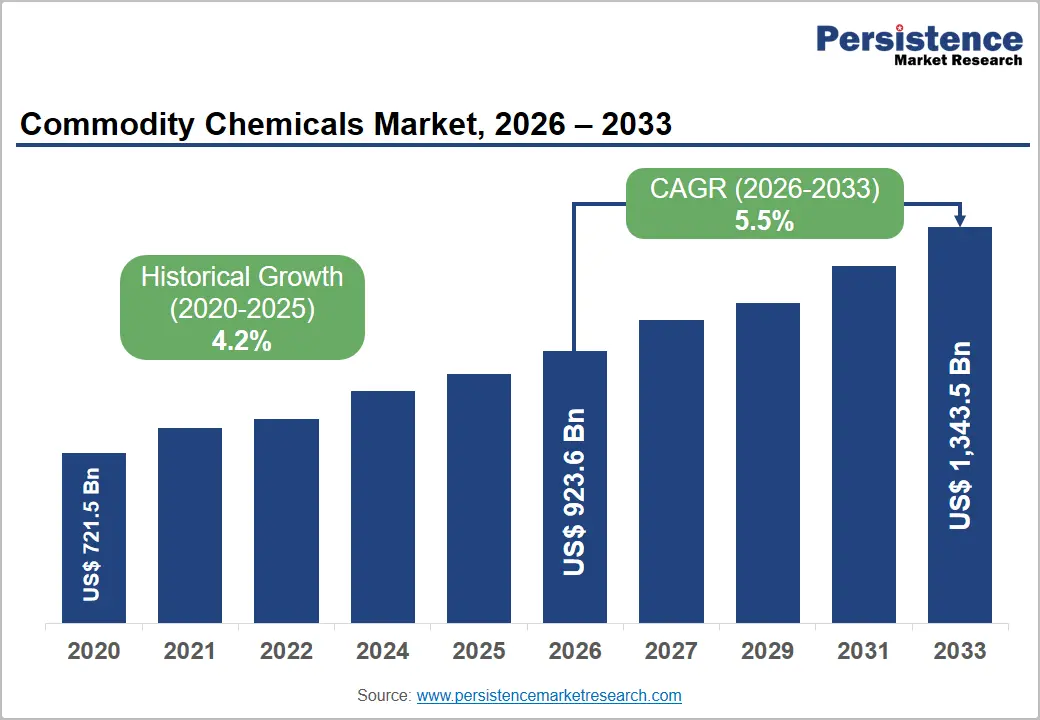
The global commodity chemicals market size is likely to be valued at US$923.6 billion in 2026 and is estimated to reach US$1,343.5 billion by 2033, growing at a CAGR of 5.5% during the forecast period from 2026 to 2033, driven by rising demand for petrochemical derivatives across packaging, construction, automotive, and consumer goods industries. Expanding industrialization in emerging economies and continuous investments in integrated refinery-petrochemical complexes are further supporting market growth.
Key Industry Highlights:
- Capacity Expansion: In November 2025, BASF commissioned the first production units at its integrated Verbund site in Zhanjiang, China, and initiated the operation of its steam cracker. The project represents one of the company's largest investments and is intended to strengthen the supply of essential commodity chemicals for the rapidly growing Asia Pacific manufacturing sector.
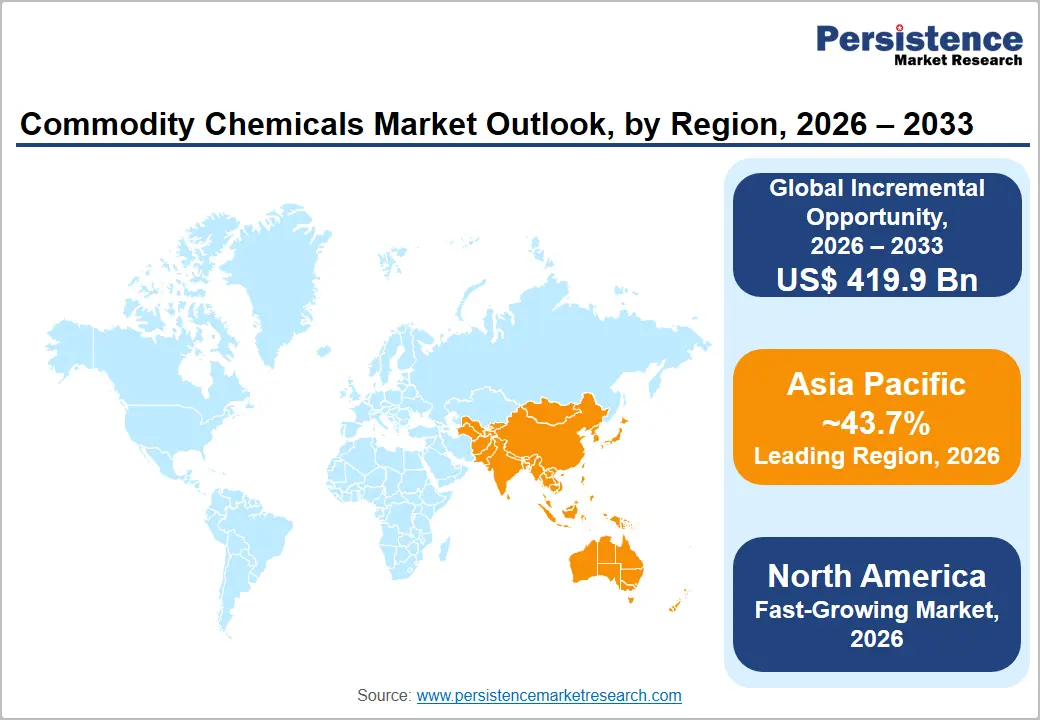
- Leading Region: Asia Pacific, with about a 43.7% share in 2026, backed by its large integrated manufacturing base and expanding petrochemical capacity.
- Fast-growing Region: North America, owing to abundant shale-based feedstock and investments in integrated petrochemical facilities.
- Leading Product Type: Petrochemicals, approximately 37.6% share in 2026, as they serve as essential raw materials for producing plastics, synthetic rubber, and fertilizers.
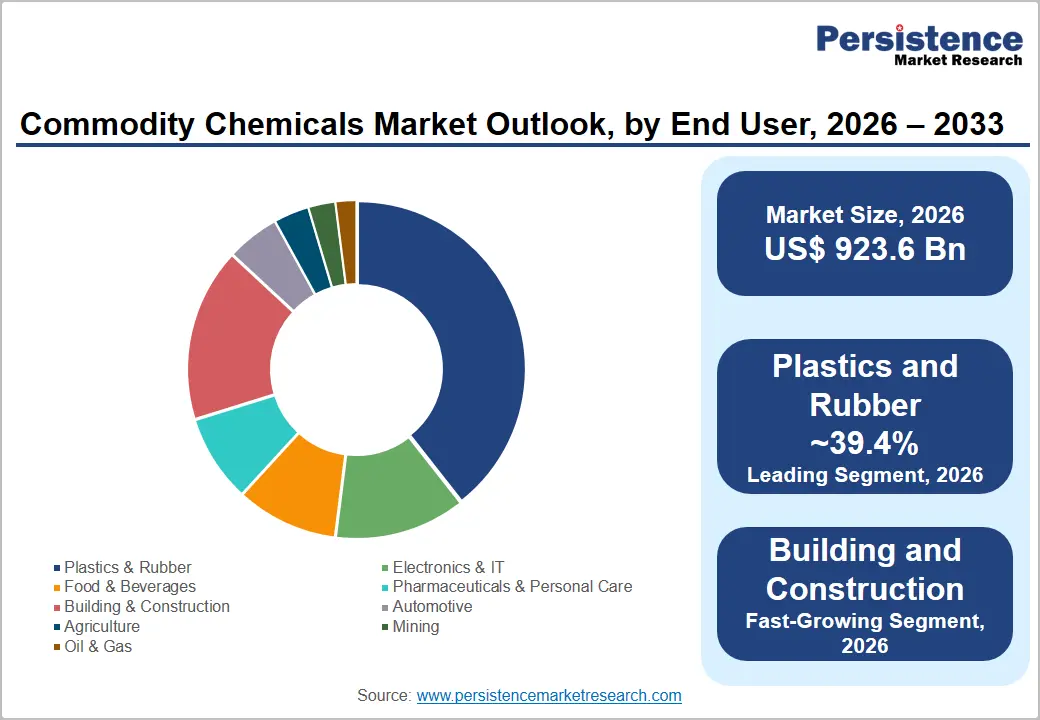
- Dominant End-user: Plastics & rubber, 39.4% share in 2026, as they consume large volumes of commodity chemicals to manufacture products used across packaging and automotive industries.
DRO Analysis
Driver - Increasing Government Investments in Infrastructure Development
Commodity chemicals, particularly Polyvinyl Chloride (PVC), Polyethylene (PE), and polypropylene (PP), are key material inputs for large infrastructure projects. They are used in piping systems, cable insulation, waterproofing membranes, concrete additives, and window profiles. According to the U.S. Geological Survey's (USGS) Mineral Commodity Summaries 2025, U.S. cement shipments in 2024 were estimated at 110 million tons with a projected value of US$17 billion.
Nearly 43% of public construction spending was propelled by roads and bridges, sectors actively supported by ongoing disbursements from the Bipartisan Infrastructure Law and the Inflation Reduction Act. Demand is also emerging at the project level. Between January and September 2025, several companies announced investments in U.S. production capacity, led by electronics, pharmaceuticals, and semiconductors. These industries require significant volumes of commodity plastics in construction, cleanroom builds, and packaging. As public infrastructure spending continues to be disbursed and large industrial facilities are built, construction-grade chemical demand will likely remain structurally high.
High Demand for Fertilizers with Surging Crop Production Requirements
Nitrogen, phosphate, and potash fertilizers are commodity chemicals whose demand is tied to cultivated land area and crop yield targets. According to the FAO Statistical Yearbook 2024, inorganic fertilizers used in agriculture reached 185 million tons of nutrients in 2022, with 58% being nitrogen, representing an increase of 37% compared to 2000. Forward projections indicate continued expansion. According to the joint OECD-FAO Agricultural Outlook 2025-2034, global agricultural and fish production is projected to expand by 14% over the next decade.
It is expected to occur primarily through productivity gains enabled by more intensive use of fertilizers in middle-income countries, especially in Africa and South Asia. According to the International Fertilizer Association's (IFA) Short-Term Fertilizer Outlook 2024-2025, global fertilizer consumption is anticipated to reach over 200 million tons of nitrogen, phosphate, and potash combined by 2025, four percent higher than 2023 levels. Growth is expected to be driven by growth in India, Qatar, Saudi Arabia, and the United Arab Emirates. This rising demand base makes basic nitrogen and phosphate chemicals a consistent volume driver for the commodity chemicals sector.
Restraint - Chronic Oversupply May Turn Commodity Chemicals into a Buyer's Market
As commodity chemicals are undifferentiated by nature, producers compete primarily on price. When capacity exceeds demand, prices and margins collapse generally across the entire market simultaneously. The downstream consequences are equally stark. According to Coface's sector risk assessment, the global chemicals industry's capacity utilization fell below 75% among leading producers, with weak demand combined with persistent oversupply hitting basic chemicals hardest.
It is a situation worsened by increasing capacity expansion across China, which now represents close to 50% of global production in key commodities such as acrylic acid, benzene, propylene, and soda ash. Between January and December 2025, prices for ethylene, propylene, butadiene, and methanol declined drastically. The decline was driven by weak global demand and ongoing oversupply, leaving producers unable to recover margins even as feedstock costs fell.
Opportunity - Green Ammonia Contracts to Open a Market for Low-Carbon Chemicals
The commodity chemicals sector is intersecting with the clean energy transition, and ammonia is where that intersection is most commercially advanced. In March 2026, Reliance Industries Limited (RIL) signed a binding 15-year Supply and Purchase Agreement (SPA) with Samsung C&T Corporation of South Korea to supply green ammonia, valued at over US$3 billion and ranked among the largest long-term green ammonia offtake agreements globally.
The ammonia will be produced at RIL's Dhirubhai Ambani Green Energy Giga Complex in Jamnagar, India. It is an integrated hub covering solar manufacturing, battery storage, electrolyzers, and green hydrogen production. RIL aims to achieve a green hydrogen production capacity of three million tons per annum by 2032, which would represent 60% of India's 2030 national target. This deal shows that the market for green commodity chemicals is transitioning from pilot-scale to billion-dollar commercial contracts.
AI to Reduce the Time and Cost of Chemical Process Optimization
Optimizing reaction conditions for a new chemical process traditionally required hundreds of laboratory experiments and months of iterative development. AI-based optimization is reducing this timeline significantly. A November 2025 paper published in the Beilstein Journal of Organic Chemistry by researchers from Delft University and the École Polytechnique Fédérale de Lausanne (EPFL) confirmed that adaptive experimentation methods pushed by Bayesian optimization can simultaneously reduce the number of experiments, experimental time, and material consumed to reach the optimum of a chemical process. This helps in lowering development costs.
The same approach is being applied to biocatalysis. A September 2025 study published in Chemical Science (Royal Society of Chemistry) reported the first application of multiobjective Bayesian optimization to a biocatalytic reaction in a continuous flow reactor. It resulted in the development of a significantly improved process in just 31 hours of total experimental time. A 2025 review in Frontiers in Chemical Science and Engineering further confirmed that AI has imparted new opportunities to the modeling of chemical reaction processes in chemical engineering, particularly at the molecular and process scale. As AI tools move from academic validation into industrial deployment, they are anticipated to reduce research & development cycle times and production costs across commodity chemical manufacturing.
Category-wise Analysis
Product Type Insights
Petrochemicals are predicted to lead with a share of approximately 37.6% in 2026, as they serve as the basic building blocks for thousands of industrial and consumer products. Ethylene, propylene, benzene, methanol, and other petrochemicals are converted into plastics, synthetic rubber, fertilizers, detergents, paints, pharmaceuticals, textiles, medical devices, and electronic components. Very few alternative feedstocks can provide such a broad range of products at a comparable cost and scale.
Polymers (PE, PP, PVC, etc.) are estimated to be the fastest-growing over the forecast period, as they offer an excellent balance of low cost, durability, chemical resistance, and ease of processing. These polymers can be molded into packaging films, pipes, automotive parts, consumer goods, medical products, cables, and household appliances. Their versatility allows manufacturers to use the same material across multiple industries while keeping production costs low. This makes them difficult to replace on a large commercial scale.
End-user Insights
The plastics & rubber segment is anticipated to dominate with a share of nearly 39.4% in 2026, as most commodity chemicals are converted directly into polymer resins and synthetic elastomers. Chemicals such as ethylene, propylene, butadiene, styrene, and vinyl chloride are the primary raw materials for manufacturing polyethylene, polypropylene, PVC, polystyrene, and synthetic rubber. These materials are then supplied to industries such as packaging, automotive, healthcare, electronics, agriculture, and construction.
The building and construction segment is expected to remain in the second position in 2026, as it requires large volumes of commodity chemical-based materials that improve durability, energy efficiency, and installation speed. PVC pipes, insulation foams, polyethylene membranes, sealants, adhesives, coatings, and synthetic rubbers are widely used in residential, commercial, and industrial projects. Compared with traditional materials, these products deliver better corrosion resistance, lower maintenance needs, and longer service life.
Regional Insights
Asia Pacific Commodity Chemicals Market Trends
Asia Pacific is anticipated to lead in 2026 with a share of nearly 43.7%, as it combines large-scale production, high domestic demand, and integrated manufacturing hubs. China, India, Japan, South Korea, and Southeast Asian countries host thousands of downstream industries that consume commodity chemicals for plastics, automotive, electronics, textiles, packaging, and construction. This allows producers to manufacture and consume chemicals in the same region, reducing logistics costs and improving supply chain efficiency. IEA notes that Asia will remain the main driver of petrochemical demand and refining capacity expansion through the end of the decade.
China Commodity Chemicals Market Trends
China will likely lead in Asia Pacific in 2026 with a regional share of around 44.7%, as it has built the world's largest integrated chemical manufacturing base. The country has invested heavily in steam crackers, refinery-petrochemical integration, and downstream polymer production. These investments enable manufacturers to produce commodity chemicals at a lower cost while supplying domestic industries such as packaging, electronics, electric vehicles, renewable energy, and consumer goods. The IEA identifies China as one of the most prominent contributors to global petrochemical capacity additions.
India Commodity Chemicals Market Trends
In 2026, India is projected to account for a regional share of approximately 29.5%, as demand for commodity chemicals is increasing across construction, packaging, automobiles, pharmaceuticals, agriculture, and consumer goods. Government initiatives such as Make in India and production-linked manufacturing programs are encouraging domestic manufacturing, leading to high consumption of polymers, petrochemicals, and industrial chemicals. The Economic Survey 2025-26 highlights a steady increase in India's chemical and petrochemical production over the past decade.
North America Commodity Chemicals Market Trends
North America is projected to be the fastest-growing market during the forecast period, driven by its abundant natural gas and shale-derived ethane, which provide some of the lowest-cost feedstock for commodity chemical production. This cost advantage has encouraged continuous investment in ethylene, polyethylene, and derivative chemical plants. Growth is also supported by rising demand from the packaging, healthcare, automotive, and energy industries. Companies are now investing in low-carbon production technologies, including methane pyrolysis, carbon capture, and electrified chemical manufacturing, to improve long-term competitiveness while meeting sustainability targets.
U.S. Commodity Chemicals Market Trends
A share of nearly 63.2% is expected to be held by the U.S. in 2026, as it combines low-cost shale gas feedstock with advanced chemical infrastructure and continuous capital investment. Ethane produced from shale gas has significantly reduced production costs for ethylene and polyethylene, making U.S. producers highly competitive in global export markets. According to the IEA, the U.S. remains one of the leading contributors to global petrochemical capacity growth through ongoing investments in integrated production facilities.
Europe Commodity Chemicals Market Trends
Europe will likely see decent growth over the forecast period with a share of nearly 17.2% in 2026, backed by its increasing focus on high-value manufacturing, sustainable chemicals, and circular economy technologies. While energy costs have reduced the competitiveness of some basic chemical plants, domestic companies continue to invest in chemical recycling, bio-based feedstock, carbon capture, and low-carbon production processes. This shift is helping maintain demand for commodity chemicals in advanced manufacturing sectors such as automotive, healthcare, electronics, and renewable energy.
Germany Commodity Chemicals Market Trends
Germany will likely register a substantial share of approximately 39.7% in 2026, as it remains one of Europe's most prominent chemical producers. This is attributed to the country’s highly integrated industrial clusters, advanced engineering expertise, and close links with automotive, machinery, pharmaceutical, and manufacturing industries. Large chemical hubs such as Ludwigshafen enable efficient sharing of feedstock, energy, and utilities across multiple production units, improving operational efficiency and lowering production costs.
U.K. Commodity Chemicals Market Trends
A regional share of around 19.4% is predicted to be held by the U.K. in 2026, as it is undergoing a period of restructuring rather than steady expansion. High energy prices, increasing environmental compliance costs, and competition from low-cost imports have created pressure on domestic producers. Several manufacturers have announced operational reviews and workforce reductions to improve competitiveness. Despite these challenges, the government is supporting strategically important chemical assets. In late 2025, the U.K. announced funding to help preserve the country's remaining ethylene production capability at Grangemouth. This helped in recognizing its importance for healthcare, automotive, water treatment, and other downstream industries.
Competitive Landscape
The global commodity chemicals market is moderately consolidated at the top, with competition dominated by a limited number of integrated multinational producers. Hundreds of regional manufacturers compete in individual product categories and local markets. Competition is primarily driven by production expansion, feedstock availability, and manufacturing costs rather than product differentiation. Commodity chemicals such as ethylene, propylene, methanol, chlorine, caustic soda, and ammonia are largely standardized products, which limits product differentiation among manufacturers.
The industry is witnessing a shift in competitive leadership toward Asia and the Middle East, where companies benefit from lower-cost feedstock, government-backed investments, and continuous capacity expansion. Several manufacturers in Europe are restructuring operations due to high energy costs. Sustainability has become an important competitive differentiator. Instead of competing solely on price, leading producers are investing in chemical recycling, low-carbon production technologies, electrified crackers, renewable feedstock, and circular economy solutions. They aim to meet increasingly stringent environmental regulations and customer requirements.
Key Industry Developments:
- In November 2025, BASF and ExxonMobil signed a joint development agreement to advance methane pyrolysis technology for low-emission hydrogen production. The companies announced plans to build a demonstration plant in Baytown, Texas, to fuel commercialization of methane pyrolysis, which produces hydrogen and solid carbon without generating direct CO2 emissions during the process.
- In October 2025, BASF signed a binding agreement with Carlyle and Qatar Investment Authority to divest its automotive coatings and surface treatment businesses at an enterprise value of €7.7 billion (approximately US$8.7 billion). BASF stated that the transaction is part of its portfolio optimization strategy, allowing the company to increase its focus on core chemical operations while retaining a minority equity stake in the new coatings business.
- In October 2025, BASF and International Flavors & Fragrances (IFF) announced a strategic collaboration to develop next-generation enzyme and polymer technologies. The partnership combines BASF's chemical expertise with IFF's biotechnology platform to develop sustainable polymer-based solutions for industrial cleaning, fabric care, dishwashing, and personal care applications.
Companies Covered in Commodity Chemicals Market
- BASF SE
- Dow Chemical Company
- Eastman Chemical Company
- Ineos Group Limited
- LyondellBasell Industries
- SABIC
- Sinopec
- ExxonMobil Corporation
- Others
Frequently Asked Questions
The global commodity chemicals market is projected to be valued at US$923.6 billion in 2026.
The commodity chemicals market is expected to reach US$1,343.5 billion by 2033.
Key market trends include rising investments in sustainable chemicals and expansion of chemical recycling technologies.
Petrochemicals are expected to be the leading product type with a share of nearly 37.6% in 2026, owing to their extensive use as essential feedstock for producing several consumer products.
The market is expected to grow at a CAGR of 5.5% from 2026 to 2033.
BASF SE, Dow Chemical Company, and Eastman Chemical Company are a few key market players.


