




- Clothing, Footwear, & Accessories
- Cambodia & Myanmar Writing Instruments Market
Cambodia & Myanmar Writing Instruments Market Size, Share, Trends, Regional Forecasts 2026 - 2033
Cambodia & Myanmar Writing Instruments Market by Product Type (Pencil, Pen, Coloring Instruments, Highlighter & Markers, Others), End-user (Students, Independent Professionals, Institutions, Others), Sales Channel (Hypermarkets/Supermarkets, Specialty Stores, Multi-brand Stores, Online Retailers, Other Sales Channels), and Country Analysis from 2026 to 2033

Cambodia & Myanmar Writing Instruments Market Share and Trends Analysis
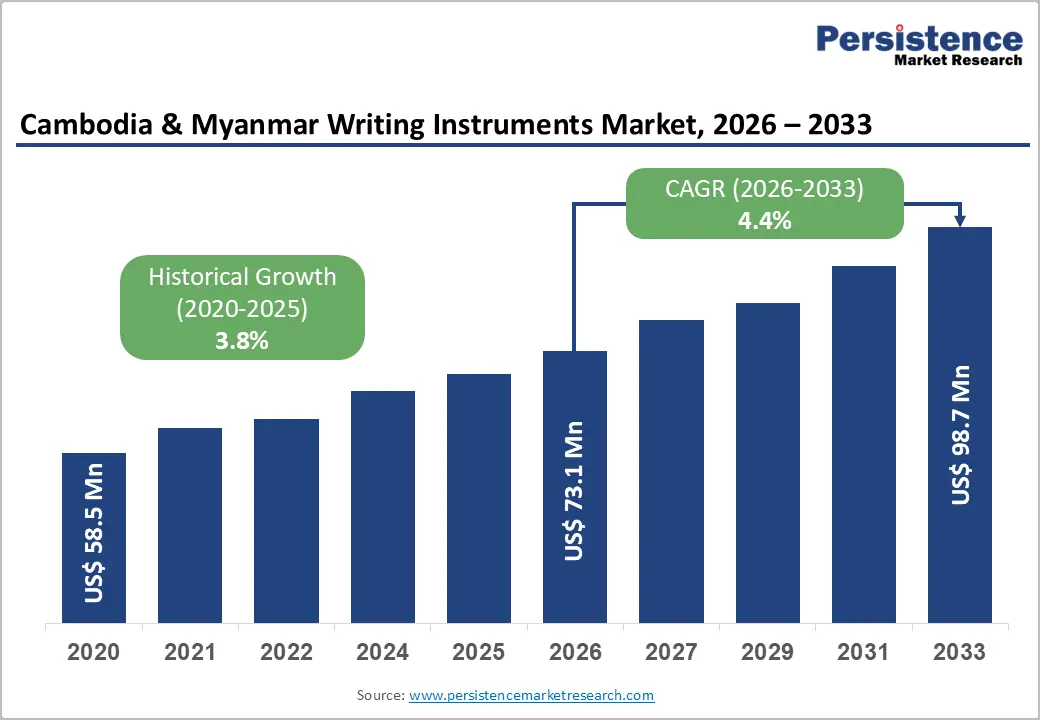
The cambodia & myanmar writing instruments market size is likely to be valued at US$ 73.1 million in 2026 and is projected to reach US$ 98.7 million by 2033, growing at a CAGR of 4.38% between 2026 and 2033.
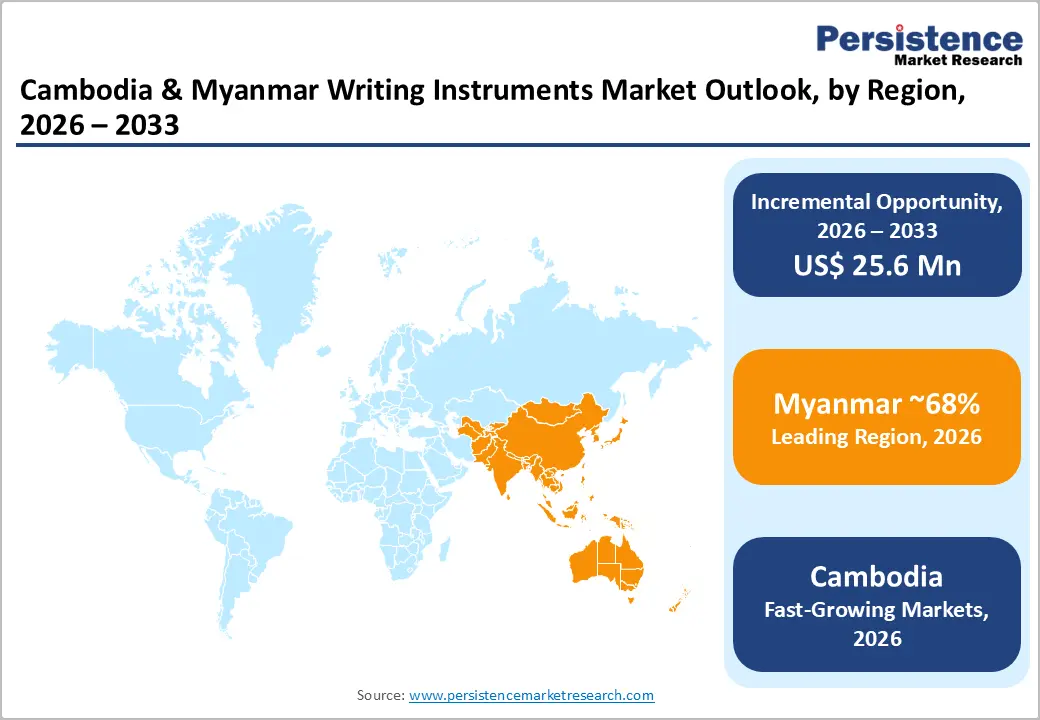
Market expansion is driven by rising educational enrollment and improvements in literacy rates, particularly in Cambodia, where Khmer-English bilingual literacy nearly doubled to 11.7%, supporting academic and professional development, and by systematic e-commerce channel development, with Cambodia's online retail market projected at US$ 1.81 billion by 2029. Myanmar maintains market dominance with a 68% regional share, driven by established commercial infrastructure and a significant student population, while Cambodia demonstrates accelerating growth momentum at a 4.8% CAGR, supported by urbanization and digital commerce adoption.
Key Industry Highlights:
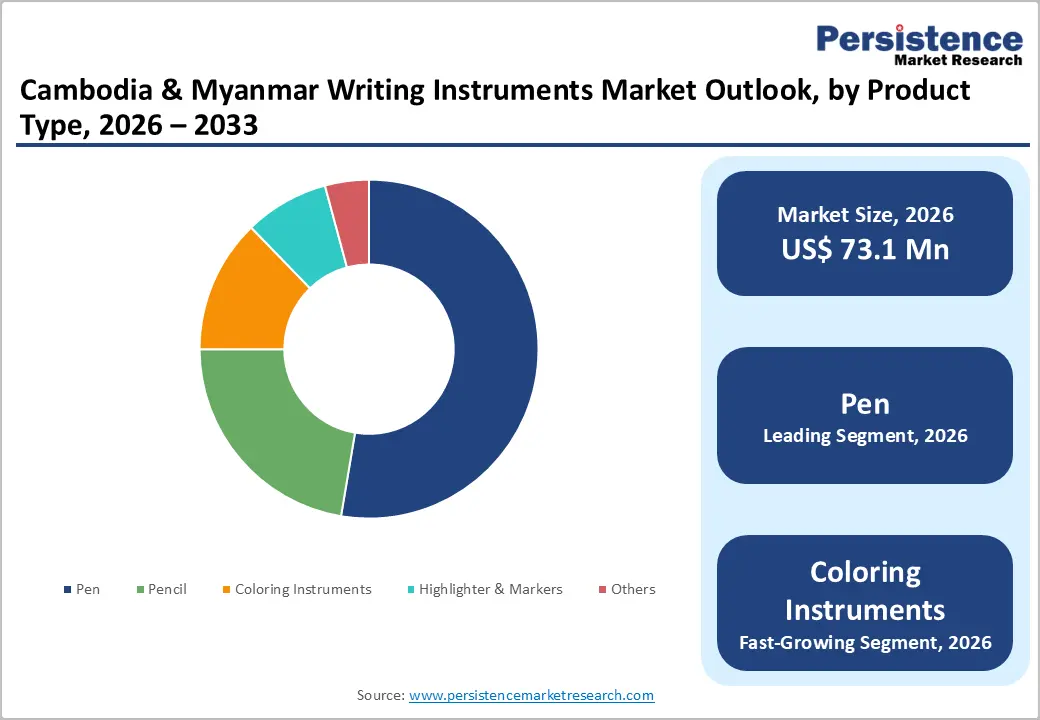
- Pens dominate with a 53% market share, while coloring instruments are the fastest-growing category, with a 4.2% CAGR, driven by creative education and e-commerce accessibility.
- Students account for 45% of demand, while independent professionals grow at a 4.5% CAGR, supported by workforce expansion and small-business formalization.
- Hypermarkets lead with 31% share, while online retail grows fastest at 5.2% CAGR, driven by e-commerce expansion and digital payments.
- Myanmar holds a 68% regional share, while Cambodia grows at a 4.8% CAGR, supported by literacy gains and digital commerce adoption.
- Staedtler, Faber-Castell, Pilot, and Pentel lead the market, focusing on e-commerce expansion, eco-friendly launches, and sustainability-led premium differentiation.
| Key Insights | Details |
|---|---|
| Cambodia & Myanmar Writing Instruments Market Size (2026E) | US$ 73.1 million |
| Market Value Forecast (2033F) | US$ 98.7 million |
| Projected Growth CAGR (2026 - 2033) | 4.4% |
| Historical Market Growth (2020 - 2025) | 3.8% |
Market Dynamics Analysis
Drivers - Rising Literacy Advancement and Bilingual Proficiency Supporting Professional Development
Significant literacy improvements, particularly in Cambodia, are creating expanded market opportunities for writing instruments, supporting educational attainment and professional communication across diverse demographic segments and regions. Cambodia’s Khmer literacy rate increased to 85.6% in 2024 from 80.4% in 2019, according to CIPS 2024, thereby expanding the literate population and household-level consumption of writing instruments. Khmer-English bilingual literacy rose sharply from 5.1% in 2019 to 11.7% in 2024, with urban areas reaching 16.8%, indicating growing demand for premium writing instruments used in professional communication and international business.
Secondary and postsecondary completion improved, with 7.5% completing a diploma or secondary program in 2024, up from 2.9% in 2019, thereby expanding the professional workforce. Vocational training growth supports demand for technical pens, markers, and precision instruments. Rising female literacy to 82.6% further broadens household educational purchasing across rural communities, youth populations, emerging professionals, and small enterprises nationwide.
Accelerating E-Commerce Digitalization and Online Retail Channel Expansion
E-commerce platform proliferation and digital payment advancements are transforming the distribution of writing instruments, expanding market access across emerging urban centers and remote areas previously limited by traditional retail. Cambodia’s e-commerce market reached USD 1.12 billion in 2024 and is projected to reach USD 1.81 billion by 2029, according to the Ministry of Commerce, creating strong online retail opportunities for writing instrument suppliers. Social commerce platforms such as Facebook and TikTok have reshaped sales and advertising, enabling small merchants to reach consumers directly and improve product accessibility.
Average online consumer spending of USD 11-50 per month supports repeat purchases of affordable pens, pencils, and markers aligned with household budgets. Rapid digital payment adoption and a tech-savvy youth population reduce transaction friction and support home delivery. Expanding smartphone penetration enables rural and semi-urban consumers broader access, while government initiatives such as the Cambodia
Restraints - Limited Consumer Purchasing Power and Price Sensitivity in Lower-Income Segments
The writing instruments market's expansion is constrained by limited household disposable income across large population segments, especially in rural areas, where cost sensitivity limits the adoption of premium products and favors basic alternatives. Cambodia’s average online consumer spending of USD 11-50 per month highlights affordability thresholds shaping pricing strategies for lower-income demographics. Rural-urban income disparities create geographic segmentation, with rural consumers prioritizing functionality over design or quality differentiation.
Education completion rates decline after age fifteen due to economic pressures that push youth into early workforce entry, reducing the student addressable market. Limited formal employment opportunities constrain professional workforce growth, suppressing demand for premium writing instruments.
Supply Chain Infrastructure Limitations and Logistics Complexity
The writing instruments market's development is constrained by an underdeveloped logistics infrastructure, inconsistent supply chain connectivity, and distribution limitations, particularly in rural regions and secondary urban centers, creating access barriers and operational inefficiencies. Cambodia e-commerce reports highlight insufficient logistics capacity and weak digital infrastructure as major challenges limiting reach beyond primary cities. Cross-border supply chain complexity and customs procedures between Cambodia and Myanmar create import delays, raising inventory risk and affecting product availability consistency.
Limited specialized handling infrastructure for fragile items such as gel pens and mechanical pencils increases damage risk and logistics costs. Underdeveloped rural distribution networks restrict secondary market availability.
Opportunity - Digital Infrastructure Modernization and Final-Mile Logistics Development
Supply chain modernization, including logistics network expansion and digital payment infrastructure advancement, represents a substantial market opportunity, with improved distribution efficiency enabling geographic market penetration into previously underserved regions, thereby accelerating market growth. Cambodia's projected e-commerce market expansion to USD 1.81 billion by 2029 supports logistics infrastructure investment, including warehousing, distribution centers, and last-mile delivery networks, enabling writing instruments accessibility across geographic regions.
Government e-commerce regulation development and the formalization of social commerce platforms create ecosystem supporting merchant professionalization and supply chain standardization. Advancements in technology infrastructure, including digital payment options and inventory management systems, enable small retailers and e-commerce merchants to optimize operations and expand product selection. Cross-border logistics optimization between Cambodia and Myanmar supported by ASEAN trade frameworks, enables regional supply chain consolidation and cost reduction supporting competitive market positioning.
Independent Professional Services Market Growth and Business Ecosystem Expansion
Independent professional and small business segment expansion represents an emerging market opportunity, with a growing professional workforce requiring specialized writing instruments supporting documentation, communication, and business operations, creating demand beyond traditional student-focused product categories. Cambodia's improving vocational training completion rate, with over 29,000 Technical Level 3 graduates, is creating an expanding professional workforce that requires workplace writing instruments and documentation tools.
Small business formalization and entrepreneurial activity, particularly in informal e-commerce and small retail operations, create workplace requirements for accounting records, inventory tracking, and business documentation. Healthcare and professional services sector expansion, including private practices and consultancy operations create specialized demand for medical writing instruments, technical documentation tools, and professional communication supplies.
Segmentation Analysis
Product Type Analysis
Pen products command approximately 53% of the Cambodia & Myanmar writing instruments market share, driven by versatility across educational and professional applications, diverse product variants including ball point, gel, roller, and fountain pens, supporting diverse consumer preferences and end-use applications. Ballpoint pens represent the primary commodity segment supporting student populations and cost-sensitive consumer preferences. Gel pens represent the premium segment appealing to style-conscious younger demographics and professional markets seeking superior writing quality and visual appeal.
Roller pens and fountain pens address premium market segments supporting professional correspondence and specialized applications, valuing writing instrument aesthetics and performance.
Coloring instruments, including markers, crayons, and specialty art supplies, represent the fastest-growing category, expanding at 4.2% CAGR driven by creative education initiatives and rising interest in arts and crafts. Emphasis on child development encourages household purchases, while digital fatigue supports traditional creativity. Expanding e-commerce availability improves product discovery, brand access, convenience, and adoption across households.
End-users Insights
The student population represents 45% of market demand, driven by primary, secondary, and tertiary educational enrollment, supporting systematic purchasing of writing instruments for classroom use and academic requirements across diverse educational institutions. Primary school enrollment at 96% creates fundamental demand for basic pens, pencils, and writing instruments. Secondary school participation creates demand for specialized writing instruments supporting advanced academic subjects and specialized learning requirements.
Higher education enrollment among a growing postsecondary population supports the adoption of premium writing instruments and specialized product requirements.
Independent professional and workforce segment expands at a 4.5% CAGR, driven by small-business formalization, growth in professional services, and rising freelance and entrepreneurial activity, increasing demand for workplace writing instruments. Healthcare professionals and consultants require tools for documentation and communication. Technical professionals use precision pens for design records, while accounting and financial professionals prefer high-quality instruments for client documentation and correspondence.
Sales Channel Insights
Hypermarkets and supermarket channels command approximately 31% of market share, driven by their wide geographic distribution across urban and semi-urban centers, and by convenient, integrated shopping that supports commodity writing instrument purchasing alongside other household goods. Large format retail providing convenient one-stop shopping supports impulse purchases and routine replenishment of writing instruments. Competitive pricing through bulk purchasing and volume discounts supports consumer price sensitivity and affordability. Established retail infrastructure and trusted brand presence supports consumer confidence in product quality and authenticity.
Online retail channels expand at 5.2% CAGR, driven by e-commerce growth, digital payment adoption, and preference for home delivery, improving accessibility and discovery. Formal platforms and social commerce enable convenient purchasing. Home delivery overcomes geographic barriers, while price comparison and promotions encourage digital adoption. Broader online availability of specialty and premium products attracts consumers beyond traditional retail.
Country Market Insights
Myanmar
Myanmar maintains market leadership commanding a dominant 68% regional market share, driven by established commercial infrastructure, significant student population, and systematic demand from educational institutions and government sector purchasing supporting sustained market activity and competitive vendor presence. Myanmar represents primary market serving as supply hub for broader Southeast Asia region due to manufacturing capabilities and established commercial networks.
Government education system supporting national literacy initiatives including compulsory schooling to age 15 creates systematic education sector demand. Urban commercial centers including Yangon and Mandalay represent concentration points for retail distribution and commercial activity supporting competitive vendor positioning.
Government education budget allocation and international organization support for educational modernization drive systematic equipment procurement requirements. Established commercial relationships and vendor infrastructure support consistent market supply and competitive pricing. Private school sector expansion supporting premium educational services creates demand for quality writing instruments differentiating private institutions and supporting premium product positioning.
Cambodia
Cambodia demonstrates considerable growth momentum at 4.8% CAGR, driven by rising literacy rates, education sector expansion, and accelerating e-commerce adoption supporting market accessibility and consumer reach expansion particularly among urban and semi-urban populations. Rising Khmer literacy and expanding bilingual literacy particularly in urban areas support educational achievement and professional development creating demand for writing instruments supporting communication requirements.
E-commerce platform proliferation and digital payment adoption enable market penetration into previously underserved markets supporting consumer accessibility and product availability expansion. Urban population concentration in Phnom Penh, Siem Reap, and secondary cities creates distribution hub opportunities enabling efficient market coverage.
Government education modernization initiatives and vocational training expansion supporting workforce development create institutional demand for writing instruments. Middle class expansion supporting rising disposable income enables consumer preference shift toward premium products and specialty offerings. Private school growth supporting premium educational services creates differentiated demand for quality writing instruments supporting private institution positioning and competitive differentiation.
Competitive Landscape
Market Structure
The Cambodia and Myanmar writing instruments market shows moderate consolidation, combining multinational brand leadership with emerging regional specialists. Global players such as Staedtler, Faber-Castell, Pilot, Pentel, and Newell Brands leverage distribution partnerships and brand equity. Japanese brands Zebra, Kokuyo, and Muji target premium niches. Local and private labels dominate value segments, sustaining fragmented competition across product categories and price tiers.
Strategic Developments
- In January 2025, BIC Group announced the acquisition of Paper Mate gel-pen assets from Newell Brands to expand regional market share, supporting gel pen category dominance and competitive positioning in Southeast Asian distribution networks, including Cambodia and Myanmar.
- In January 2025, Staedtler Group announced its Go Beyond growth strategy, emphasizing innovation, cost leadership, and market expansion in emerging Asia-Pacific markets, including Southeast Asia, targeting Cambodia and Myanmar student populations and institutional purchasing segments, supporting regional market penetration acceleration.
- In October 2024, Pilot Corporation announced a strategic partnership with Zebra Pen Corporation to co-develop an advanced gel ink formulation aimed at improving smear resistance and flow control across cross-brand retail channels, supporting premium gel pen segment expansion.
Business Strategies
Market leaders pursue premium positioning, emphasizing quality and design, expand distribution via hypermarkets and e-commerce, and develop sustainable products addressing evolving preferences. Omnichannel accessibility, portfolio diversification, and digital transformation dominate strategies. Regional players prioritize cost leadership and geographic penetration, while international brands focus on premium differentiation and higher-margin positioning.
Companies Covered in Cambodia & Myanmar Writing Instruments Market
- Staedtler
- Faber-Castell
- Pilot Corporation
- Pentel
- Newell Brands
- BIC
- Paper Mate
- Zebra
- Kokuyo
- Muji
- Maped
- Crayola
Frequently Asked Questions
The Cambodia & Myanmar Writing Instruments Market was valued at US$ 73.1 million in 2026 and is projected to reach US$ 98.7 million by 2033, driven by education growth, literacy improvements, Myanmar’s 68% share, and Cambodia’s 4.8% CAGR.
Market growth is driven by rising educational enrollment, expanding e-commerce and social commerce adoption, and improving literacy and bilingual proficiency supporting academic and professional writing needs.
The market is forecast to grow at a 4.4% CAGR from 2026 to 2033, with faster growth in coloring instruments, independent professionals, and online retail channels.
Key opportunities include logistics and digital infrastructure development, premium and eco-friendly product expansion, and growing demand from independent professionals and formalizing small businesses.
Major players include Staedtler, Faber-Castell, Pilot, Pentel, and Newell Brands, alongside regional leaders Zebra, Kokuyo, and Muji, focusing on e-commerce, sustainability, and social commerce strategies.


