




- Hardware & Software IT Services
- Building Information Modeling Market
Building Information Modeling Market Size, Share, and Growth Forecast, 2026 - 2033
Building Information Modeling Market by Component Type (Software, Cloud‑based/SaaS Platforms, Others), Application (Design & Pre‑Construction, Execution/Construction‑Phase BIM, Others), End‑user, Deployment, and Regional Analysis for 2026 - 2033

Building Information Modeling Market Size and Trends Analysis
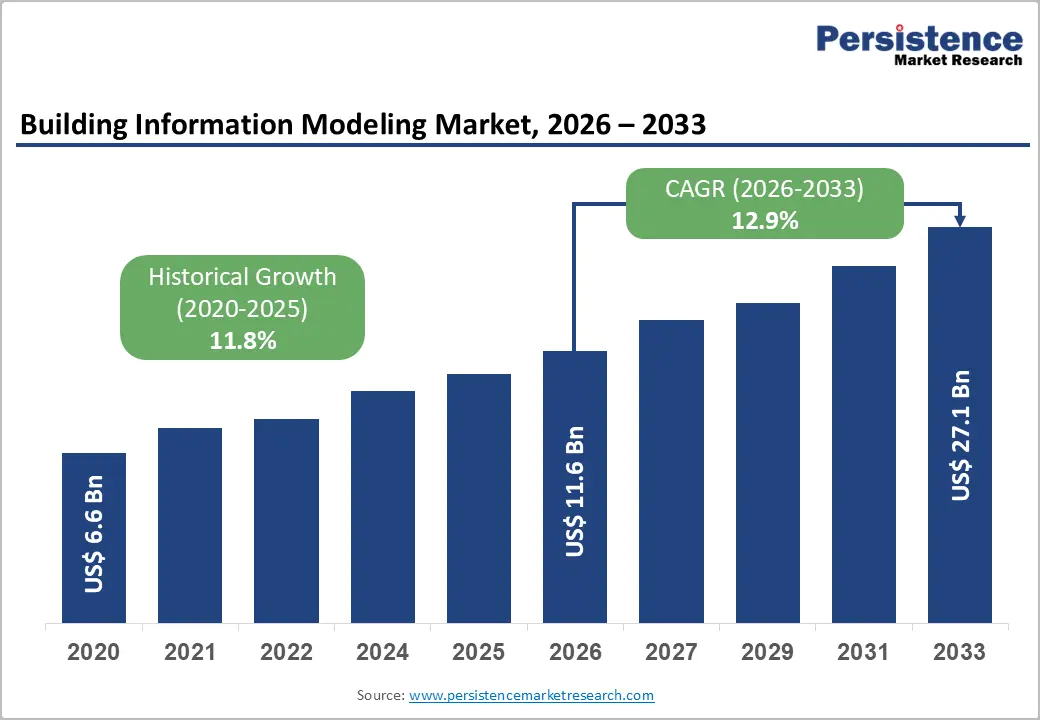
The global building information modeling market size is likely to be valued at US$11.6 billion in 2026 and is expected to reach US$27.1 billion by 2033, growing at a CAGR of 12.9% between 2026 and 2033, driven by the increasing adoption of digital project delivery solutions among construction, infrastructure, and facility management stakeholders to enhance project coordination, minimize rework, and improve asset lifecycle management.
The expansion of cloud-based collaboration platforms, AI-powered modeling capabilities, openBIM frameworks, and the growing integration of digital twin technologies across commercial and public infrastructure projects are further supporting market development. In addition, government regulations, sustainability initiatives, and the rising focus on operational efficiency are accelerating BIM implementation across both mature and developing economies.
Key Industry Highlights:
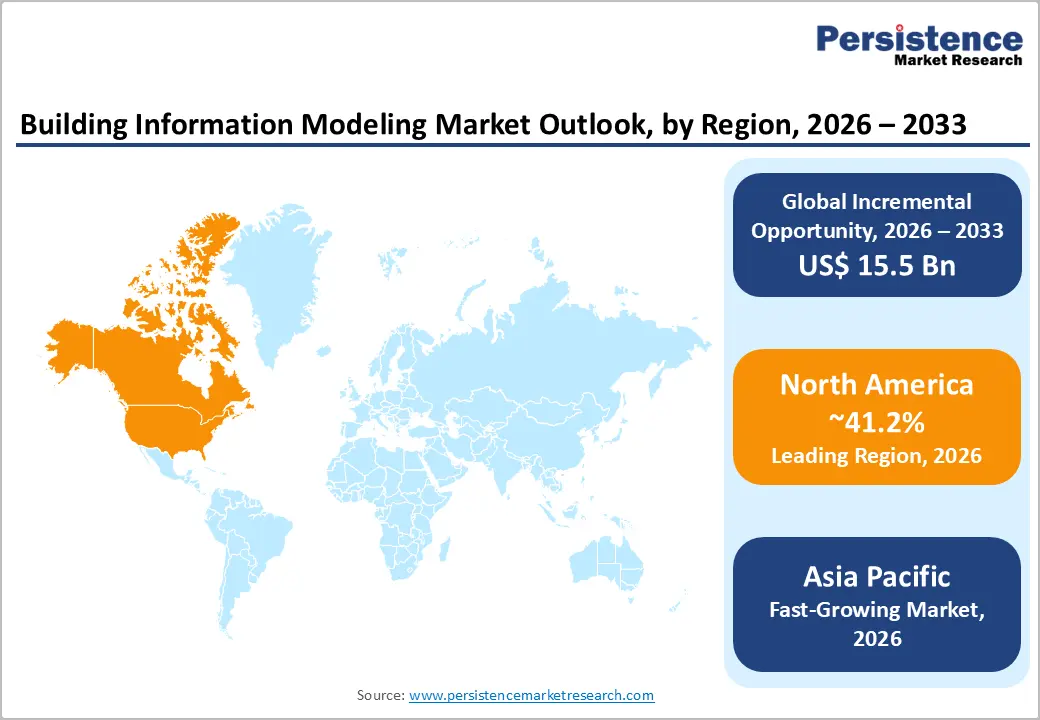
- Leading Region: North America is projected to lead the market with approximately 41.2% market share in 2026, supported by strong digital construction adoption, infrastructure modernization programs, and advanced cloud-based project delivery ecosystems.
- Fastest-growing Region: Asia Pacific is projected to be the fastest-growing regional market, due to rapid urbanization, smart-city investments, and transportation infrastructure development across China, India, Japan, and ASEAN economies.
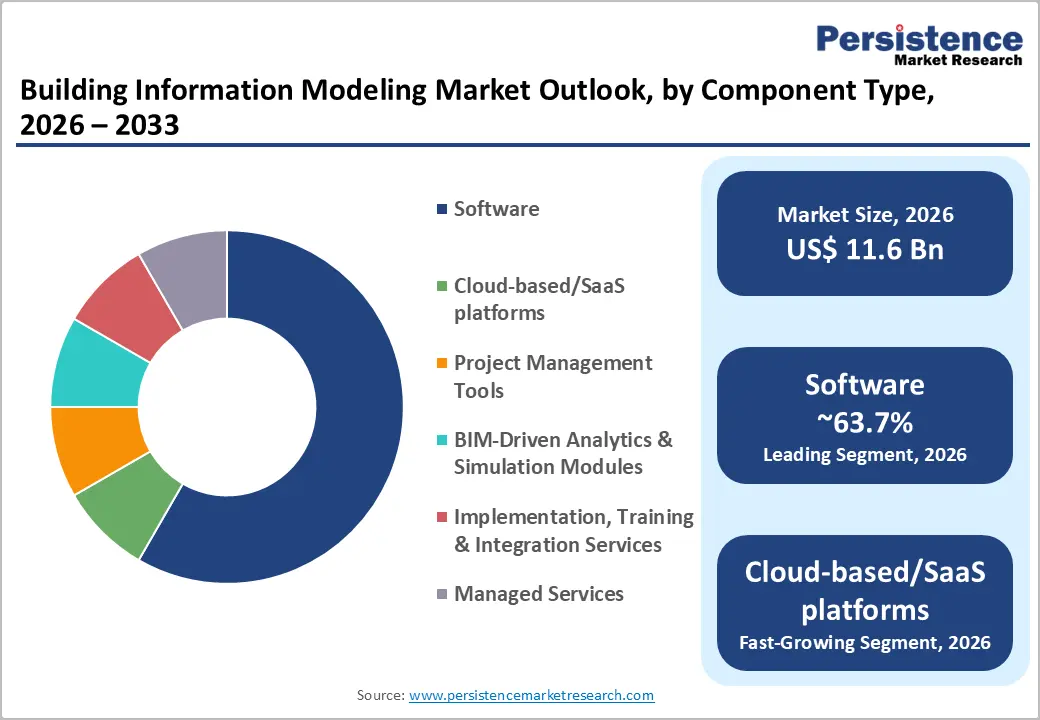
- Dominant Component Type: The software segment is anticipated to account for approximately 63.7% of the market share in 2026, driven by strong demand for project visualization, clash detection, scheduling, 4D/5D modeling, and lifecycle asset management solutions.
- Leading Application: Design and pre-construction applications are expected to lead the market with an anticipated share of over 39.8% in 2026, supported by the rising adoption of BIM-driven constructability analysis, quantity takeoff, and multidisciplinary coordination.
DRO Analysis
Driver - Regulatory Mandates and OpenBIM Standardization Accelerating Industry Adoption
Governments and regulatory bodies are increasingly treating Building Information Modeling as a strategic requirement for infrastructure planning, public procurement, and lifecycle asset management. Public-sector construction agencies across North America, Europe, and Asia Pacific are integrating BIM standards into transportation, utilities, healthcare, and smart-city projects to improve project transparency, interoperability, and operational efficiency. International standards such as ISO 19650 and openBIM frameworks are helping organizations establish consistent information management practices across multidisciplinary construction environments.
The push toward digital permitting and integrated project delivery is reducing inefficiencies associated with fragmented design workflows. Countries including Singapore, the U.K., Germany, and several Nordic economies have strengthened BIM requirements for public projects, encouraging broader industry participation. These mandates improve collaboration between architects, engineers, contractors, and facility operators while supporting long-term asset visibility. The regulatory shift is creating stable long-term demand for BIM software, implementation services, and cloud-based collaboration ecosystems across both commercial and infrastructure construction sectors.
Cloud Computing, AI Integration, and Lifecycle Digitization Improving BIM Value Proposition
The BIM ecosystem is evolving from standalone 3D modeling software into an integrated lifecycle management platform connecting design, scheduling, costing, fabrication, commissioning, and operations. Cloud-based BIM environments enable real-time collaboration across geographically distributed teams, allowing project stakeholders to access synchronized project data throughout the construction lifecycle. AI-assisted design optimization, automated clash detection, predictive analytics, and generative design tools are improving productivity while reducing costly design revisions.
The growing adoption of digital twins is also strengthening BIM’s commercial value. Facility owners increasingly use BIM-generated asset data for predictive maintenance, energy optimization, and operational planning. Vendors are responding by integrating AI-enabled workflows, analytics engines, and cloud-native collaboration capabilities into their platforms. The expansion of subscription-based software models and SaaS deployment structures is lowering upfront investment barriers while generating recurring revenue opportunities for software providers. These technological improvements are increasing BIM adoption among contractors, infrastructure developers, and asset managers seeking measurable improvements in project efficiency and lifecycle cost control.
Restraint - High Implementation Costs and Workflow Complexity Limiting SME Adoption
Despite strong long-term growth potential, BIM implementation remains financially and operationally challenging for many small and medium-sized construction firms. Deployment requires investment in software licensing, employee training, data management systems, workflow restructuring, and hardware upgrades. Many organizations also face integration challenges when attempting to synchronize BIM environments across multiple vendors, subcontractors, and legacy systems.
The complexity of model governance and interoperability creates additional adoption barriers, particularly for companies operating with limited digital infrastructure capabilities. Smaller contractors and engineering firms often struggle to justify the upfront implementation cost before measurable productivity benefits are realized. In fragmented construction ecosystems, inconsistent standards and limited digital maturity among project participants can reduce BIM efficiency gains. These factors continue to slow full-scale adoption in price-sensitive markets and among organizations with limited technical expertise.
Opportunity - Digital Twin Integration and Asset Lifecycle Management Creating Long-Term Revenue Potential
One of the strongest growth opportunities in the BIM market lies in post-construction operations and digital twin integration. Organizations are increasingly using BIM-generated models as operational intelligence platforms for facility management, maintenance scheduling, energy optimization, and infrastructure monitoring. The transition from static project models to continuously updated operational environments is creating demand for advanced analytics, cloud storage, and managed BIM services.
Asset owners in healthcare, transportation, manufacturing, and commercial real estate are investing in lifecycle-oriented BIM environments to reduce operational costs and improve asset utilization. The integration of BIM with IoT sensors, building automation systems, and enterprise asset management software is expected to strengthen long-term demand for AI-enabled digital infrastructure platforms. Vendors capable of providing interoperable lifecycle solutions are likely to benefit from recurring subscription revenue and higher customer retention.
Asia Pacific Infrastructure Expansion and Smart-City Investments Supporting Market Growth
Asia Pacific represents the fastest-growing regional opportunity for the BIM industry due to rapid urbanization, large-scale infrastructure modernization, and government-led smart-city initiatives. Countries such as China, India, Japan, Singapore, and several ASEAN economies are investing heavily in transportation corridors, industrial facilities, urban housing, airports, utilities, and public infrastructure systems.
Governments in the region are increasingly adopting BIM-based approval and project management systems to improve construction efficiency, reduce delays, and standardize digital workflows. Labor shortages and rising infrastructure complexity are also encouraging construction firms to adopt automation-enabled BIM platforms. As public and private investments continue to expand across infrastructure and commercial construction sectors, software vendors and implementation service providers have significant opportunities to localize cloud-based BIM platforms and expand regional partnerships.
Category-wise Analysis
Component Type Insights
The software segment is anticipated to account for approximately 63.7% of the market share during the forecast period, making it the leading component category. BIM software platforms remain essential for project visualization, clash detection, scheduling, cost estimation, and lifecycle data management. Major platforms such as Autodesk Revit, Bentley OpenBuildings, Trimble Tekla, and Graphisoft Archicad are widely used across commercial buildings, transportation infrastructure, and industrial construction projects to improve multidisciplinary coordination and reduce project rework.
The segment continues to benefit from growing adoption of AI-assisted modeling, generative design, and 4D/5D BIM workflows. Increasing demand for integrated project delivery and digital construction management across smart-city and infrastructure developments is further strengthening software adoption among architects, engineers, and contractors.
Cloud-based BIM platforms and managed BIM services are anticipated to witness the fastest growth, with adoption accelerating across distributed construction environments and multi-location projects. SaaS-enabled BIM ecosystems allow stakeholders to access centralized project data in real time, improving collaboration, version control, and workflow transparency.
Platforms such as Autodesk Construction Cloud and Bentley iTwin are increasingly being adopted for remote project coordination and lifecycle asset management. Managed BIM services are also expanding as organizations outsource model management, implementation support, and workflow standardization to specialized providers. The growing integration of BIM with ERP, GIS, CMMS, and digital twin systems is expected to further support cloud-based deployment growth, particularly in infrastructure, utilities, and government-led construction projects.
Application Insights
The design and pre-construction segment is anticipated to hold over 39.8% of the market share in 2026, maintaining its leadership due to strong demand for early-stage project coordination and error detection. BIM tools help architects, structural engineers, and MEP consultants create highly coordinated digital models that reduce construction delays, material waste, and design conflicts.
Applications such as clash detection, quantity takeoff, and constructability analysis are widely used in commercial real estate, hospitals, airports, and transportation infrastructure projects. The segment continues to benefit from increasing investment in complex infrastructure and smart-building developments where accurate planning and multidisciplinary collaboration are critical. The ability to optimize design performance before physical construction begins remains a major factor supporting segment dominance.
Execution-phase and post-construction BIM applications are anticipated to record the fastest growth, supported by rising contractor adoption and lifecycle asset management demand. Contractors increasingly use BIM for scheduling, fabrication modeling, resource allocation, and site coordination, particularly in large infrastructure and modular construction projects.
Solutions integrating 4D and 5D BIM workflows are helping improve project sequencing and cost monitoring efficiency. Post-construction BIM is also gaining traction through digital twin integration and predictive maintenance applications. Facility owners in healthcare, transportation, and commercial real estate are adopting BIM-enabled operational models to improve maintenance planning and long-term asset performance. Growing demand for operational efficiency and lifecycle optimization is expected to accelerate adoption across commissioning and facility management applications.
Regional Insights
North America Building Information Modeling Market Trends
North America is projected to account for approximately 41.2% of the market share in 2026. The region benefits from advanced digital infrastructure, high enterprise software adoption, and widespread implementation of cloud-enabled construction technologies across commercial, industrial, and public infrastructure projects. Growing investment in transportation modernization, smart utilities, healthcare infrastructure, and sustainable building development continues to support BIM adoption across the region.
U.S. Building Information Modeling Market Trends
The U.S. dominates the North America BIM market due to large-scale infrastructure investments, advanced construction technology adoption, and strong demand for cloud-based project delivery solutions. Federal funding for transportation, utilities, healthcare facilities, and smart-city development is accelerating the adoption of BIM workflows across both public and private sectors.
Construction firms in the U.S. increasingly use BIM for clash detection, scheduling, digital twins, prefabrication planning, and lifecycle asset management. Major software vendors continue expanding AI-enabled design tools and integrated construction cloud ecosystems to improve collaboration and project visibility. The growing complexity of commercial and infrastructure projects is expected to sustain long-term BIM demand across the country.
Canada Building Information Modeling Market Trends
Canada is experiencing steady BIM adoption, due to increasing investments in transportation infrastructure, green building projects, and public-sector digital construction initiatives. Engineering and construction firms are adopting BIM to improve project coordination, reduce operational inefficiencies, and strengthen sustainability compliance across commercial and institutional developments.
The country’s focus on energy-efficient construction and smart infrastructure modernization is increasing the importance of BIM-enabled lifecycle management and digital asset tracking systems. Cloud-based collaboration platforms are also gaining traction among mid-sized contractors and engineering firms seeking scalable project management solutions.
Europe Building Information Modeling Market Trends
Europe represents a mature yet steadily expanding BIM market supported by strong regulatory harmonization, sustainability initiatives, and digital construction policies. Governments across the region increasingly promote interoperable openBIM frameworks to improve project transparency, reduce vendor dependency, and strengthen lifecycle asset management practices.
Germany Building Information Modeling Market Trends
Germany remains one of Europe’s strongest BIM markets due to its advanced industrial engineering capabilities, transportation infrastructure investments, and emphasis on precision-driven construction workflows. BIM adoption is particularly strong across rail modernization, industrial facilities, smart manufacturing infrastructure, and commercial construction projects.
German construction firms increasingly integrate BIM with prefabrication systems, automation technologies, and sustainability-focused project planning tools. The country’s strong manufacturing ecosystem and digital engineering expertise continue to support advanced BIM deployment across complex infrastructure environments.
U.K. Building Information Modeling Market Trends
The U.K. maintains one of the most mature BIM ecosystems globally due to long-standing government-backed digital construction initiatives. Public-sector procurement policies encouraging BIM adoption have accelerated implementation across transportation, healthcare, education, and commercial infrastructure projects.
The U.K. market continues to benefit from strong private-sector participation and growing use of cloud-based collaboration environments. Contractors and engineering firms are increasingly adopting AI-driven BIM workflows, digital twins, and lifecycle asset management systems to improve operational efficiency and regulatory compliance.
Asia PacificBuilding Information Modeling Market Trends
Asia Pacific is projected to be the fastest-growing regional BIM market during the forecast period due to rapid urbanization, infrastructure expansion, industrial development, and government-led smart-city initiatives. Countries across the region are investing heavily in transportation corridors, industrial facilities, utilities, airports, and high-density urban developments, creating strong demand for BIM-enabled project delivery solutions.
China Building Information Modeling Market Trends
China remains one of the largest BIM growth engines globally due to extensive infrastructure investment, smart-city development programs, and rapid urban construction activity. BIM adoption is increasing across rail transportation, airports, industrial parks, utilities, and high-rise commercial developments.
Government-backed digital construction initiatives and the growing adoption of prefabricated building methods are strengthening demand for advanced BIM workflows. Chinese construction companies are increasingly integrating BIM with AI, automation, and digital twin technologies to improve project execution and operational performance.
Japan Building Information Modeling Market Trends
Japan continues adopting BIM to improve construction productivity and address labor shortages in highly advanced infrastructure environments. Construction companies increasingly use BIM for prefabrication planning, digital simulations, and lifecycle asset optimization across transportation, industrial, and urban redevelopment projects.
The country’s focus on automation, robotics, and smart-building technologies is accelerating BIM integration with IoT-enabled monitoring systems and digital twin platforms. Japan’s advanced engineering ecosystem continues to support innovation in AI-assisted construction workflows and operational analytics.
Competitive Landscape
The global building information modeling market is moderately concentrated, with several global software providers accounting for a significant share of industry revenue. Major vendors including Autodesk, Bentley Systems, Nemetschek Group, Trimble, and Hexagon collectively maintain strong market influence through integrated software ecosystems, cloud collaboration capabilities, and lifecycle asset management solutions. Autodesk remains a leading participant in vertical building workflows, while Bentley maintains a strong position in infrastructure engineering applications. Nemetschek continues expanding its openBIM and architecture-focused portfolio, while Trimble strengthens office-to-field integration capabilities.
Leading BIM companies are prioritizing platform consolidation, AI-driven automation, subscription-based cloud deployment, and interoperability-focused ecosystems. Market participants are expanding digital twin capabilities, lifecycle asset management solutions, and API-driven integration frameworks to strengthen customer retention and recurring revenue generation. Strategic partnerships, regional expansion, and cloud-native collaboration platforms remain central competitive differentiators.
Key Industry Developments:
- In April 2025, Nemetschek Group announced a strategic partnership with Google Cloud to accelerate AI-driven BIM innovation, expand cloud-based workflows, and strengthen its presence in high-growth markets including India and Saudi Arabia.
- In March 2025, Trimble launched Tekla Structures 2025 with AI-enabled automation tools, enhanced fabrication drawing capabilities, and improved model-based collaboration features aimed at strengthening BIM-driven construction and fabrication workflows.
Companies Covered in Building Information Modeling Market
- Autodesk
- Bentley Systems
- Nemetschek Group
- Trimble
- Hexagon AB
- Graphisoft
- ALLPLAN
- RIB Software
- Procore Technologies
- AVEVA Group
- Bluebeam
- Dassault Systèmes
- Oracle Construction and Engineering
- Siemens Digital Industries Software
- Tekla
- ACCA Software
Frequently Asked Questions
The global building information modeling market is anticipated to be valued at US$11.6 Bn in 2026.
The global building information modeling market is projected to reach approximately US$27.1 billion by 2033.
Key trends include increasing adoption of cloud-based BIM platforms, AI-assisted modeling, digital twin integration, 4D/5D BIM workflows, openBIM interoperability standards, and lifecycle asset management solutions.
The software segment is the leading component category, accounting for approximately 63.7% of the global market share, driven by strong demand for project visualization, scheduling, clash detection, and lifecycle management tools.
The building information modeling market is projected to grow at a CAGR of 12.9% between 2026 and 2033.
Major companies include Autodesk, Bentley Systems, Nemetschek Group, Trimble, and Hexagon AB.


