




- Hardware & Software IT Services
- Retail Audience Measurement Solutions Market
Retail Audience Measurement Solutions Market Size, Share, and Growth Forecast 2026 - 2033
Retail Audience Measurement Solutions Market by Component (Hardware, Software), by Application (Customer Traffic & Footfall, Queue Management), by End User (Supermarkets & Hypermarkets), and Regional Analysis, 2026 - 2033

Retail Audience Measurement Solutions Market Size and Trends Analysis
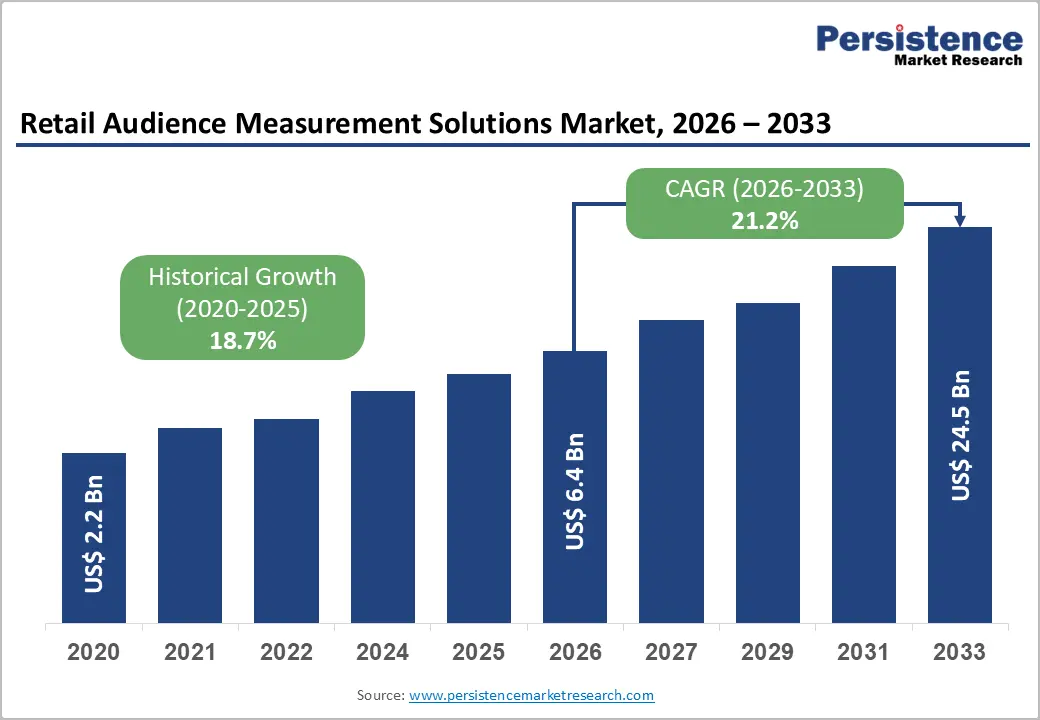
The global retail audience measurement solutions market size is likely to be valued at US$6.4 billion in 2026 and is expected to reach US$24.5 billion by 2033, growing at a CAGR of 21.2% during the forecast period from 2026 to 2033, driven by the ongoing expansion of retail media networks, where physical stores are increasingly treated as measurable advertising channels. Rising adoption of AI-supported analytics in brick-and-mortar environments is also enabling retailers to optimize layouts.
Key Industry Highlights:
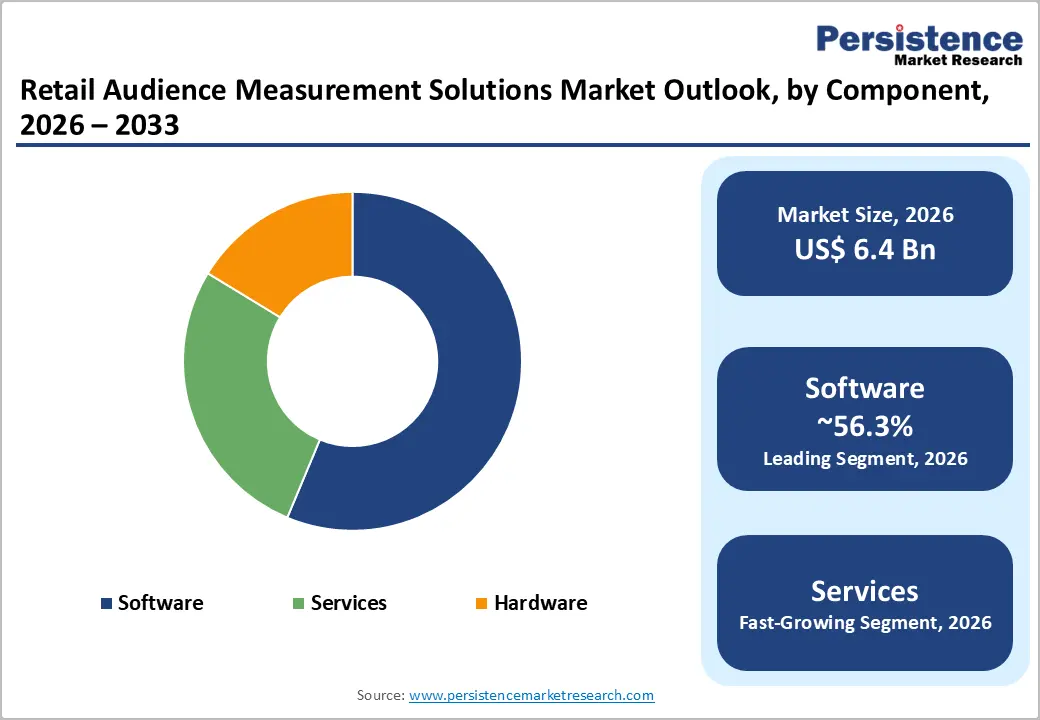
- Leading Component: Software, approximately 56.3% share in 2026, as retailers prefer cloud-based analytics platforms that integrate data from cameras, sensors, and loyalty apps into a single decision-making interface.
- Dominant Application: Customer traffic & footfall, nearly 32.6% in 2026, as they form the foundation for all other insights.
- Recent Partnership: In May 2025, Advertima and Publicis Media Middle East joined forces for unified, omnichannel retail media measurement. The strategic collaboration aimed to enable media buyers to activate consistent audience segments in real time across both online and physical environments.
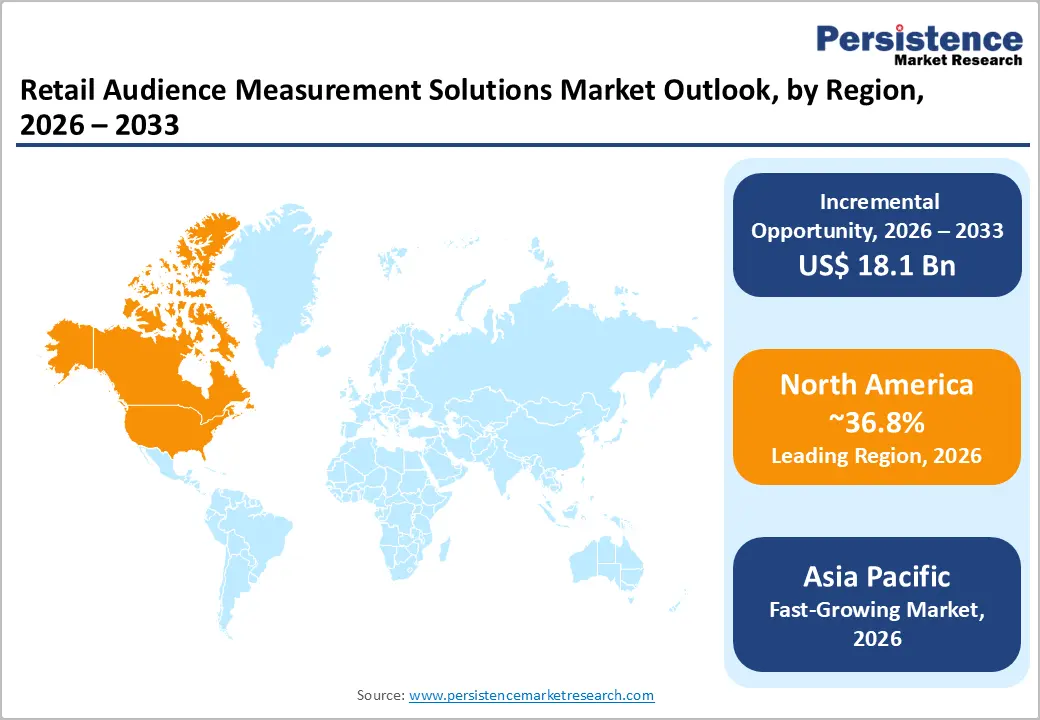
- Leading Region: North America, with about 36.8% share in 2026, owing to early adoption of retail media networks and widespread deployment of data-backed store formats across large retail chains.
- Fast-growing Region: Asia Pacific, due to rising investments in smart stores and expanding organized retail.
DRO Analysis
Driver - Shift of Physical Stores toward Data-led Shopper Intelligence
Brick-and-mortar retailers are constantly investing in audience measurement tools to close the gap with e-commerce-level insights. Unlike earlier footfall counters, modern systems track dwell time, repeat visits, and product interaction at aisle level. This shift is boosted by the need to optimize store layouts and promotions in near real time. For example, retailers using AI-based video analytics have reported measurable improvements in conversion by repositioning high-margin products in high-dwell zones.
In 2025, several grocery chains across Europe integrated in-store analytics with loyalty apps, allowing them to link physical browsing behavior with purchase history. This has enabled more precise targeting, such as triggering personalized offers when a shopper spends more than a few seconds in a category zone, directly improving in-store engagement.
Privacy Changes to Fuel First-Party Retail Data Interfaces
The phase-out of third-party cookies is pushing brands to rely heavily on retailer-owned data, making in-store audience measurement a strategic asset. Retailers are now positioning themselves as media owners, using their physical spaces to deliver measurable advertising. In 2025, retail media networks expanded beyond online channels, with in-store screens and smart displays becoming measurable ad inventory.
For instance, campaigns run on in-store digital signage are now evaluated using exposure-to-purchase correlation instead of basic impressions. This shift is compelling brands to collaborate more closely with retailers, as first-party data from store visits, dwell behavior, and purchase patterns becomes important for campaign attribution in a privacy-first environment.
Restraint - Difficulty in Proving True Sales Impact across Channels
A key restraint is the challenge of isolating whether in-store engagement actually drives purchases, especially in omnichannel journeys. Shoppers often interact with products in-store but complete purchases online, or vice versa, making attribution complex. Even unique systems struggle to connect exposure data with final transactions without relying on loyalty IDs or app integrations.
Retailers running in-store digital campaigns, for instance, often see increased engagement metrics but cannot definitively prove whether those interactions caused incremental sales or simply influenced already-intended purchases. This incrementality gap reduces advertiser confidence and slows budget allocation toward in-store media, particularly when compared to digital channels where attribution models are more mature and standardized.
Opportunity - AI-Supported Visual Tracking to Provide Shopper Behavior Insights
Developments in computer vision and edge AI are creating new opportunities for deep behavioral analytics. Modern systems can now map complete shopper journeys, including path tracking, product interaction, and engagement time, without requiring active user input. Retailers deploying these technologies are moving beyond basic analytics to predictive insights, such as identifying which store zones lead to high basket sizes.
AI-assisted platforms, for example, deployed in large-format stores can now process thousands of shopper movements daily and recommend layout changes within hours. This capability is mainly valuable in high-traffic environments where manual observation was previously impossible at scale.
Connected Store Infrastructure to Enable Real-Time Decision Intelligence
The integration of smart shelves, digital price tags, and sensor-enabled carts is opening new growth avenues by directly linking physical interactions to analytics systems. These technologies capture micro-level actions such as product pick-ups, comparisons, and returns to shelves, providing insights that were previously limited to online shopping.
In recent deployments, retailers have used electronic shelf labels combined with sensors to dynamically adjust pricing based on demand patterns observed throughout the day. Smart carts equipped with scanners and location tracking are also enabling real-time recommendations and frictionless checkout. These are simultaneously feeding high-quality behavioral data into audience measurement platforms.
Category-wise Analysis
Component Insights
The software segment is expected to lead the market in 2026, accounting for around 56.3% of the total share. While hardware components such as cameras and sensors are primarily responsible for collecting raw data, it is the software layer that converts this data into actionable insights. As retailers focus on delivering seamless experiences across physical stores, online platforms, and media channels, demand is increasing for software solutions that can monitor and connect customer journeys across all touchpoints. These platforms consolidate inputs from in-store sensors, e-commerce systems, and digital advertising networks to create a unified view of consumer behavior.
The services segment is anticipated to be the fastest-growing in 2026. The surge is fueled by increasing demand for managed services, system integration, installation, and real-time support. As retailers prioritize smooth deployment, ongoing analytics optimization, and maintenance of unique measurement systems, service providers are playing a key role in enabling extensible and end-to-end solutions across multiple store formats.
Application Insights
The customer traffic & footfall segment is projected to lead in 2026, with a share of nearly 32.6%. This dominance is pushed by its foundational role in providing core insights that retailers depend on. These include how many people enter the store, where they go, how long they stay, and what percentage convert into buyers. These metrics are important for daily store operations, staffing optimization, and measuring the success of marketing campaigns or promotions.
The store layout & planogram optimization segment is expected to remain in the second position in 2026. Audience measurement data feeds directly into layout decisions. When a retailer knows which aisles attract the most dwell time, it can place high-margin products in those zones. When it knows which sections are ignored, it can redesign them. An aisle heatmap showing where shoppers spend the most time helps retailers position high-margin products in those areas.
Regional Insights
North America Retail Audience Measurement Solutions Market Trends
In 2026, North America is anticipated to dominate with about 36.8% of the market share. This leadership is propelled by the presence of leading retail chains, high digital maturity, and early adoption of AI-based analytics across brick-and-mortar formats. Retailers in the U.S. and Canada have been at the forefront of integrating video analytics, in-store sensors, and footfall tracking technologies to improve operational efficiency and personalize the customer experience.
Big-name collaborations are also happening here first. In February 2025, Nielsen and TransUnion expanded their relationship so that advanced audiences created in TransUnion's TruAudience platform could be shared with and measured by Nielsen ONE. It enabled a comprehensive, deduplicated view of custom audience reach across TV, streaming, digital, and mobile channels. These integrations showcase how deeply measurement is now embedded in North America’s retail strategy.
U.S. Retail Audience Measurement Solutions Market Trends
The U.S. is seeing the fastest growth in North America, due to increasing investments by Walmart, Target, and Kroger in data-backed retail. The market is evolving at an accelerated rate, with the influx of AI-assisted video analytics, computer vision systems, and cloud-based audience insights changing in-store operations and targeted marketing. Collaborations between technology vendors such as NielsenIQ, Microsoft Azure, and AWS Retail Cloud are also augmenting mass deployments of real-time shopper analytics. Privacy regulation is pushing the market forward rather than holding it back.
Asia Pacific Retail Audience Measurement Solutions Market Trends
In 2026, Asia Pacific is projected to witness exponential growth, spurred by ongoing retail digitalization, high adoption of AI-based analytics, and the expansion of organized retail chains across China, India, Japan, and South Korea. The region's mobile-first consumer base is also a driver. In Asia Pacific alone, mobile transactions grew by 23% in Q1 2025 compared to the previous year. High transaction volumes demand better analytics to understand who is buying what, and when.
China Retail Audience Measurement Solutions Market Trends
China is the dominant market in Asia Pacific for retail analytics. It is fostered by early adoption of novel analytics solutions, a strong presence of global technology providers, and high investments in digital transformation initiatives. The country's advantage is its integrated digital interface. Alibaba, JD.com, and Tencent are the most prominent retailers. They are extending their investments into real-time customer behavior analysis, facial recognition, and in-store IoT to maximize consumer interaction and advertising performance.
Alibaba's Hema supermarkets already link mobile app purchases with in-store shopping data in real time. In 2025, for instance, Alibaba Cloud introduced novel AI-assisted retail analytics tools to help brick-and-mortar stores optimize inventory management and improve personalized customer engagement. China's e-commerce expansion also feeds demand for audience measurement.
Japan Retail Audience Measurement Solutions Market Trends
Japan's growth is steady rather than explosive, and the reasons are rooted in its distinct retail culture. The market is witnessing steady growth due to the country's tech-savvy population, increasing digital adoption in retail, and emphasis on operational efficiency. Retailers are utilizing advanced analytics for customer behavior tracking, merchandising optimization, and demand forecasting.
Japan also has a long-standing data culture in retail. Its convenience stores have recorded the age, gender, time, and purchase details of every single transaction for at least the past 30 years. This information was integrated with location and weather data to provide a detailed analysis of shopping behavior store by store. Now, building on this legacy and using digital payment and loyalty data, retailers routinely use data analytics and AI to optimize operations.
Europe Retail Audience Measurement Solutions Market Trends
Europe's growth is fueled by rising retail media investment, omnichannel transformation, and the pressure of the General Data Protection Regulation (GDPR). GDPR has acted as both a constraint and a catalyst. It limits what data can be collected, but it has also pushed retailers toward privacy-compliant and high-quality first-party measurement tools. Several local retailers embraced privacy-first analytics tools in 2024 to ensure GDPR compliance, boosting market share for compliant analytics products.
U.K. Retail Audience Measurement Solutions Market Trends
The U.K. is seeing exponential growth, augmented by a highly competitive grocery sector and ongoing retail media adoption. VusionGroup's deals in the country are a telling indicator. In May 2025, the company announced a strategic alliance with NielsenIQ to empower manufacturers and retailers to maximize their sales performance by harnessing data and using connected technologies that digitize physical stores. That was followed by a partnership with The Co-operative Group (Co-op) to replace paper shelf edge labels with electronic shelf edge labels across nearly 2,400 stores. It was the largest single-retailer rollout of electronic shelf edge labels in the U.K. and Ireland.
Germany Retail Audience Measurement Solutions Market Trends
Germany is Europe's anchor market for retail analytics. Factors such as a well-established retail sector, advanced technological infrastructure, and high adoption rates of AI-supported analytics tools are mainly boosting growth. Government policy has played a direct role. According to the Federal Ministry for Economic Affairs and Climate Action, Germany’s retailers are using analytics to optimize supply chains and improve customer experiences, especially in e-commerce, which accounts for 22% of total retail sales. The country’s rising emphasis on GDPR compliance has spurred investments in secure analytics platforms.
Competitive Landscape
The global retail audience measurement solutions market is moderately fragmented, but it is gradually moving toward consolidation around full-stack analytics providers. Leading players such as NielsenIQ, Quividi, Dor Technologies, Walkbase, and Advertima are competing through computer vision, sensor fusion, and predictive analytics capabilities. They are also differentiating through real-time analytics, omnichannel integration, privacy-safe tracking, and retail media monetization capabilities.
Privacy regulation is another factor influencing competition, especially in Europe. Vendors that rely heavily on facial recognition are facing pressure from GDPR-related compliance concerns. This is creating demand for anonymous analytics technologies. Another competitive trend is the rise of autonomous and cashier-less retail environments. Audience measurement vendors are embedding their systems into autonomous stores to support theft detection, inventory tracking, and shopper movement analysis.
Key Industry Developments:
- In December 2025, Nielsen and Roku extended their long-term strategic partnership. Building on years of collaboration, this next phase incorporated Roku data into Nielsen's unique campaign measurement and outcome solutions.
- In June 2025, VenHub launched the first fully autonomous AI-backed smart store at the LAX/Metro Transit Center in Los Angeles. The Smart Store aimed to provide travelers and transit riders with a frictionless and staffless shopping experience. It was positioned to serve the influx of visitors expected for the 2026 FIFA World Cup and the 2028 Olympic and Paralympic Games.
- In June 2025, DoorDash acquired retail media adtech company Symbiosys for US$175 million. This acquisition was designed to help DoorDash advertisers extend their campaign reach to search, social, and display with closed-loop measurement.
Companies Covered in Retail Audience Measurement Solutions Market
- Advertima
- Broox Technologies S.L.U.
- Nielsen
- Dor Technologies
- Engagis Pty Ltd.
- Macnica, Inc.
- AdQuick
- Kantar
- Quividi
- Raydiant (Sightcorp)
- Convenience StoresNext
- V-Count
- Walkbase
Frequently Asked Questions
The global retail audience measurement solutions market is projected to be valued at US$6.4 billion in 2026.
The retail audience measurement solutions market is expected to reach US$24.5 billion by 2033.
The rise of AI-supported computer vision and the integration of in-store analytics with retail media platforms are a few key market trends.
Software is expected to be the leading component with a share of nearly 56.3% in 2026, fueled by the need to reduce reliance on hardware replacement.
The retail audience measurement solutions market is expected to grow at a CAGR of 21.2% from 2026 to 2033.
Advertima, Broox Technologies S.L.U., Nielsen, Dor Technologies, and Engagis Pty Ltd. are a few key market players.


