




- Hardware & Software IT Services
- AI in Accounting Market
AI in Accounting Market Size, Share, and Growth Forecast, 2026 - 2033
AI in Accounting Market by Component (Solution, Services), Deployment Mode (Cloud-based, On-premises), Technology, Application, and Regional Analysis for 2026 - 2033

AI in Accounting Market Size and Trends Analysis
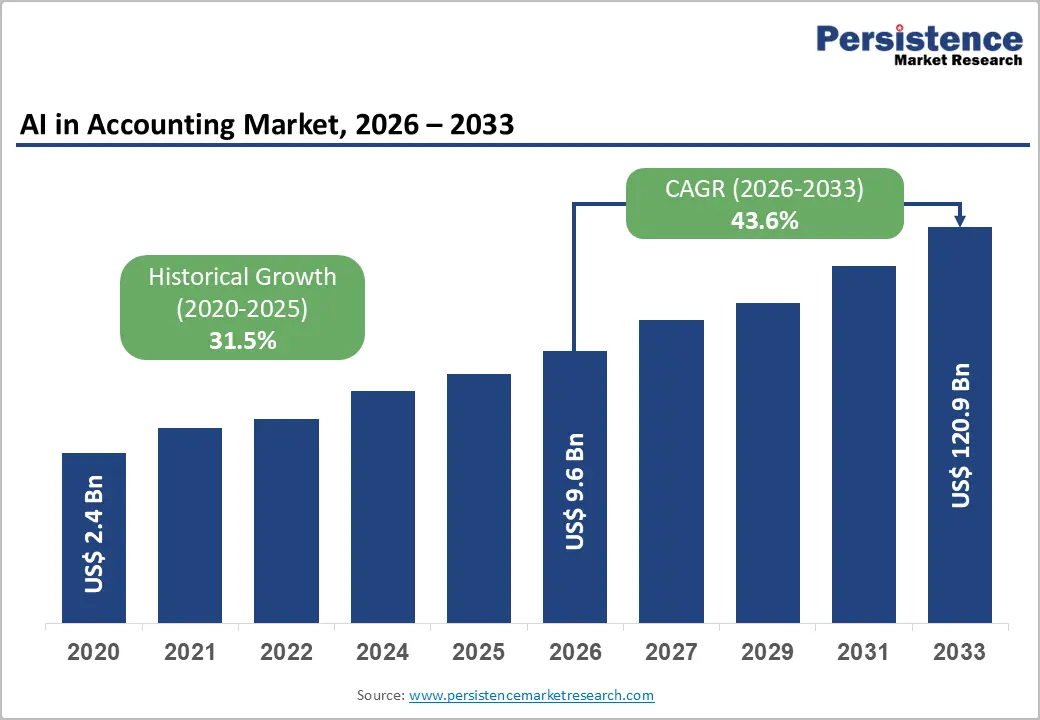
The global AI in accounting market size is likely to be valued at US$9.6 billion in 2026 and is expected to reach US$120.9 billion by 2033, growing at a CAGR of 43.6% between 2026 and 2033, driven by the increasing adoption of automation technologies across finance operations to enhance reporting accuracy, minimize manual processes, improve regulatory compliance, and accelerate financial closing procedures.
The growing integration of cloud-based accounting platforms, machine learning-powered analytics, and intelligent automation solutions is positioning AI as a core component of modern financial infrastructure rather than merely an operational support tool. AI-enabled accounting systems are playing a critical role in finance transformation initiatives by supporting real-time monitoring, scalable compliance processes, and automated financial decision-making.
Key Industry Highlights:
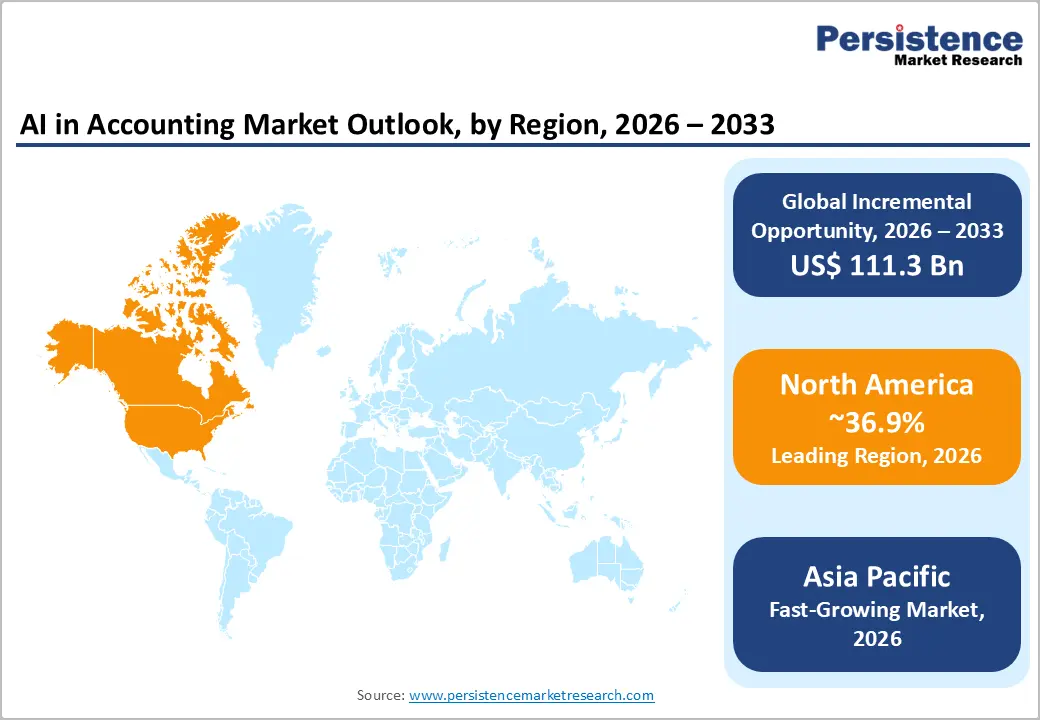
- Leading Region: North America is projected to account for the largest market share of 36.9%, supported by strong enterprise AI adoption, mature cloud infrastructure, and extensive investment in finance automation technologies.
- Fastest-growing Region: Asia Pacific is projected to register the fastest growth, driven by rapid SME digitization, cloud adoption, and expanding digital financial ecosystems across China, India, and Southeast Asia.
- Dominant Component: The solution segment is expected to lead with a 66.2% market share in 2026, due to rising adoption of integrated AI-powered accounting platforms for bookkeeping, audit management, and financial reporting automation.
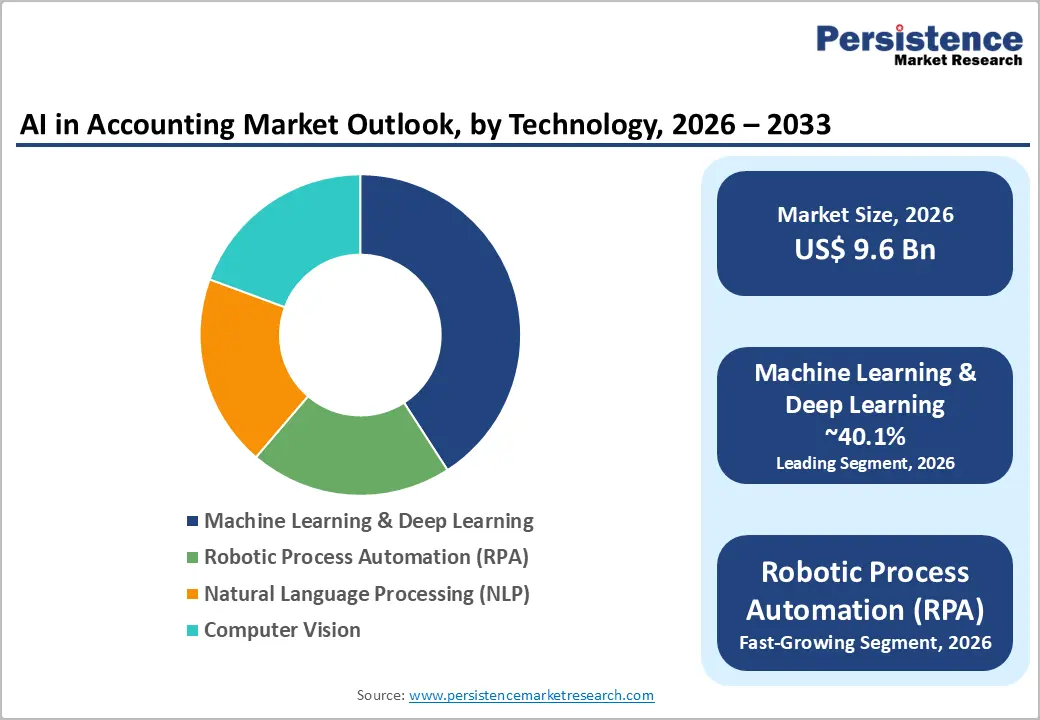
- Leading Technology: The machine learning and deep learning segment is expected to account for an anticipated 40.1% market share in 2026, supported by the growing use in fraud detection, predictive analytics, automated reconciliation, and continuous financial monitoring applications.
DRO Analysis
Driver - Regulatory Digitization and Real-Time Compliance Requirements
Governments and tax authorities worldwide are accelerating the transition toward digital tax infrastructure, electronic invoicing, and real-time financial reporting systems. This shift is significantly increasing demand for AI-enabled accounting tools capable of automating invoice processing, transaction categorization, reconciliation, and compliance monitoring. Enterprises are adopting intelligent accounting systems to reduce administrative burdens, improve audit readiness, and minimize reporting errors in increasingly complex regulatory environments.
The adoption of AI is particularly important for multinational organizations managing high transaction volumes across multiple jurisdictions. AI-powered accounting platforms improve operational efficiency by automating repetitive tasks while supporting faster and more accurate reporting. Machine learning algorithms can identify inconsistencies in ledger entries, flag unusual transactions, and maintain audit trails with minimal human intervention. These capabilities are becoming essential as finance teams face pressure to improve reporting accuracy while controlling labor costs.
Productivity Gains through Intelligent Finance Automation
AI technologies are delivering measurable productivity improvements across finance and accounting operations. Intelligent automation tools can process invoices, reconcile accounts, generate financial reports, and support forecasting activities at significantly higher speeds than traditional manual processes. Enterprises are using AI to shorten month-end close cycles, improve data accuracy, and optimize resource allocation within finance departments.
Machine learning and predictive analytics are enabling accounting teams to move beyond transactional processing toward strategic financial planning and advisory functions. Automated systems can continuously monitor financial data, identify anomalies, and generate actionable insights that support decision-making. This transition is improving operational scalability while reducing dependency on manual data entry and repetitive administrative work.
Organizations are increasingly shifting spending from isolated accounting software solutions toward AI-enabled finance transformation programs that include workflow redesign, implementation support, governance frameworks, and cloud integration services. The growing integration of AI within ERP and accounting platforms is creating long-term demand for advanced automation capabilities across bookkeeping, auditing, tax management, and financial forecasting applications.
Restraint - Data Governance and Trust Challenges
Despite strong adoption momentum, governance concerns remain a major barrier to AI implementation in accounting. Accounting systems operate within highly regulated environments where financial accuracy, auditability, and data integrity are critical. Organizations remain cautious about deploying AI in sensitive functions such as tax reporting, audit preparation, and financial statement generation because errors or compliance failures can create significant legal and reputational risks.
Many enterprises also face challenges related to fragmented financial data, legacy infrastructure, and inconsistent data quality. AI systems require structured, high-quality datasets to deliver reliable outputs, yet many finance departments still operate across disconnected systems and manual workflows. This increases implementation complexity and slows enterprise-scale deployment.
Regulatory scrutiny surrounding AI transparency, privacy, and accountability is also increasing. Businesses are investing heavily in governance frameworks, validation procedures, and human oversight mechanisms before deploying AI in mission-critical accounting environments.
Opportunity - Emergence of Agentic Accounting Platforms
One of the most significant growth opportunities lies in the development of agentic accounting systems capable of executing multi-step financial workflows autonomously with human oversight. These next-generation AI platforms can process invoices, reconcile accounts, generate journal entries, validate compliance requirements, and prepare financial reports within integrated workflow environments.
The growing adoption of AI agents is creating a new category of enterprise finance software focused on continuous accounting operations. Businesses are increasingly seeking platforms that combine automation, predictive analytics, compliance management, and audit traceability within unified systems. This creates opportunities for software vendors, implementation providers, and managed service firms specializing in AI-enabled finance transformation.
The opportunity extends beyond software licensing into consulting, workflow optimization, governance design, and ongoing AI monitoring services. Enterprises are prioritizing scalable solutions capable of integrating with existing ERP environments while supporting future automation requirements.
Expanding AI Adoption across Asia Pacific SMEs
Asia Pacific represents a major growth opportunity owing to rapid cloud adoption, expanding digital infrastructure, and increasing SME technology investment. Businesses across China, India, Southeast Asia, and other emerging economies are seeking cost-efficient accounting automation tools capable of improving operational efficiency and reducing manual administrative workloads.
SMEs are increasingly adopting AI-powered bookkeeping, invoice processing, payroll management, and tax compliance solutions because these technologies improve scalability without requiring large finance teams. Cloud-based deployment models are further accelerating adoption by reducing upfront infrastructure investment requirements.
Category-wise Analysis
Component Insights
The solution segment is anticipated to hold 66.2% market share in 2026, due to the rising demand for integrated accounting platforms that automate bookkeeping, reconciliation, invoice processing, and audit workflows. Companies are increasingly adopting AI-enabled solutions to improve reporting accuracy, reduce manual workloads, and strengthen compliance management. Cloud-based accounting platforms from providers such as Microsoft, Oracle, and Intuit are integrating AI capabilities for predictive analytics, automated reporting, and financial visibility. The growing shift toward unified finance ecosystems is expected to sustain demand as enterprises continue replacing legacy accounting infrastructure.
The services segment is projected to expand as organizations require implementation support, governance consulting, and workflow optimization services. Enterprises adopting AI accounting platforms often need assistance with ERP integration, data migration, and compliance validation. Consulting firms and managed service providers are increasingly offering end-to-end finance transformation solutions that combine AI deployment, cloud migration, and operational support. Demand for these services is expected to rise as businesses seek scalable and compliant AI accounting operations.
Technology Insights
Machine learning and deep learning are anticipated to account for a 40.1% market share in 2026, as accounting environments generate large volumes of structured financial data suitable for predictive analytics and anomaly detection. These technologies are widely used for automated bookkeeping, fraud detection, forecasting, and audit analytics. AI models help organizations identify irregular transactions, improve forecasting accuracy, and automate reconciliation processes. Companies such as SAP and Workday are integrating machine learning into enterprise finance systems to strengthen real-time monitoring and financial controls.
Robotic Process Automation (RPA) is projected to grow due to the increasing automation of repetitive accounting tasks such as invoice routing, payroll processing, and data entry. RPA improves operational efficiency by reducing manual intervention and accelerating transaction processing. Organizations are increasingly combining RPA with NLP and computer vision technologies to automate invoice capture, document processing, and compliance workflows. UiPath and Automation Anywhere are expanding AI-powered finance automation solutions to support end-to-end accounting operations and continuous workflow management.
Regional Insights
North America AI in Accounting Market Trends
North America is expected to dominate, accounting for a market share of 36.9% in 2026, due to strong cloud infrastructure, enterprise technology spending, and widespread adoption of AI-powered finance solutions.
U.S. AI in Accounting Market Trends
The U.S. dominates the regional market, as enterprises are rapidly integrating AI into ERP systems, accounting software, and financial analytics platforms. Large organizations are adopting AI-powered bookkeeping, fraud detection, and reconciliation systems to improve reporting efficiency and reduce manual workloads. Strong investment activity from technology companies and venture capital firms is also accelerating innovation in agentic accounting platforms and predictive finance tools.
Canada AI in Accounting Market Trends
Canada is witnessing the steady adoption of AI accounting technologies across the banking, insurance, and professional services industries. Businesses are increasingly implementing AI-driven compliance monitoring, audit automation, and cloud-based accounting systems to improve operational transparency and financial accuracy. Government support for AI innovation and digital transformation initiatives is further supporting market growth.
Europe AI in Accounting Market Trends
Europe is supported by digital tax reforms, electronic invoicing regulations, and increasing demand for compliance automation.
Germany AI in Accounting Market Trends
Germany leads the European market due to its strong enterprise manufacturing base and high adoption of ERP-integrated accounting systems. Businesses are investing in AI-powered financial automation tools to improve audit readiness, automate tax compliance, and enhance financial reporting efficiency.
U.K. AI in Accounting Market Trends
The U.K. is a major market for AI accounting software because of rapid cloud adoption and strong financial services activity. Enterprises and accounting firms are increasingly deploying AI for predictive analytics, fraud detection, and continuous auditing applications. The country also benefits from a strong fintech ecosystem, driving innovation in finance automation technologies.
France AI in Accounting Market Trends
France is experiencing rising demand for AI-powered accounting systems due to increasing regulatory digitization and e-invoicing initiatives. Organizations are prioritizing intelligent invoice processing, compliance automation, and AI-driven reporting solutions to improve operational efficiency and reduce administrative burdens.
Spain AI in Accounting Market Trends
Spain is emerging as a growing market for AI accounting technologies as SMEs and large enterprises accelerate digital transformation initiatives. Businesses are increasingly adopting cloud-based bookkeeping and payroll automation solutions to improve scalability and financial visibility.
Asia Pacific AI in Accounting Market Trends
Asia Pacific is projected to expand at the fastest CAGR of 46.5% during the forecast period, due to rapid cloud adoption, expanding digital economies, and rising SME technology investments.
China AI in Accounting Market Trends
China is a major contributor to regional growth as enterprises are rapidly adopting AI-powered accounting and financial automation systems. The country’s strong digital infrastructure and large transaction volumes are driving demand for automated bookkeeping, intelligent invoicing, and AI-based compliance monitoring solutions.
India AI in Accounting Market Trends
India is witnessing significant growth in AI accounting adoption due to rapid SME digitization and expanding cloud infrastructure. Businesses are increasingly implementing AI-powered payroll systems, tax compliance software, and automated accounting platforms to improve efficiency and support scalable business operations.
Japan AI in Accounting Market Trends
Japan remains an important market as enterprises are investing heavily in workflow automation and intelligent finance management systems to address labor shortages and improve operational productivity. AI-driven reconciliation, forecasting, and audit automation solutions are gaining strong traction among large organizations.
Competitive Landscape
The global AI in accounting market remains moderately fragmented, with competition distributed across enterprise software providers, accounting technology firms, cloud platform vendors, and consulting organizations. Large technology companies maintain strong market influence because of extensive ERP ecosystems, cloud infrastructure capabilities, and established enterprise customer bases.
Leading companies are focusing on embedded AI functionality, cloud-native accounting platforms, compliance-oriented automation, and strategic ecosystem partnerships. Vendors are increasingly prioritizing workflow orchestration, predictive analytics, and agentic automation capabilities to strengthen competitive positioning and improve customer retention.
Key Industry Developments:
- In November 2025, Thomson Reuters announced the launch of new agentic AI solutions for tax, audit, and accounting workflows, including automated 1040 tax preparation and AI-powered audit intelligence tools, aiming to improve workflow efficiency and strengthen compliance automation capabilities.
- In November 2025, Thomson Reuters introduced ONESOURCE+, an AI-powered intelligent compliance network connecting tax, legal, trade, and risk management workflows, designed to help enterprises automate compliance operations and improve cross-functional financial governance.
Companies Covered in AI in Accounting Market
- Microsoft
- Oracle
- SAP
- Intuit
- Thomson Reuters
- Workday
- Sage
- Xero
- BlackLine
- UiPath
- IBM
- ServiceNow
- Zoho
- Automation Anywhere
- AppZen
- Vic.ai
Frequently Asked Questions
The global AI in accounting market is anticipated to reach US$9.6 billion in 2026.
The AI in accounting market is projected to reach approximately US$120.9 billion by 2033.
Major trends include the adoption of agentic AI workflows, AI-powered fraud detection, cloud-based accounting systems, predictive financial analytics, automated reconciliation, and increasing integration of AI into ERP platforms.
The solution segment is anticipated to lead the market with a 66.2% market share because enterprises prefer integrated accounting platforms for workflow automation and compliance management.
The AI in accounting market is expected to grow at a 43.6% CAGR between 2026 and 2033.
Major companies include Microsoft, Oracle, Intuit, SAP, and Thomson Reuters.


