




- Hardware & Software IT Services
- Live Commerce Market
Live Commerce Market Size, Share, and Growth Forecast 2026 - 2033
Live Commerce Market by Product Type (Livestream Marketplace Platforms, Embedded Livestream Shopping Plugins), Platform Type (Social Media Platforms), Industry Vertical, and Regional Analysis, 2026 - 2033

Live Commerce Market Size and Trends Analysis
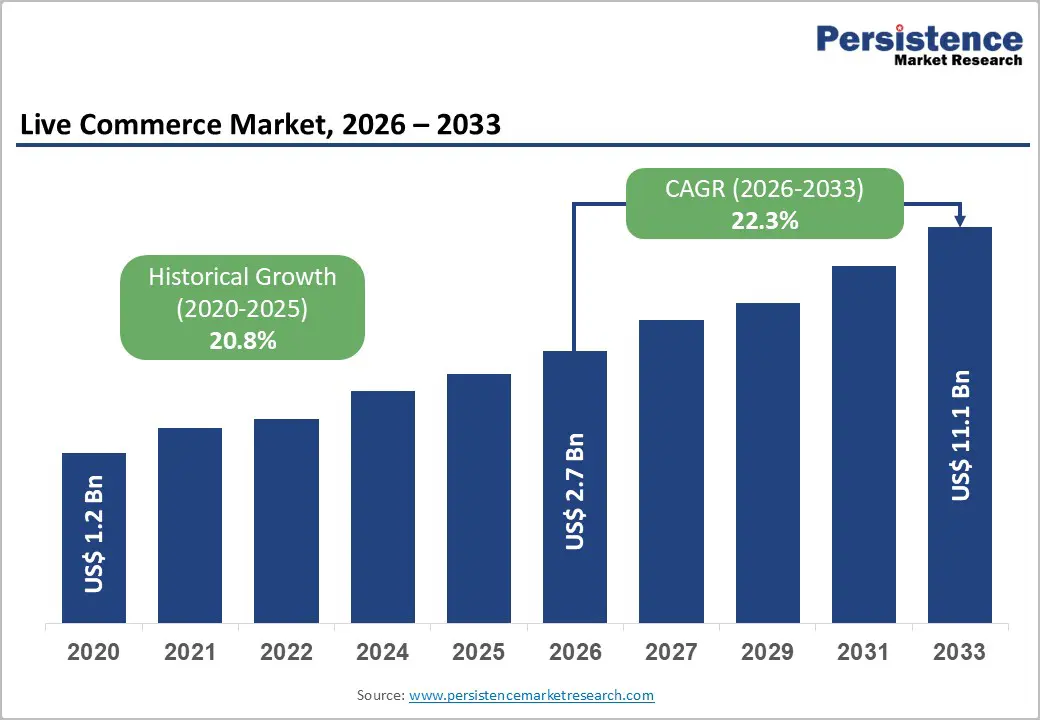
The global live commerce market size is likely to be valued at US$2.7 billion in 2026 and is expected to reach US$11.1 billion by 2033, growing at a CAGR of 22.3% during the forecast period from 2026 to 2033, driven by the shift toward video-first digital behavior, where consumers prefer interactive and real-time content over static product listings. Improving mobile internet access and smartphone usage in emerging markets is also broadening the audience base.
Key Industry Highlights:
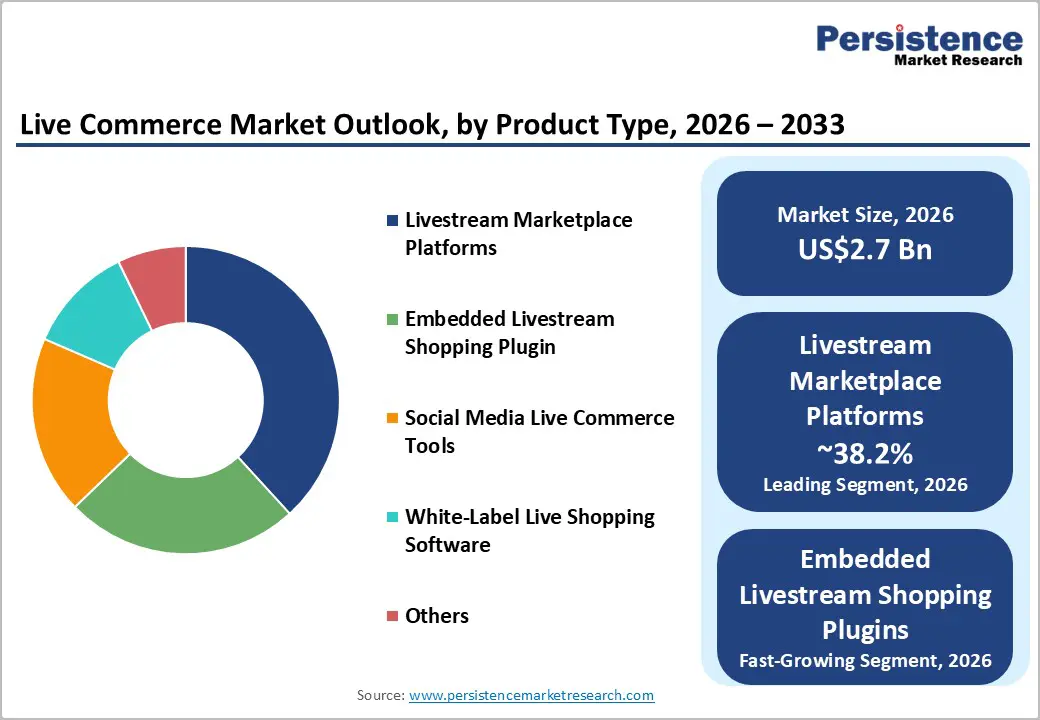
- Leading Product Type: Livestream marketplace platforms, around 38.2% in 2026, owing to their ability to combine content, checkout, and logistics in one interface.
- Dominant Platform Type: Social media platforms, nearly 45.7% in 2026, backed by their superior network of influencers, where creators build trust and product discovery.
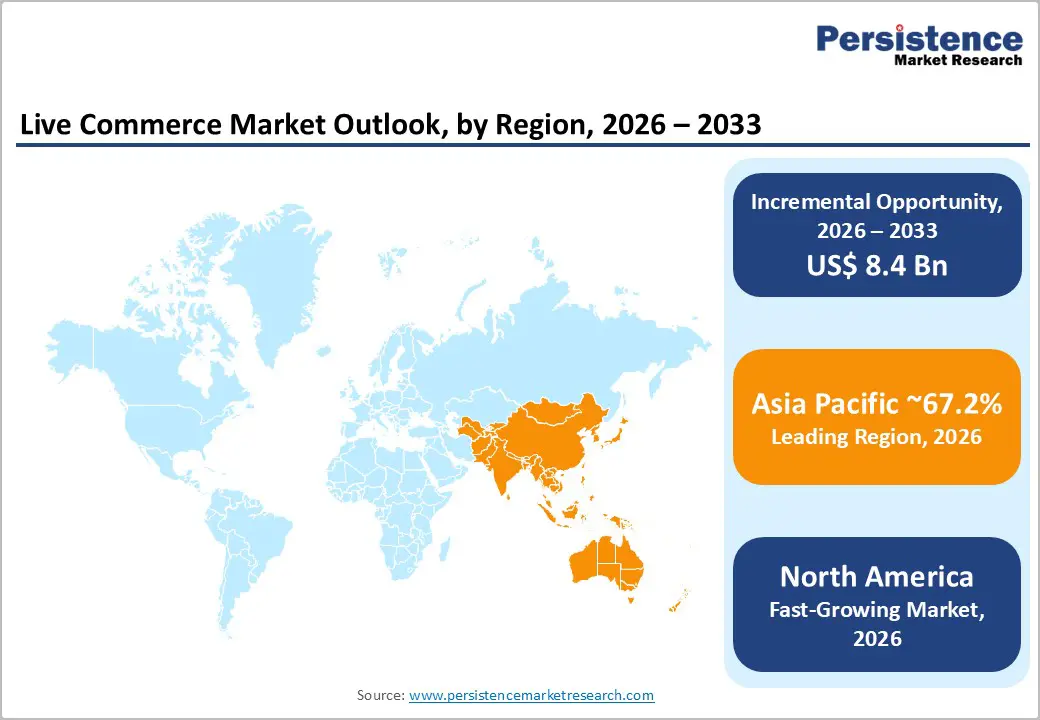
- Leading Region: Asia Pacific, with 67.2% share in 2026, spurred by strong creator-led selling and super-app networks.
- Fast-growing Region: North America, due to increasing investments by retailers and tech platforms in shoppable video and creator partnerships.
- New Live Shopping Platform: Amaze Holdings recently launched Amaze Live, a live shopping platform that enables multi-channel sales for entrepreneurs and creators. It is aimed at improving real-time sales and engagement.
DRO Analysis
Driver - Youth-driven Shift toward Interactive Shopping Formats
Gen Z and millennials are changing online buying patterns by prioritizing real-time engagement over static browsing. Live commerce aligns with their preference for short-form video and creator-led content, mirroring what they consume on platforms such as TikTok and Instagram Live. In China, where livestream e-commerce is mature, the China Internet Network Information Center reported in 2024 that over 60% of livestream e-commerce users are under 35, underscoring how young cohorts drive engagement and repeat purchases.
Brands are responding by partnering with micro-influencers who propel higher engagement rates than traditional ads. For instance, beauty labels in Southeast Asia have reported higher conversion rates during livestream drops hosted by niche creators than with standard e-commerce listings. This shows how relatability and immediacy directly impact purchase decisions.
Expanding Smartphone Access Fueling Real-time Retail Adoption
The ongoing spread of affordable smartphones and high-speed internet in emerging economies is accelerating participation in live commerce. Countries such as India and Indonesia have seen a surge in mobile-first users, with India crossing 750 million smartphone users in 2024, according to industry estimates. This shift enables consumers to access livestream shopping without requiring desktops or novel infrastructure.
Platforms are optimizing for low-bandwidth environments, making live sessions smooth even in tier-2 and tier-3 cities. A notable example is how regional sellers on apps such as Meesho and Flipkart are using live video to demonstrate products in local languages, significantly improving trust and reducing return rates. This accessibility is turning previously untapped audiences into active digital buyers.
Restraint - Rising Cost Burden in Acquiring and Converting Live Shoppers
Live commerce depends heavily on continuous promotion, influencer partnerships, and platform visibility, which is making customer acquisition very expensive. Unlike traditional e-commerce, brands must invest in creators, real-time production, and paid amplification to attract audiences to live sessions. According to the Interactive Advertising Bureau, digital ad costs have continued to rise due to competition for user attention. It is directly impacting new formats such as livestream shopping.
In India, several small sellers on platforms such as Flipkart Live report spending more on influencer-led sessions without guaranteed conversions, especially when audience turnout is inconsistent. This cost pressure is further exacerbated by the need to deliver time-bound discounts during live events, which reduces margins and makes it difficult for small brands to sustain long-term participation.
Opportunity - Cross-border Logistics Create New Growth Avenues
Live commerce is opening up international selling opportunities as logistics networks become integrated and predictable. Cross-border fulfillment systems, enabled by customs digitization and speedy last-mile delivery, are allowing sellers to showcase products to global audiences in real time without maintaining local inventory. The Universal Postal Union has showcased ongoing improvements in international parcel tracking and interoperability, which are reducing friction in cross-border e-commerce.
A recent example includes Southeast Asia-based sellers using livestreams on platforms such as Shopee to target buyers in neighboring countries, supported by simplified shipping workflows. This trend enables niche products, including regional fashion or specialty goods, to find buyers beyond domestic markets, broadening revenue potential without heavy physical expansion.
Brands to Build Dedicated Live Content Infrastructure Internally
Companies are now setting up in-house livestream studios to control content quality, reduce reliance on external influencers, and create consistent shopping experiences. This shift allows brands to experiment with formats such as product tutorials, behind-the-scenes sessions, and limited-time drops while maintaining brand voice. According to insights shared by the National Retail Federation, retailers are investing in owned digital channels to strengthen direct consumer engagement.
Global beauty brands and electronics companies, for instance, have started running daily or weekly livestream schedules from their own studios. They are also integrating real-time customer queries and instant checkout features. This approach not only improves conversion consistency but also builds long-term audience loyalty through repeated engagement.
Category-wise Analysis
Product Type Insights
Livestream marketplace platforms are expected to lead with nearly 38.2% of the share in 2026, owing to their ability to remove friction across the entire buying journey. Users can discover products, interact with hosts, complete payments, and track deliveries without leaving the platform. This tightly connected structure improves impulse buying during live sessions, as viewers can instantly act on limited-time offers. These platforms also support sellers with built-in logistics and analytics, making them more efficient than standalone solutions.
Embedded livestream shopping plugins are expected to be the fastest-growing segment during the forecast period, as they enable businesses to integrate live shopping experiences directly into their own websites and applications, reducing dependence on third-party marketplaces. This gives brands greater control over customer data, pricing strategies, and user experience. Instead of directing traffic to third-party platforms, companies can retain audiences across their own networks while still delivering interactive shopping.
Platform Type Insights
Social media platforms are predicted to dominate with approximately 45.7% of the market share in 2026. It is attributed to their ability to keep up with how users consume content, including short videos, live streams, and influencer-led interactions. These platforms already have massive daily engagement, which reduces the requirement for additional customer acquisition efforts. According to the Telecom Regulatory Authority of India, a large share of internet users access content primarily through mobile, with video consumption forming a key portion of usage. This behavior makes social platforms ideal for integrating shopping features, as users can move from entertainment to purchase without changing apps.
Brand-owned platforms are likely to remain in the second position over the forecast period, as companies want to reduce dependency on third-party platforms and protect their margins. By hosting livestreams on their own websites or apps, brands can control storytelling, pricing, and customer interactions more effectively. This strategy also supports data ownership, allowing companies to personalize future campaigns and improve retention. The National Retail Federation has emphasized the shift toward direct-to-consumer models, where brands invest in owned digital channels to strengthen loyalty.
Regional Insights
Asia Pacific Live Commerce Market Trends
With a share of approximately 67.2% in 2026, Asia Pacific is predicted to be the dominant market. In this region, live commerce has evolved as a natural extension of existing super-app networks where shopping, payments, and entertainment are already interconnected. China, Indonesia, and Thailand have consumers who are comfortable buying directly from video content, especially through influencer-led sessions. Also, regional platforms actively promote live selling through algorithmic visibility and seller incentives, accelerating adoption faster than in other regions.
China Live Commerce Market Trends
China represents the most advanced live commerce environment, where livestream shopping is deeply embedded in everyday consumption. Platforms deliver smooth integration of video, chat, payments, and delivery, allowing users to complete purchases within seconds during broadcasts. The market is also highly competitive, with professional hosts, scheduled product drops, and real-time discounts becoming standard practices. These are gradually turning live commerce into a structured retail channel rather than an experimental format.
South Korea Live Commerce Market Trends
South Korea’s live commerce field is influenced by its unique digital infrastructure and consumers who are already deeply engaged in mobile shopping. Retailers and platforms frequently use live sessions to launch exclusive products, offer limited-time deals, and interact directly with viewers. The integration of fast delivery services further improves the appeal, as consumers can receive products quickly after live purchases. Local platforms and homegrown retailers are also experimenting with high-quality production formats, including studio-based broadcasts and celebrity hosts. These are making live commerce feel more like curated entertainment than traditional selling.
North America Live Commerce Market Trends
North America is expected to be the fastest-growing market in 2026, as prominent tech and retail platforms invest in live shopping features to capture shifting consumer attention toward video content. Platforms are utilizing influencers and content creators to build trust and engagement, rather than relying solely on traditional advertising. The National Retail Federation has emphasized that retailers are exploring new digital formats to strengthen customer engagement, and live commerce fits this shift toward interactive experiences. While adoption is still developing compared to Asia Pacific, the superior creator economy and high social media usage are creating a solid foundation for growth.
U.S. Live Commerce Market Trends
In the U.S., live commerce is still in a growth phase, with adoption concentrated in categories such as beauty, fashion, and electronics, where demonstrations add value. Consumers are more accustomed to researching products independently, which slows impulse-driven purchases compared to Asia’s markets. Platforms are experimenting with new formats, including integrating live shopping into short-form video and influencer content. Retailers are also testing hybrid approaches, combining livestreams with traditional e-commerce to gradually shift consumer behavior toward more interactive shopping experiences.
Middle East & Africa Live Commerce Market Trends
The Middle East & Africa is experiencing decent growth, due to increasing smartphone penetration and easy access to mobile internet. Several consumers in this region are entering the digital commerce space for the first time, and live commerce provides an engaging and trust-building format through real-time interaction. Social media plays a key role, as users are already highly active on video platforms, making the transition to live shopping smooth. Improvements in digital payment systems and logistics are further supporting this shift, enabling swift transactions and deliveries.
Saudi Arabia Live Commerce Market Trends
Saudi Arabia is emerging as a key market, due to its young population and strong engagement with social media platforms. Consumers are highly responsive to influencer-led content, which is in line with live commerce formats. Government-led digital transformation initiatives are also encouraging the growth of e-commerce and related technologies. Brands are increasingly collaborating with regional influencers to host live sessions. It is especially evident in fashion and beauty, where visual presentation and real-time interaction significantly influence purchase decisions.
South Africa Live Commerce Market Trends
South Africa is witnessing gradual growth in live commerce as internet accessibility improves and more consumers become comfortable with online transactions. The rise of mobile payments and local e-commerce platforms is helping build trust among users who were previously hesitant to shop online. Live commerce is specifically effective in this market as it allows sellers to demonstrate product authenticity and answer questions in real time, addressing concerns around quality and reliability. As digital infrastructure continues to strengthen, more retailers are expected to experiment with livestream-based selling to engage customers.
Competitive Landscape
The global live commerce market is becoming highly platform-driven, with a few dominant firms shaping how brands and sellers operate. In China, platforms owned by Alibaba Group and JD.com have built deeply integrated models where payments, logistics, and livestreaming are unified, allowing near-instant purchase during broadcasts. Markets in the West remain fragmented, with Amazon, YouTube, and TikTok competing to define the model, often relying more on creators than integrated retail infrastructure.
Competition is also intensifying at the creator and brand level, where differentiation depends less on pricing and more on engagement quality and trust. Platforms are prioritizing algorithms that push high-retention livestreams, making visibility difficult for new entrants without strong content strategies. Regional players are constantly striving to localize. Platforms in India, for instance, are experimenting with vernacular livestreams and influencer-led selling to appeal to non-metro audiences.
Key Industry Developments:
- In April 2026, Tilt declared the introduction of a new integrated AI feature, Snap. It automatically creates product listings from live video, including better titles, optimized descriptions, and accurate categories, as well as prices.
- In January 2026, Society Pass Incorporated and Thoughtful Media Group Incorporated launched a live commerce digital retail advertising platform called TMG Social in Thailand. The companies aim to broaden their presence in Southeast Asia’s social commerce sector with this launch.
- In September 2025, AnyMind Group launched AnyLive for Creators. It allows content creators and influencers in Southeast and East Asia to create AI avatars that can host livestreams and support revenue generation through affiliate campaigns.
Companies Covered in Live Commerce Market
- Amazon.com, Inc.
- Bilibili
- Facebook (Meta Platforms)
- Heliophilia Pte. Ltd. (Lemon8)
- JD.com
- Kuaishou Technology
- NTWRK
- Pinterest TV
- Popshop Live
- QVC, Inc.
- Shopify (Shopify Live)
- Taobao.com
- TikTok (ByteDance)
- YouTube (Google)
Frequently Asked Questions
The global live commerce market is projected to be valued at US$ 2.7 billion in 2026.
The live commerce market is expected to reach US$ 11.1 billion by 2033.
The rise of AI-supported livestreams and the shift toward vernacular as well as regional-language livestreams are a few key market trends.
Social media platforms are predicted to dominate in terms of platform type with around 45.7% share in 2026, as they allow brands to convert entertainment-driven engagement into instant purchases.
The live commerce market is expected to grow at a CAGR of 22.3% from 2026 to 2033.
Amazon.com, Inc., Bilibili, Facebook (Meta Platforms), and Heliophilia Pte. Ltd. (Lemon8) are a few key market players.


