




- Hardware & Software IT Services
- Data Center Virtualization Market
Data Center Virtualization Market Size, Share, and Growth Forecast, 2026 - 2033
Data Center Virtualization Market by Product Type (Server, Network, Others), Component (Software, Services, Others), End-user, and Regional Analysis for 2026 - 2033

Data Center Virtualization Market Size and Trends Analysis
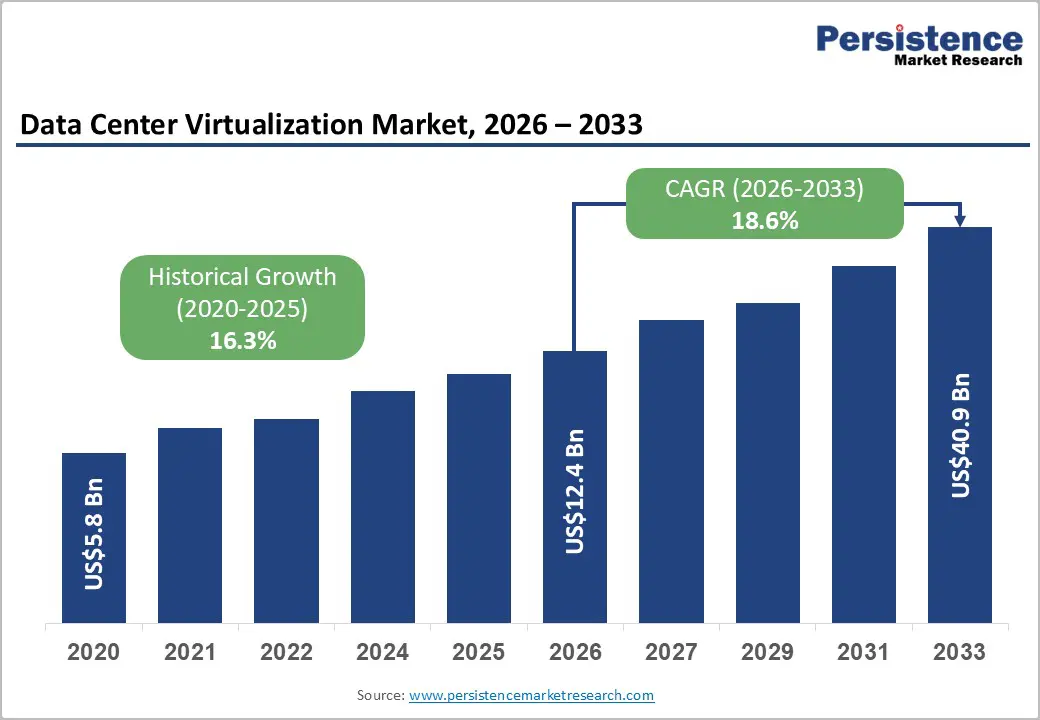
The global data center virtualization market size is likely to be valued at US$12.4 billion in 2026 and is expected to reach US$40.9 billion by 2033, growing at a CAGR of 18.6% between 2026 and 2033, driven by the transition from conventional server consolidation practices to advanced software-defined infrastructure models, supported by increasing hybrid cloud adoption, AI-intensive workloads, evolving cybersecurity demands, and growing emphasis on energy efficiency.
Rising power consumption in data centers and increasing infrastructure complexity are further accelerating the adoption of virtualization technologies as a core component of enterprise IT strategies. Organizations are increasingly leveraging virtualization to optimize server utilization, minimize reliance on physical hardware, simplify workload management, and enable seamless multi-cloud operations.
Key Industry Highlights:
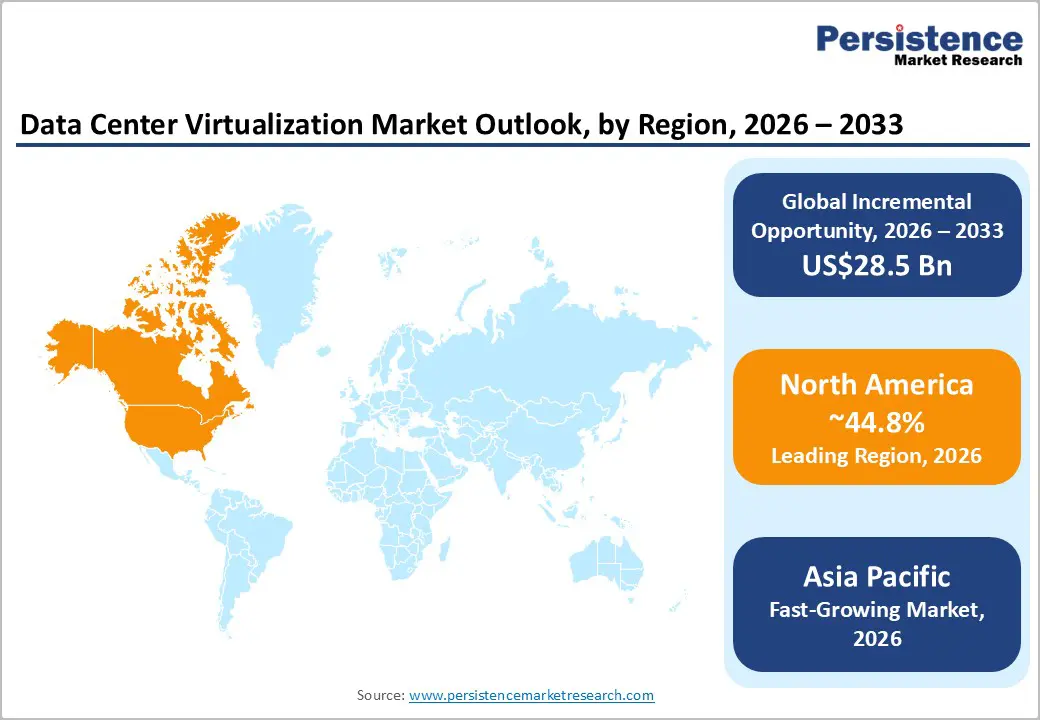
- Leading Region: North America is projected to dominate the market, with a 44.8% revenue share in 2026, supported by strong hyperscale infrastructure expansion, AI-driven data center investments, and widespread hybrid cloud adoption across the U.S. and Canada.
- Fastest-growing Region: Asia Pacific is projected to register the fastest growth during the forecast period, driven by rapid digital transformation, hyperscale cloud expansion, and AI infrastructure deployment.
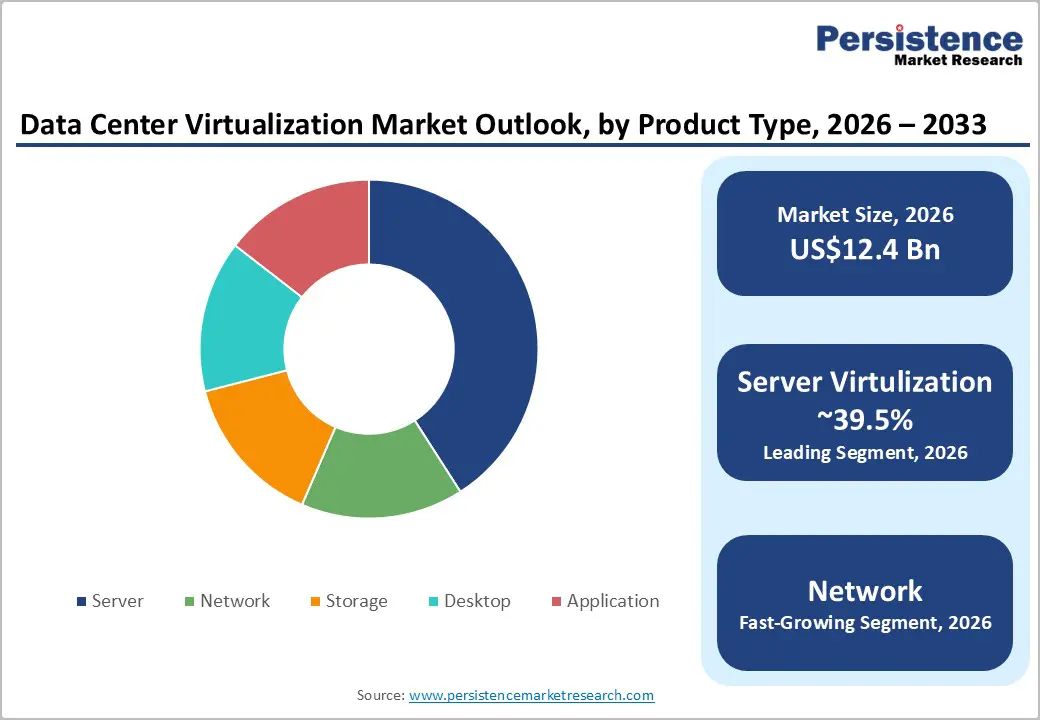
- Dominant Product Type: Server virtualization is anticipated to lead with a 39.5% market share in 2026, driven by increasing enterprise demand for workload consolidation, infrastructure optimization, hybrid cloud deployments and improved server utilization efficiency.
- Leading Component: Software is estimated to dominate with an estimated 77.2% market share in 2026, supported by rising adoption of orchestration platforms, automation tools, software-defined infrastructure, and centralized virtualization management solutions.
DRO Analysis
Drivers - AI-Era Compute Density Is Increasing the Strategic Value of Virtualization
The rapid growth of AI applications, machine learning workloads, and data-intensive computing environments is significantly increasing infrastructure complexity across enterprise and hyperscale data centers. Virtualization technologies enable organizations to optimize computing resources by consolidating workloads onto fewer physical servers while maintaining operational flexibility and scalability. This approach reduces hardware utilization inefficiencies, minimizes cooling requirements, and improves overall data-center performance.
As enterprises deploy GPU-intensive AI workloads, rack density and power consumption are rising sharply. Virtualization helps operators dynamically allocate computing resources, isolate workloads, and manage infrastructure utilization more efficiently. The technology also supports workload mobility across hybrid environments, enabling organizations to balance performance requirements with energy-efficiency objectives. Enterprises are increasingly viewing virtualization not only as a cost-reduction mechanism but also as a foundational infrastructure layer for AI-ready data-center architectures. The growing emphasis on sustainable infrastructure management and operational optimization continues to strengthen demand for virtualization platforms across cloud providers, enterprises, and colocation operators.
Hybrid Cloud Modernization Is Transforming Virtualization into a Platform-Centric Investment
Enterprise IT modernization strategies are increasingly centered on hybrid and multi-cloud operating environments. Organizations require consistent infrastructure management across on-premises data centers, edge locations, and public cloud environments, which is driving adoption of integrated virtualization platforms. Modern virtualization ecosystems now combine orchestration, automation, and security, networking, and workload management capabilities into unified software-defined infrastructure frameworks.
Major technology providers are expanding hybrid-cloud virtualization solutions to support distributed enterprise operations and cloud-native application environments. Virtualization platforms are increasingly integrated with Kubernetes, AI orchestration tools, and software-defined networking technologies, allowing enterprises to modernize legacy applications while maintaining operational continuity.
Restraint - Infrastructure Costs and Power Constraints Continue to Affect Deployment Timelines
Despite strong growth potential, the market continues to face structural challenges associated with infrastructure modernization costs, power availability, and supply-chain pressures. Virtualization deployment often requires substantial investments in upgraded servers, networking infrastructure, storage systems, and software licensing. For many organizations, particularly mid-sized enterprises, these upfront modernization costs can delay implementation decisions.
Power availability has also become a major operational concern for data center operators worldwide. Increasing AI-driven workloads are placing significant pressure on electricity grids and cooling infrastructure, particularly in major cloud and colocation hubs. Supply-chain disruptions and geopolitical trade uncertainties have driven up the costs of servers, semiconductors, and networking equipment. These factors may slow large-scale infrastructure refresh cycles and prompt some organizations to extend the lifecycles of existing systems rather than pursue full virtualization modernization projects.
In highly regulated sectors, migration complexity and compliance validation requirements can further increase deployment timelines and operational risks, creating additional barriers for smaller enterprises with limited technical resources.
Opportunities - Europe’s Sustainability and Compliance Initiatives Are Creating New Modernization Demand
Europe is emerging as a strategically important growth market for virtualization technologies due to expanding sustainability regulations, digital sovereignty initiatives, and enterprise modernization requirements. Regulatory authorities across the region are increasing focus on energy monitoring, emissions reporting, and operational transparency for large-scale data centers. These developments are encouraging enterprises to adopt virtualization technologies that improve infrastructure efficiency and reduce reliance on hardware.
Virtualization platforms enable organizations to optimize server utilization, lower energy consumption, and streamline workload orchestration across distributed infrastructure environments. Enterprises in sectors such as banking, manufacturing, healthcare, and government services are increasingly investing in software-defined infrastructure solutions to meet evolving operational and compliance standards. Enterprises are prioritizing data residency, cybersecurity, and operational resilience, particularly in industries handling sensitive information.
Asia Pacific Is Becoming a Major Growth Hub for Localized Cloud and Virtualization Infrastructure
Asia Pacific is expected to be the fastest-growing regional market, driven by accelerating digital transformation, expanding cloud infrastructure, and rising enterprise technology investments across China, India, Japan, South Korea, and ASEAN economies. Governments and enterprises across the region are prioritizing domestic cloud infrastructure, AI deployment, and digital-service scalability, creating strong demand for virtualization technologies.
The rapid expansion of hyperscale data centers and enterprise cloud adoption is increasing the need for efficient workload management and infrastructure optimization. Virtualization platforms allow organizations to deploy scalable computing environments while minimizing hardware costs and improving operational flexibility. This is particularly important in emerging economies, where enterprises require cost-efficient digital infrastructure to support rapid business growth.
Growing adoption of edge computing, smart manufacturing, digital banking, and e-commerce platforms is further strengthening demand for virtualized environments. Enterprises across the region are increasingly investing in hybrid-cloud architectures to improve resilience, reduce latency, and support localized data processing requirements.
Category-wise Analysis
Product Type Insights
Server virtualization is anticipated to account for the leading market share of 39.5% in 2026. The segment maintains its dominant position because it provides the most direct and measurable improvements in infrastructure efficiency, resource utilization, and operational cost reduction. Organizations use server virtualization to consolidate workloads, reduce hardware dependency, and improve infrastructure scalability while maintaining business continuity.
The technology remains highly relevant in enterprise data centers undergoing cloud migration and modernization initiatives. Enterprises increasingly rely on server virtualization to support hybrid-cloud environments, disaster recovery systems, and dynamic workload allocation. Large organizations across banking, telecommunications, healthcare, and government sectors continue to prioritize server virtualization as it enables centralized infrastructure management and improves operational flexibility. As organizations attempt to optimize energy consumption and maximize computing efficiency, server virtualization continues to serve as the foundational layer for software-defined infrastructure environments.
Network virtualization is projected to register the fastest growth rate during the forecast period. The expansion is primarily driven by rising adoption of software-defined networking (SDN), network function virtualization (NFV), edge computing infrastructure, and cloud-native application architectures.
Enterprises are increasingly virtualizing networking functions to improve traffic management, enhance security, simplify infrastructure deployment, and support distributed operations across hybrid environments. The growing use of multi-cloud ecosystems and containerized applications has accelerated demand for software-controlled network environments capable of supporting dynamic workload movement and real-time policy management.
Component Insights
The software segment is estimated to hold the dominant market position with 77.2% market share in 2026. Virtualization technologies are fundamentally software-driven, relying on orchestration platforms, hypervisors, automation tools, and workload management systems to create virtual computing environments. Organizations increasingly prioritize virtualization software investments because centralized management capabilities improve operational efficiency, infrastructure visibility, and resource optimization.
Enterprises also require advanced monitoring, automation, and security integration features to support large-scale hybrid-cloud operations and AI-driven workloads. The software segment benefits from growing enterprise demand for cloud-native infrastructure management, cybersecurity integration, and policy-based automation. Vendors are increasingly incorporating AI-assisted workload optimization, predictive analytics, and automated lifecycle management capabilities into virtualization software platforms.
The services segment is projected to experience the fastest growth throughout the forecast period. Organizations increasingly require consulting, migration, deployment, optimization, and managed services to support complex virtualization projects and hybrid-cloud modernization initiatives.
Many enterprises operate legacy IT environments that require phased migration strategies and extensive infrastructure assessment before virtualization deployment. Managed-service providers and systems integrators play a critical role in reducing operational risk, improving migration efficiency, and ensuring regulatory compliance during infrastructure transformation projects. The rising adoption of subscription-based and cloud-managed infrastructure models is also supporting demand for ongoing support and optimization services. Small and medium-sized enterprises, in particular, increasingly rely on external expertise due to limited in-house IT resources and growing cybersecurity requirements.
Regional Insights
North America Data Center Virtualization Market Trends
North America is projected to account for the largest regional share of the market, representing 44.8% of the market share in 2026. The region is projected to maintain strong growth momentum with a CAGR of approximately 20.8% between 2026 and 2033, while the U.S. remains the dominant national market.
U.S. Data Center Virtualization Market Trends
The U.S. represents the largest market for data center virtualization in North America due to its advanced cloud ecosystem, strong enterprise IT spending, and concentration of hyperscale infrastructure providers. Major technology companies, cloud service operators, and colocation providers continue expanding AI-ready data centers and hybrid-cloud infrastructure across the country. Enterprises in the banking, healthcare, telecommunications, retail, and government sectors are investing heavily in virtualization technologies to improve workload scalability, strengthen cybersecurity resilience, and support cloud-native application environments.
The country also benefits from strong adoption of software-defined networking, AI infrastructure orchestration, and edge computing platforms. Rising investments in generative AI, high-performance computing, and large-scale cloud modernization initiatives are accelerating virtualization demand. Federal cybersecurity regulations and disaster recovery requirements are further encouraging enterprises to deploy virtualized infrastructure capable of supporting operational continuity and workload portability.
Canada Data Center Virtualization Market Trends
Canada is emerging as a strategically important market due to growing cloud adoption, government-supported digital transformation programs, and increasing enterprise investment in secure data infrastructure. The country’s expanding hyperscale and colocation footprint is driving demand for virtualization platforms that improve infrastructure efficiency and reduce operational costs.
Canadian enterprises are increasingly prioritizing hybrid-cloud deployment models, particularly in financial services, healthcare, education, and public-sector operations. Sustainability initiatives and energy-efficiency goals are also encouraging organizations to optimize infrastructure utilization through virtualization technologies. The presence of renewable energy resources and stable regulatory conditions continues to attract long-term data-center investments across major cities such as Toronto, Montreal, and Vancouver.
Europe Data Center Virtualization Market Trends
Europe represents a strategically important market driven by sustainability initiatives, digital sovereignty priorities, and enterprise modernization programs.
Germany Data Center Virtualization Market Trends
Germany remains one of the largest and most technologically advanced data center virtualization markets in Europe. The country benefits from a strong industrial base, widespread enterprise digitalization, and high demand for secure infrastructure solutions across manufacturing, automotive, banking, and healthcare sectors. German enterprises are increasingly adopting virtualization technologies to support Industry 4.0 initiatives, AI-enabled manufacturing environments, and cloud-based operational systems.
The country’s emphasis on data security, operational reliability, and energy efficiency is accelerating the adoption of software-defined infrastructure solutions. Germany also serves as a major colocation and hyperscale infrastructure hub within Europe, supported by advanced connectivity networks and strong enterprise technology investment.
U.K. Data Center Virtualization Market Trends
The U.K. continues to be a major market for virtualization technologies due to rapid cloud migration, financial-sector modernization, and increasing investment in AI infrastructure. Enterprises across banking, insurance, retail, and telecommunications sectors are deploying virtualized environments to improve workload flexibility and support hybrid-cloud operations.
London remains a key data-center hub for Europe, attracting investment from hyperscale cloud providers and colocation operators. The country also benefits from strong enterprise adoption of automation technologies, cybersecurity platforms, and software-defined networking solutions. Regulatory focus on data protection and operational resilience continues to strengthen demand for secure and scalable virtualization infrastructure.
Asia Pacific Data Center Virtualization Market Trends
Asia Pacific is projected to be the fastest-growing regional market throughout the forecast period. Strong digital transformation initiatives, rapid cloud adoption, expanding hyperscale infrastructure, and increasing AI deployment are driving substantial demand for virtualization technologies across the region.
China Data Center Virtualization Market Trends
China represents one of the largest data center infrastructure markets globally, supported by strong government-backed digitalization initiatives, large-scale cloud expansion, and rapid AI deployment. Domestic cloud providers and enterprise technology companies continue investing heavily in hyperscale infrastructure and software-defined data-center environments.
Virtualization technologies are increasingly used to optimize computing resources, improve workload scalability, and support expanding digital-service ecosystems. Industries such as e-commerce, financial technology, manufacturing, and telecommunications are driving strong demand for virtualized infrastructure platforms across the country.
Japan Data Center Virtualization Market Trends
Japan remains a technologically advanced market characterized by strong enterprise adoption of AI infrastructure, cloud computing, and automation technologies. Enterprises across manufacturing, financial services, healthcare, and telecommunications sectors are investing in virtualization to improve operational resilience and support advanced digital services.
The country’s focus on disaster recovery preparedness, infrastructure reliability, and cybersecurity is accelerating demand for virtualized environments capable of supporting business continuity. Japan also continues to attract substantial investment in hyperscale cloud facilities and AI-ready infrastructure deployment.
India Data Center Virtualization Market Trends
India is emerging as one of the fastest-growing markets for data center virtualization due to rapid enterprise digitalization, expanding cloud adoption, and increasing AI infrastructure investment. The country is witnessing substantial growth in hyperscale data-center construction driven by digital banking, e-commerce, fintech, and government digitalization initiatives.
Enterprises are increasingly deploying virtualization technologies to improve infrastructure scalability, reduce hardware costs, and support hybrid-cloud operations. Government initiatives supporting digital transformation, data localization, and smart-city development are further strengthening long-term market growth opportunities across India’s technology ecosystem.
Competitive Landscape
The global data center virtualization market remains moderately concentrated among major global infrastructure and cloud technology providers. Leading companies continue to compete across virtualization software, hybrid-cloud infrastructure, automation platforms, and managed services.
Leading companies are prioritizing platform integration, hybrid-cloud expansion, AI-enabled infrastructure management, ecosystem partnerships, and managed-service delivery models. Vendors are also increasing investment in cybersecurity integration, automation capabilities, and sovereign cloud infrastructure to strengthen customer retention and improve long-term competitive positioning.
Key Industry Developments:
- In June 2025, Broadcom announced the general availability of VMware Cloud Foundation 9.0, introducing a unified private-cloud platform designed to support AI workloads, hybrid-cloud operations, and software-defined infrastructure management across data centers, edge environments, and hyperscale cloud ecosystems.
- In August 2025, Amazon Web Services launched the general availability of Amazon Elastic VMware Service (Amazon EVS), enabling enterprises to run VMware Cloud Foundation directly within Amazon Virtual Private Cloud (VPC) environments without application refactoring, strengthening AWS’s hybrid-cloud virtualization portfolio.
Companies Covered in Data Center Virtualization Market
- VMware by Broadcom
- Microsoft Corporation
- Amazon Web Services
- IBM Corporation
- Cisco Systems
- Oracle Corporation
- Red Hat
- Nutanix
- Dell Technologies
- Hewlett-Packard Enterprise
- Citrix Systems
- Huawei Technologies
- Alibaba Cloud
- Google Cloud
- Fujitsu Limited
- SUSE
Frequently Asked Questions
The global data center virtualization market is estimated to be valued at US$12.4 billion in 2026.
The data center virtualization market is projected to reach approximately US$40.9 billion by 2033.
Key trends include the rapid adoption of hybrid-cloud architectures, increasing deployment of AI-ready infrastructure, growing use of software-defined networking (SDN), rising demand for edge computing, and expanding investment in energy-efficient data-center operations.
Server virtualization is the leading product segment, accounting for 39.5% of the market share, due to its ability to improve server utilization, reduce infrastructure costs, and support scalable enterprise computing environments.
The data center virtualization market is projected to grow at a CAGR of 18.6% between 2026 and 2033.
Major companies include Broadcom, Microsoft Corporation, Amazon Web Services, IBM Corporation, and Cisco Systems.


