




- Medical Devices
- Biosensor Market
Biosensor Market Size, Share, Growth, and Regional Forecast, 2026 to 2033
Biosensor Market by Product (Electrochemical biosensors, Optical Biosensors, Piezoelectric biosensors, Thermistor biosensors), Application (Medical Diagnostics, Food Toxicity Detection, Industrial Process Control, Environmental Analysis, Agricultural Testing), End User (Home Healthcare Diagnostics, Research Laboratories, Security and Bio-defense, Others), and Regional Analysis from 2026 to 2033.

Biosensor Market Size and Trend Analysis
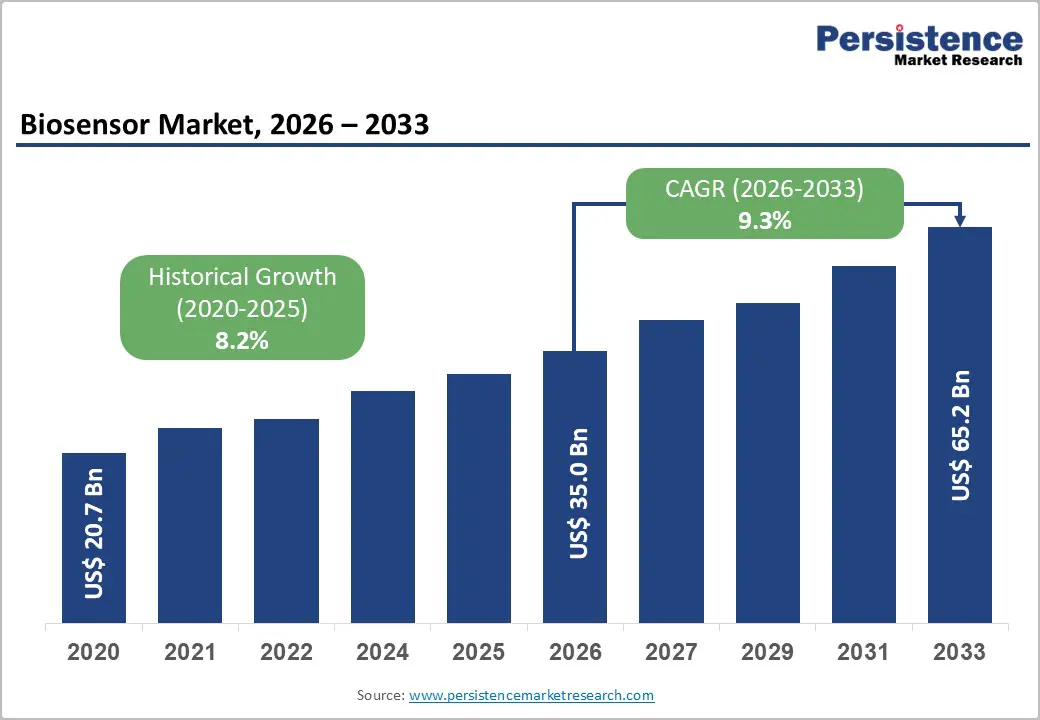
The global biosensor market is estimated to grow from US$ 35.0 Bn in 2026 to US$ 65.2 Bn by 2033. The market is projected to record a CAGR of 9.3% during the forecast period from 2026 to 2033.
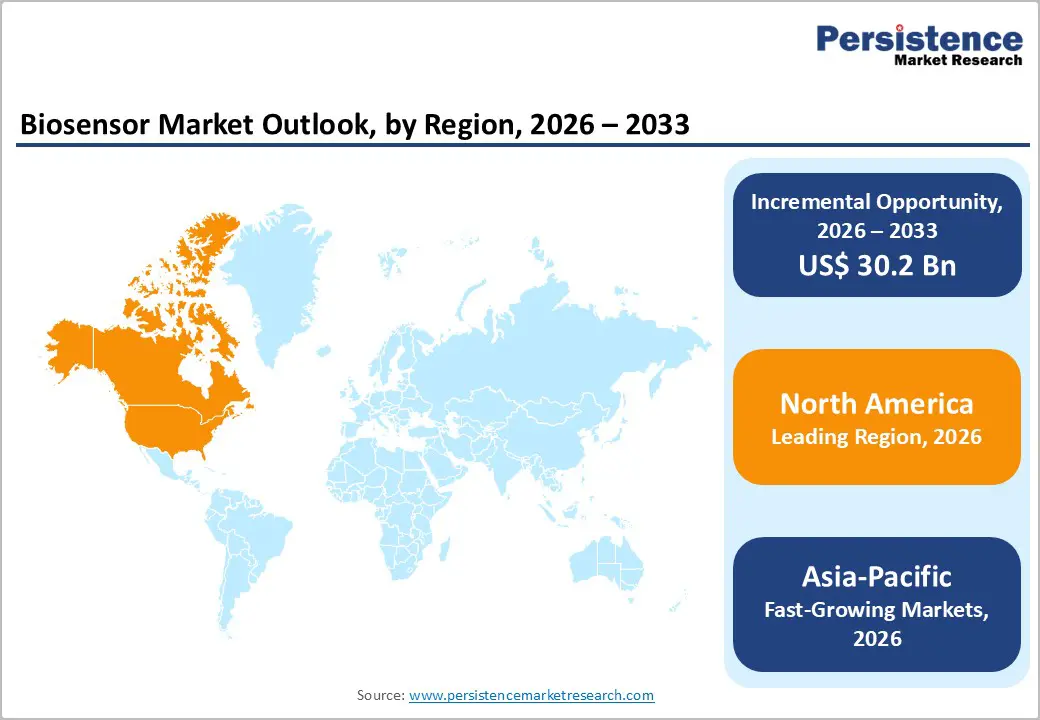
The global biosensor market is growing steadily, fueled by telehealth, healthcare analytics, and digital care adoption. North America leads due to advanced infrastructure and strong regulations, while Asia-Pacific is the fastest-growing region, driven by expanding healthcare, government digital initiatives, rising patient awareness, and increased investments in software, services, and interoperable remote monitoring solutions.
Key Industry Highlights
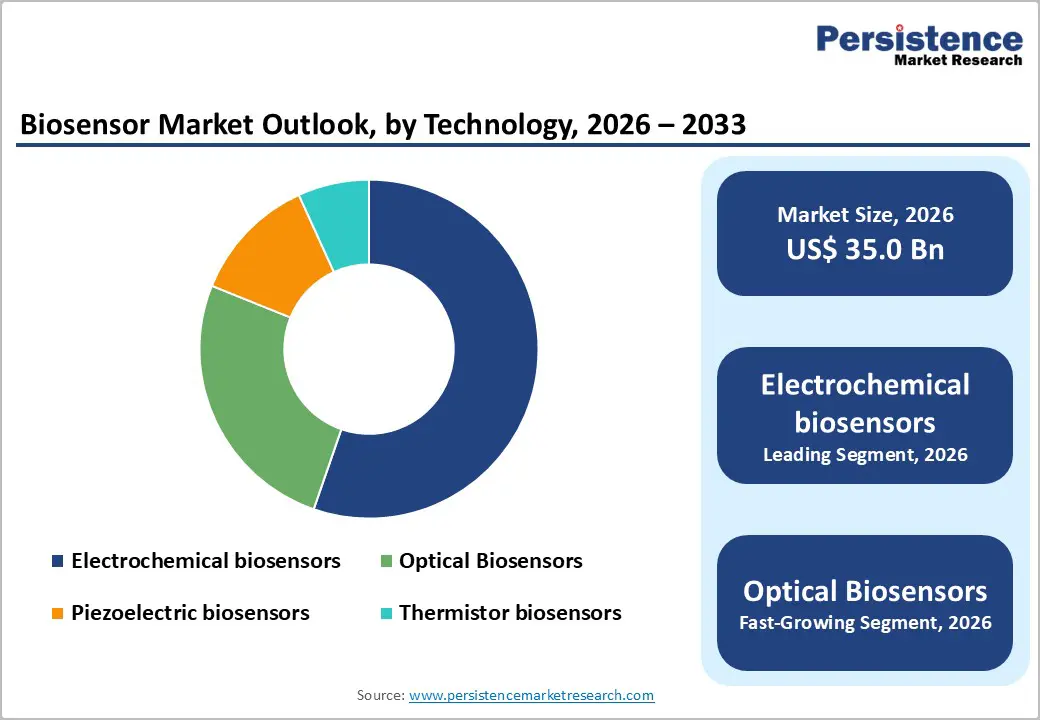
- Dominant Segment: Electrochemical biosensors hold the largest share with 55.3% in 2025, driven by widespread use in glucose monitoring, point-of-care diagnostics, and wearable health devices. Their reliability, cost-effectiveness, and integration with mobile and cloud platforms enable real-time monitoring, remote health tracking, and compatibility with telehealth and digital care workflows.
- Dominant Region: North America leads the market with 39.5% share in 2025, supported by advanced healthcare infrastructure, strong regulatory frameworks, and high adoption of digital monitoring solutions. Asia-Pacific is the fastest-growing region, fueled by healthcare expansion, government digital initiatives, rising patient awareness, and increased investments in remote monitoring, software, and interoperable biosensor solutions.
- Market Drivers: Growth is propelled by rising chronic disease prevalence, increasing demand for real-time monitoring, telehealth adoption, advancements in AI and IoT-enabled sensors, and the need for efficient clinical and home-based health management.
- Market Opportunity: Key opportunities include wearable and implantable biosensors, AI-enabled predictive health monitoring, remote patient tracking, integration with telehealth and mHealth platforms, environmental and food safety biosensors, and rapid market expansion across emerging economies with growing healthcare digitization.
| Global Market Attributes | Key Insights |
|---|---|
| Global Biosensor Market Size (2026E) | US$ 35.0 Bn |
| Market Value Forecast (2033F) | US$ 65.2 Bn |
| Projected Growth (CAGR 2026 to 2033) | 9.3% |
| Historical Market Growth (CAGR 2020 to 2025) | 8.2% |
Market Dynamics
Driver: Telehealth & remote patient monitoring adoption
Telehealth and remote patient monitoring (RPM) adoption has rapidly expanded, forming a key driver for the biosensor market by embedding real?time physiological data into digital care workflows. In the United States, telemedicine use surged from 16?percent of physicians in 2019 to over 80?percent by 2021, demonstrating widespread provider engagement with remote care modalities. According to digital health adoption data, RPM services and monitoring tools are expected to reach over 30?million U.S. patients by 2024, with 88?percent of patients reporting access to remote healthcare in the last year. These trends increase demand for connected biosensor technologies that continuously capture and transmit vital signs, enabling clinicians to assess patient status remotely.
Government surveys indicate telehealth has become a routine component of care delivery post?COVID?19. The CDC reported 37?percent of U.S. adults used telemedicine in the past 12?months (2021), compared with much lower pre?pandemic levels, reflecting sustained remote engagement. Independent data show the use of remote monitoring kits or devices is a priority for healthcare organizations, with 41?percent of telehealth technology respondents indicating RPM interest, underscoring institutional demand. RPM adoption reduces unnecessary in?person visits and enables chronic disease management outside hospitals, driving biosensor integration into standard care and expanding the market for wearable and connected sensing solutions.
Restraints: High device and deployment costs
High device and deployment costs significantly restrain biosensor market adoption, particularly for advanced clinical?grade solutions. Developing and manufacturing biosensors involves substantial investment in R&D, precision components, and compliance with medical standards, with some biosensor development programs historically exceeding $20?million and taking 7–10?years before commercialization. In healthcare settings, advanced wearable and sensor?based devices often require rigorous clinical validation and regulatory approvals, adding time and expense; for example, FDA approval timelines of 12–24?months are common, raising development costs further. These high upfront costs make biosensors less accessible in price?sensitive markets and constrain adoption by smaller providers and low?income patient populations.
Cost barriers extend beyond development to implementation and ongoing operation. Medical biosensors must integrate with existing clinical workflows, electronic systems, and data platforms, increasing deployment expenses beyond the device itself. Hospitals and providers face equipment, software, and IT integration costs that may be prohibitive without clear reimbursement pathways. Although comprehensive government statistics on specific device prices are limited, broader medical technology cost analyses show that 20–25?percent of total healthcare costs in hospitals can be attributable to medical device expenditure, including diagnostics and monitoring equipment. In many regions, inconsistent insurance coverage for advanced monitoring devices leaves patients paying out?of?pocket, dampening demand and slowing market growth.
Opportunity: Wearable and implantable biosensors
Wearable biosensors represent a significant growth opportunity for the biosensor market by enabling continuous, real?time health monitoring outside traditional clinical environments. Government?related research indicates that nearly one in three U.S. adults uses a wearable device, such as a smartwatch or band, to track health and fitness metrics, and over 80?percent of these users are willing to share device data with clinicians to support health monitoring. This widespread adoption reflects rising consumer acceptance and suggests a large potential user base for biosensor technologies that feed clinical insights into telehealth and chronic disease management, thereby expanding biosensor integration into everyday healthcare delivery.
Implantable biosensors, particularly continuous glucose monitors (CGMs), underscore another substantial market opportunity by offering long?term physiological data essential for chronic disease management. The Food and Drug Administration recently cleared an implantable CGM that lasts up to one year, providing glucose readings every five minutes and enhancing continuous monitoring for people with diabetes. With diabetes affecting over 30?million people in the United States and projected to rise globally, implantable sensors can improve disease management by reducing the need for frequent invasive checks and facilitating real?time adjustments to care. These innovations align with broader healthcare goals of personalized, data?driven care pathways and create opportunities for deeper clinical adoption and integration with remote monitoring systems.
Category-wise Analysis
By Technology, Electrochemical biosensors Dominates the Biosensor Market
Electrochemical biosensors occupies 55.3% share of the global market in 2025, due to their high sensitivity, accuracy, low cost, and ease of integration into point-of-care and wearable devices. They are particularly critical in diabetes management, with continuous glucose monitoring systems relying on electrochemical transduction for real-time measurements. In the United States, about 15.8?percent of adults have diabetes, highlighting a substantial user base driving demand. Electrochemical biosensors also enable rapid, quantitative detection of multiple analytes in blood, saliva, and sweat, supporting remote monitoring and telehealth applications. Their compact design, compatibility with digital platforms, and ability to provide real-time data make them more widely adopted than optical, piezoelectric, or thermal sensors, securing over 70?percent of the market share globally.
By Application, Medical Diagnostics dominates due to chronic disease monitoring, rapid testing, and remote healthcare integration
Medical diagnostics dominates the biosensor market because healthcare increasingly relies on rapid, accurate, and decentralized testing for disease detection and management. Biosensors are integral to diagnosing chronic conditions like diabetes, where continuous glucose monitoring systems measure glucose every few minutes, dramatically improving glycemic control and reducing complications. Clinical biosensors also enable point?of?care diagnostics, reducing turnaround times from hours to minutes for critical tests such as cardiac markers and infectious disease screening. Telehealth and remote monitoring further amplify this trend, with connected biosensors providing clinicians real?time physiological data outside traditional facilities. The global rise in chronic diseases and preventive care emphasis has established medical applications as the predominant use case, accounting for the largest share of biosensor deployments worldwide.
Regional Insights
North America Biosensor Market Trends
North America dominates the biosensor market with 39.5% share in 2025, because its advanced healthcare infrastructure, high healthcare spending, and technology adoption drive widespread use of sensor?based diagnostics and monitoring tools. In 2023, U.S. healthcare spending reached about?$4.9?trillion, representing roughly 17?% of GDP, underscoring strong investment in medical technologies and care delivery systems. The region also bears a heavy chronic disease burden, with about 90?percent of healthcare expenditures linked to chronic conditions, prompting adoption of continuous monitoring solutions that often rely on biosensors. Moreover, close to 96?% of U.S. hospitals and 78?percent of physicians use certified electronic health records, facilitating integration of biosensor data into clinical workflows. These factors, along with strong R&D and reimbursement environments, bolster North America’s leadership in the global biosensor market.
Europe Biosensor Market Trends
Europe is an important region in the global biosensor market because it combines advanced healthcare infrastructure, universal healthcare coverage, and a high prevalence of chronic conditions that drive diagnostic and monitoring demand. Europeans spend about 10?percent of GDP on healthcare, with significant per?capita investment in medical technology and diagnostics. The region accounts for around 28?% of the global biosensor market, making it the second?largest market globally. Countries such as Germany, the UK, and France lead adoption due to robust clinical systems, national digital health initiatives, and strong regulatory frameworks that ensure safety and integration of biosensor technologies into routine care. Moreover, Europe’s aging population and proactive preventive healthcare policies create sustained demand for real?time monitoring and early diagnosis solutions fundamental to biosensor growth
Asia-Pacific Biosensor Market Trends
Asia?Pacific is the fastest?growing region in the biosensor market because rapid digital healthcare adoption, rising chronic disease burden, and expanding connectivity are driving demand for remote monitoring and sensor-based solutions. The region has over 1.5?billion mobile internet users, facilitating telehealth and wearable health device uptake. Governments are investing in national digital health programs, such as India’s Ayushman Bharat Digital Mission with over 400?million enrolled health IDs, enhancing digital care access. The WHO notes non-communicable diseases cause a significant portion of deaths in Asia Pacific, increasing demand for continuous monitoring tools that biosensors support. Additionally, internet penetration exceeding 70?% enables broader use of apps and devices that integrate biosensors with clinical workflows, accelerating market growth.
Market Competitive Landscape
Leading biosensor market companies focus on connected devices, software, and services, emphasizing interoperability, security, and user-friendly designs. Investments target AI-driven analytics, telehealth, and patient engagement, while R&D improves accuracy and efficiency. Collaborations with healthcare providers and regulators accelerate adoption, innovation, and global integration, driving growth in remote monitoring, digital health, and continuous patient care solutions.
Key Industry Developments:
- In November 2025, Thermo Fisher Scientific inaugurated its Customer Experience and Bioprocess Centres in Hyderabad, enhancing support for biopharma and life sciences customers. The new centres provide advanced training, hands-on demonstrations, and process optimization services, enabling clients to accelerate research and biomanufacturing workflows.
- In October 2025, Thermo Fisher Scientific acquired Clario Holdings, Inc., strengthening its offerings for pharmaceutical and biotechnology customers. The acquisition enables clients to accelerate innovation by providing deeper clinical insights through enhanced data analytics and integrated solutions.
- In July 2025, Dexcom launched a new AI-powered meal logging feature across its glucose biosensing portfolio. The feature enables users to automatically track and analyze dietary intake alongside continuous glucose monitoring data, providing personalized insights for better diabetes management.
Companies Covered in Biosensor Market
- Johnson & Johnson Services, Inc.
- Thermo Fisher Scientific, Inc.
- DexCom, Inc.
- Siemens Healthineers
- Abbott Laboratories
- Metrohm AG
- Medtronic
- Universal Biosensors, Inc.
- Cyrcadia Health
- Biosensors International Group
- Sensirion AG
- Pinnacle Technology, Inc.
- Nix Biosensors
- F. Hoffmann-La Roche
- Zimmer & Peacock AS
- Dupont
- Lifescan
Frequently Asked Questions
The global biosensor market is projected to be valued at US$ 35.0 Bn in 2026.
Rising chronic diseases, telehealth adoption, wearable integration, digital health expansion, and technological advancements drive biosensor growth.
The global biosensor market is poised to witness a CAGR of 9.3% between 2026 and 2033.
Wearable and implantable biosensors, AI analytics, remote monitoring, telehealth integration, and emerging market expansion.
Johnson & Johnson Services, Inc., Thermo Fisher Scientific, Inc., DexCom, Inc., Siemens Healthineers, Abbott Laboratories, Metrohm AG.


