




- Medical Devices
- EEG Biosensors Market
EEG Biosensors Market Size, Share, and Growth Forecast, 2026 - 2033
EEG Biosensors Market by Product Type (Wired, Wireless), Electrode Connection, Application (Biological Industry, Medical Industry, Others), and Regional Analysis for 2026 - 2033

EEG Biosensors Market Size and Trends Analysis
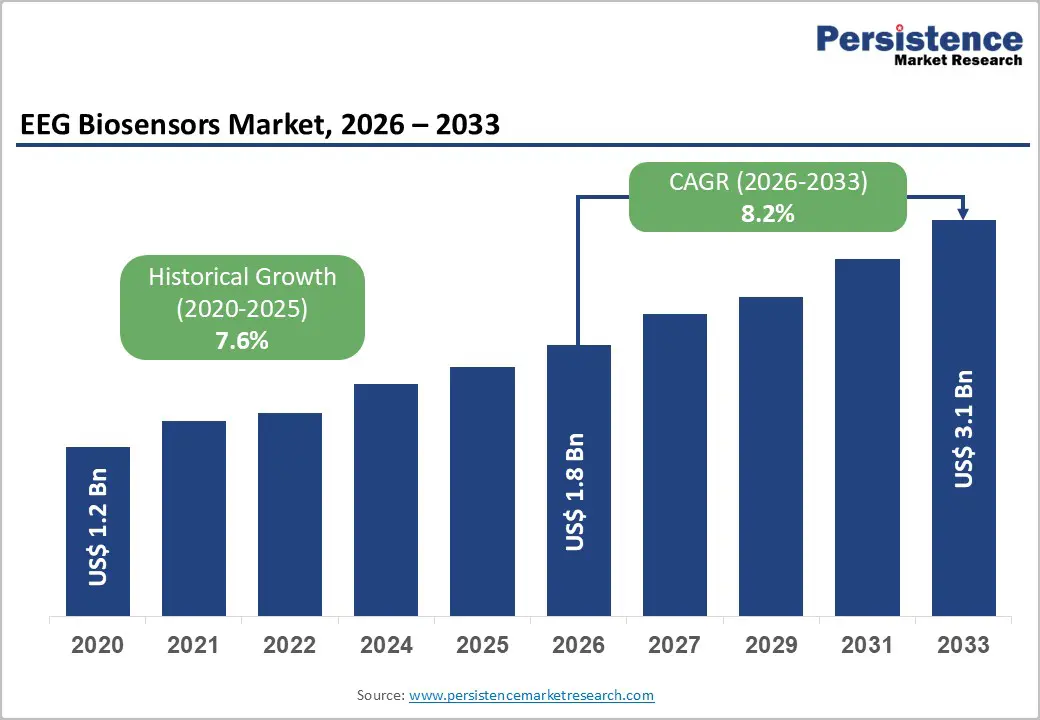
The global EEG biosensors market size is likely to be valued at US$1.8 billion in 2026, and is expected to reach US$3.1 billion by 2033, growing at a CAGR of 8.2% during the forecast period from 2026 to 2033, driven by rising demand for non-invasive brain monitoring, increasing adoption in medical diagnostics, and expanding use in research and consumer neurotechnology. The increasing application of EEG biosensors for neurological disorder diagnosis and brain-computer interface development remains a major driver of the EEG biosensors market growth.
Key Industry Highlights:
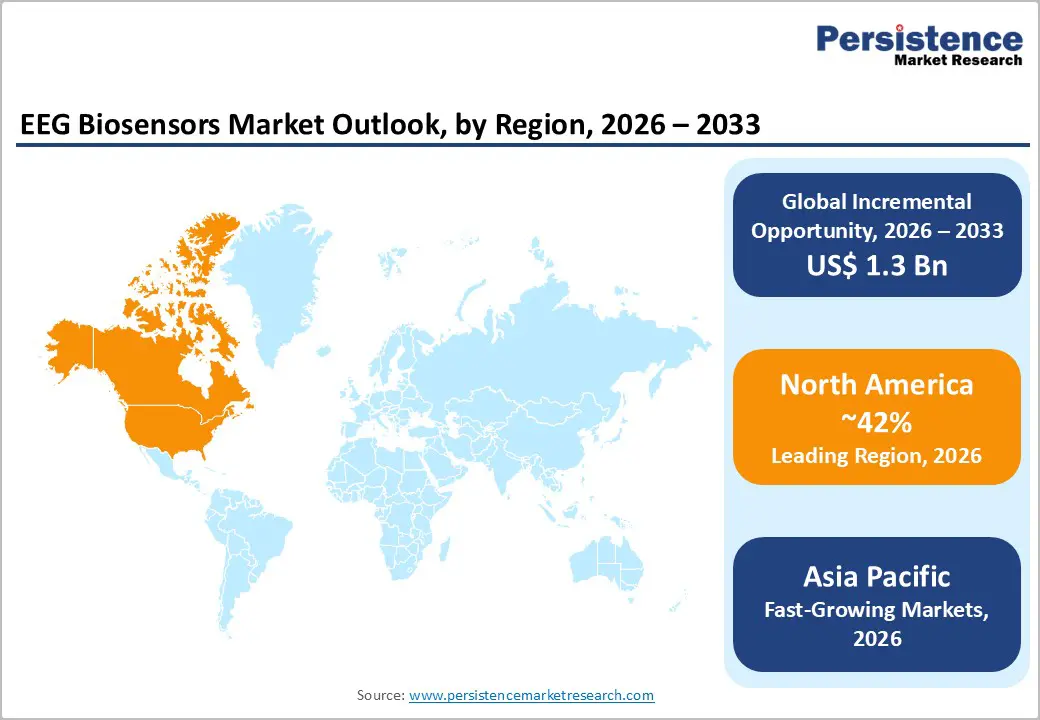
- Leading Region: North America is projected to dominate with about 42% revenue share in 2026, driven by advanced healthcare infrastructure, strong technology adoption, and increasing use of EEG biosensors in neurological diagnostics and real-time patient monitoring.
- Fastest-growing Region: Asia Pacific, fueled by improving healthcare infrastructure, rising neurological disorder awareness, increasing medical technology investments, and strong demand from countries, including China, India, and Japan.
- Dominant Product Type: Wireless EEG biosensors are expected to dominate with around 62% share in 2026, driven by superior mobility, ease of use, real-time connectivity, and suitability for comfortable long-term and remote monitoring.
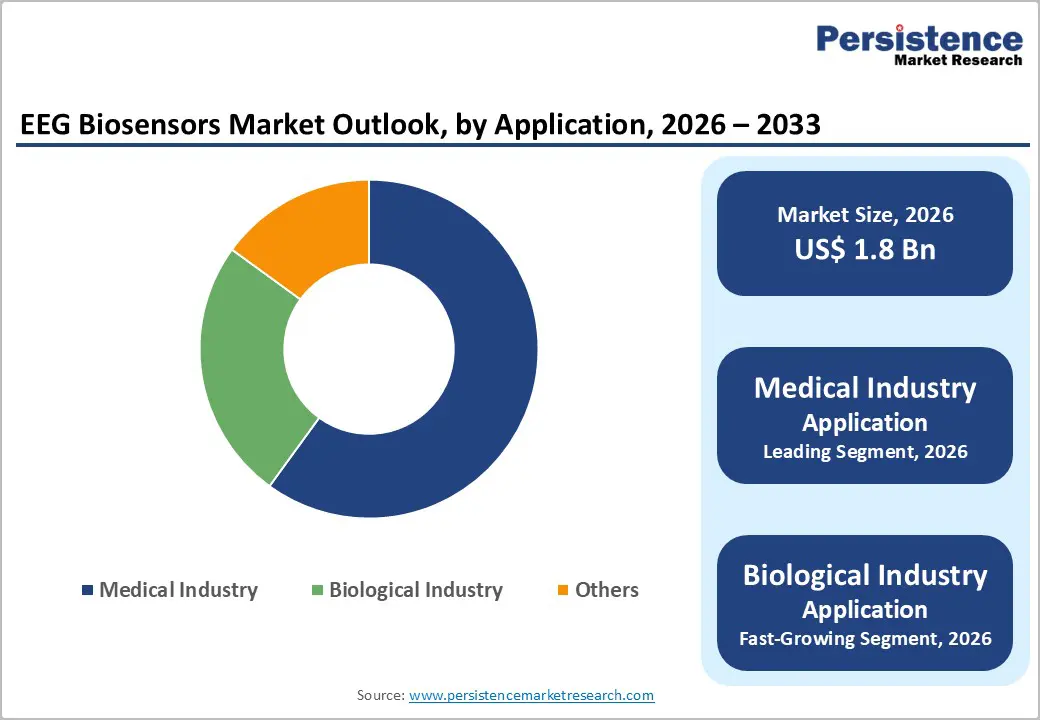
- Leading Application: The medical industry is projected to dominate with around 60% share in 2026, driven by extensive use of EEG biosensors in neurological diagnostics, continuous monitoring, and long-term management of conditions such as epilepsy, sleep disorders, and brain injuries.
| Key Insights | Details |
|---|---|
| EEG Biosensors Market Size (2026E) | US$1.8 Bn |
| Market Value Forecast (2033F) | US$3.1 Bn |
| Projected Growth CAGR (2026 - 2033) | 8.2% |
| Historical Market Growth (2020 - 2025) | 7.6% |
DRO Analysis
Driver - Rising Prevalence of Neurological Disorders
The growing burden of neurological conditions is driving strong demand for advanced brain-monitoring solutions, such as EEG biosensors. Disorders such as epilepsy, Alzheimer’s disease, Parkinson’s disease, and stroke are becoming increasingly common due to aging populations, changing lifestyles, and improved diagnostic awareness. These conditions often require continuous or repeated monitoring of brain activity to support accurate diagnosis, treatment planning, and long-term management. EEG biosensors provide a non-invasive and cost-effective method for capturing real-time neural signals, making them highly suitable for both clinical and home-based settings.
The rising incidence of sleep disorders, traumatic brain injuries, and mental health conditions such as anxiety and depression is further expanding the application scope of EEG technologies. Healthcare providers are increasingly relying on these devices to monitor disease progression and evaluate therapeutic outcomes. The shift toward early diagnosis and preventive care also encourages the use of EEG biosensors for identifying abnormalities at an early stage. As healthcare systems focus more on personalized and continuous monitoring approaches, the relevance of EEG biosensors continues to grow, positioning them as essential tools in modern neurological care.
Growing Demand for Non-Invasive Brain Monitoring
The preference for safer and patient-friendly diagnostic techniques is accelerating the adoption of non-invasive brain monitoring technologies. EEG biosensors have attracted significant attention because they enable continuous monitoring of brain activity without the need for surgical procedures or exposure to radiation. This makes them particularly suitable for vulnerable patient groups such as children, elderly individuals, and those requiring long-term neurological observation. Their ability to provide real-time insights into brain function supports timely clinical decisions and enhances overall patient care.
Healthcare providers are increasingly integrating these solutions into routine diagnostics, intensive care monitoring, and neurorehabilitation programs. The convenience of non-invasive systems also enables their use beyond hospitals, including home-based monitoring and ambulatory care settings. Technological advancements such as wearable headsets and wireless connectivity further improve patient comfort and ease of use, encouraging broader acceptance. The growing emphasis on early diagnosis and preventive healthcare is driving demand for tools that can detect neurological abnormalities without causing discomfort.
Restraint - Signal Accuracy and Noise Interference Issues
The reliability of EEG biosensors is often challenged by the inherently weak nature of brain signals and their susceptibility to external and physiological disturbances. Electrical activity captured from the scalp can be easily affected by factors such as muscle movements, eye blinking, sweating, and environmental electromagnetic interference. These artifacts can distort the recorded signals, making it difficult to distinguish meaningful neural patterns from noise, especially in real-world or non-clinical settings.
Accurate electrode placement and consistent skin contact are also critical for obtaining high-quality data, but variations in setup or user handling can lead to inconsistencies in signal acquisition. This becomes more pronounced as the use of wearable and portable EEG devices grows, where maintaining stable conditions is more challenging than in controlled clinical environments.
Limited Standardization and Regulatory Challenges
Variations in device design, data acquisition methods, and performance benchmarks create inconsistencies across EEG biosensor systems, making it difficult to establish uniform standards. Differences in electrode types, signal processing techniques, and software algorithms can lead to variability in results, which affects comparability and clinical reliability. This lack of harmonization poses challenges for healthcare providers and researchers who rely on consistent data for diagnosis, treatment planning, and cross-study analysis.
Regulatory pathways further complicate market expansion, as EEG biosensors must comply with stringent approval requirements across different regions. Manufacturers are required to demonstrate safety, accuracy, and clinical effectiveness, which often involves extensive validation studies and documentation. The evolving nature of wearable and AI-enabled EEG technologies adds another layer of complexity, as regulatory frameworks may not always keep pace with innovation.
Opportunity - Growth of Brain-Computer Interface (BCI) Technologies
Advancements in technologies that enable direct communication between the human brain and external devices are creating significant opportunities for EEG biosensors. Brain-computer interfaces rely heavily on accurate and real-time detection of neural signals, making EEG-based systems a preferred choice due to their non-invasive nature and relative affordability. These technologies are increasingly being explored for applications that translate brain activity into commands, allowing users to control computers, prosthetic limbs, or assistive devices without physical movement.
The potential impact is particularly strong in the field of healthcare, where such systems are being developed to support individuals with paralysis, spinal cord injuries, and severe neurological impairments. By enabling communication and mobility through neural signals, EEG-driven interfaces are transforming rehabilitation and assistive care. Beyond medical use, there is growing interest in integrating these systems into areas such as gaming, virtual reality, and human-machine interaction, where cognitive inputs can enhance user experiences. Continuous improvements in signal processing, machine learning, and sensor design are making these interfaces more responsive and user-friendly.
Rising Adoption of Wearable and Portable EEG Devices
The shift toward compact, user-friendly neuro-monitoring solutions is significantly transforming the EEG biosensors landscape. Modern devices are increasingly designed to be lightweight, wireless, and easy to use, enabling continuous brain activity tracking outside traditional clinical environments. This evolution is addressing long-standing limitations associated with bulky equipment and complex setups, making EEG technology more accessible to a broader range of users, including patients, researchers, and even general consumers.
Portable and wearable EEG systems are gaining traction in home care settings, where they support long-term monitoring of neurological conditions without requiring frequent hospital visits. This is particularly beneficial for managing disorders that need continuous observation, as it allows clinicians to collect real-world data over extended periods. The convenience of these devices also enhances patient compliance, as they minimize discomfort and simplify daily usage. Beyond healthcare, wearable EEG solutions are being adopted across cognitive training, mental wellness, and performance optimization. Integration with smartphones and digital platforms enables seamless data tracking and analysis, further improving usability. Advances in battery life, connectivity, and sensor technology are continuing to enhance performance and reliability.
Category-wise Analysis
Product Type Insights
Wireless is anticipated to dominate and be the fastest-growing, capturing 62% of the market share in 2026, due to its superior mobility and ease of use. These systems eliminate the constraints of wired connections, enabling seamless monitoring of brain activity in both clinical and non-clinical settings. Their lightweight and portable design enhances patient comfort, making them ideal for long-term and home-based monitoring. Integration with mobile devices and cloud platforms supports real-time data access and remote diagnostics.
Emotiv Inc. offers wireless EEG biosensors through its product, the Emotiv Insight. This device is a compact, fully wireless neuroheadset developed for brain monitoring, brain-computer interface applications, and cognitive studies. It incorporates semi-dry sensors and enables smooth connectivity with computers and mobile devices, allowing real-time tracking of brain activity without the limitations of wired systems.
Application Insights
The medical industry is projected to dominate, with approximately 60% market share in 2026, driven by its critical role in neurological diagnostics and patient monitoring. EEG biosensors are extensively used in clinical settings for conditions such as epilepsy, sleep disorders, and brain injuries, where continuous and accurate brain activity tracking is essential. Hospitals and diagnostic centers rely on these systems for early detection, treatment planning, and long-term disease management. Philips Healthcare offers the Philips IntelliVue EEG Monitoring System, which is extensively utilized in hospitals and intensive care units for continuous monitoring of brain activity. It plays a crucial role in managing patients with epilepsy, traumatic brain injuries, and those undergoing anesthesia. The system delivers real-time EEG data, enabling healthcare professionals to evaluate neurological status and promptly identify abnormalities during critical care situations.
Biological Industry is the fastest-growing application, supported by expanding research in cognitive neuroscience and brain-computer interface development. Academic institutions and research organizations increasingly rely on EEG technologies to study brain function, neural pathways, and cognitive behavior in real time. These biosensors enable precise data collection for experiments on memory, attention, and decision-making. NeuroSky offers the MindWave Mobile 2, which is widely used in neuroscience research and brain-computer interface development. This device is engineered to record real-time brainwave activity using dry sensor technology and wirelessly transmit the data for further analysis in research settings.
Regional Insights
North America EEG Biosensors Market Trends
North America is projected to dominate, capturing 42% of revenue in 2026, driven by advanced healthcare infrastructure, high adoption of innovative medical technologies, and a well-established research ecosystem. The region is witnessing increasing integration of EEG biosensors in clinical diagnostics, particularly for conditions such as epilepsy, sleep disorders, and neurodegenerative diseases. Hospitals and specialized neurological centers are emphasizing continuous and real-time brain monitoring to enhance patient outcomes and support precision medicine approaches.
The rapid adoption of wearable and wireless EEG devices is enabling remote patient monitoring and expanding applications beyond traditional hospital settings. The growing focus on mental health and cognitive wellness is also encouraging the use of EEG biosensors in neurofeedback, stress management, and performance optimization. Strong collaboration between academic institutions, healthcare providers, and technology companies is accelerating innovation in brain-computer interfaces and AI-driven EEG analytics. Regulatory support and ongoing investments in neuroscience research further strengthen the market landscape.
Europe EEG Biosensors Market Trends
Europe is evolving steadily, supported by strong healthcare systems, growing emphasis on neurological research, and increasing awareness of brain health. Countries across the region are focusing on improving early diagnosis and management of conditions such as epilepsy, Alzheimer’s disease, and sleep disorders, which is driving the adoption of EEG-based monitoring technologies. Public healthcare initiatives and funding for neuroscience research are further contributing to market development.
A prominent trend in Europe is the rising demand for wearable and portable EEG biosensors, particularly for home-based care and long-term monitoring. The shift toward decentralized healthcare is encouraging the use of remote monitoring solutions, enabling continuous tracking of neurological conditions outside hospital settings. In addition, there is increasing interest in integrating EEG biosensors with digital health platforms to support data-driven clinical decisions and personalized treatment approaches.
Collaborations between research institutions, universities, and medical device companies are accelerating innovation in brain-computer interfaces and cognitive research applications. Regulatory frameworks focused on safety and quality are also shaping product development.
Asia Pacific EEG Biosensors Market Trends
Asia Pacific is likely to be the fastest-growing region, fueled by improving healthcare infrastructure, rising awareness of neurological disorders, and increasing investment in medical technology. Countries such as China, India, and Japan are playing a key role in market growth due to their large patient populations and growing focus on early diagnosis and treatment of brain-related conditions. The increasing burden of epilepsy, stroke, and sleep disorders is encouraging healthcare providers to adopt advanced monitoring solutions like EEG biosensors.
Rising adoption of cost-effective and portable EEG devices, which are particularly suited for resource-constrained settings and rural healthcare delivery. This is enabling wider access to neurological care and expanding the application of EEG biosensors beyond urban centers. There is a growing emphasis on research and innovation, particularly in brain-computer interfaces and cognitive neuroscience. Collaborations between academic institutions, technology firms, and healthcare providers are accelerating product development and commercialization.
Competitive Landscape
The global EEG biosensors market is characterized by intense competition, with key players such as NeuroSky, iMotions, Bitbrain Technologies, Ceribell Inc., Compumedics Neuroscan, Butler Technologies, g.tec neurotechnology GmbH, TMSi, BIOPAC Systems Inc., and EB Neuro actively driving innovation. These companies are prioritizing the development of wireless and lightweight EEG systems to enhance usability and patient comfort.
A strong emphasis is placed on improving signal accuracy through advanced sensor technologies and integrating artificial intelligence for faster and more precise data interpretation. Strategic collaborations with hospitals, universities, and research institutions are enabling clinical validation and expanding application areas. Companies are focusing on broadening their distribution networks and entering emerging markets to strengthen their global presence, while continuously investing in research to support both medical and neuroscience applications.
Key Industry Developments:
- In February 2026, NextSense announced the official launch and commercial shipment of its NextSense Smartbuds. The company introduced this innovation as an advanced brain-sensing wearable that went beyond traditional sleep trackers. Smartbuds used six EEG sensors to monitor brain activity in real time and actively delivered precisely timed audio stimulation to guide users into deeper and more restorative sleep.
- In November 2025, NeuroSky announced the formation of a joint venture with ZKTeco on November 11, 2025. Through this partnership, the companies aimed to accelerate global innovation in brain-computer interface technologies and expand advancements in emotion-aware human-machine interaction. This collaboration represented a significant step toward enhancing intelligent systems by integrating biosensing capabilities with multimodal AI technologies.
Companies Covered in EEG Biosensors Market
- NeuroSky
- iMotions
- Bitbrain Technologies
- Max-Planck-Gesellschaft
- Ceribell Inc.
- Compumedics Neuroscan
- Butler Technologies
- g.tec neurotechnology GmbH
- TMSi
- BIOPAC Systems Inc.
- EB Neuro
- Hikma Pharmaceuticals PLC
Frequently Asked Questions
The global EEG biosensors market is projected to reach US$1.8 billion in 2026.
The EEG biosensors market is primarily driven by the rising prevalence of neurological disorders and increasing adoption of wireless, portable brain monitoring devices.
The EEG biosensors market is poised to witness a CAGR of 8.2% from 2026 to 2033.
Key opportunities in the EEG biosensors market include the development of affordable wireless devices, integration with AI analytics, and expansion into emerging markets with growing neurological care needs.
Key players in the EEG biosensors market include NeuroSky, Ceribell Inc., g.tec neurotechnology GmbH, and BIOPAC Systems Inc.


