




- Sporting Goods & Equipment
- Athleisure Market
Athleisure Market Size, Share, and Growth Forecast 2026 - 2033
Athleisure Market by Product Type (Yoga Apparel, Footwear, Innerwear, Other), Category (Mass, Premium), End-user (Men, Women, Kids), Distribution Channel (Online, Hypermarket, Sporting Goods Retailers, Others), and Regional Analysis for 2026 - 2033

Athleisure Market Size and Trend Analysis
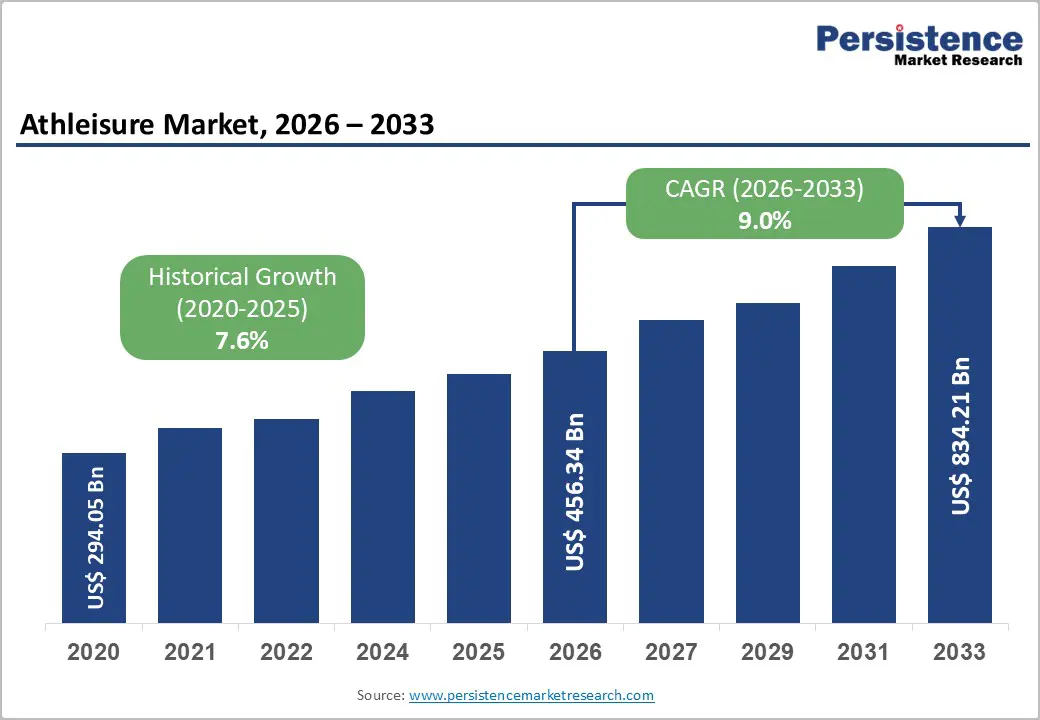
The global athleisure market size is supposed to be valued at US$ 456.3 billion in 2026 and is projected to reach US$ 834.2 billion by 2033, growing at a CAGR of 9.0% between 2026 and 2033.
The market is driven by a fundamental shift in consumer lifestyle preferences, in which comfort and functionality have become as important as aesthetics in daily wardrobes. Health and fitness awareness has escalated globally, with governments implementing ambitious wellness initiatives, such as China's Healthy China 2030 plan, which targets 530 million regular exercisers. Simultaneously, the proliferation of e-commerce and social media marketing has democratized access to premium athleisure brands, making them available across diverse income segments and geographies, thereby accelerating market penetration beyond traditional metropolitan centers.
Key Industry Highlights:
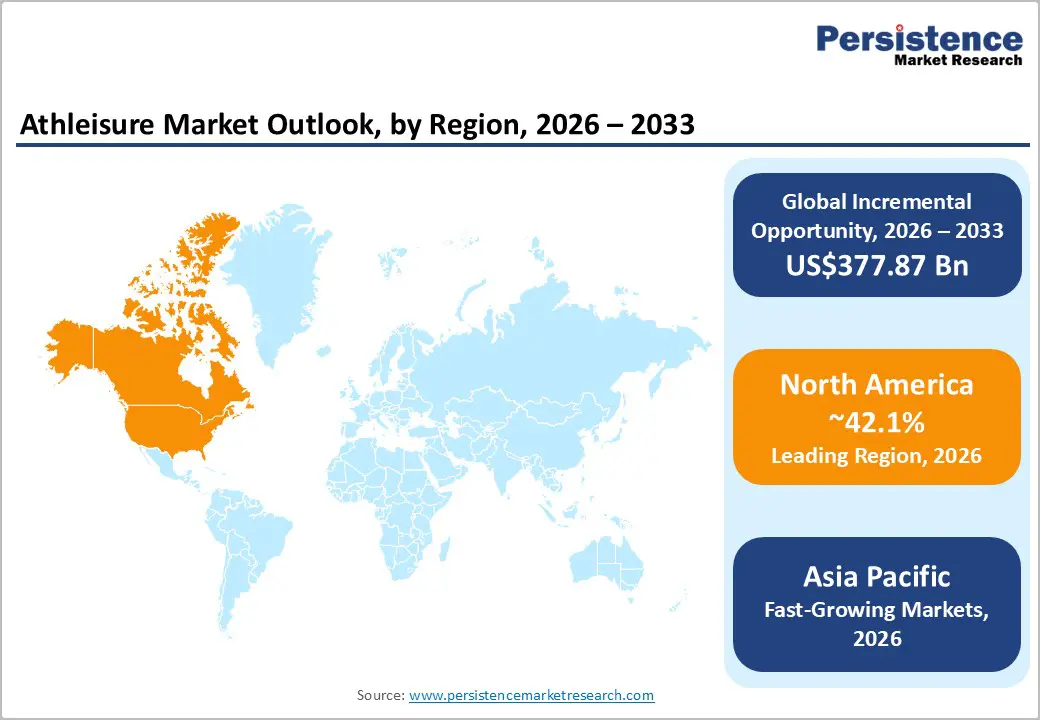
- Regional Leader: North America dominates regional market dynamics with 42.1% global share, establishing the most mature consumer base with high discretionary spending, robust e-commerce infrastructure, and established brand loyalty supporting premium product positioning and profitability for market leaders.
- Fastest Growing Region: Asia Pacific represents the fastest-growing regional market, propelled by rapid urbanization in China and India, rising middle-class disposable incomes, expanding e-commerce platforms with $5.2 billion in Chinese athleisure sales, and increasing fitness awareness across ASEAN nations, with India's online retail market projected to reach USD 200 billion by 2030.
- Leading Category: Mass market segment maintains dominant positioning at 65% market share through accessibility, wide distribution via hypermarkets and online platforms, and successful incorporation of technical performance features enabling value delivery that justifies mainstream consumer adoption across income levels.
- Fastest Growing Distribution Channel: Online distribution channels represent the fastest-growing segment, driven by shopping convenience, personalization through AI recommendations, and direct-to-consumer strategies.
- Key Opportunity: The premium sustainable athleisure segment offers exceptional growth potential, driven by consumers prioritizing eco-friendly products, a willingness to pay a premium, and successful brand examples such as Lululemon, Patagonia, and Adidas that integrate recycled materials.
| Key Insights | Details |
|---|---|
|
Athleisure Market Size (2026E) |
US$ 456.3 Bn |
|
Market Value Forecast (2033F) |
US$ 834.2 Bn |
|
Projected Growth CAGR (2026-2033) |
9.0% |
|
Historical Market Growth (2020-2025) |
7.6% |
Market Dynamics
Driver - Rising Health and Wellness Awareness
The growing emphasis on fitness and wellness has become a key catalyst for the expansion of the athleisure market. In 2022, the World Health Organization reported that 1.8?billion adults, 31% of the global population, failed to meet recommended physical activity levels, with inactivity expected to reach 35% by 2030, prompting extensive government and corporate wellness initiatives. China’s “Healthy China 2030” program alone expanded national fitness facilities from approximately 500 gyms in 2001 to more than 128,000 by 2023. This shift toward preventive healthcare has reshaped consumer wardrobe preferences, driving widespread adoption of functional, comfortable apparel.
Rising participation in organized sports, increased use of wellness technologies, and the growth of yoga, practiced by over 36 million people in the U.S. in 2024, continue to elevate demand for performance-oriented athleisure.
Surge in E-Commerce and Digital Influence
The rapid expansion of online retail and the influence of social media are significantly accelerating the growth of the athleisure market. E-commerce platforms provide consumers with convenience, extensive product selection, and personalized recommendations, as evidenced by a 14.3% increase in online sales in recent years. Influencer marketing and celebrity endorsements have strengthened brand visibility, particularly among younger consumers, encouraging higher engagement and repeat purchases. This digital evolution has broadened market accessibility, enabling brands to reach global audiences with greater efficiency.
Furthermore, the substantial increase in digital sales, now exceeding half of total revenue for leading brands such as Nike, underscores the transformative impact of online channels. Direct-to-consumer strategies and major e-commerce partners further strengthen customer relationships, while platforms such as Douyin continue to drive strong growth in key markets, including China.
Restraint - Supply Chain Disruptions and Rising Costs
Persistent supply chain disruptions and rising raw material costs continue to constrain the growth of the athleisure market. Fragmented sourcing of sustainable fabrics results in inconsistent availability and higher prices, limiting brands' ability to expand into mass markets.market segments. Conventional materials remain more cost-efficient than recycled alternatives, compelling companies to either absorb reduced margins or restrict eco-friendly products to premium categories, slowing widespread adoption.
The industry also faces procurement challenges due to increasing demand for organic cotton, bamboo fiber, and recycled polyester, all of which are costlier and less readily available than synthetic options. Global supply chain fluctuations, dependency on specific production regions, and the specialized manufacturing requirements of performance fabrics further elevate operational risks. As a result, brands pursuing sustainability must balance reliable sourcing with competitive pricing to appeal to mainstream consumers.
Intense Competition and Market Saturation
Intensifying competition from established global brands and fast-fashion retailers continues to create substantial barriers in mature markets. Saturation across North America and Europe limits opportunities for new entrants, while the influx of low-quality, uncertified products undermines consumer trust and contributes to market fragmentation. This environment exerts downward pressure on prices and reduces differentiation, challenging the growth prospects of individual brands despite rising overall demand.
The competitive landscape is further strained as both long-standing sportswear companies and emerging direct-to-consumer labels contend for market share within a crowded product space. With numerous brands offering similar items, maintaining a distinct identity and sustaining customer loyalty has become increasingly difficult. As price wars and promotional strategies erode margins, particularly for mid-tier brands, companies must innovate in design, technology, and sustainable materials while tightly managing production costs to remain profitable.
Opportunity - Digital-Native Commerce and Direct-to-Consumer Channel Expansion
The online distribution channel has emerged as the fastest-growing segment in the athleisure market, significantly outpacing the modest growth of traditional retail. Digital transformation enables brands to cultivate direct consumer relationships and leverage preference data to enhance personalized marketing and product development. Advanced technologies, including augmented-reality fitting tools, AI-driven recommendation systems, and integrated social commerce, have improved the online shopping experience by reducing return rates and increasing customer lifetime value.
Nike’s digital sales now account for more than half of total revenue, with projections indicating that 70% of sportswear purchases will bypass conventional retail by 2026. The growth of e-commerce infrastructure in emerging markets, supported by rising middle-class incomes and increasing digital adoption, further strengthens this channel. Influencer-led social commerce on platforms such as Instagram and TikTok demonstrates the suitability of athleisure for highly visual, community-driven digital retail models.
Sustainability and Technological Innovations
Advancements in eco-friendly fabrics and technology-integrated apparel are creating significant opportunities in the athleisure market. Brands incorporating moisture-wicking and recycled materials increasingly align with consumer preferences for sustainable products, supported by regulatory initiatives in the EU and wellness-focused programs in the U.S. The premium athleisure segment is poised for substantial growth, driven by consumers’ willingness to pay higher prices for environmentally responsible activewear.
Companies such as Lululemon, Patagonia, and PrAna exemplify this trend through products made from organic cotton, bamboo fibers, and recycled polyester. Growing scrutiny of sustainability claims further encourages brands to adopt transparent supply chains, credible certifications, and purpose-driven communication to attract millennial and Gen Z consumers.
Category-wise Analysis
Product Type Insights
Yoga apparel holds a leading position within the product segment, accounting for nearly 35% of the market, driven by the global rise in yoga participation and the growing adoption of wellness-focused lifestyles. This segment includes tops, pants, shorts, unitards, and capris designed with moisture-wicking fabrics, four-way stretch, and versatile silhouettes suitable for both studio practice and everyday wear. With over 300 million global yoga practitioners and 36 million participants in the United States in 2024, demand for specialized yoga clothing continues to strengthen.
The expansion of the yoga and meditation products market further supports this growth, alongside advancements in fabric technology, including odor resistance, UV protection, and sustainable materials such as organic cotton and bamboo. Strong brand loyalty, particularly toward premium players like Lululemon Athletica, enhances segment momentum, reinforced by social media influence and celebrity endorsements that position yoga apparel as both functional activewear and a lifestyle statement.
Category Analysis
The mass market holds approximately 65% of the market, supported by its strong affordability and broad accessibility through hypermarkets, discount stores, and extensive online distribution. These channels effectively meet the needs of budget-conscious consumers, resulting in a dominant 66% share of revenue for mass-market offerings. Mass-athleisure products combine functional quality, contemporary styling, and essential performance features at price points suitable for mainstream consumers. This leadership is reinforced by robust distribution strategies spanning supermarkets, sporting goods retailers, and digital platforms, ensuring a wide geographic and demographic reach.
Advancements in fabric technology and manufacturing processes have enabled mass-market producers to integrate features once exclusive to premium lines, such as enhanced breathability, moisture management, and ergonomic design. Despite the rising popularity of premium athleisure, the mass segment remains resilient by addressing core consumer preferences for versatile, comfortable apparel.
End-user Insights
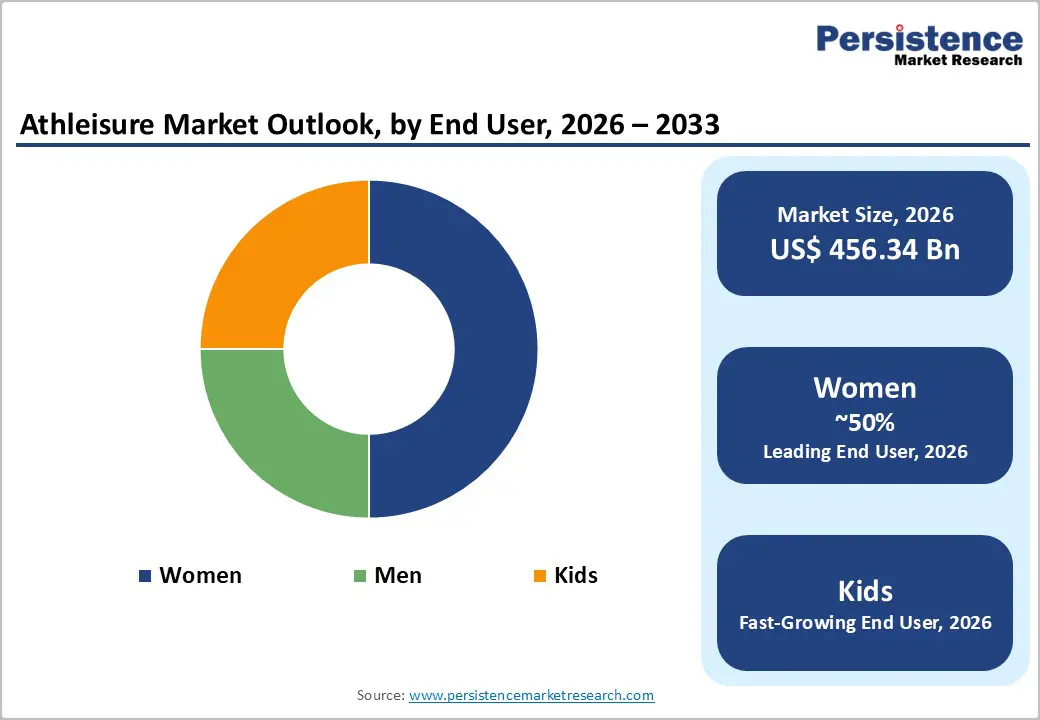
Women constitute the largest end-user segment in the athleisure market, representing nearly 50% of total demand. Their strong focus on fitness, wellness, and fashion-oriented activewear drives consistent adoption of products that combine performance functionality with aesthetic appeal. This segment has experienced notable growth as more women participate in sports, fitness activities, and holistic wellness routines. Women also exhibit higher purchase frequency and greater willingness to explore a wider range of athleisure categories, including yoga pants, sports bras, dresses, and outerwear.
Social media plays a significant role in shaping their preferences, with influencers and celebrity endorsements accelerating trend adoption. Furthermore, women exhibit a pronounced preference for sustainable and ethically produced athleisure, prompting brands to expand product offerings, introduce inclusive size ranges, and incorporate stylish elements that blend activewear with everyday fashion.
Distribution Channel Insights
Online distribution channels account for nearly 45% of the athleisure market and remain the fastest-growing segment, with a projected CAGR of 11.5%. The convenience of e-commerce has fundamentally reshaped consumer purchasing behavior by enabling access to wide product assortments, customer reviews, and competitive pricing without reliance on physical stores. This channel is especially critical in regions with limited brick-and-mortar infrastructure, expanding the reach of both established brands and emerging direct-to-consumer players.
Nike’s digital sales, now exceeding 50% of total revenue, underscore the strategic importance of online platforms, with forecasts indicating that 70% of sportswear purchases will bypass traditional retail by 2026. Enhanced personalization through AI-based recommendations, virtual fitting tools, subscription models, and exclusive online releases further strengthens consumer engagement. Mobile and social commerce, including platforms such as Douyin, continue to accelerate this growth.
Regional Insights
North America Athleisure Market Trends
North America remains the leading region in the global athleisure market, primarily driven by the deeply ingrained health and fitness culture in the United States. The region benefits from robust regulatory frameworks covering textile labeling, product safety, and consumer protection, creating a favorable operating environment for athleisure brands. U.S. consumers display a strong willingness to invest in premium activewear, supported by 36 million yoga practitioners seeking specialized apparel.
North America’s innovation ecosystem, anchored by leading brands such as Nike, Lululemon Athletica, and Under Armour, continues to advance smart apparel, sustainable materials, and performance technologies. Lululemon exemplifies this regional strength, generating $10.6 billion in revenue in 2024 with a 10% year-over-year increase. A mature e-commerce infrastructure and evolving workplace norms, including remote work and relaxed dress codes, have further normalized athleisure as everyday and professional attire, reinforcing the region’s leadership.
Europe Athleisure Market Trends
Europe continues to demonstrate strong performance in the athleisure market, with Germany, the U.K., France, and Spain acting as primary growth drivers supported by sophisticated consumer preferences and a high emphasis on sustainability. European consumers prioritize quality, durability, and ethical production practices, creating favorable conditions for premium and eco-friendly athleisure brands. Regulatory harmonization across the European Union ensures consistent product standards, environmental compliance, and efficient cross-border trade, thereby facilitating smoother brand expansion.
Adidas, headquartered in Germany, exemplifies regional leadership, with its Primeblue recycled materials representing 60% of its product line. The region’s strong sports culture, outdoor recreation habits, and government initiatives promoting active lifestyles further drive demand. Urban populations across major cities increasingly adopt athleisure as everyday attire, supported by robust retail infrastructure and fashion-driven influences from Paris, Milan, and London.
Asia Pacific Athleisure Trends
Asia Pacific is emerging as the fastest-growing regional market for athleisure, projected to record the highest CAGR through 2034. This growth is driven by rapid urbanization, rising disposable incomes, and increasing fitness awareness across China, Japan, India, and ASEAN countries. China remains the leading contributor, supported by a growing middle class, a strong e?commerce ecosystem, and expanding demand for both international and domestic athleisure brands.
India also shows robust potential, with its online fashion and lifestyle market expected to reach USD 200 billion by 2030, enabling athleisure to penetrate beyond major metropolitan areas. The region benefits from significant manufacturing advantages in countries such as Vietnam, Bangladesh, and China, enhancing cost-effective sourcing. Additionally, technologically advanced consumer preferences in Japan and South Korea, combined with a young, digitally engaged population, further strengthen regional demand.
Competitive Landscape
The athleisure market demonstrates moderate consolidation, with leading global brands such as Nike, Adidas, and Lululemon Athletica holding substantial market shares while numerous regional and direct-to-consumer players contribute to competitive fragmentation. Market leaders strengthen their positions through strategies focused on sustainability innovation, digital transformation, and geographic expansion. Companies increasingly differentiate through technological advancements, including smart fabrics with biometric capabilities, sustainability credentials, community-driven branding, and premium product positioning. The rise of direct?to?consumer models is reshaping traditional wholesale structures, enabling agile brands to respond quickly to evolving consumer trends while maintaining pricing control and customer data ownership.
Key Developments:
- October 2024: Authentic Brands Group finalized the acquisition of athleticwear icon Champion, its second-largest brand acquisition to date. Champion generates nearly $3 billion in global retail sales annually, significantly enhancing Authentic's position as the largest sports and entertainment licensing company worldwide.
- February 2024: Lululemon, a company that manufactures athletic apparel, footwear, and accessories for yoga, running, training, and most other activities, launched a footwear collection that offers athletes a complete uniform from head to toe. This includes debut casual sneaker, Cityverse and new running models: Beyondfeel and Beyondfeel trail. The collection is available for both men and women, online and in select stores across Europe, North America, and Mainland China.
- March 2025: Under Armour expanded its product range with the launch of UA ECHO, a footwear design that combines athletic functionality with cultural elements. The UA ECHO targets younger consumers, particularly Generation Z, who value both performance and personal expression in athletic footwear.
Top Companies in the Athleisure Market
Nike Inc. (Beaverton, U.S.) dominates the global athletic apparel market. The company's digital transformation strategy positions online sales to exceed 50% of total revenue, while its Move to Zero sustainability initiative demonstrates environmental leadership, with 60% of products incorporating recycled materials. Nike's innovation ecosystem, athlete endorsements, and brand recognition maintain its position as the most valuable sportswear brand globally, successfully balancing mass-market accessibility with premium performance positioning.
Lululemon Athletica Inc. (Vancouver, Canada) exemplifies premium athleisure success, with consistent annual growth of 9-10%. The brand's community-focused marketing, product innovation in yoga and training apparel, and successful expansion into men's activewear differentiate its market position. Lululemon's direct-to-consumer strategy, experiential retail stores, and brand ambassador programs build strong customer loyalty, enabling premium pricing that resonates with affluent consumers who prioritize quality and lifestyle alignment over value-driven alternatives.
Adidas AG (Herzogenaurach, Germany) is the second-largest sportswear brand globally. The company's Primeblue sustainable product line, which uses recycled ocean plastic, accounts for 60% of its portfolio, positioning Adidas as a sustainability leader. A strong presence across multiple sports categories, strategic partnerships with designers and celebrities, and a balance between performance functionality and street-style aesthetics enable Adidas to appeal to diverse consumer segments, from professional athletes to fashion-conscious urbanites.
Companies Covered in Athleisure Market
- Lululemon Athletica Inc.
- Adidas AG
- Nike Inc.
- Puma SE
- Under Armour Inc.
- Hanesbrands Inc.
- Patagonia, Inc.
- Eileen Fisher
- Vuori
- Outerknown
- Alo Yoga
- Gymshark
Frequently Asked Questions
The global athleisure market is projected to reach US$ 834.2 Bn by 2033, growing from US$ 456.3 Bn in 2026 at a CAGR of 9.0% during the forecast period, driven by increasing health consciousness, digital commerce expansion, and growing demand for versatile activewear that transitions seamlessly between fitness activities and daily wear.
The primary drivers include the global surge in health and fitness consciousness with over 300 million yoga practitioners worldwide, the 84% increase in athleisure orders since the pandemic, digital transformation with online sales exceeding 50% of revenue for major brands, and growing sustainability awareness, with 65% of consumers prioritizing eco-friendly products and willing to pay 15-20% premiums.
The mass market segment maintains dominant positioning at 65% market share through accessibility, wide distribution via hypermarkets and online platforms, and successful incorporation of technical performance features enabling value delivery that justifies mainstream consumer adoption across income levels.
North America leads the athleisure market, with the U.S. demonstrating the highest consumption driven by a deeply embedded fitness culture, strong regulatory frameworks, innovation ecosystems housing Nike, Lululemon, and Under Armour, mature e-commerce infrastructure, and corporate wellness programs normalizing athleisure as professional attire.
The premium sustainable athleisure segment offers exceptional growth potential, supported by consumers prioritizing eco-friendly products, willingness to pay more for premiums, and successful brand examples like Lululemon, Patagonia, and Adidas integrating recycled materials.
Key market players include Nike Inc., Lululemon Athletica, Adidas AG, Puma SE, Under Armour Inc., and emerging brands like Vuori and Gymshark.


