




- Non-food Packaging
- APET Film Market
APET Film Market Size, Share, and Growth Forecast, 2026 - 2033
APET Film Market by End-use Industry (Consumer Goods, Food & Beverage, Others), Product Type (Anti-Fog, High-Barrier, Others), Application, and Regional Analysis for 2026 - 2033

APET Film Market Size and Trends Analysis
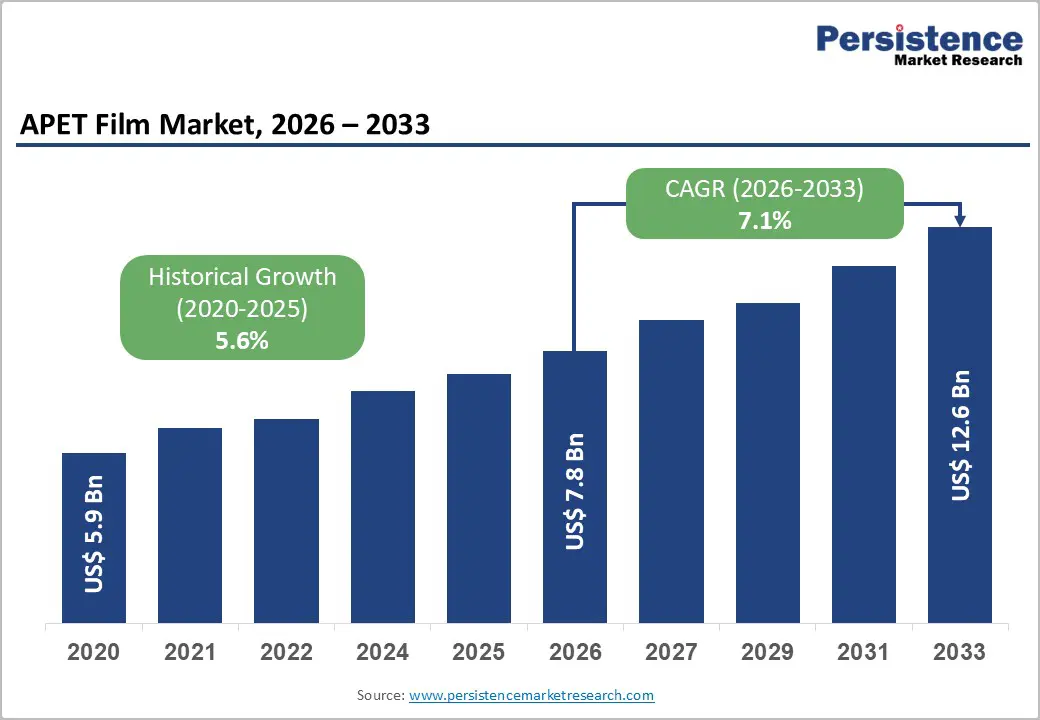
The global APET Film market size is likely to be valued at US$7.8 billion in 2026 and is expected to reach US$12.6 billion by 2033, growing at a CAGR of 7.1% between 2026 and 2033, driven by increasing use of APET films in food & beverage and consumer goods thermoforming applications, a shift towards lighter packaging materials replacing heavier options like glass and metal, and the rising demand for specialty functional grades such as anti-fog and high-barrier films for retail-ready displays. Ongoing investments in production capacity by leading film manufacturers are also strengthening the shift toward APET film formats.
Key Industry Highlights:
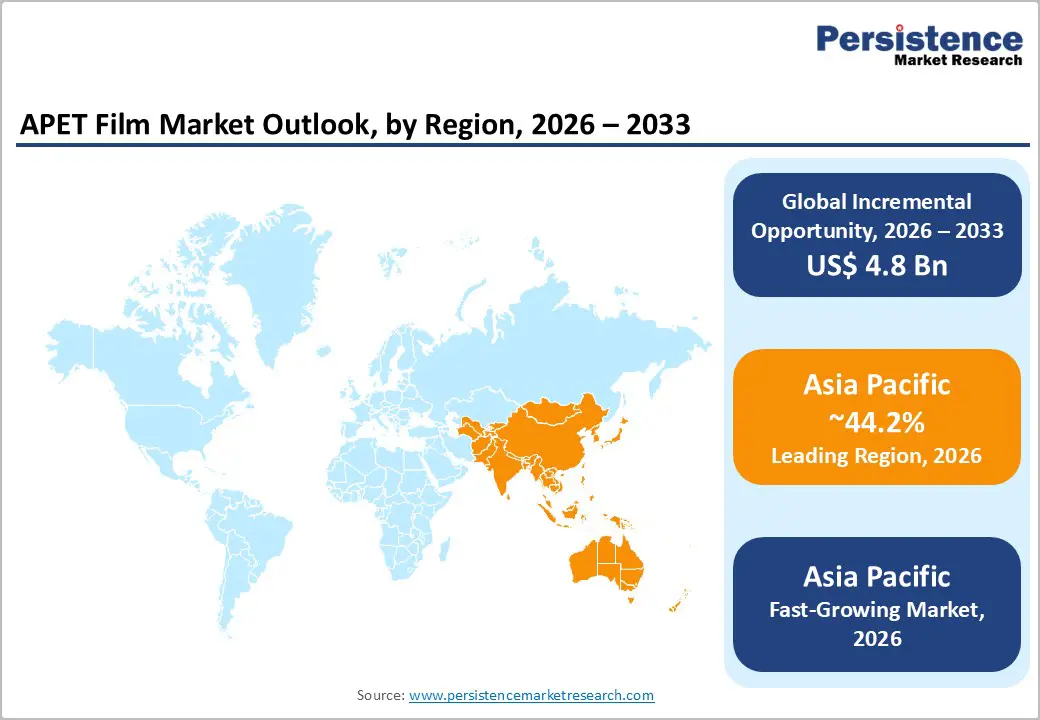
- Leading Region: Asia Pacific is projected to account for approximately 44.2% of market share, supported by strong manufacturing density, organized retail expansion, and export-oriented packaging production in China, India, Japan, and ASEAN countries.
- Fastest-growing Region: Asia Pacific, registering the highest regional CAGR during 2026 - 2033, driven by rapid growth in packaged food consumption, thermoforming capacity additions, and rising adoption of specialty APET films.
- Investment Plans: Ongoing capacity expansions and coating-line upgrades across Asia Pacific and Europe, including multi-year capex programs by major polyester film producers focused on new PET/APET lines, rPET integration, and specialty grades such as anti-fog and high-barrier films.
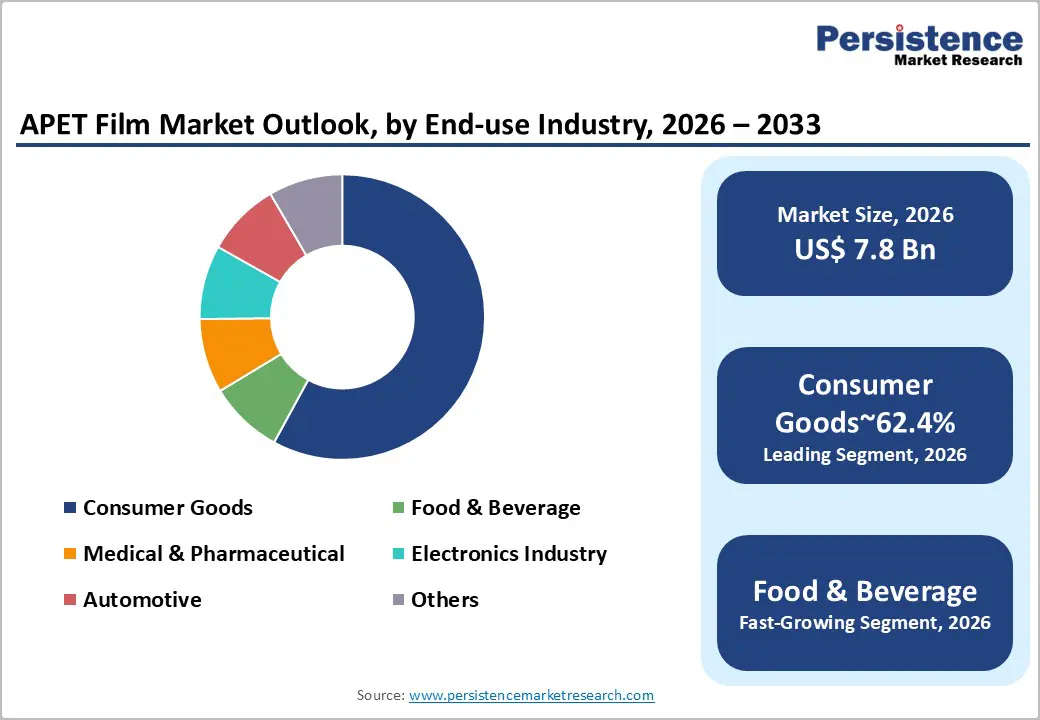
- Dominant End-use Industry: Consumer goods are expected to account for approximately 62.4% of the market, driven by demand for retail-ready packaging, blister packs, and display applications requiring high clarity and rigidity.
- Leading Product Type: Anti-fog APET films are estimated to account for approximately 30.8% of the market, reflecting widespread adoption in fresh food, ready meals, and refrigerated packaging, where visibility and shelf appeal are critical.
| Key Insights | Details |
|---|---|
| APET Film Market Size (2026E) | US$7.8 Bn |
| Market Value Forecast (2033F) | US$12.6 Bn |
| Projected Growth (CAGR 2026 to 2033) | 7.1% |
| Historical Market Growth (CAGR 2020 to 2025) | 5.6% |
Market Factors - Growth, Barriers, and Opportunity Analysis
Growth Analysis - Shift to Lightweight, Retail-Ready Packaging for Food & Consumer Goods
The transition toward lightweight and visually appealing packaging formats is a major catalyst for APET film demand. Thermoformed APET continues to replace heavier materials, such as glass, metal, and rigid PVC, owing to its superior clarity, dimensional stability, and ease of thermoforming. Food & beverage and consumer goods collectively account for the majority of APET film consumption, reflecting the need for display-oriented packaging solutions in organized retail environments. E-commerce growth further accelerates demand for durable yet lightweight packaging materials that protect products during transit while maintaining product visibility. As a result, manufacturers are prioritizing high-clarity, food-contact compliant APET grades and investing in downstream thermoforming and coating technologies to enhance performance and capture margin expansion.
Specialty Functionalization and Value Migration
The evolution of specialty APET grades is driving value migration within the market. Functional coatings and co-extruded constructions, such as anti-fog, high-barrier, UV-resistant, and heat-sealable layers, command price premiums over standard polyester films. These value-added features enhance shelf appeal, extend product shelf life, and improve sealing performance, particularly in fresh and processed food applications. Premium APET grades contribute to higher average selling prices per metric ton, even when underlying volume growth remains moderate. Converters and brand owners benefit from improved product protection and branding differentiation, while film manufacturers diversify revenue streams through innovation-driven portfolios. This transition toward performance-oriented films is reshaping competitive positioning and reinforcing long-term growth fundamentals.
Regional Manufacturing Expansion and Supply Chain Re-shoring
APET film production capacity has expanded across the Asia Pacific, with selective investments in Europe and North America to strengthen regional supply chains. Film producers are establishing new lines and upgrading facilities to shorten lead times and reduce dependence on cross-border logistics. In the short term, these investments enhance supply resilience and moderate pricing volatility during feedstock disruptions. Over the medium term, localized production strengthens customer relationships, improves technical support, and enhances service differentiation. This regional realignment supports the forecasted CAGR and positions APET film producers to respond more effectively to end-user customization requirements.
Barrier Analysis -Feedstock Volatility and Cost Pass-Through Challenges
APET film production relies heavily on petrochemical feedstocks, including paraxylene (PX), monoethylene glycol (MEG), and virgin PET resin. Volatility in these input costs directly affects producer margins. When raw material prices rise rapidly, manufacturers may struggle to pass increases through to converters and end users, leading to compressed profitability. Historical cycles demonstrate that feedstock spikes can materially reduce EBITDA margins, particularly for smaller, non-integrated producers. Companies lacking long-term procurement contracts or backward integration face greater exposure to price fluctuations, whereas import-dependent markets remain vulnerable to currency and trade dynamics.
Regulatory Pressure and Recyclability Requirements
Environmental regulations are tightening globally, particularly around extended producer responsibility (EPR), recycled-content mandates, and packaging waste reduction targets. APET films must increasingly meet recyclability standards and incorporate recycled PET (rPET) content to maintain market access. Compliance may require capital investment in rPET supply chains, testing protocols, and production line retrofits. Jurisdictions that mandate minimum recycled-content requirements can increase raw material costs and introduce supply constraints. Producers unable to align with circular economy frameworks risk losing share in high-regulation markets such as Europe and parts of North America.
Opportunity Analysis - Premium Functional Films for Fresh Food Lidding and Blister Packaging
The premiumization of APET film grades represents a significant value opportunity. Anti-fog, high-barrier, and heat-sealable constructions address performance gaps in fresh food lidding, pharmaceutical blisters, and electronics packaging. If specialty grades capture 20-25% of total APET film tonnage by 2030, incremental market value could reach several hundred million dollars globally, reflecting higher pricing differentials. Strategic collaboration between film manufacturers and brand owners, through joint product development and pilot-scale innovation, can accelerate adoption. Investments in co-extrusion and coating technologies are essential to capturing these premium segments.
Asia Pacific Capacity Expansion and Retrofit Demand
The Asia-Pacific region presents a significant growth opportunity, projected to lead and expand the fastest due to rapid retail modernization, urbanization, and a strong focus on export-oriented manufacturing, all of which drive sustained demand for packaging films. Ongoing greenfield and brownfield expansions in China, India, and Southeast Asia are enhancing domestic supply capabilities. Investors and producers who prioritize food-grade certification, establish localized technical service teams, and implement flexible manufacturing lines will be well-positioned to cater to both commodity and specialty-grade demands. Regional capacity expansions are also improving export competitiveness and streamlining supply chain efficiency, creating a favorable environment for growth and market entry.
Category-wise Analysis
End-use Industry Insight
Consumer goods are expected to lead, accounting for approximately 62.4% of market share in 2026. The segment’s leadership stems from APET’s high clarity, rigidity, dimensional stability, and thermoformability, which make it ideal for retail-ready packaging formats such as blister packs, clamshells, display windows, and merchandising trays. Personal care products, small electronics accessories, stationery items, and household tools extensively use transparent APET packaging to enhance shelf visibility and strengthen brand positioning in competitive retail environments. Converters supplying branded retail chains require consistent film thickness, excellent printability, and customized specifications such as heat-sealable or UV-resistant grades. Long-term supply agreements are common in this segment, particularly with multinational consumer goods companies that demand just-in-time deliveries and stringent quality assurance. This creates relatively stable and predictable revenue streams for manufacturers that can offer tailored solutions and technical support.
The food & beverage segment is likely to be the fastest-growing end-use category and is anticipated to gain incremental market share over the forecast period. Growth is driven by rising demand for ready-to-eat meals, fresh produce packaging, portion-controlled servings, bakery items, and meal-kit formats. Anti-fog and barrier-enhanced APET films are widely used in salad bowls, fruit trays, deli containers, and lidding applications to maintain product visibility while extending shelf life. Retail consolidation, the expansion of organized supermarkets, and the rapid growth of e-commerce grocery platforms are increasing demand for durable, lightweight, and recyclable packaging solutions. Food safety standards and sustainability mandates are encouraging converters to shift toward mono-material APET structures rather than complex multi-layer laminates. As brands prioritize extended freshness, tamper-evidence, and recyclability claims, adoption of APET in food applications continues to accelerate.
Product Type Insights
Anti-fog APET films are expected to account for 30.8% of market share in 2026 and are anticipated to retain their leading position due to widespread usage in fresh-food packaging. These films prevent condensation of moisture on packaging surfaces, preserving visibility and reinforcing consumer perceptions of freshness. Applications include salad containers, bakery clamshells, fresh-cut fruit packs, and refrigerated ready-meal trays, where condensation control directly influences purchasing decisions. Manufacturers offering food-contact-compliant coatings with durable anti-fog performance can command premium prices and secure long-term supply contracts with food processors and major retail chains. Continuous improvements in coating technologies, including dual-side anti-fog treatments and enhanced durability under cold-chain conditions, further support segment stability and sustained demand.
High-barrier APET films are expected to be the fastest-growing product category and to steadily increase their share through 2033. These films incorporate co-extruded layers or specialized coatings to provide enhanced oxygen and moisture barriers, extending product shelf life and reducing food waste. Demand is particularly strong in processed foods, pharmaceutical blister packaging, medical device trays, and certain electronics applications requiring moisture protection. As regulatory frameworks increasingly emphasize recyclability and lightweighting, high-barrier APET solutions offer a more sustainable alternative to multi-layer laminates composed of incompatible materials. Their ability to combine clarity, protection, and recyclability positions them as a preferred solution for brand owners seeking performance without compromising circular-economy objectives.
Regional Insights
North America APET Film Market Trends - Pharma-Led Demand, Retail Stability, and rPET Integration
North America is a mature yet structurally stable APET film market, characterized by consistent demand for food packaging, pharmaceutical blisters, and selected industrial applications. While regional growth is moderate compared to the Asia Pacific, value expansion is supported by premiumization, higher adoption of specialty grades, and integration of recycled PET (rPET). Demand remains concentrated in thermoformed trays, lidding films, and blister packaging used in pharmaceuticals, consumer electronics accessories, and personal care products. The region’s developed retail ecosystem and strong cold-chain logistics infrastructure continue to support steady consumption of high-clarity and functional APET films.
The U.S. leads regional demand, underpinned by its robust pharmaceutical manufacturing base and large organized retail chains such as Walmart, Kroger, and Costco, which require consistent retail-ready packaging formats. Pharmaceutical blister packaging demand remains resilient, supported by domestic drug manufacturing and over-the-counter product volumes. On the supply side, companies such as Eastman Chemical Company have expanded their specialty polyester capabilities and molecular recycling initiatives, reinforcing feedstock security and sustainability positioning. Indorama Ventures has also strengthened PET recycling infrastructure in the U.S., thereby increasing the availability of food-grade rPET for film extrusion.
Regulatory emphasis in North America centers on FDA food-contact compliance and evolving state-level recycled-content mandates, particularly in California and other progressive states. These developments are encouraging film manufacturers to integrate higher rPET content while maintaining optical clarity and mechanical strength. Investment activity includes coating-line retrofits for anti-fog and heat-sealable films, strategic acquisitions to strengthen converting footprints, and partnerships focused on recycling integration. As brand owners increase their sustainability commitments, suppliers capable of delivering certified-recycled-content APET films are gaining competitive advantages in long-term contracts.
Europe APET Film Market Trends - Circular-Economy Compliance and Specialty Coated Film Innovation
Europe maintains strong demand for APET film, particularly in food packaging, lidding films, and pharmaceutical blister applications. Market growth is moderate yet stable, with sustainability regulations and circular-economy directives strongly influencing purchasing behavior and product development. The region places a premium on compliance-ready, recyclable mono-material solutions, shaping innovation priorities among film producers and converters. Germany serves as both a production and innovation hub for polyester films.
Mitsubishi Polyester Film’s continued investments in its German operations, including the construction of new PET film lines in recent years, have strengthened local supply for specialty-coated grades such as HOSTAPHAN® films. Toray and other major polyester film producers maintain advanced coating capabilities in Europe, enabling high-barrier and heat-sealable product offerings tailored to pharmaceutical and fresh-food markets. The U.K., France, and Spain demonstrate consistent demand growth, driven by organized retail modernization, the expansion of private-label packaged foods, and the rising adoption of clear, recyclable trays in fresh produce and bakery categories.
European regulatory frameworks, including revisions to the EU Packaging and Packaging Waste Directive and recycled-content targets under the Circular Economy Action Plan, directly shape material selection decisions. These policies encourage mono-material PET structures over complex laminates and accelerate the integration of rPET into thermoformed packaging. As a result, manufacturers are investing in advanced recycling partnerships and upgrading extrusion lines to process higher recycled content without compromising performance. The regulatory environment, while stringent, is fostering innovation in barrier coatings and recyclable functional films, reinforcing Europe’s position as a leader in sustainable packaging development.
Asia Pacific APET Film Market Trends - Volume-Driven Growth, Manufacturing Scale, and Export Expansion
Asia-Pacific is expected to be the largest and fastest-growing APET film market, accounting for over 44.2% of global revenue. The region benefits from high manufacturing density, rapid urbanization, expanding organized retail networks, and strong export-oriented packaging industries. Growth is volume-driven, yet increasingly supported by the adoption of premium specialty films as brand owners seek enhanced clarity, anti-fog performance, and barrier functionality. China leads in both production and consumption, supported by a vast network of thermoforming converters and strong domestic food and consumer goods industries.
Large-scale polyester producers, including Toray and regional integrated PET manufacturers, operate advanced production lines that serve both domestic and export markets. The country’s emphasis on modern retail expansion and ready-meal consumption continues to stimulate demand for retail-ready APET trays and lidding films. Japan contributes technological leadership, particularly in specialty barrier and coated polyester films. Companies such as Toray Industries and Mitsubishi Polyester Film leverage R&D capabilities to develop high-performance and recyclable film solutions, influencing premium segment growth across the region. India demonstrates strong growth momentum, supported by rising packaged food consumption and significant capacity investments.
Jindal Poly Films (JPFL) has announced major capital expenditure programs exceeding INR 700 crore (US$84 million) for new BOPP and PET lines, strengthening domestic supply and export competitiveness. Polyplex Corporation and SRF Limited have also expanded polyester film capacities, enhancing India’s role as a global packaging film exporter. ASEAN markets, including Indonesia, Thailand, and Vietnam, benefit from expanding retail infrastructure and cross-border trade growth, increasing demand for clear thermoformed packaging.
Competitive Landscape
The global APET film market is moderately consolidated. Large integrated global polyester film manufacturers compete alongside regional producers and converters. Specialty high-barrier and coated segments show higher concentration among leading players, while standard APET grades remain relatively fragmented. Competitive positioning is driven by technical capability, geographic footprint, and sustainability alignment.
Market leaders focus on product premiumization, regional expansion, vertical integration into rPET supply chains, and close collaboration with converters and brand owners. Differentiation increasingly depends on innovation capability, regulatory compliance, and customer service proximity.
Key Industry Developments:
- In May 2025, Nobelus launched StrataFlex Thermal Pre-Lams for the digital flexible packaging market, featuring a METPET-based core with PE sealant layers to optimize print quality and lamination workflow efficiency, enabling converters to improve throughput and reduce material changeovers.
Companies Covered in APET Film Market
- Toray Industries
- Mitsubishi Polyester Film
- Teijin Films
- Jindal Poly Films
- Polyplex Corporation
- SKC
- Kolon Industries
- DuPont
- Eastman Chemical Company
- Cosmo Films
- SRF Limited
- Toyobo
- Terphane
- Taghleef Industries
- Uflex
- Oben Group
- Indorama Ventures
- Futamura Chemical
Frequently Asked Questions
The global APET film market size is projected to be valued at US$7.8 billion in 2026.
The APET film market is expected to reach approximately US$12.6 billion by 2033.
Key trends include premiumization of functional films, particularly anti-fog and high-barrier grades, and a shift toward mono-material and recyclable packaging in response to regulatory mandates.
By end-use industry, consumer goods lead with approximately 62.4% market share, driven by demand for transparent retail-ready packaging and blister packs. By product type, anti-fog films lead with 30.8% market share, reflecting strong demand in fresh food and refrigerated packaging.
The APET film market is projected to grow at a CAGR of 7.1% between 2026 and 2033.
Major companies include Toray Industries, Inc., Mitsubishi Polyester Film GmbH, Teijin Limited (Teijin Films), Jindal Poly Films Ltd., and Polyplex Corporation Ltd.


