




- Food Ingredients & Additives
- Whipping Agent Market
Whipping Agent Market Size, Share, Growth, and Regional Forecast, 2026 to 2033
Whipping Agent Market by Source (Plant-based, Animal-based), Form (Powder, Liquid), Service, Application, End-user, and Regional Analysis from 2026 to 2033

Whipping Agent Market Share and Trends Analysis
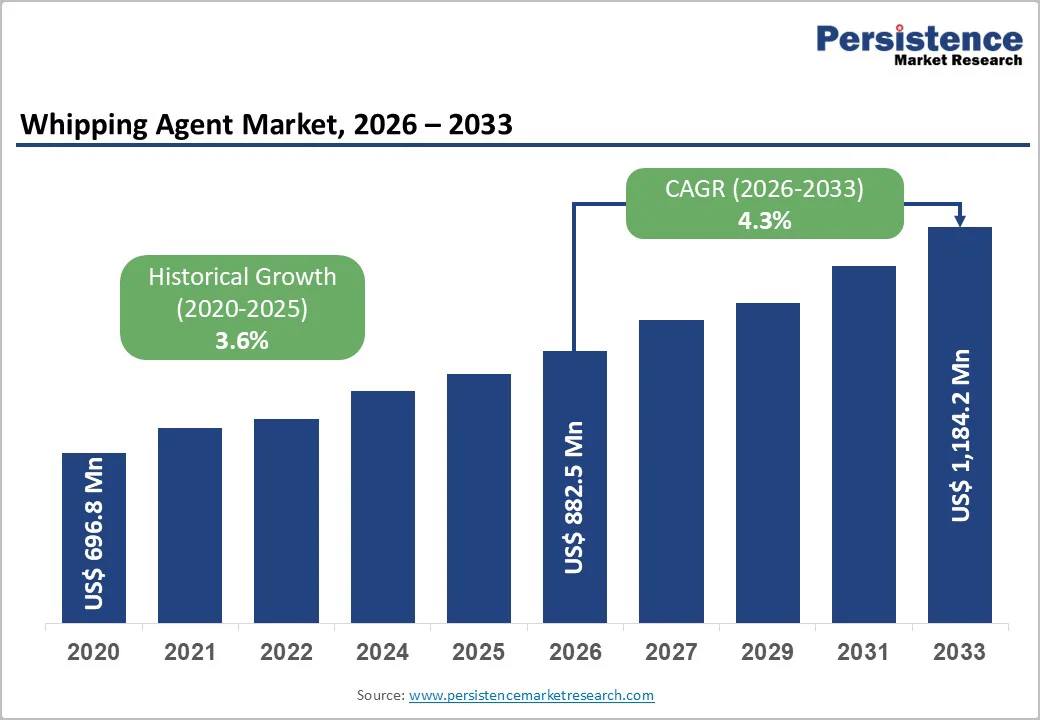
The global whipping agent market size is estimated to grow from US$882.5 million in 2026 to US$1,184.2 million by 2033. The market is projected to record a CAGR of 4.3% from 2026 to 2033. The market is set achieve a steady growth based on rising demand for aerated and foamed food products across bakery, confectionery, dairy, and beverage applications.
Whipping agents help create stable foam, improve texture, and enhance volume in products like whipped cream, cakes, mousses, and desserts. The shift toward plant-based and clean-label ingredients is also driving innovation in non-dairy whipping solutions.
Foodservice expansion, ready-to-eat desserts, and premium bakery trends further support market growth. Manufacturers are focusing on powder and liquid formulations offering better stability, improved shelf life, and high performance.
Key Industry Highlights
- The market is growing as consumers prefer light, fluffy, and aerated food products like whipped cream, cakes, mousses, and desserts.
- Plant-based whipping agents are gaining traction as consumers shift toward vegan and lactose-free products. Soy, pea, coconut, and starch-based whipping agents are increasingly preferred.
- Hotels, cafés, and restaurants are major contributors to demand for whipping agents, especially for desserts, beverages, and bakery preparations.
- Animal-based whipping agents account for the largest market share today because egg albumen and dairy proteins (casein/whey) are still widely used in the bakery, confectionery, and dairy industries for their strong foaming and stability.
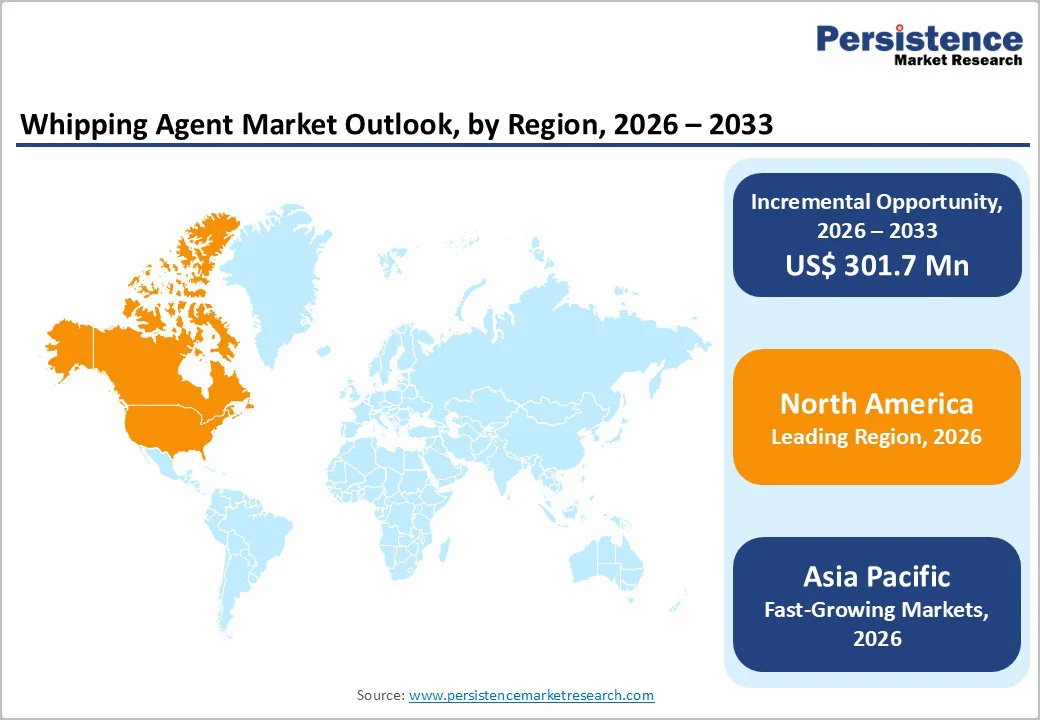
- North America leads the Whipping Agent Market due to strong demand for bakery, confectionery, whipped toppings, and ready-to-eat desserts, as well as the high adoption of premium and clean-label whipping ingredients by large food manufacturers.
| Key Insights | Details |
|---|---|
| Whipping Agent Market Size (2026E) | US$ 882.5 Mn |
| Market Value Forecast (2033F) | US$ 1,184.2 Mn |
| Projected Growth (CAGR 2026 to 2033) | 4.3% |
| Historical Market Growth (CAGR 2020 to 2025) | 3.6% |
Market Dynamics
Driver - Expansion of Freeze-Stable Dessert Categories
The growing popularity of frozen desserts, including ice cream cakes, mousse-filled pastries, and ready-to-eat frozen treats, is creating significant demand for whipping agents that can withstand extreme cold without compromising texture or volume. Consumers increasingly expect airy, light, and creamy textures even after freezing and thawing, which challenges traditional whipping agents.
Manufacturers are therefore innovating specialized freeze-stable formulations that maintain foam integrity, prevent syneresis, and deliver consistent mouthfeel over extended storage periods.
This trend is particularly strong in premium dessert segments and e-commerce-ready frozen products, where visual appeal and sensory quality are crucial. As frozen dessert consumption rises globally, the need for high-performance, freeze-tolerant whipping agents becomes a key driver of market growth and innovation.
Restraints - Technical formulation challenges for natural/plant-based alternatives
One of the major challenges in the whipping agent market is the technical formulation of natural or plant-based alternatives. Unlike traditional dairy-based whipping agents, plant-based or clean-label variants often struggle to achieve the same level of aeration, creaminess, and texture.
Maintaining stability over time is another concern, as these alternatives can separate or lose structure under varying temperature conditions during processing, storage, or transport. Additionally, replicating the performance of dairy proteins in terms of foaming and whipping consistency requires complex formulation techniques and ingredient combinations, thereby increasing production costs and limiting large-scale adoption in commercial applications.
Opportunity - Ready-to-use Whipping Powders for Home Bakers
The growing trend of home baking has created a strong opportunity for ready-to-use whipping powders designed specifically for household consumers. As more people prepare cakes, desserts, and beverages at home, there is a rising demand for convenient, quick-whipping, and foolproof solutions that deliver consistent results without professional skills.
Ready-to-use whipping powders eliminate the need for multiple ingredients, reduce preparation time, and ensure stable foaming and texture, even for beginners. These products are especially attractive for urban households, small home bakers, and online baking entrepreneurs. Brands can further capitalize by offering flavored, vegan, and low-sugar variants to meet diverse consumer preferences.
Category-wise Analysis
By Source Insights
Plant-based whipping agents hold the highest market share mainly due to the global shift toward vegan, dairy-free, and clean-label food products. Consumers today prefer ingredients perceived as healthier, more sustainable, and allergen-free, positioning plant-derived proteins and starches as the preferred choice.
Unlike animal-based agents, plant-based versions cater to a wider audience, including vegans, lactose-intolerant individuals, and those avoiding eggs due to allergies. They also offer greater cost stability than fluctuating dairy or egg prices. Manufacturers are increasingly investing in plant-based formulations due to improved functionality, making them suitable for bakery, confectionery, desserts, and beverage applications.
By Application Insights
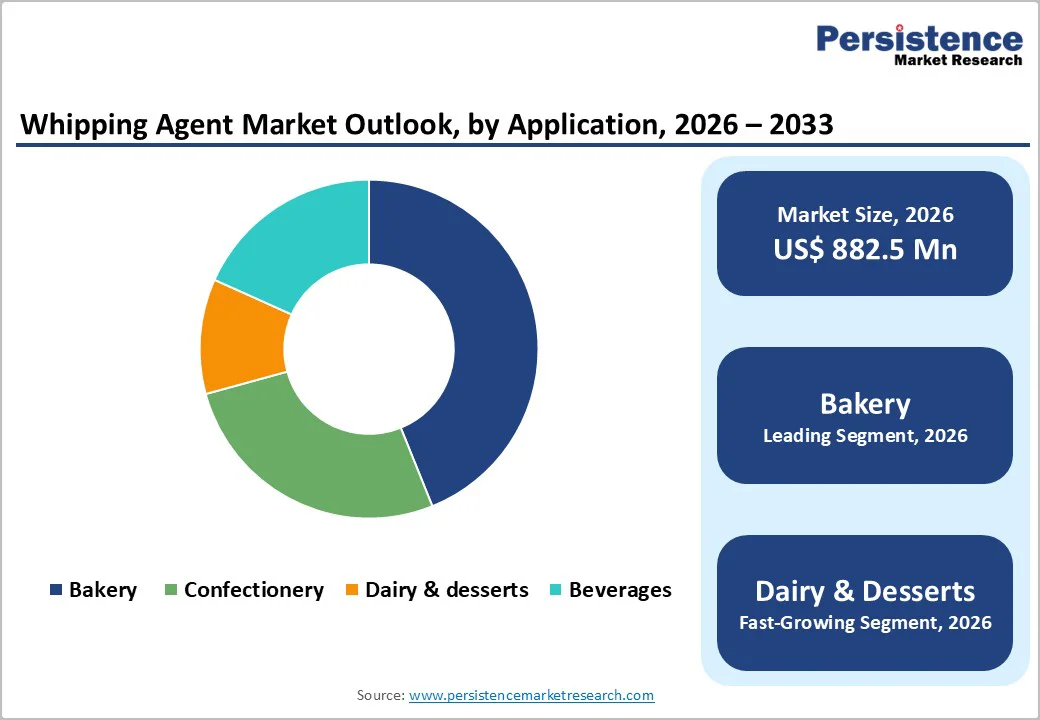
Bakery applications hold the largest share of the whipping agent market because whipped textures are fundamental to a wide range of bakery products, including cakes, pastries, muffins, rolls, and dessert toppings. Whipping agents play a key role in creating volume, softness, and light aeration qualities that consumers consistently expect in baked goods.
The global expansion of commercial bakeries, quick-service restaurants, café chains, and packaged bakery brands further increases demand. Additionally, the surge in home baking and ready-mix products has increased demand for easy-to-use whipping solutions. Since bakery products are produced in high volumes and consumed daily across regions, they naturally represent the biggest application segment.
Regional Insights
North America Whipping Agent Trends
North America leads the global whipping agent market due to its strong bakery, confectionery, and dairy processing industries, as well as early adoption of clean-label and plant-based ingredients. The region’s mature food manufacturing ecosystem continually demands high-performance whipping agents that deliver stability, consistent aeration, and ease of use for large-scale production.
Growth in premium desserts, ready-to-eat bakery items, and café culture also drives higher consumption. In the U.S., the rising popularity of home baking, gluten-free and vegan desserts, and innovation in plant-based whipped toppings are shaping product development. American manufacturers are increasingly focusing on sustainable, allergen-free, and easy-to-use whipping solutions to meet evolving consumer preferences.
Asia Pacific Whipping Agent Market Trends
Asia Pacific is emerging as one of the fastest-growing regions in the whipping agent market, driven by the rapid expansion of bakery, confectionery, and café chains across China, India, Indonesia, and Southeast Asia. Rising urbanization, increasing disposable incomes, and growing interest in Western-style desserts are fueling strong demand for high-performance whipping solutions.
Local manufacturers are adopting plant-based and cost-efficient formulations to cater to price-sensitive markets while meeting clean-label preferences. The region is also witnessing strong growth in home baking, online bakery businesses, and premium dessert segments. With a young consumer base and an expanding food processing industry, the Asia Pacific presents exceptional future growth potential for whipping agents.
Competitive Landscape
The global whipping agent market is moderately competitive, with a mix of global ingredient leaders and specialized regional suppliers.
Major players focus on developing high-performance, clean-label, and plant-based formulations to meet growing demand from bakery, confectionery, and dairy manufacturers. Companies compete on product functionality, foam stability, cost efficiency, and customization for industrial processing. Strategic activities such as partnerships with bakery brands, expansion into emerging markets, and investments in R&D are common.
Key Industry Developments:
- In July 2025, Dole Packaged Foods LLC named Haberman, a Minneapolis-based modern storytelling agency, as the creative and media strategic lead for the new Dole Whip® fruit-first frozen treat available in select grocery stores nationwide. Haberman led an integrated summer campaign spanning creative, paid media, public relations, influencer partnerships, and full-funnel strategy rooted in the brand’s legacy and joyful storytelling.
Companies Covered in Whipping Agent Market
- Cargill
- Ingredion
- Kerry Group
- Tate & Lyle
- ADM (Archer Daniels Midland)
- BASF
- Wacker Chemie
- Palsgaard
- Puratos
- Döhler
- Gelita
- Corbion
- Others
Frequently Asked Questions
The global whipping agent market is projected to be valued at US$882.5 Mn in 2026.
Consumers prefer vegan, dairy-free, and natural whipping solutions, pushing manufacturers to innovate.
The global whipping agent market is poised to witness a CAGR of 4.3% between 2026 and 2033.
Whipping agents for premium desserts such as artisanal pastries, mousse cups, and café beverages.
Cargill, Ingredion, Kerry Group, Tate & Lyle, BASF, and others.


