Mammalian Cell Banking Market Size, Share, and Growth Forecast for 2025 - 2032

Mammalian Cell Banking Market Cell Type (CHO, BHK, NS0), Technology(TEP, IEP, SEP ) and Regional Analysis

ID: PMRREP31663
Calendar

April 2025

251 Pages

Author : Pravin Rewale

Mammalian Cell Banking Market Outlook (2025-2032)

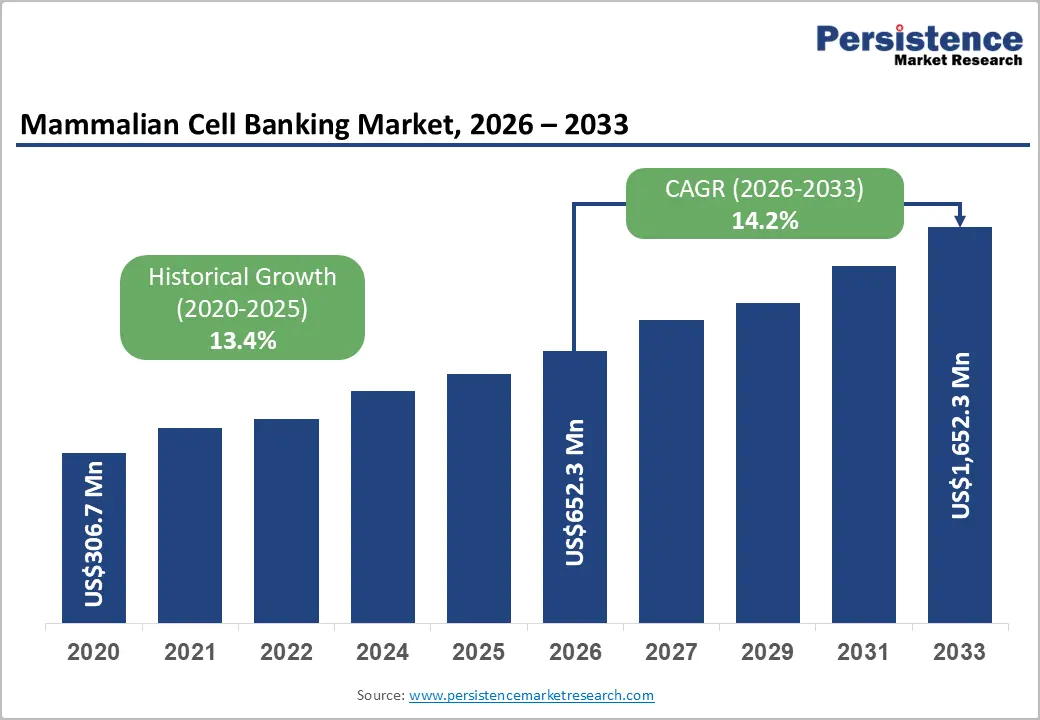
Global revenue from the market was about US$ 567.0 Million in 2025 with the worldwide market estimated to surge ahead at a CAGR of 14.0% to reach a valuation of around US$ 1,418.8 Million by the end of 2032.

Mammalian Cell Banking Market Size (2025)

US$ 567.0 Million

Projected Market Value (2032)

US$ 1,418.8 Million

Global Market Growth Rate (2025-2032)

 14.0% CAGR

Historical Market Growth (CAGR 2019 to 2024)

12.8%

Sales Analysis of Market from 2019 to 2024 Vs Market Outlook for 2025 to 2032

The market value for mammalian cell banking market was approximately 14.0% of the overall US$ 567.0 Million of the global cell banking outsourcing market in 2025.

The global market recorded a historic CAGR of 12.8% in the last 5 years from 2019 to 2024.

Mammalian cells are cells that are separated from or developed from a mammal's tissue. Mammalian cell lines are utilized for practical biotechnology purposes in the production of viruses, proteins, and other things in addition to modelling biological systems and disease.

To support and promote research on cancer research, the National Cancer Institute and other institutions make significant research investments. These initiatives include The National Clinical Trials Network (NCTN), Cancer Moonshot, NCI Community Oncology Research Program (NCORP), NCI Genomic Data Commons (GDC), etc. This initiative taken by different organizations to support the market will boost sales in the forecast period.

Demand for preclinical studies is rising as the number of cancer cases increases. This is the primary driver of the mammalian cell banking market's growth. The biopharmaceutical industry will gain benefits from advances in cryopreservation technology. In the biopharmaceutical sector, mammalian cells are frequently used to produce recombinant therapeutic proteins. The biopharmaceutical industry uses mammalian cell lines as the host cells for the manufacturing of biologics.

The global mammalian cell banking market is thus likely to show high growth over the coming years with a CAGR of 14.0% and reach a global market size of around US$ 1,418.8 Million by 2032.

How can Mammalian Cell Banking Market Grow?

“Increasing focus on Oncological Research to Boost Market Growth”

As cancer cells are more receptive to in vitro culture, mammalian cell culture may have contributed the most to oncology research. For the scientific experiment, cell lines offer a perpetual stream of biological material. Government agencies in the South Asia region are funding more cancer research, expanding the market for companies that offer services for mammalian cell banks.

For instance, a Memorandum of Understanding (MoU) announced a signed partnership agreement between Cancer Research UK and the Department of Biotechnology (DBT) for the India-UK Cancer Research Initiative in November 2018. The Department of Biotechnology, Cancer Research UK (CRUK), and the Ministry of Science & Technology, India collaborated on a five-year India-UK cancer research initiative with a focus on developing cost-effective cancer treatments. In this five-year project, CRUK and DBT invested £5 million, and they actively seek out additional funding from other potential partners.

Cell banks are used to improve post-cryopreservation techniques to enhance cell recovery. Cryopreserved cell lines are offered in numerous vials to avoid repeated handling and reviving of cell lines during the research process, which could lead to contamination and genetic diversity. Hence, researchers will adopt the product more frequently for research propose.

This will promote the successful cryopreservation of cell lines, which is required for the development of effective processes for the production of biopharmaceutical products. Cryopreservation is also more important than conventional cell preservation techniques. This is the primary driver of the mammalian cell banking market's growth.

Governmental and non-governmental organizations are contributing more to cancer research in terms of financials. The market for mammalian cell banking will expand as a result. Over the projection period, this will present prospects for market size expansion.

Are There Any Barriers That Can Affect the Growth of the Mammalian Cell Banking Market in Any Way?

Lack of Skilled Professionals Limiting Market Growth

Skilled professionals can contribute to innovation and growth in research and development by generating new knowledge in the field. Unfortunately, there is a shortage of skilled professionals engaged in research and developmental activities.

Low salary scales, challenging roles, and inadequate laboratory training are some of the main factors contributing to the lack of skilled professionals. Special laboratory training courses are necessary for handling cell line culture. As these courses are expensive for people, the growth of the market is hindered in the forecast period.

Less awareness of cell banking training programs resulted in a lack of experienced people in research laboratories, thus hampering the growth of the mammalian cell banking market. The Lack of skilled professionals and shortage of equipment & other accessories associated with research laboratories can negatively affect the mammalian cell banking market growth in developing regions.

Country-wise Insights

Why is the U.S. Market Booming?

“Increasing Consolidation Activities among Key Players in U.S.”

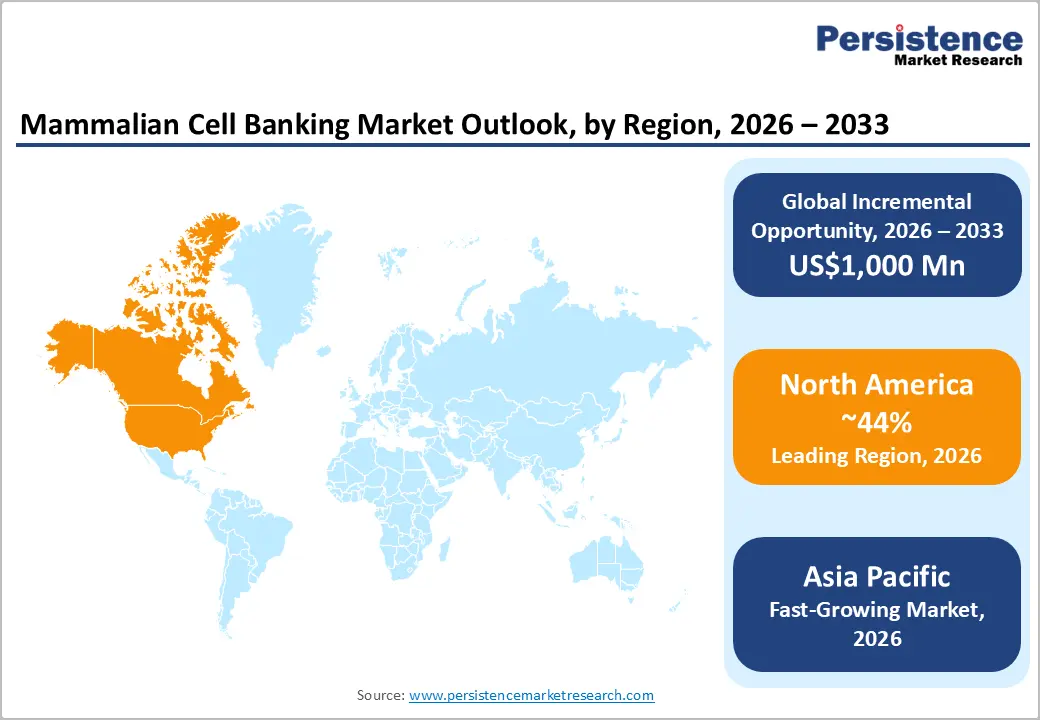
The U.S. accounted for around 91.7% market share in the North American market in 2024 and is expected to over the forecast period.

The mammalian cell banking market is expanding with the growth of cancer research. Key manufacturers are concentrating to increase staff productivity and redefine flexibility, and efficiency.

An increase in service consolidation activities including sales and service agreements, collaborations, increased research and development activities, new service launches, and mergers & acquisitions by global and regional players in the U.S. are characteristic of the overall competition in the global market. These are the key factors aiding towards a prominent share of within U.S. market.

Will India be a Lucrative Market?

“Increasing Research and Development Activities by the Department of Biotechnology for Cancer Genomics”

India held around 4.4% market share of the global market in 2024 and market value is US$ 16.9 Million in 2024.

In India, cancer is a major public health problem. Every year, more than 1 million new cases of cancer are reported in India, this number is expected to rise due to the country's ageing population and changing lifestyle.

To conduct basic, translational, and clinical research as well as to develop new approaches to the prevention and treatment of disease, DBT (Department of Biotechnology) has formed resources available to multi-institutional networking programs, individual investigators and institutions through its Research & Development programs for cancer disease.

For instance, on 11 May 2020, to set up Virtual Network Centers (VNCs) in cancer immunology and immunotherapy, DBT launched a grant call. Due to all these initiatives taken by DBT for research and development activities in India, the country holds a significant share of the market.

How is Japan Emerging as a Prominent Market?

“Custom Service Offerings for Specific Needs”

Japan held a prominent market share of about 59.0% in the East Asia market in 2024.

The demand for specialized cell culture has increased due to the constantly changing needs of the research community to the point that the majority of vendors who are now providing these services cannot rely simply on sales from catalogue services in Japan. Because of the time and effort required to validate a customized cell line before usage in tests, research consumers frequently prefer particular solutions to meet the needs of the project. Vendors concentrate on building a robust distribution network to enable services to reach customers from their manufacturing plants in this region quickly.

Category-wise Insights

Which Cell is Driving Growth of the Global Market?

“CHO is used in the Manufacturing of Therapeutic Proteins and Biologics”

The CHO segment held around 61.6% share of the global market in 2024, and tis expected to expand at a lucrative CAGR of 14.8% in forecast period.

In the development of biologics, Chinese Hamster Ovary (CHO) cells have become the benchmark. CHO cells became popular due to the low chromosome number and used to study genetics. The expression of high-quality protein has possible by recent developments in the bioprocessing of CHO cells to produce recombinant proteins and monoclonal antibodies.

CHO used in the commercial manufacture of therapeutic proteins as well as biological and medical research such as types of cancer. Due to all this positive advantages of CHO cell holds highest share in term of cell in the market.

Which Technology is Driving Growth of the Global Market?

“SEP Used in Bulk Production Activities”

The SEP (Stable Expression Platform) technology segment hold around 71.3% share of the global market in 2024.

Stable expression platform systems are used frequently in biopharmaceutical industry. For early stage manufacturers, where the most possible financial and commercial flexibility is required, cell line ownership, complications with IP, royalty payments and licensing may restrict alternatives for SEP. While various proteins can be produced quickly using transient technology in small quantities, the production of stable cell lines is necessary for producing larger quantities of material. Stable expression platform technologies often use auxotrophic selection or epigenetic engineering. Hence, due to all this positive factors SEP holds highest share in the market.

Which Application is Driving Growth of the Global Market?

“Ease of Recombinant Protein Production”

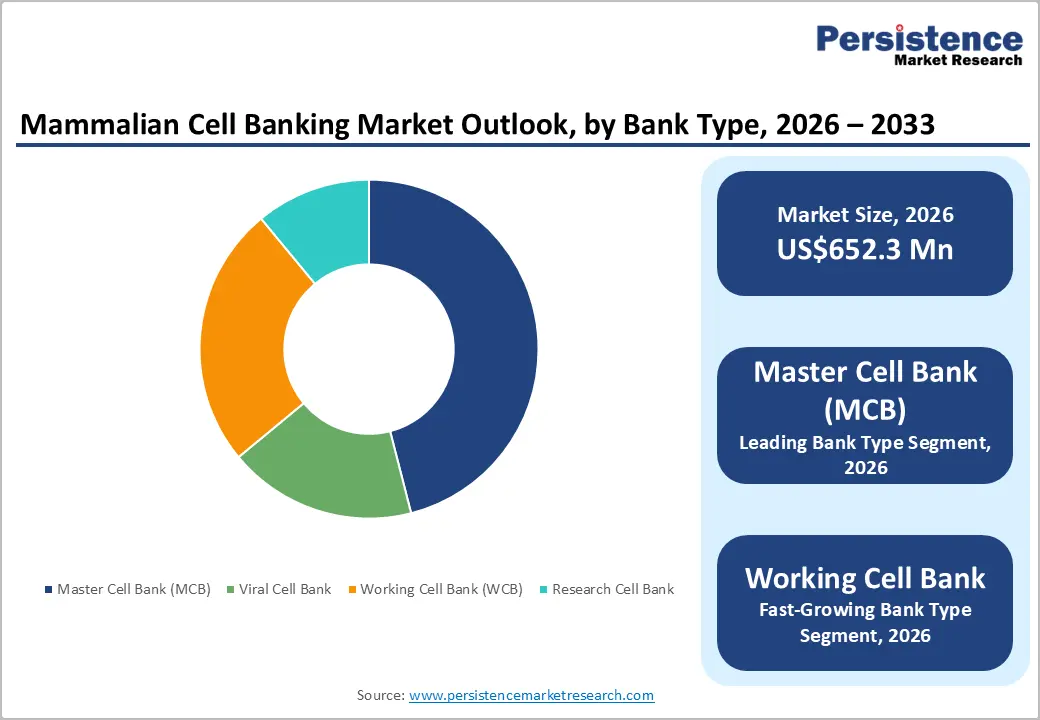
The WCB Application segment hold around 47.3% share of the global market in 2024.

Under specific cell culture conditions, working cell banks (WCB) are developed from the master cell bank (MCB). To verify that the WCB and MCB are genetically identical and to assure that the WCB is free of impurities, quality control tests using DNA profiling methods are carried out. WCB are clonal cell lines that have been formed and engineered to produce recombinant proteins, as further specified in a work order.

These mammalian cells are able to introduce post-translational modifications, optimal protein folding, and product assembly for recombinant proteins, all of which are required for biological function. The WCB are able to produce recombinant proteins.

Which End User Poses a Greater Adoption?

“Growing Research and Development Activities”

Biopharmaceutical companies hold the largest share of about 69.1% with a market value of around US$ 263.1 Million in 2024.

In terms of end users, recombinant therapeutic proteins is formed in the biopharmaceutical industry using mammalian cells. The biopharmaceutical industry uses mammalian cell lines as the host cells for the manufacturing of biologics. Biopharmaceutical companies use improved post-cryopreservation techniques to enhance cell recovery. This is a key factor for biopharmaceutical companies to hold highest share in terms of the end-user.

Competitive Landscape

Key players concentrate on product launches, strategic alliances, and acquisitions to increase market presence. Apart from this, strategies of the manufacturers, include expansions such as the opening of new facilities in order to expand the developing new technology and innovative research and development capability of the company.

For instance:

  • In 8 August 2019, Sartorius Stedim Biotech introduced new services for the production of mammalian cell banks
  • In 1 March 2021, Eurofins DiscoverX Corporation announced the acquisition of Beacon Discovery, Inc. The acquisition of Beacon Discovery contributes to Eurofins' strategy of serving as the pharmaceutical industry's by offering expertise, and a track record in improving drug discovery and the development of novel therapies.
  • In 5 april 2022, Merck KGaA announced the acquisition of MAST (Modular Automated Sampling Technology) from Lonza.

Similarly, the team at Persistence Market Research has tracked recent developments related to companies within the mammalian cell banking space, which are available in the full report.

Mammalian Cell Banking Market Scope

Attribute

Details

Forecast Period

2025 - 2032

Historical Data Available for

2019 - 2024

Market Analysis

Value: US$ Bn/Mn, Volume: As applicable

Key Countries Covered

  • U.S.
  • Canada
  • Brazil
  • Mexico
  • Argentina
  • U.K.
  • Germany
  • Italy
  • France
  • Spain
  • BENELUX
  • Nordic Countries
  • Russia
  • India
  • Indonesia
  • Malaysia
  • Thailand
  • China
  • Japan
  • South Korea
  • Australia
  • New Zealand
  • GCC Countries
  • Turkey
  • South Africa
  • North Africa

Key Market Segments Covered

  • Cell
  • Technology
  • application
  • End User
  • Region

Key Companies Profiled

  • Eurofins DiscoverX Corporation
  • Merck KGaA
  • Sartorius Stedim BioOutsource Limited.
  • Charles River Laboratories
  • Altogen Labs
  • Abzena Ltd
  • Northway Biotechpharma
  • Lonza Group Ltd
  • VIRUSURE
  • Selexis SA
  • Takara Bio Inc
Report Highlights
  • Market Forecast and Trends
  • Competitive Intelligence & Share Analysis
  • Growth Factors and Challenges
  • Strategic Growth Initiatives
  • Pricing Analysis & Technology Roadmap
  • Future Opportunities and Revenue Pockets
  • Industry Market Analysis Tools   

Customization & Pricing

Available upon Request

Companies Covered in Mammalian Cell Banking Market

  • Eurofins DiscoverX Corporation
  • Merck KGaA
  • Sartorius Stedim BioOutsource Limited.
  • Charles River Laboratories
  • Altogen Labs
  • Abzena Ltd
  • Northway Biotechpharma
  • Lonza Group Ltd
  • VIRUSURE
  • Selexis SA
  • Sigma-Aldrich
  • Takara Bio Inc
Frequently Asked Questions

Rising cancer research initiatives and biopharmaceutical demand will drive future market growth.

The U.S. will continue to dominate due to increased consolidation and R&D activities.


India's market will grow with expanding cancer genomics research and government funding.

SEP (Stable Expression Platform) will lead bulk production activities and hold major share.

CHO cells will remain the preferred choice for producing therapeutic proteins and biologics.

Key Segments Covered in Manufacturing of Industry Research

Cell Type:

  • CHO
  • BHK
  • NS0
  • YB2/0 & P2/0
  • HEK293 & Derivatives
  • HELA

Technology:

  • TEP
  • IEP
  • SEP

Application:

  • MCB
  • WCB
  • EoP
  • R&D CB

End User:

  • Academic & Research Institute
  • Biopharmaceutical Companies
  • CROs

Region:

  • North America
  • Latin America
  • Europe
  • South Asia
  • East Asia
  • Oceania
  • The Middle East & Africa (MEA)

Related Reports

1. Executive Summary

    1.1. Global Market Outlook

    1.2. Demand Side Trends

    1.3. Supply-Side Trends

    1.4. Analysis and Recommendations

2. Market Overview

    2.1. Market Coverage / Taxonomy

    2.2. Market Definition / Scope / Limitations

    2.3. Inclusions and Exclusions

3. Key Market Trends

    3.1. Key Trends Impacting the Market

    3.2. Development/Innovation Trends

4. Key Success Factors

    4.1. Pipeline Assessment

    4.2. Value chain Analysis

    4.3. Key Promotional Strategies, By Key Manufacturers

    4.4. Regulatory Landscape

    4.5. PESTLE Analysis

    4.6. Porter’s Analysis

5. Market Background

    5.1. Macro-Economic Factors

        5.1.1. Global GDP Growth Outlook

        5.1.2. Global Healthcare Expenditure

        5.1.3. Global Cell Banking Outsourcing Market Outlook

    5.2. Forecast Factors - Relevance & Impact

        5.2.1. Key Player’s Historic Growth

        5.2.2. Market Consolidation Activities

        5.2.3. Increasing Geriatric Population

        5.2.4. Rising Cases of Cancer

        5.2.5. Growing Preference of Mammalian Cell Banking

        5.2.6. Increased R&D investments by Government

    5.3. Market Dynamics

        5.3.1. Drivers

        5.3.2. Restraints

        5.3.3. Opportunity Analysis

6. COVID-19 Crisis – Impact Assessment

    6.1. COVID-19 and Impact Analysis

        6.1.1. By Cell

        6.1.2. By Technology

        6.1.3. By Application

        6.1.4. By End User

        6.1.5. By Region

    6.2. 2022 Market Scenario

7. Global Mammalian Cell Banking Market Outlook, 2019 - 2032

    7.1. Historical Market Value (US$ Mn) Analysis, 2019-2023

    7.2. Current and Future Market Value (US$ Mn) Projections, 2024-2032

        7.2.1. Y-o-Y Growth Trend Analysis

        7.2.2. Absolute $ Opportunity Analysis

8. Global Mammalian Cell Banking Market Outlook, 2019 - 2032 , By Cell

    8.1. Introduction / Key Findings

    8.2. Historical Market Size (US$ Mn) Analysis By Cell, 2019-2023

    8.3. Current and Future Market Size (US$ Mn) Analysis and Forecast By Cell, 2024-2032

    8.4. Market Attractiveness Analysis By Cell

9. Global Mammalian Cell Banking Market Outlook, 2019 - 2032 , By Technology

    9.1. Introduction / Key Findings

    9.2. Historical Market Size (US$ Mn) By Technology, 2019-2023

    9.3. Current and Future Market Size (US$ Mn) Analysis and Forecast By Technology, 2024-2032

    9.4. Market Attractiveness Analysis By Technology

10. Global Mammalian Cell Banking Market Outlook, 2019 - 2032 , By Application

    10.1. Introduction / Key Findings

    10.2. Historical Market Size (US$ Mn) Analysis By Application, 2019-2023

    10.3. Current and Future Market Size (US$ Mn) Analysis and Forecast By Application, 2024-2032

    10.4. Market Attractiveness Analysis By Application

11. Global Mammalian Cell Banking Market Outlook, 2019 - 2032 , By End User

    11.1. Introduction / Key Findings

    11.2. Historical Market Size (US$ Mn) By End User, 2019-2023

    11.3. Current and Future Market Size (US$ Mn) Analysis and Forecast By End User, 2024-2032

        11.3.1. Academic & Research Institute

        11.3.2. Biopharmaceutical Companies

        11.3.3. CROs

    11.4. Market Attractiveness Analysis By End User

12. Global Mammalian Cell Banking Market Outlook, 2019 - 2032 , By Region

    12.1. Introduction

    12.2. Historical Market Size (US$ Mn) Analysis by Region, 2019-2023

    12.3. Current Market Size (US$ Mn) Analysis and Forecast by Region, 2024-2032

        12.3.1. North America

        12.3.2. Latin America

        12.3.3. Europe

        12.3.4. East Asia

        12.3.5. South Asia

        12.3.6. Oceania

        12.3.7. Middle East and Africa (MEA)

    12.4. Market Attractiveness Analysis By Region

13. North America Mammalian Cell Banking Market Outlook, 2019 - 2032

    13.1. Introduction

    13.2. Historical Market Size (US$ Mn) Trend Analysis by Market Taxonomy, 2019-2023

    13.3. Current and Future Market Size (US$ Mn) Analysis and Forecast by Market Taxonomy, 2024-2032

        13.3.1. By Country

            13.3.1.1. U.S.

            13.3.1.2. Canada

    13.4. Market Attractiveness Analysis

    13.5. Market Trends

    13.6. Key Market Participants - Intensity Mapping

    13.7. Drivers and Restraints - Impact Analysis

    13.8. Country Level Analysis & Forecast

        13.8.1. U.S. Mammalian Cell Banking Market Analysis

            13.8.1.1. Introduction

            13.8.1.2. Market Analysis and Forecast by Market Taxonomy

        13.8.2. Canada Mammalian Cell Banking Market Analysis

            13.8.2.1. Introduction

            13.8.2.2. Market Analysis and Forecast by Market Taxonomy

14. Latin America Mammalian Cell Banking Market Outlook, 2019 - 2032

    14.1. Introduction

    14.2. Historical Market Size (US$ Mn) Trend Analysis by Market Taxonomy, 2019-2023

    14.3. Current and Future Market Size (US$ Mn) Analysis and Forecast by Market Taxonomy, 2024-2032

        14.3.1. By Country

            14.3.1.1. Mexico

            14.3.1.2. Brazil

            14.3.1.3. Argentina

            14.3.1.4. Rest of Latin America

    14.4. Market Attractiveness Analysis

    14.5. Market Trends

    14.6. Key Market Participants - Intensity Mapping

    14.7. Drivers and Restraints - Impact Analysis

    14.8. Country Level Analysis & Forecast

        14.8.1. Mexico Mammalian Cell Banking Market Analysis

            14.8.1.1. Introduction

            14.8.1.2. Market Analysis and Forecast by Market Taxonomy

        14.8.2. Brazil Mammalian Cell Banking Market Analysis

            14.8.2.1. Introduction

            14.8.2.2. Market Analysis and Forecast by Market Taxonomy

        14.8.3. Argentina Mammalian Cell Banking Market Analysis

            14.8.3.1. Introduction

            14.8.3.2. Market Analysis and Forecast by Market Taxonomy

15. Europe Mammalian Cell Banking Market Outlook, 2019 - 2032

    15.1. Introduction

    15.2. Historical Market Size (US$ Mn) Trend Analysis by Market Taxonomy, 2019-2023

    15.3. Current and Future Market Size (US$ Mn) Analysis and Forecast by Market Taxonomy, 2024-2032

        15.3.1. By Country

            15.3.1.1. Italy

            15.3.1.2. Germany

            15.3.1.3. U.K

            15.3.1.4. France

            15.3.1.5. Spain

            15.3.1.6. BENELUX

            15.3.1.7. Nordic Countries

            15.3.1.8. Russia

            15.3.1.9. Rest of Europe

    15.4. Market Attractiveness Analysis

    15.5. Market Trends

    15.6. Key Market Participants - Intensity Mapping

    15.7. Drivers and Restraints - Impact Analysis

    15.8. Country Level Analysis & Forecast

        15.8.1. Italy Mammalian Cell Banking Market Analysis

            15.8.1.1. Introduction

            15.8.1.2. Market Analysis and Forecast by Market Taxonomy

        15.8.2. Germany Mammalian Cell Banking Market Analysis

            15.8.2.1. Introduction

            15.8.2.2. Market Analysis and Forecast by Market Taxonomy

        15.8.3. U.K. Mammalian Cell Banking Market Analysis

            15.8.3.1. Introduction

            15.8.3.2. Market Analysis and Forecast by Market Taxonomy

        15.8.4. France Mammalian Cell Banking Market Analysis

            15.8.4.1. Introduction

            15.8.4.2. Market Analysis and Forecast by Market Taxonomy

        15.8.5. Spain Mammalian Cell Banking Market Analysis

            15.8.5.1. Introduction

            15.8.5.2. Market Analysis and Forecast by Market Taxonomy

        15.8.6. BENELUX Mammalian Cell Banking Market Analysis

            15.8.6.1. Introduction

            15.8.6.2. Market Analysis and Forecast by Market Taxonomy

        15.8.7. Nordic Countries Mammalian Cell Banking Market Analysis

            15.8.7.1. Introduction

            15.8.7.2. Market Analysis and Forecast by Market Taxonomy

        15.8.8. Russia Mammalian Cell Banking Market Analysis

            15.8.8.1. Introduction

            15.8.8.2. Market Analysis and Forecast by Market Taxonomy

16. South Asia Mammalian Cell Banking Market Outlook, 2019 - 2032

    16.1. Introduction

    16.2. Historical Market Size (US$ Mn) Trend Analysis by Market Taxonomy, 2019-2023

    16.3. Current and Future Market Size (US$ Mn) Analysis and Forecast by Market Taxonomy, 2024-2032

        16.3.1. By Country

            16.3.1.1. India

            16.3.1.2. Indonesia

            16.3.1.3. Malaysia

            16.3.1.4. Thailand

            16.3.1.5. Rest of South Asia

        16.3.2. By Cell

    16.4. Market Attractiveness Analysis

    16.5. Market Trends

    16.6. Key Market Participants - Intensity Mapping

    16.7. Drivers and Restraints - Impact Analysis

    16.8. Country Level Analysis & Forecast

        16.8.1. India Mammalian Cell Banking Market Analysis

            16.8.1.1. Introduction

            16.8.1.2. Market Analysis and Forecast by Market Taxonomy

        16.8.2. Indonesia Mammalian Cell Banking Market Analysis

            16.8.2.1. Introduction

            16.8.2.2. Market Analysis and Forecast by Market Taxonomy

        16.8.3. Malaysia Mammalian Cell Banking Market Analysis

            16.8.3.1. Introduction

            16.8.3.2. Market Analysis and Forecast by Market Taxonomy

        16.8.4. Thailand Mammalian Cell Banking Market Analysis

            16.8.4.1. Introduction

            16.8.4.2. Market Analysis and Forecast by Market Taxonomy

17. East Asia Mammalian Cell Banking Market Outlook, 2019 - 2032

    17.1. Introduction

    17.2. Historical Market Size (US$ Mn) Trend Analysis by Market Taxonomy, 2019-2023

    17.3. Current and Future Market Size (US$ Mn) Analysis and Forecast by Market Taxonomy, 2024-2032

        17.3.1. By Country

            17.3.1.1. China

            17.3.1.2. Japan

            17.3.1.3. South Korea

    17.4. Market Attractiveness Analysis

    17.5. Market Trends

    17.6. Key Market Participants - Intensity Mapping

    17.7. Drivers and Restraints - Impact Analysis

    17.8. Country Level Analysis & Forecast

        17.8.1. China Mammalian Cell Banking Market Analysis

            17.8.1.1. Introduction

            17.8.1.2. Market Analysis and Forecast by Market Taxonomy

        17.8.2. Japan Mammalian Cell Banking Market Analysis

            17.8.2.1. Introduction

            17.8.2.2. Market Analysis and Forecast by Market Taxonomy

        17.8.3. South Korea Mammalian Cell Banking Market Analysis

            17.8.3.1. Introduction

            17.8.3.2. Market Analysis and Forecast by Market Taxonomy

18. Oceania Mammalian Cell Banking Market 2015-2022 and Forecast 2023-2033

    18.1. Introduction

    18.2. Historical Market Size (US$ Mn) Trend Analysis by Market Taxonomy, 2019-2023

    18.3. Current and Future Market Size (US$ Mn) Analysis and Forecast by Market Taxonomy, 2024-2032

        18.3.1. By Country

            18.3.1.1. Australia

            18.3.1.2. New Zealand

    18.4. Market Attractiveness Analysis

    18.5. Market Trends

    18.6. Key Market Participants - Intensity Mapping

    18.7. Drivers and Restraints - Impact Analysis

    18.8. Country Level Analysis & Forecast

        18.8.1. Australia Mammalian Cell Banking Market Analysis

            18.8.1.1. Introduction

            18.8.1.2. Market Analysis and Forecast by Market Taxonomy

        18.8.2. New Zealand Mammalian Cell Banking Market Analysis

            18.8.2.1. Introduction

            18.8.2.2. Market Analysis and Forecast by Market Taxonomy

19. Middle East and Africa (MEA) Mammalian Cell Banking Market Outlook, 2019 - 2032

    19.1. Introduction

    19.2. Historical Market Size (US$ Mn) Trend Analysis by Market Taxonomy, 2019-2023

    19.3. Current and Future Market Size (US$ Mn) Analysis and Forecast by Market Taxonomy, 2024-2032

        19.3.1. By Country

            19.3.1.1. GCC Countries

            19.3.1.2. Turkey

            19.3.1.3. South Africa

            19.3.1.4. North Africa

            19.3.1.5. Rest of Middle East and Africa

    19.4. Market Attractiveness Analysis

    19.5. Market Trends

    19.6. Key Market Participants - Intensity Mapping

    19.7. Drivers and Restraints - Impact Analysis

    19.8. Country Level Analysis & Forecast

        19.8.1. GCC Countries Mammalian Cell Banking Market Analysis

            19.8.1.1. Introduction

            19.8.1.2. Market Analysis and Forecast by Market Taxonomy

        19.8.2. Turkey Mammalian Cell Banking Market Analysis

        19.8.3. South Africa Mammalian Cell Banking Market Analysis

        19.8.4. North Africa Mammalian Cell Banking Market Analysis

20. Market Structure Analysis

    20.1. Market Analysis by Tier of Companies

    20.2. Market Share Analysis of Top Players (%)

    20.3. Market Presence Analysis

        20.3.1. By Regional Footprint of Players

        20.3.2. Cell Footprint of Players

        20.3.3. Channel Footprint of Players

21. Competition Analysis

    21.1. Competition Dashboard

    21.2. Competition Benchmarking

    21.3. Competition Deep Dive

        21.3.1. Eurofins DiscoverX Corporation

            21.3.1.1. Overview

            21.3.1.2. Product & Services Portfolio

            21.3.1.3. Key Financials

            21.3.1.4. SWOT Analysis

            21.3.1.5. Key Developments

            21.3.1.6. Sales Footprint

            21.3.1.7. Strategy Overview

                21.3.1.7.1. Marketing Strategy

                21.3.1.7.2. Product Strategy

                21.3.1.7.3. Channel Strategy

        21.3.2. Merck KGaA

        21.3.3. Sartorius Stedim BioOutsource Limited.

        21.3.4. Charles River Laboratories

        21.3.5. Altogen Labs

        21.3.6. Abzena Ltd

        21.3.7. Northway Biotechpharma

        21.3.8. Lonza Group Ltd

        21.3.9. VIRUSURE

        21.3.10. Selexis SA

        21.3.11. Sigma-Aldrich

        21.3.12. Takara Bio Inc

22. Assumptions and Acronyms Used

23. Research Methodology


Research Methodology Framework for Market Research Excellence

At Persistence Market Research, we implement a comprehensive, validated, and multi-dimensional approachto market analysis that delivers actionable insights across complex market landscapes. Our methodology combines the analytical rigor of leading consulting firms with innovative research techniques, ensuring robust market assessments that guide strategic decision-making with confidence.

Core Research Philosophy

Our methodology is built on four foundational pillars:

Research Philosophy Image

At Persistence Market Research, our methodology is designed to transcend conventional market studies by combining analytical rigor, multi-source validation, and future-focused insights.

We integrate advanced research frameworks, robust data collection strategies, cutting-edge analytics, and innovative technologies to deliver a 360-degree view of complex markets.

We integrate advanced research frameworks, robust data collection strategies, cutting-edge analytics, and innovative technologies to deliver a 360-degree view of complex markets.

Each stage spanning from strategic scoping and hypothesis-building to competitive intelligence, quality validation, and actionable recommendations is engineered to provide clients with unmatched clarity, precision, and confidence in decision-making.

By embedding innovation and technology at the core, our approach ensures that insights are not only comprehensive but also predictive, empowering businesses to seize opportunities, mitigate risks, and achieve sustainable growth

Research Philosophy Image

Capturing Key Information and Events

During this phase, key research objectives focus on essential information and data points for assessing the market, including:

Research Philosophy Image

TAM-SAM-SOM Framework Implementation

We employ both top-down and bottom-up approaches to ensure accurate market sizing.

Top-Down Market SizingBottom-Up Market Sizing
Universe Definition: Total global/regional market identificationUnit Economics: Average transaction values, purchase frequencies, customer lifecycle
Segmentation Filters: Geographic, demographic, and behavioral constraintsCustomer Segmentation: Detailed buyer persona development and sizing
Market Share Analysis: Competitive landscape assessment and share allocationPenetration Analysis: Market penetration rates by segment and geography
Growth Rate Application: Historical trends and forward-looking growth assumptionsScaling Methodology: Extrapolation techniques with confidence intervals

Validation & Cross-Verification

  • Triangulation: Comparing top-down and bottom-up results for consistency
  • Sensitivity Analysis: Testing key assumptions and parameter variations
  • Peer Benchmarking: Comparison with analogous markets and industry benchmarks
  • Expert Review: External validation through industry specialist consultation

Research Philosophy Image

Forecasting & Projection Modeling

Our proprietary forecasting models incorporate multiple variables and scenarios.

Forecasting Components

  • Historical Trend Analysis: 10-year historical growth patterns and cyclical variations
  • Driver-Based Modeling: Economic indicators, demographic shifts, technology adoption
  • Scenario Planning: Base case, optimistic, and conservative projections
  • Monte Carlo Simulations: Probability-weighted outcomes and risk assessments

Model Validation

  • Back-Testing: Historical accuracy assessment over 3–5-year periods
  • Cross-Validation: Multiple modeling approaches for result comparison
  • External Benchmarking: Comparison with established market forecasts
  • Continuous Calibration: Quarterly model updates based on new data

Comprehensive Data Collection Strategy

Our secondary research phase establishes a robust knowledge base utilizing diverse, credible sources.

Secondary Data Sourcess

  • Industry Publications & Reports
  • Government & Regulatory Data
  • Financial Intelligence (filings & reports)
  • Academic Research & Digital Intelligence

Quality Assurance Protocol

  • Source credibility assessment and publication date validation
  • Data consistency checks across multiple sources
  • Bias identification and neutralization techniques
  • Information gap tracking for primary research prioritization

Research Philosophy Image

Primary Research Excellence

Our primary research methodology employs best-in-class techniques to capture unique market insights.

Quantitative Research Methods

  • Large-Scale Surveys: Statistically representative samples with 95% confidence intervals
  • Survey Methodology: Multi-channel deployment (online, telephone, in-person)
  • Question Architecture and Response Optimization

Qualitative Research Methods

  • Executive Interviews
  • Focus Groups
  • Expert Consultations

Quality Assurance & Validation Framework

Multi-Stage Validation Process

  • Source Verification and Consistency Testing
  • Outlier Detection and Bias Assessment
  • Peer Review Process and External Validation
  • Sensitivity Analysis and Confidence Intervals

Research Philosophy Image

Methodology Validation & Credibility

Our research methodology has been extensively validated through:

  • Academic Partnerships: Collaborations with top-tier business schools and research institutions
  • Client Success Stories: Documented case studies demonstrating research impact and ROI
  • Continuous Benchmarking: Performance comparison with leading global research firms

This comprehensive methodology framework positions Persistence Market Research at the forefront of market intelligence, combining the analytical sophistication of top-tier consulting firms with innovative research techniques. Our approach ensures that every market assessment delivers precise, actionable, and strategically valuable insights that drive business success in competitive market environments.

Ready to unlock your market potential? Contact our research experts to discuss how our validated methodology can transform your strategic decision-making with data-driven market intelligence.

Copyright © 2026 Persistence Market Research. All Rights Reserved

Connect With Us -