




- Hardware & Software IT Services
- Data Historian Market
Data Historian Market Size, Share, and Growth Forecast, 2026 - 2033
Data Historian Market by Component (Software, Services [Professional Services, Managed Services]), Deployment (On-Premises, Cloud / SaaS, Hybrid), Application, Industry, and Regional Analysis for 2026 - 2033

Data Historian Market Size and Trends
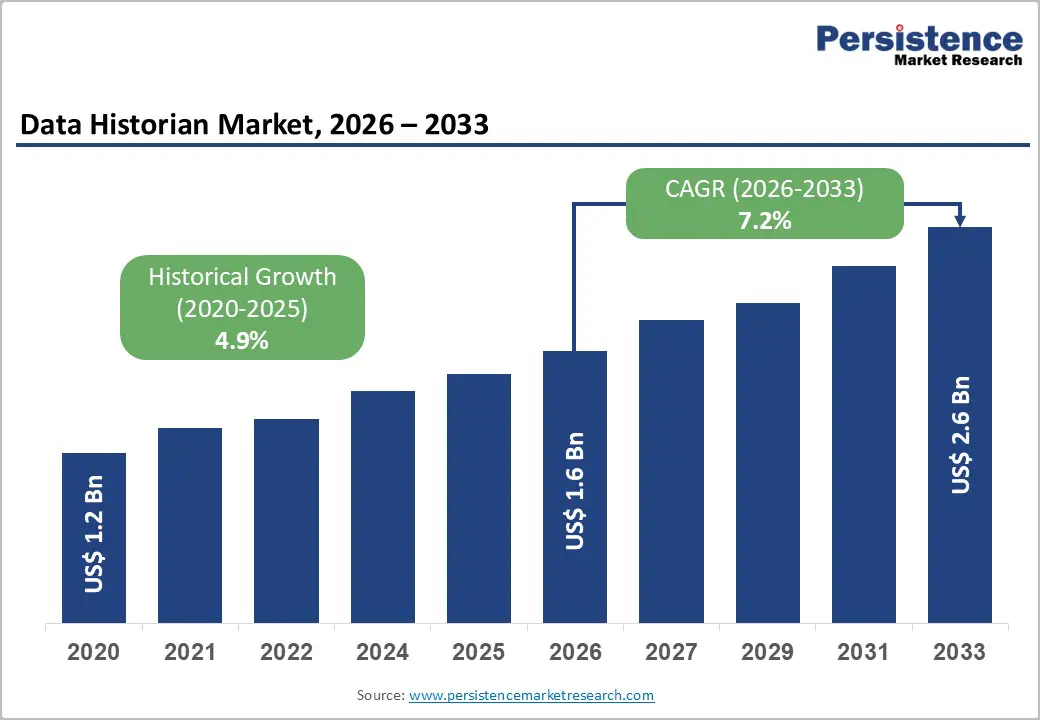
The global data historian market size is projected to rise from US$ 1.6 Bn in 2026 to US$ 2.6 Bn by 2033. It is anticipated to witness a CAGR of 7.2% during the forecast period from 2026 to 2033, driven by the accelerating adoption of Industry 4.0 technologies and the exponential growth of Industrial Internet of Things (IIoT) data generation across manufacturing facilities worldwide.
Organizations are increasingly recognizing that data consolidation and real-time analytics capabilities are essential for optimizing operations, reducing unplanned downtime, and making informed business decisions. The convergence of operational technology (OT) and information technology (IT) systems is enabling manufacturers to leverage historical operational data for predictive maintenance, asset performance optimization, and regulatory compliance, thereby creating substantial demand.
Key Industry Highlights:
- Leading Component: Software dominates the market with over 72% share in 2026, valued at more than US$ 1.2 Bn, driven by the critical need for scalable time-series data collection, real-time visualization, and historical analytics across industrial operations. Services represent the fastest-growing component, supported by rising demand for system integration, customization, cybersecurity, compliance management, and ongoing performance optimization.
- Leading Deployment: On-Premises solutions lead with over 43% market share in 2026, valued at more than US$ 689.5 Mn, due to stringent data security, regulatory compliance, low-latency requirements, and seamless integration with legacy OT systems. Cloud/SaaS is the fastest-growing deployment model with a CAGR of 12.2%, driven by scalability, faster deployment, remote accessibility, and lower upfront infrastructure costs.
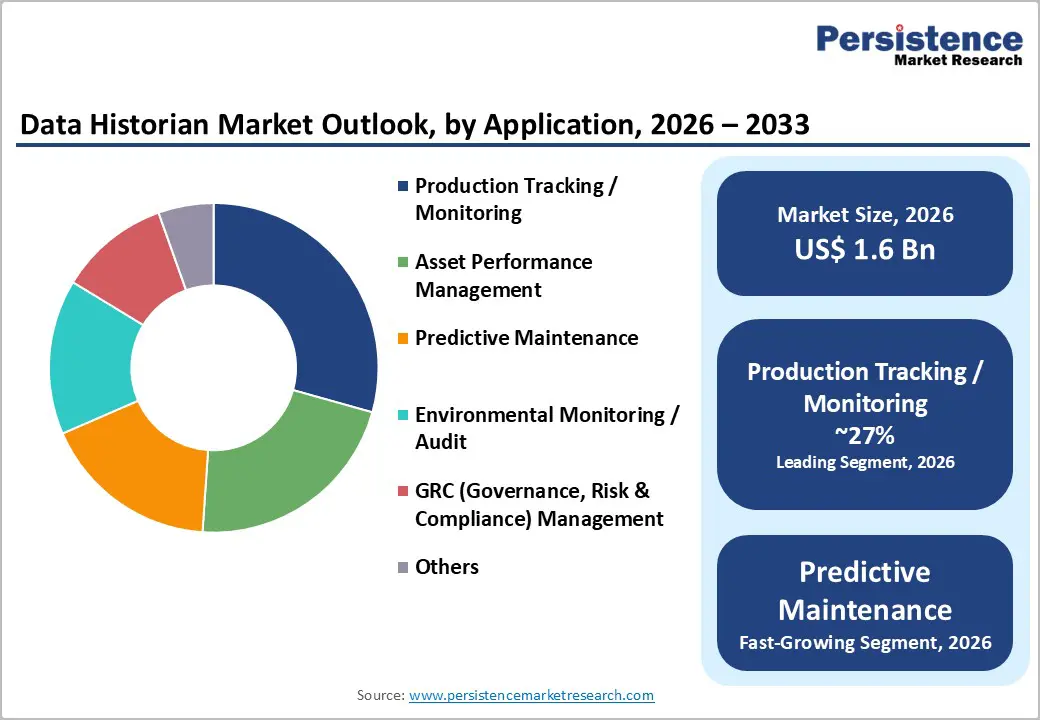
- Leading Application: Production tracking and monitoring holds the largest share at over 27% in 2026, valued at approximately US$ 432.9 Mn, as manufacturers prioritize real-time operational visibility, downtime reduction, and process optimization. Predictive maintenance is the fastest-growing application, fueled by IoT adoption, asset performance management needs, and strong ROI from reduced failures and extended equipment life.
- Leading Industry: Oil & Gas commands the largest market share at over 23% in 2026, supported by massive real-time data generation, safety-critical operations, regulatory compliance requirements, and predictive maintenance for aging infrastructure. Data centers represent a high-growth industry segment, driven by AI workloads, hyperscale expansion, energy optimization needs, and strict uptime and SLA requirements.
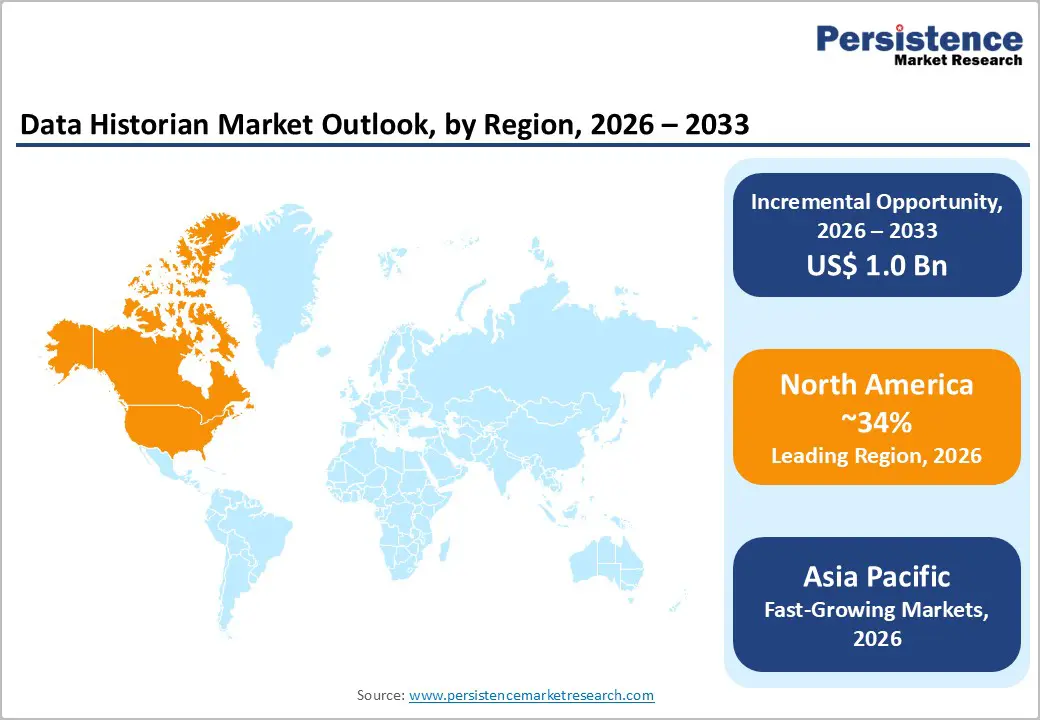
- Leading Region: North America leads the global market with over 34% share in 2026, valued at approximately US$ 545.2 Mn, driven by advanced industrial digitization, strong regulatory frameworks, and the presence of major technology vendors. Asia Pacific is the fastest-growing region with a CAGR of 13.1%, supported by rapid industrialization, government-backed Industry 4.0 initiatives, and expanding manufacturing and data center investments. Europe holds over 23% share, driven by strong manufacturing hubs, strict compliance mandates, and widespread Industry 4.0 adoption.
| Global Market Attribute | Key Insights |
|---|---|
| Data Historian Market Size (2026E) | US$1.6 Bn |
| Market Value Forecast (2033F) | US$2.6 Bn |
| Projected Growth (CAGR 2026 to 2033) | 7.2% |
| Historical Market Growth (CAGR 2020 to 2025) | 4.9% |
Market Dynamics
Driver
Growing Adoption of IoT and Industry 4.0 in Manufacturing
The rapid adoption of IoT devices and sensors in manufacturing has generated massive volumes of real-time operational data, creating a need for advanced data management systems. According to a study, over 70% of manufacturers are significantly increasing their digitization efforts. As manufacturers move toward Industry 4.0, the convergence of IT and OT systems has become essential for achieving holistic visibility across production processes. This integration enables better monitoring, analytics, and decision-making, driving continuous improvements in operational efficiency and productivity. Data historians have become indispensable components of modern manufacturing infrastructure, supporting digital transformation initiatives worldwide.
Predictive Maintenance and Asset Performance Management Capabilities
Unplanned equipment failures are a major cost driver in industrial operations, causing losses from hundreds of thousands to millions of dollars, depending on scale and complexity. Early detection of anomalies enables timely maintenance interventions, reducing production disruptions and extending asset life. IoT-based predictive maintenance has shown to increase equipment lifespan by about 20% while optimizing spare parts inventory and labor, leading to lower maintenance costs. This improves operational efficiency, asset utilization, and ROI. Data historians are increasingly adopted in capital-intensive industries like Oil & Gas, Chemicals, Pharmaceuticals, and Manufacturing, where reliability directly affects profitability and competitiveness.
Restraint
High Implementation Costs and Complexity
Data historian adoption faces major financial and technical barriers, especially for SMEs, despite clear operational benefits. Initial deployment demands significant capital for specialized hardware, enterprise software licenses, and IT infrastructure upgrades, while ongoing costs include hiring and training skilled data engineers, IT administrators, and system integrators. Integration with legacy automation systems, proprietary equipment, and varied communication protocols is complex, as incompatible data formats and heterogeneous sources hinder seamless connectivity. Ensuring consistent data quality and consolidating disparate systems often leads to implementation timelines of 6-18 months, with budget overruns of 30-50%. These challenges make manufacturers hesitant to invest in full-scale historian solutions, limiting broader market growth.
Data Security, Privacy, and Regulatory Compliance Challenges
Critical infrastructure sectors such as Pharmaceuticals, Oil & Gas, and Energy & Utilities must comply with strict standards like FDA 21 CFR Part 11, EU GMP Annex 11, and GxP, requiring robust audit trails, electronic signatures, data integrity verification, and immutable record-keeping. Increasing cyber threats targeting operational technology and supply chains demand advanced security controls, encryption, and threat detection systems. Maintaining compliance is typically the responsibility of data historian administrators, who must continuously update configurations to align with evolving regulations without disrupting operations. The need for specialized cybersecurity and compliance expertise often forces organizations to hire external consultants, further increasing costs and acting as a barrier for new market entrants.
Opportunity
Artificial Intelligence and Machine Learning Integration
The integration of AI and ML with data historian platforms is reshaping their role from mere archival systems to strategic, intelligence-driven infrastructure. Modern historians now enable advanced predictive analytics, anomaly detection, and autonomous decision-making by providing high-quality operational datasets for training models. Cloud-based historians further enhance this by enabling seamless AI/ML integration and facilitating model deployment from cloud to edge for real-time predictive analysis. The rapid adoption of AI-driven ETL tools highlights how intelligent data processing is improving operational efficiency and accelerating digital transformation. It empowers prescriptive analytics, recommending optimal maintenance schedules, resource allocation, and process adjustments to maximize performance while reducing costs.
Energy Optimization and Data Center Market Expansion
The surge in AI workloads and cloud infrastructure is driving unprecedented demand for data historian solutions. Hyperscale operators face major challenges in optimizing cooling, preventing equipment failures, and managing energy as GPU-intensive AI training significantly increases heat and power consumption. With global data center power demand expected to rise by 165% by 2030, operators urgently need advanced monitoring and predictive analytics to enhance efficiency. The adoption of liquid cooling and direct-to-chip technologies increases the need for granular operational data, positioning data historians as essential for sustainable, efficient data center growth. This creates strong revenue potential for vendors offering data center-focused historian solutions and services.
Category-wise Analysis
Component Analysis
Software dominates the global market, capturing more than 72% market share in 2026 with a value exceeding US$ 1.2 Bn, as organizations need robust tools to collect, store, and analyze large volumes of time-series and operational data efficiently. These solutions enable real-time visualization and historical trend analysis, which are essential for optimizing industrial processes and reducing downtime. They also support integration with SCADA, IoT platforms, and analytics systems, helping businesses derive actionable insights. Software-centric historian systems offer scalability and flexible deployment, matching diverse enterprise needs.
Services demonstrate significant growth as companies increasingly need expert support to deploy, integrate, and maintain complex historian systems across diverse industrial environments. As organizations collect larger volumes of operational data, they require services for system customization, data migration, and ensuring seamless connectivity with SCADA, MES, and ERP platforms. Growing cybersecurity and compliance requirements drive demand for professional managed services and regular system audits. As industries move toward predictive maintenance and real-time analytics, service providers help optimize historian performance and enable advanced use cases without burdening internal IT teams.
Deployment Analysis
On-Premises dominate the market, capturing over 43% market share in 2026 with a value exceeding US$ 689.5 Mn, due to many industries requiring high data security, strict compliance, and full control over operational data. The systems provide low-latency, reliable access to real-time process data even in remote or network-restricted environments. They also integrate seamlessly with existing OT infrastructure and legacy control systems, reducing disruption and implementation complexity. On-premises solutions avoid recurring cloud costs and help companies maintain ownership of critical historical data for long-term analysis and audits.
Cloud / SaaS demonstrates highest growth with a CAGR of 12.2% due to organizations increasingly need rapid deployment and scalability without heavy upfront infrastructure costs. SaaS models enable real-time data access from anywhere, supporting remote operations and faster decision-making. They also simplify maintenance and upgrades, reducing the burden on internal IT teams. With growing demand for secure, centralized data storage and analytics, SaaS offers flexible subscription pricing that aligns with variable usage and expansion needs.
Application Analysis
Production tracking / monitoring holds over 27% of the market share in 2026, with a value exceeding US$ 432.9 Mn, as manufacturers urgently need real-time visibility into operations to quickly detect anomalies, reduce downtime, and improve throughput. It supports continuous optimization by capturing detailed processes and equipment data, enabling faster decision-making on the plant floor. This functionality also helps ensure product quality consistency and compliance with regulatory standards. It directly ties data insights to core production performance and cost savings.
Predictive maintenance is expected to grow at the highest rate as industries are increasingly focused on reducing unexpected equipment failures and costly downtime. Data historians capture and store large volumes of real-time operational data, which is essential for building accurate predictive models. With rising adoption of IIoT and sensor networks, organizations can now continuously monitor asset health and identify anomalies early. This enables proactive maintenance scheduling, optimizes spare parts inventory, and extends equipment life delivering strong cost savings and higher operational efficiency.
Industry Analysis
Oil & Gas commands the largest market share at over 23% in 2026, due to industry generating massive volumes of real-time operational data from drilling, production, pipelines, and refineries, requiring robust storage and retrieval systems. Data historians enable continuous monitoring and analysis of process variables to improve safety, prevent downtime, and optimize production. They support regulatory compliance and audit requirements by maintaining accurate historical records of critical parameters. The need for predictive maintenance and asset performance management in aging infrastructure drives heavy adoption of historian solutions.
Data centers are expected to grow at a significant rate as they generate massive volumes of operational and performance data from servers, cooling systems, power distribution, and network equipment, creating a strong need for time-series storage and analysis. Data historians help operators track trends, detect anomalies, and predict failures, which is critical for maintaining uptime and avoiding costly outages. As data center deployments expand with cloud adoption and AI workloads, the demand for real-time monitoring and historical analytics rises sharply. Strict SLAs and compliance requirements push data centers to implement robust data logging and audit trails, further driving historian adoption.
Regional Insights
North America Data Historian Market Trends
North America accounts for over 34% of the Data Historian market share in 2026, reaching approximately US$ 545.2 Mn, driven by heavy R&D investments and the presence of major technology vendors. The region’s mature industrial base, including advanced manufacturing, energy infrastructure, and technology-forward enterprises, supports early adoption of Industry 4.0 and cloud computing. Strong regulatory frameworks such as FDA compliance, EPA monitoring, and SEC cybersecurity disclosure rules create urgent demand for data historians to automate compliance and reduce risk. A robust innovation ecosystem and specialized technical talent enable continuous enhancement of historian capabilities and integration with emerging technologies. Many global enterprises also choose North American vendors for digital transformation projects, leveraging regional expertise to standardize data management across international operations.
Asia Pacific Data Historian Market Trends
Asia Pacific is expected to grow at the highest rate with a CAGR of 13.1%, due to rapid industrialization in China, India, Japan, and Southeast Asia, and strong government investment in digital manufacturing transformation. China dominates the region, supported by “Made in China 2025” and provincial subsidies covering up to 50% of automation investments. India is experiencing strong growth driven by expanding pharmaceutical, automotive, and IT sectors, along with incentives such as SAMARTH Udyog Bharat 4.0. Japan and South Korea are mature innovation hubs where advanced data historian systems with AI/ML support semiconductor, automotive, and precision manufacturing. Southeast Asian markets like Vietnam, Thailand, and Malaysia are emerging rapidly due to FDI and supply chain diversification, while labor cost inflation and skill shortages are accelerating automation and predictive maintenance adoption across the region.
Europe Data Historian Market Trends
Europe is expected to hold more than 23% share by 2026, driven by strong manufacturing hubs in Germany, Italy, France, and the UK where automotive and precision industries require advanced operational data management. The region’s strict regulatory framework, including GDPR, EU GMP Annex 11, and CE marking, creates strong compliance-driven demand for historian systems that support audit trails and documentation. European companies also lead in Industry 4.0 adoption, supported by government funding and digital infrastructure initiatives. Major technology leaders drive innovation and regional growth, while EU regulatory harmonization enables standardized, cross-border deployment of data historian solutions.
Competitive Landscape
The data historian market is moderately consolidated, with a few global vendors holding strong positions while smaller specialized players compete in niche industries. Companies compete by bundling historian software with advanced analytics, edge computing, and IIoT integration, enabling customers to turn raw time-series data into actionable insights. They also focus on scalability and cloud-ready architectures to support growing data volumes and remote operations. Vendors are differentiating through open-connectivity, seamless integration with automation systems, and competitive pricing models to win long-term deployments.
Key Industry Developments
- In April 2025, Rockwell Automation and AWS are partnering to accelerate manufacturing digital transformation by connecting Rockwell’s industrial automation data with AWS cloud services. Rockwell is expanding its FactoryTalk Hub SaaS offerings on AWS, including DataMosaix and Fiix CMMS, enabling scalable edge-to-cloud analytics and AI-driven insights.
- In March 2024, GE Digital announced major updates to Proficy Historian 2024, introducing enhanced horizontal scalability, stronger security protocols, and cloud hyper-scalability to support enterprise-wide industrial data management. The release also includes improved ETL performance benchmarking, enabling faster and more efficient handling of large-scale time-series data across distributed operations.
Companies Covered in Data Historian Market
- Honeywell International Inc.
- General Electric Company
- AVEVA Group plc
- Siemens AG
- ABB Ltd.
- Rockwell Automation, Inc.
- Emerson Electric Co.
- IBM
- Yokogawa Electric Corp.
- Aspen Technology, Inc.
- Schneider Electric SE
- ICONICS, Inc.
- Open Automation Software LLC
- Others
Frequently Asked Questions
The global market is projected to be valued at US$1.6 Bn in 2026.
The unprecedented operational data volumes, requiring sophisticated management infrastructure, and the increasing organizational emphasis on predictive maintenance and asset performance management, which reduce downtime and maintenance costs, are key drivers of the market.
The market is expected to witness a CAGR of 7.2% from 2026 to 2033.
AI and machine learning integration enable the transformation of data historians from passive data repositories to intelligent analytics platforms and accelerate data center growth, creating strong market expansion potential.
Honeywell International Inc., General Electric Company, AVEVA Group plc, Siemens AG, ABB Ltd., Rockwell Automation, Inc. are among the leading key players.


