




- Hardware & Software IT Services
- AI Powered Content Creation Market
AI Powered Content Creation Market Size, Share, and Growth Forecast 2026 - 2033
AI Powered Content Creation Market by Content Type (Text, Image), by Component (Software, Services), Deployment (On-premises, Cloud), Application (Entertainment and Media, E-commerce), and Regional Analysis, 2026 - 2033

AI Powered Content Creation Market Size and Trend Analysis
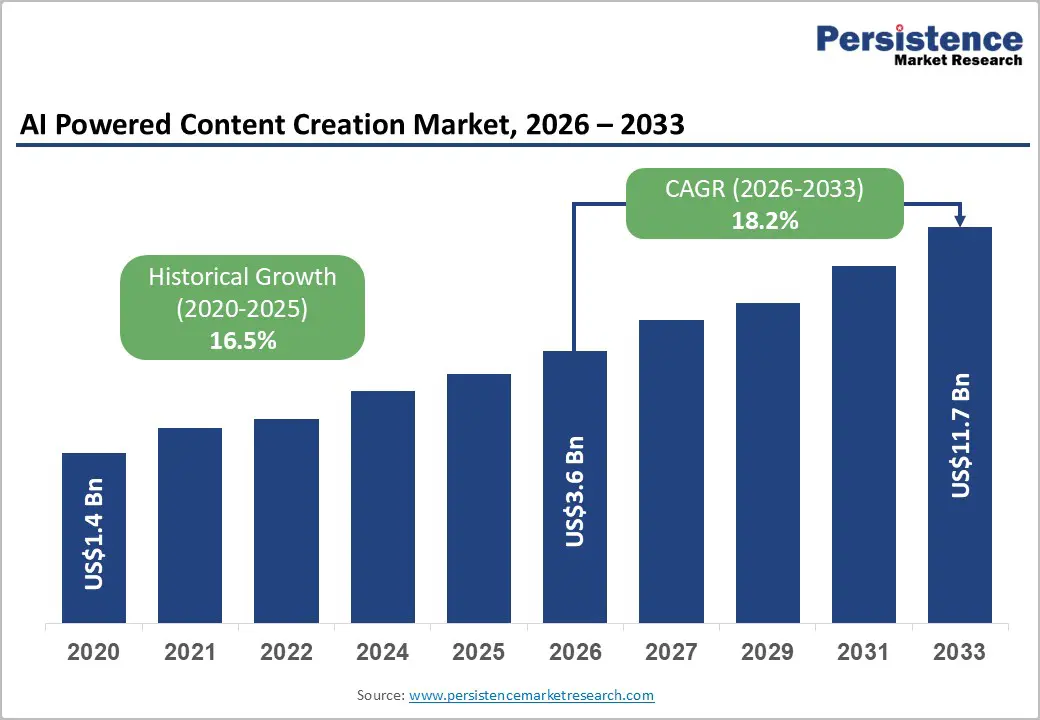
The global AI powered content creation market size is likely to be valued at US$3.6 billion in 2026 and is expected to reach US$11.7 billion by 2033, growing at a CAGR of 18.2% during the forecast period from 2026 to 2033, driven by increasing adoption of generative AI tools across the marketing, media, and e-commerce sectors to simplify content production and reduce turnaround time. Rising demand for personalized and multilingual content is also encouraging businesses to deploy AI-supported platforms that can extend content creation efficiently.
Key Industry Highlights:
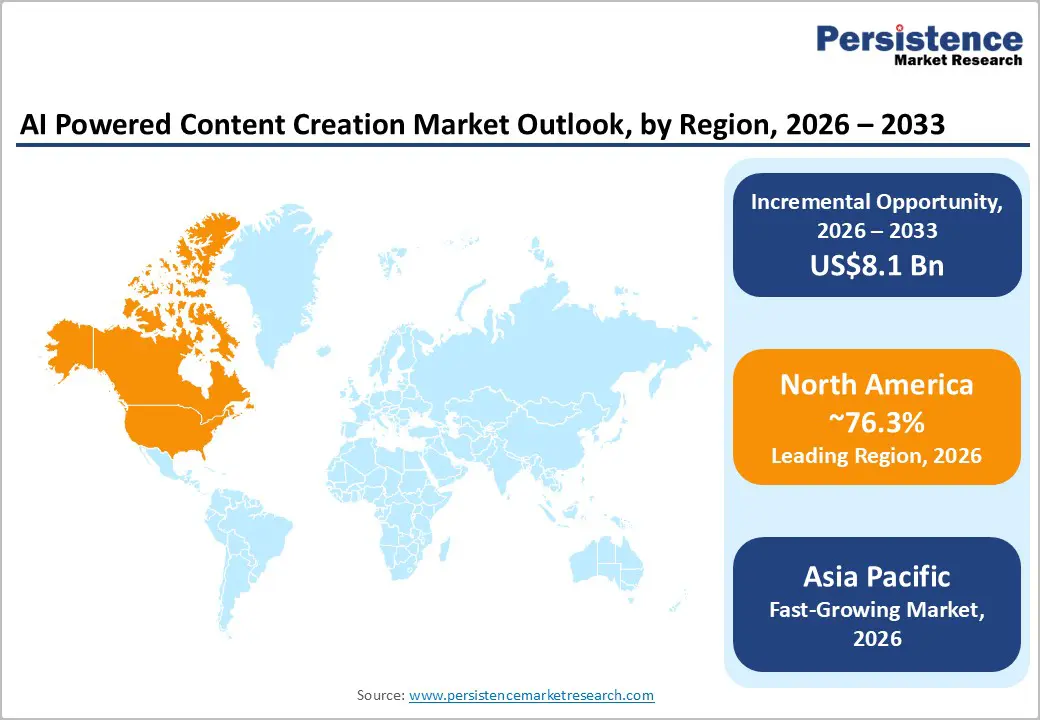
- Leading Region: North America, with about 76.3% share in 2026, backed by early adoption of generative AI by large tech firms and enterprises.
- Fast-growing Region: Asia Pacific, fueled by increasing digital content demand from mobile-first users.
- Latest Partnership: In December 2025, The Walt Disney Company and OpenAI reached a landmark three-year partnership. Disney announced plans to invest US$1 billion in OpenAI in a deal that granted the company access to copyrighted characters from Star Wars, Marvel, Pixar, and other properties for users of AI short-form video generator Sora.
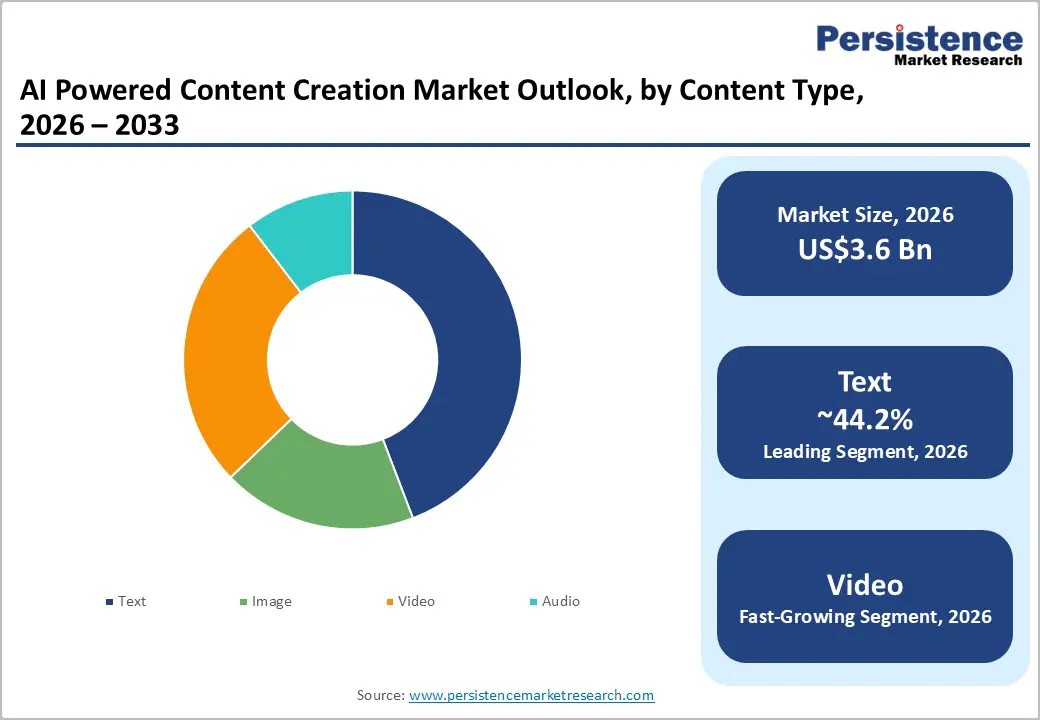
- Leading Content Type: Text, approximately 44.2% share in 2026, as businesses prioritize formats such as blogs, ads, and product descriptions that directly support SEO as well as digital marketing efforts.
- Dominant Application: Entertainment and media, nearly 39.9% in 2026, as studios and streaming platforms use AI to generate scripts, subtitles, and promotional content to meet constant content demand.
DRO Analysis
Driver - Demand for Hyper-Personalized Content to Transform User Engagement
Brands are moving beyond broad targeting to micro-segmentation, where AI dynamically adapts tone, format, and timing for each user. Platforms such as Netflix and Spotify already use AI to customize recommendations. However, the same logic is now applied to marketing copy, product descriptions, and email flows.
A 2024 Salesforce survey found that over 65% of consumers expect companies to understand their individual requirements. This is pushing businesses to adopt AI tools that can generate thousands of content variations instantly. Retailers are also using AI to localize campaigns in multiple languages without dedicated regional teams, thereby improving conversion rates in markets such as Southeast Asia and Latin America. This shift toward real-time personalization is becoming a core growth driver.
Surging Need for Automation to Compress Content Production Cycles
AI is not just assisting writers. But it is restructuring the entire content workflow. Tools now generate research summaries, SEO briefs, and first drafts in minutes, thereby reducing production timelines that used to take days. For instance, HubSpot reported in 2025 that teams using AI-assisted writing tools reduced content creation time by nearly 40% while maintaining output quality.
Newsrooms and digital publishers are also using AI to produce earnings reports and sports summaries instantly. This efficiency allows companies to increase content output without a proportional increase in headcount. It is making AI a prominent solution for high-volume industries such as e-commerce and digital advertising.
Restraint - Over-Reliance on AI May Weaken Brand Distinctiveness
As more companies use similar AI models trained on overlapping datasets, content is starting to show patterns in tone, structure, and phrasing. This creates a risk where brand messaging becomes indistinguishable from competitors. A 2025 study by Originality.ai found that over 50% of AI-generated web content shared noticeable linguistic similarities, especially in blog and product copy.
Some publishers have already reported drops in engagement when audiences perceive content as generic or lacking authenticity. Brands that depend too heavily on AI without human editing may struggle to maintain a unique voice. It is important for long-term audience trust and differentiation in crowded digital markets.
Opportunity - Next-Gen Text-to-Video Tools to Broaden Content Formats
The emergence of novel models such as OpenAI’s Sora is enabling businesses to convert written prompts into realistic video content, reducing the requirement for traditional production teams. This is mainly useful for industries such as education, real estate, and advertising, where visual storytelling drives engagement.
Early adopters are using these tools to create product demos and social media ads at a fraction of the usual cost. According to Cisco estimates, video already accounts for over 80% of internet traffic. Hence, the ability to generate high-quality visuals directly from text is creating new revenue streams and content strategies.
AI-Assisted Podcast Editing Platforms to Lower Entry Barriers
AI-based audio platforms are simplifying podcast creation by automating editing, noise reduction, transcription, and even voice synthesis. Tools such as Descript and Adobe Podcast allow users to edit audio by modifying text transcripts. It is making production accessible to non-technical creators.
In 2025, for example, Spotify extended its AI voice translation feature, enabling podcasters to reach global audiences without re-recording episodes. This has encouraged brands and individuals to enter the podcasting space, using AI to produce consistent and high-quality content with minimal effort. The rising demand for audio content, combined with reduced production complexity, is creating new opportunities in this segment.
Category-wise Analysis
Content Type Insights
The text segment is expected to dominate with a share of nearly 44.2% in 2026, as text-based AI solutions are comparatively easier to implement and integrate into existing digital workflows than multimedia formats. A marketing team, for instance, can deploy a text tool overnight without overhauling infrastructure, which is simply not possible with video or audio tools. Increasing demand for written material across a wide range of industries and surging demand for budget-friendly options are expected to further drive the segment’s growth.
The video segment is anticipated to be the fastest-growing in 2026. It is attributed to rising demand for personalized content and the dominance of short-form video platforms such as Instagram Reels and YouTube Shorts. The need for businesses to produce more video at less cost is another key driver. According to Vivideo, the average time to produce a 60-second marketing video dropped from 13 days to just 27 minutes using AI tools. Hence, when barriers collapse this sharply, adoption surges exponentially.
Application Insights
The entertainment and media segment is estimated to lead with a share of approximately 39.9% in 2026. The high demand for automated content generation in film, television, music, gaming, and digital media platforms augments this growth. AI tools are now being used to create scripts, storyboards, visual effects, and promotional content, thereby reducing production time and costs. The rise of streaming services and digital platforms has also propelled the demand for continuous and high-quality content, making AI solutions essential for expansion.
The marketing and advertising segment will remain in the second position in 2026. Growth is backed by increasing demand for personalized and targeted marketing campaigns that can engage consumers more effectively. Brands can no longer afford to push the same creative to millions of users, and AI makes mass customization possible. According to HubSpot's 2025 AI Trends for Marketers report, content creation is the dominant AI use case for marketers (55%). The most common uses include email marketing and newsletters (51%), text-based social media (49%), video/audio social media (47%), and blog posts and long-form content (46%).
Regional Insights
North America AI Powered Content Creation Market Trends
In 2026, North America is predicted to lead with a share of approximately 76.3%. The region is home to leading AI developers and platforms such as OpenAI, Adobe, Inc., Google LLC, and Meta. These have been instrumental in advancing generative AI capabilities. High levels of investment in AI start-ups and widespread enterprise integration of AI-supported content tools are further spurring market growth. The ongoing adoption of generative AI technologies across marketing, advertising, and media industries is another key driver.
U.S. AI-Powered Content Creation Market Trends
The U.S. is the dominant market in North America, primarily driven by its superior AI research ecosystem, well-established digital infrastructure, and concentration of leading technology firms. Key players such as OpenAI, Google, Adobe, and Microsoft are headquartered in the U.S., propelling development through large-scale AI investments and partnerships.
The U.S. also benefits from a dense network of enterprise adopters. As per a few studies, in 2024, U.S. private AI investment grew to US$109.1 billion, significantly outpacing China (US$9.3 billion) and the U.K. (US$4.5 billion). A staggering 92% of companies plan to increase their AI investment over the next three years. In 2025, for instance, Adobe introduced its Firefly generative AI suite in the country, empowering creators to produce text-to-image and video content efficiently.
Asia Pacific AI-Powered Content Creation Market Trends
Asia Pacific is estimated to be the fastest-growing region in the forecast period. This growth is being fueled by widespread adoption of AI content tools across industries such as marketing, e-commerce, entertainment, and media, where multilingual and localization demands are particularly high. Countries, including China, Japan, India, South Korea, and Southeast Asian nations, are leading the charge. Growth is supported by government-led digital transformation initiatives, research and development funding, and a surge in smartphone and 5G adoption.
China AI-Powered Content Creation Market Trends
China leads the regional market, particularly in e-commerce and gaming applications across major technology hubs such as Shanghai, supported by domestic AI models, including Baidu’s Ernie. The country benefits from a strong ecosystem of homegrown AI platforms designed to meet the localized content needs of its population of over 1.4 billion. Baidu’s SEC filings further highlight the rapid expansion of AI-generated content adoption. In October 2025, nearly 70% of mobile search result pages on Baidu reportedly included AI-generated content, reflecting one of the highest levels of AI content integration globally.
In March 2025, China’s Cyberspace Administration introduced the final Measures for Labeling AI-Generated Content, which came into effect on September 1, 2025. The regulation requires online platforms that create or distribute AI-generated material to clearly label such content, underscoring the growing mainstream adoption of AI-powered content across the country.
Japan AI-Powered Content Creation Market Trends
Japan’s distinctive content industry serves as a strong catalyst for market growth. The rising popularity of anime streaming services and anime-focused e-commerce businesses highlights the significant potential of Japan’s digital content creation sector. A collaborative ecosystem between content creators and brands is further supporting expansion, as companies increasingly recognize the role of digital content in strengthening audience engagement and enhancing brand loyalty. In addition, Japan is steadily integrating AI into enterprise workflows across industries.
Europe AI-Powered Content Creation Market Trends
Europe's growth is influenced heavily by regulatory frameworks. The EU AI Act of 2024 was the world's first comprehensive AI law, providing harmonized rules and an AI Code of Practice. It emphasizes responsible AI development, strict data security, and user privacy. Western Europe leads in adoption, with Germany, France, and the U.K. driving growth. Growth is backed by advanced digital systems and substantial funding. Government policies, supported by funding programs, also drive innovation and promote safe AI deployment practices across multiple business sectors.
Germany AI-Powered Content Creation Market Trends
Germany has institutional depth in AI but faces execution challenges. It was an early adopter of AI and among the first nations to create a national AI strategy in 2018. At the time, Europe was the global leader in AI research publications, ahead of both the U.S. and China. Germany pledged more than double the public investment into AI than the U.K. or France. According to an OECD report on Germany's AI strategy, the German Federal Government committed a total of EUR 5 billion (US$5.4 billion) for AI promotion by 2025, and EUR 3.38 billion (US$3.92 billion) had been directed toward specific projects by June 2024.
France AI-Powered Content Creation Market Trends
France is considered a pioneer in ethical and sustainable AI in Europe. The country’s creative industries in Paris are adopting AI for film post-production, while the General Data Protection Regulation (GDPR) augments demand for ethical AI frameworks. It is also coordinating key EU-level infrastructure initiatives. France coordinates the Important Project of Common European Interest on Next-Generation Cloud Infrastructure and Services. Also, initiatives are underway to develop efficient algorithms and software, including efforts to strengthen the semiconductor network. The country’s national AI strategy further aims to train around 400,000 individuals annually by 2030 through its skills and professions initiative.
Competitive Landscape
The global AI powered content creation market is highly fragmented, with the presence of large technology firms and fast-growing start-ups competing across niches. Big players such as OpenAI, Google, and Adobe dominate through interface integration, embedding AI tools into widely used platforms, including Google Workspace and Adobe Creative Cloud. Specialized firms such as Jasper and Copy.ai are gaining traction by delivering focused, user-friendly solutions customized for marketers and small businesses.
Competition is intensifying around product differentiation rather than pricing, with companies racing to improve output quality, factual accuracy, and multimodal capabilities. For instance, Adobe’s Firefly models are trained on licensed data to address copyright concerns, while OpenAI continues to improve reasoning and contextual understanding in its models. Platforms are also bundling writing, image, and video generation into a single interface to reduce tool fragmentation.
Key Industry Developments:
- In March 2026, Google launched an updated version of Flow with Veo 3.1 integrated. The update introduced new and improved creative capabilities to edit clips, giving users more granular control over their final scenes.
- In February 2026, ElevenLabs, the AI audio and voice synthesis start-up, raised US$500 million at an US$11 billion valuation. With this fund, the company aims to broaden its portfolio to creators, enabling businesses to build agents that can talk, type, and take action.
- In February 2026, Runway raised US$315 million in a Series E round led by General Atlantic, nearly doubling its valuation to US$5.3 billion. The funds were intended to allow Runway to pre-train the next generation of world models and bring them to new products and industries.
Companies Covered in AI Powered Content Creation Market
- Adobe
- CopyAI
- Copysmith
- Hour One
- Jasper AI
- OpenAI
- Peppertype
- Rct AI
- Scalenut
- Sonantic
- Stability AI
- Synthesia
- Writesonic
- Others
Frequently Asked Questions
The global AI powered content creation market is projected to be valued at US$3.6 billion in 2026.
The AI powered content creation market is expected to reach US$11.7 billion by 2033.
The rise of multimodal AI tools and increasing focus on copyright-safe training data are a few key market trends.
Text is expected to be the leading content type with a share of nearly 44.2% in 2026, as it requires lower computational resources compared to video or image generation.
The AI powered content creation market is expected to grow at a CAGR of 18.2% from 2026 to 2033.
Adobe, CopyAI, Copysmith, and Google are a few key market players.


