




- Hardware & Software IT Services
- AI Video Market
AI Video Market Size, Share, and Growth Forecast 2026 - 2033
AI Video Market by Device Type (Desktop Computers, Mobile Devices, Cloud-based Platforms), User (B2B, B2C), Offering Type (Creative AI Video Generators, Video Enhancement AI, Video Editing AI), and Regional Analysis, 2026 - 2033

AI Video Market Size and Trends Analysis
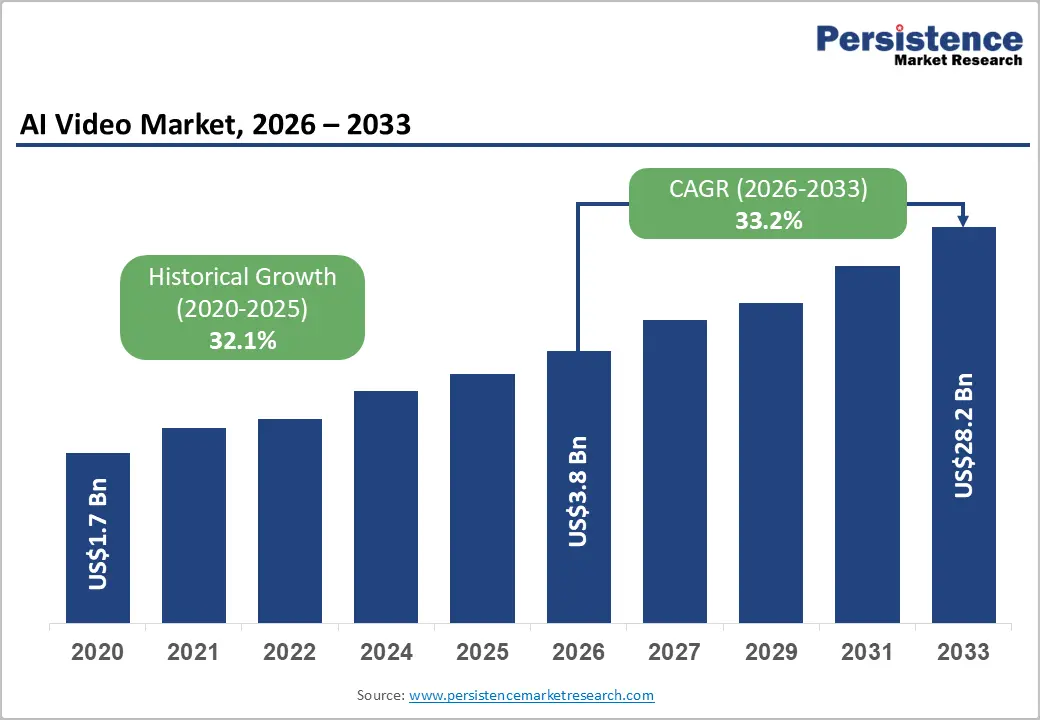
The global AI video market size is likely to be valued at US$3.8 billion in 2026 and is expected to reach US$28.2 billion by 2033, growing at a CAGR of 33.2% during the forecast period from 2026 to 2033, driven by the rising need for fast and cost-efficient video production across marketing, education, and enterprise communication.
Continuous upgrades in generative models, including better motion realism and voice synchronization, are further making AI video tools more reliable for professional use.
Key Industry Highlights
- Latest Upgrade: In October 2025, Google DeepMind released Veo 3.1, a new upgrade to its flagship video model. The update introduced comprehensive audio support across all Flow editing features, including Ingredients to Video, Frames to Video, and the Extend feature.
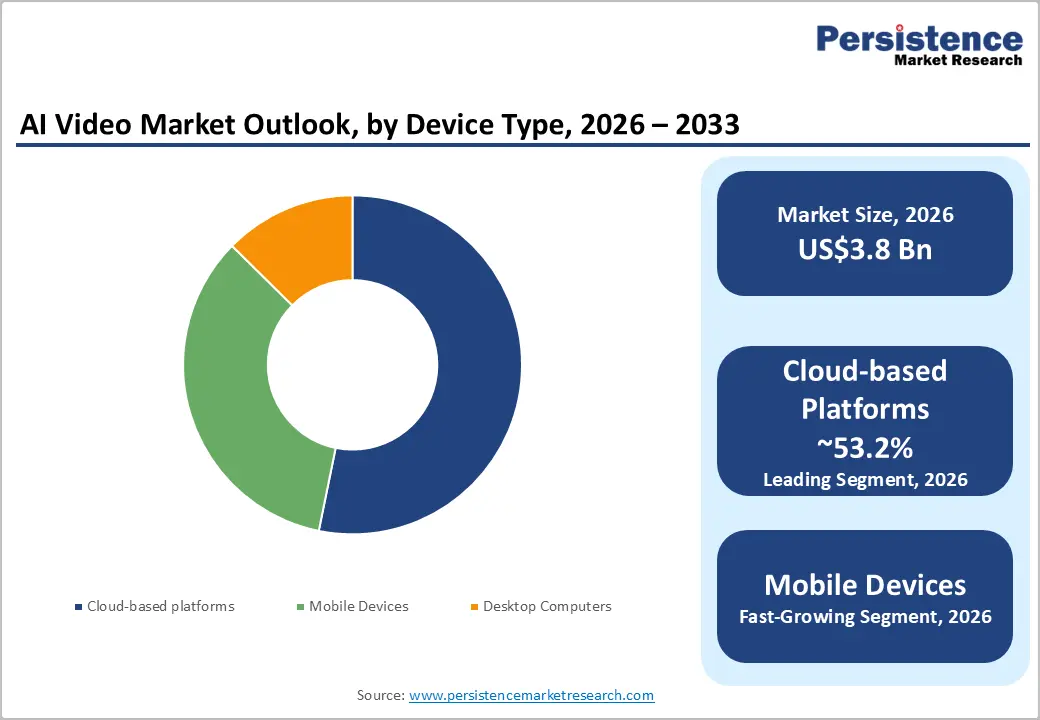
- Leading Device Type: Cloud-based platforms, approximately 53.2% share in 2026, as these enable users to create and edit AI videos without high-end hardware, enabling speedy deployment and easy expansion across teams.
- Dominant User: B2B (enterprise), nearly 71.6% in 2026, owing to high demand for automated video creation in training, marketing, and internal communication at scale.
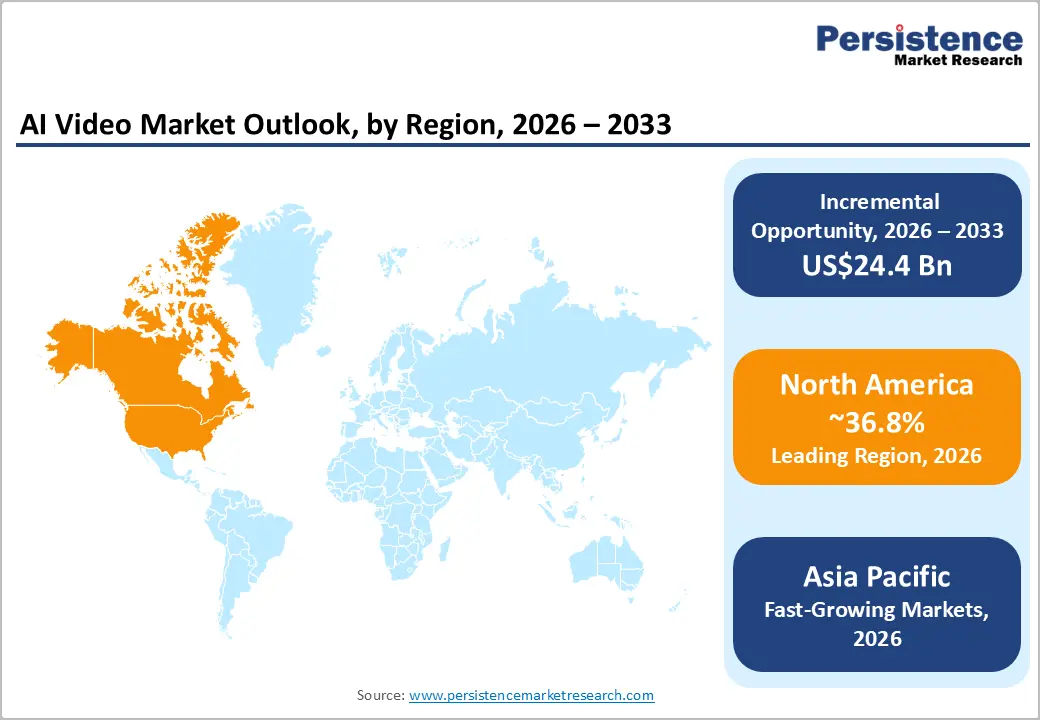
- Leading Region: North America, with about 36.8% share in 2026, backed by rising AI investments, well-established cloud infrastructure, and early adoption by media and enterprise sectors.
- Fast-growing Region: Asia Pacific, spurred by increasing mobile-first content creation, easy internet access, and superior government-led digital initiatives.
DRO Analysis
Driver - Surging Use of Social Platforms by Brands to Connect with Audiences
Businesses are shifting budgets toward video-first engagement as platforms reward visual storytelling over static content. AI video tools help brands produce short-form content quickly, which is in line with formats used on platforms such as Instagram Reels and YouTube Shorts. According to Meta’s official business reports, video posts generate higher engagement rates than image posts across industries.
Governments are also adopting this trend. India’s MyGov platform, for instance, uses AI-assisted video explainers to simplify policies and increase citizen interaction. This shift reduces production time and cost, making it easier for small firms to compete with large brands. Hence, AI video tools are becoming essential for consistent and extensible social media communication.
Rising Preference for Immersive and High-Quality Video Experiences
Consumers now expect content that feels cinematic, even in short formats. AI video platforms are responding by enabling features such as auto-enhanced visuals, voice syncing, and real-time editing. A 2024 report from the European Commission on digital media trends highlights that users are more likely to retain information from dynamic video compared to text.
Streaming platforms and edtech firms are already using AI-generated videos to improve engagement and completion rates. For example, Coursera’s product updates mention AI-assisted video summaries and lectures to keep learners engaged. This surging expectation for quality pushes creators to adopt AI tools that can deliver professional-grade output without requiring advanced editing skills.
Restraint - Limitations in Replicating Deep Storytelling and Emotional Complexity
AI video models still face challenges in handling layered narratives, timing, and humor. While they can generate visuals and dialogue, they often miss cultural context or emotional depth. A Stanford University Human-Centered AI report notes that generative models struggle with consistent character emotions across scenes. OpenAI’s technical papers also highlight issues with long-form coherence in video generation.
It becomes a problem for industries such as entertainment and advertising, where emotional connection drives impact. For example, AI-generated ads often feel repetitive or lack subtle humor, which reduces viewer trust. These gaps mean human editors and writers are still required, slowing full-scale automation and limiting adoption in high-end creative projects.
Opportunity - Creative Control to Improve with Novel Scene Direction Capabilities
AI video tools are evolving from simple prompt-based systems to more detailed creative engines. Users can now guide camera angles, lighting, and shot duration using structured inputs. This shift increasingly mirrors professional filmmaking workflows. For instance, Runway’s official product releases highlight features such as motion brush and camera path controls for precise scene creation.
Research from MIT Media Lab also shows how AI-assisted direction tools can improve storytelling efficiency. This opens new opportunities for independent creators and small studios. They can produce visually rich content without expensive equipment. As control improves, AI video becomes a practical tool for professional-grade production.
Consistent Character and Scene Management across Long Video Sequences
Maintaining uniform characters across multiple scenes was a key limitation earlier. New AI systems now use structured character libraries and reference-based generation. This allows creators to reuse the same face, outfit, and style across videos. NVIDIA’s research on generative AI frameworks shows how persistent identity models improve visual consistency in long-form content.
Adobe’s Firefly updates further mention tools for maintaining design uniformity across frames. This is useful in marketing, gaming, and education, where continuity matters. Brands can update a character once and apply changes across all content. This reduces manual effort and ensures a cohesive visual identity across campaigns.
Category-wise Analysis
Device Type Insights
The cloud-based platforms segment is predicted to lead with a share of approximately 53.2% in 2026, as they remove the need for heavy local hardware and allow instant expansion. Companies can run AI video tools directly from browsers without installing software. This reduces IT burden and speeds up deployment. For example, the National Institute of Standards and Technology highlights that cloud adoption improves flexibility and security updates through centralized control. Platforms such as Adobe and Runway deliver frequent updates without user intervention.
The mobile devices segment is estimated to be the fastest-growing in the forecast period. Mobile usage is rising as content creation is shifting toward real-time and on-the-go formats. Smartphones now support AI video editing, voice cloning, and instant publishing. According to the International Telecommunication Union, over 70% of global internet traffic comes from mobile devices, which propels mobile-first design. Social media apps also prioritize mobile uploads, making it easier for creators to produce and share videos instantly.
User Insights
The B2B (enterprise) segment is projected to account for nearly 71.6% of the market share in 2026, driven by the growing need among large organizations for scalable and consistent content creation. AI-powered video tools enable enterprises to streamline the production of training materials, product demonstrations, and internal communications. According to a whitepaper published by the World Economic Forum, businesses are increasingly adopting AI technologies to enhance operational efficiency and lower content production expenses.
For instance, IBM uses AI-generated videos for employee training modules, reducing production time significantly. Enterprises also have budgets and data infrastructure to support advanced AI tools. Their demand for brand consistency and multilingual content further increases reliance on AI video platforms.
The B2C (individual) segment is expected to remain in the second position in 2026. Individual creators are adopting AI video tools as entry barriers are falling. Tools now deliver templates, auto-editing, and voiceovers that require no technical skills. According to YouTube’s official creator reports, a large share of new channels use AI-assisted editing features to speed up production. Freelancers, educators, and influencers benefit from swift turnaround times. For example, AI avatar tools are being used by educators to create explainer videos without appearing on camera. This democratization of video creation is expanding the user base, especially among gig workers and content creators.
Regional Insights
North America AI Video Market Trends
In 2026, North America will dominate with a share of around 36.8%, owing to superior AI research, funding, and early adoption. The region hosts leading AI firms and cloud providers. According to the National Science Foundation, the U.S. continues to invest heavily in AI research and infrastructure. Companies such as Google and Microsoft integrate AI video tools into their interfaces. Regulatory clarity and enterprise readiness also support fast deployment. Media and entertainment industries in the U.S. boost demand for advanced video tools, giving the region a strong lead.
U.S. AI Video Market Trends
The U.S. market is expanding due to increasing private and public investment. The National AI Initiative continues to fund research and workforce development. According to the U.S. Department of Commerce, AI adoption is rising across education, defense, and public services. For instance, AI-generated video simulations are being used in emergency response training. Tech firms are also launching new tools at a fast pace, which keeps the market dynamic. The presence of venture capital and start-up ecosystems ensures continuous product development and rapid expansion of AI video platforms.
Asia Pacific AI Video Market Trends
Asia Pacific is projected to witness the fastest growth in the forecast period, spurred by its large digital population and mobile-first behavior. Countries in the region consume and create short-form videos at a very high rate. The Asian Development Bank highlights that digital adoption is accelerating due to affordable internet and smartphone penetration. Governments are also investing in AI infrastructure. For instance, South Korea and Singapore have national AI strategies that include media and content development. This environment supports the quick adoption of AI video tools across entertainment, education, and e-commerce sectors.
China AI Video Market Trends
China’s expansion is associated with its well-established platform economy. Apps such as Douyin and Kuaishou are integrating AI video generation features directly into user interfaces. The government’s Next Generation AI Development Plan encourages large-scale AI deployment. According to the Ministry of Industry and Information Technology, AI is being actively used in digital commerce and smart media. A key example is AI-generated product videos used in livestream shopping, which helps sellers reduce production time. Local tech giants are also investing in proprietary AI models, thereby reducing reliance on external technologies.
India AI Video Market Trends
India’s growth is spurred by a blend of policy push and creator economy expansion. Programs such as Digital India and the IndiaAI Mission are encouraging AI adoption across sectors. According to NITI Aayog, AI is being used in education, agriculture, and governance. AI video tools are helping government bodies, including MyGov, create multilingual awareness campaigns. Regional content demand is further rising across platforms such as YouTube and Instagram. Creators are using AI tools for dubbing and subtitles in multiple Indian languages, which increases reach and engagement.
Europe AI Video Market Trends
Europe’s market is expanding at a stable pace due to its favorable regulatory framework. The region emphasizes ethical AI use and data privacy. The European Commission supports AI development through funding programs such as Horizon Europe. AI video tools are being adopted in education, media, and corporate training. For example, local universities are using AI-generated lecture videos to improve accessibility. This balanced approach helps build long-term trust among users and organizations.
Germany AI Video Market Trends
Germany’s market is surging exponentially due to its focus on Industry 4.0 and enterprise efficiency. AI video tools are used for employee training, product demonstrations, and technical simulations. According to the Federal Ministry for Economic Affairs and Climate Action, AI adoption is increasing in the manufacturing and engineering sectors. Companies are using AI-generated videos to explain complex machinery and processes. This reduces training time and improves workforce productivity, making AI video a practical tool rather than just a creative solution.
U.K. AI Video Market Trends
The U.K. is seeing decent growth due to its well-established media and advertising industries. AI video tools are being used in film production, marketing, and digital content creation. According to the U.K. Department for Science, Innovation and Technology, AI investments are increasing through public-private partnerships. The country is also supporting start-ups focused on generative media. For instance, AI-assisted video personalization is being used in targeted advertising campaigns, which improves engagement rates.
Competitive Landscape
The global AI video market is moderately fragmented and highly competitive, with the presence of large technology companies, AI-native start-ups, and open-source developers. Companies such as OpenAI, Google, and Adobe are expanding into AI video with models such as Sora, Veo, and Firefly. Start-ups, including Runway, Synthesia, HeyGen, and Pika Labs, are gaining traction by focusing on creator tools and enterprise video automation. Reuters reported that Adobe launched Firefly Video specifically to compete with OpenAI and Runway, showing how intense the rivalry has become.
Enterprise demand is also becoming a key battleground. Companies now demand AI video tools that support localization, compliance, and integration with existing workflows. This is pushing vendors to move beyond basic video generation toward full production interfaces. Platforms are adding features such as collaborative editing, asset libraries, AI dubbing, and automated branding.
Key Industry Developments:
- In April 2026, Runway launched a US$10 million venture fund to support early-stage start-ups building across AI, media, and simulation. The initiative includes a Builders program providing significant API credits to start-ups developing on Runway's platform, with the company having already backed early investments, including LanceDB and Tamarind Bio.
- In March 2026, ByteDance moved to expand Seedance 2.0 internationally via its CapCut video editing app. The rollout covered Africa, South America, the Middle East, and Southeast Asia, with more regions to follow. The expansion came after a brief pause triggered by legal threats from leading Hollywood studios over copyright concerns.
- In December 2025, Luma AI announced the opening of its first international office in London as part of a broad global expansion. The company plans to add 200 new jobs in London in 2026 and extend partnerships across the U.K., European Union, and Saudi Arabia in the first phase of expansion.
Companies Covered in AI Video Market
- Adobe
- Designs.ai
- Google LLC
- International Business Machines Corporation
- Lumen5
- Microsoft
- Midjourney
- Muse.ai
- NVIDIA Corporation
- OpenAI
Frequently Asked Questions
The global AI video market is projected to be valued at US$3.8 billion in 2026.
The AI video market is expected to reach US$28.2 billion by 2033.
Key market trends include the shift toward cinematic AI video generation and increased use of AI avatars for communication.
Cloud-based platforms are expected to be the leading device type with a share of nearly 53.2% in 2026, as these support real-time collaboration and frequent updates.
The AI video market is expected to grow at a CAGR of 33.2% from 2026 to 2033.
Adobe, Designs.ai, Google LLC, and International Business Machines Corporation are a few key market players.


