




- Hardware & Software IT Services
- AI in Software Development Market
AI in Software Development Market Size, Share, and Growth Forecast 2026 - 2033
AI in Software Development Market by Technology (Machine Learning, NLP), Deployment (Cloud, On-Premises), Application (Code Generation and Auto-completion), End-user (Retail and E-commerce), and Regional Analysis, 2026 - 2033

AI in Software Development Market Size and Trends Analysis
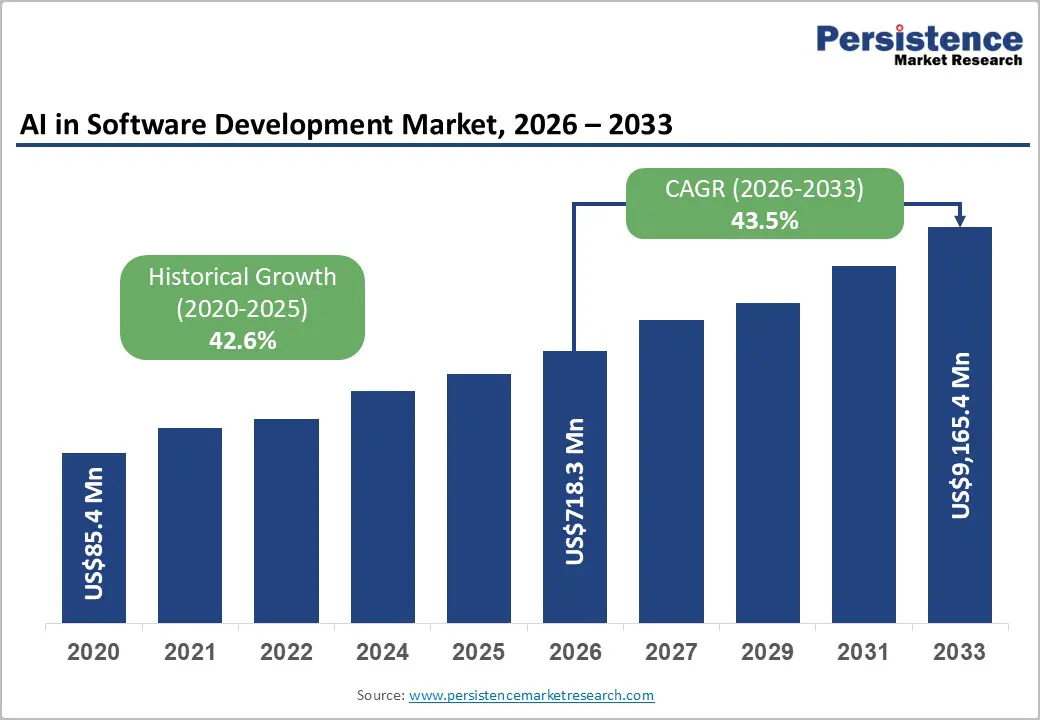
The global AI in software development market size is likely to be valued at US$718.3 million in 2026 and is expected to reach US$9,165.4 million by 2033, growing at a CAGR of 43.5% during the forecast period from 2026 to 2033, driven by the rising adoption of AI-supported coding assistants that reduce development time and improve productivity. Increasing demand for automated testing and debugging tools to enhance software quality is also predicted to spur growth.
Key Industry Highlights:
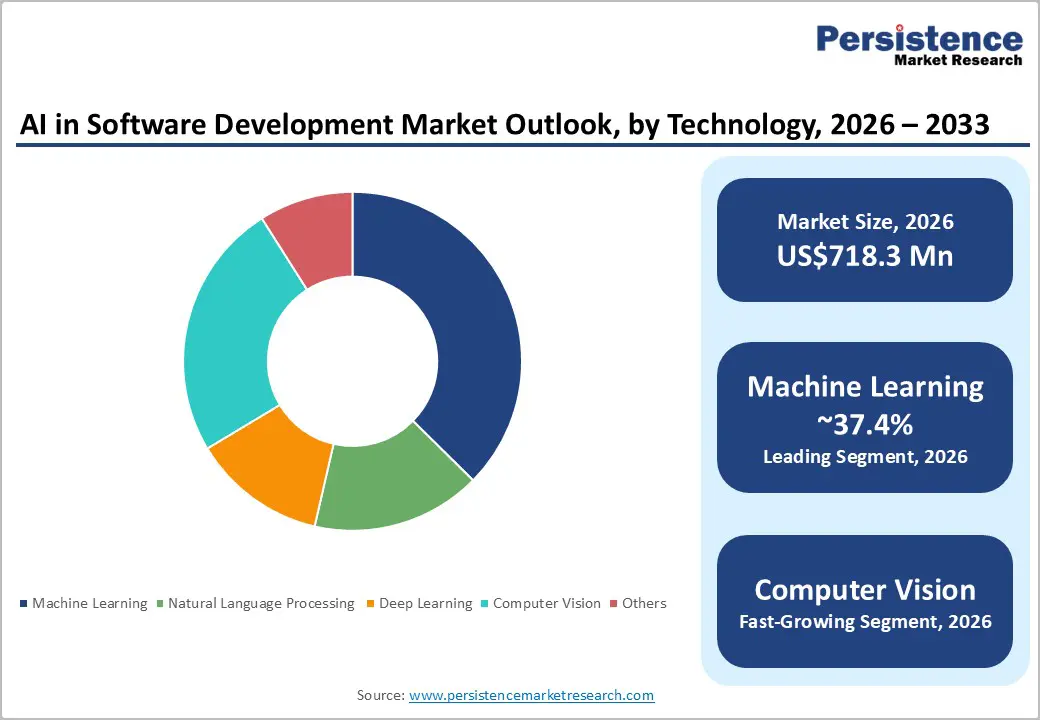
- Leading Technology: Machine learning, approximately 37.4% share in 2026, as it is already embedded in enterprise tools such as fraud detection, recommendation engines, and predictive analytics used by Google and Amazon.
- Dominant User: IT and software services, nearly 53.1% in 2026, as they both build AI tools and use them internally for coding, testing, and cloud operations, creating a high adoption loop.
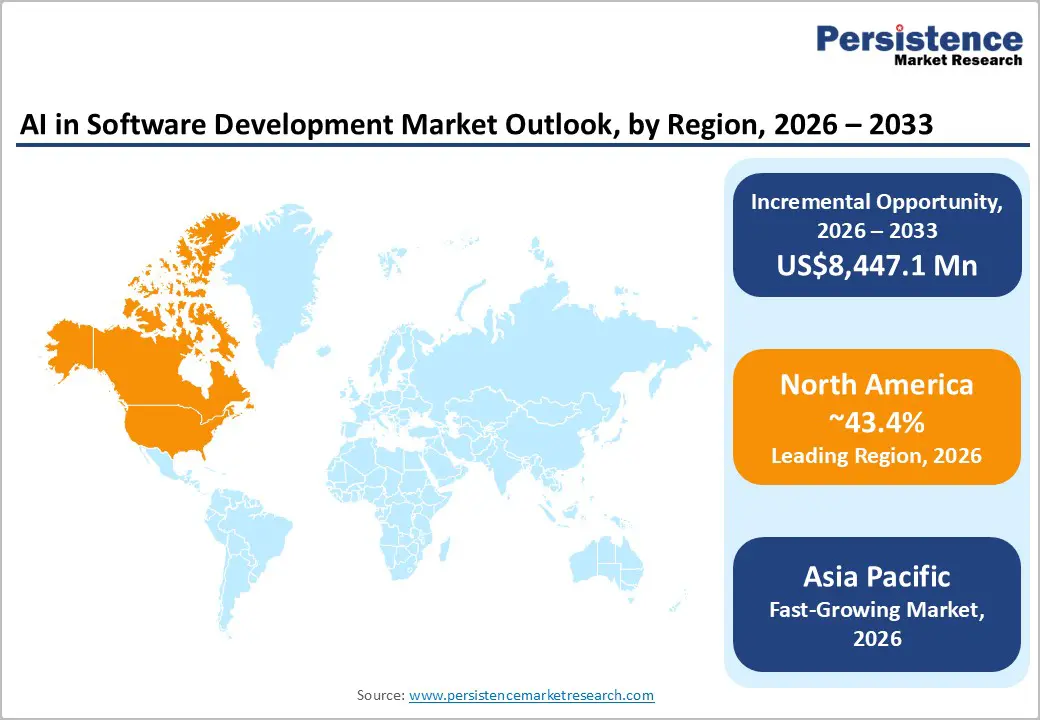
- Leading Region: North America, with about 43.4% share in 2026, owing to high research and development funding as well as surging university-industry collaboration.
- Fast-growing Region: Asia Pacific, as government bodies such as NITI Aayog and national AI missions in countries, including China and Singapore, are pushing large-scale AI adoption.
- Latest Acquisition: In November 2025, Palo Alto Networks announced a definitive agreement to acquire Chronosphere, a next-generation observability platform built for the AI era. The combination of Chronosphere's platform with Palo Alto Networks' Cortex AgentiX was intended to deliver real-time, agentic remediation for AI-native companies.
DRO Analysis
Driver - Swift Coding Cycles Bolstered by AI-Assisted Development
AI coding tools are reducing development time by handling repetitive work. This includes writing boilerplate code, generating Application Programming Interfaces (APIs), and suggesting fixes. Hence, developers focus more on logic and design. A study by the National Bureau of Economic Research found that developers using AI tools completed tasks up to 55% faster in controlled experiments.
In real use, GitHub reported that Copilot users generate a large share of code automatically in supported languages. This shift is changing how teams plan projects. Short release cycles and fast prototyping are now common, which directly pushes demand for AI in software development.
Improved Code Reliability through AI-Led Testing Automation
AI is improving software quality by automating testing and debugging. These tools simulate user behavior and detect issues early in development. This reduces costly errors after deployment. For example, Google Research published work on AI systems that detect bugs and suggest fixes across large codebases.
In another case, Microsoft Research showed that AI-assisted debugging tools can resolve issues faster than manual methods in several scenarios. This leads to high test coverage and few failures in production. As software becomes more complex, this automated quality layer is becoming essential, which supports market growth.
Restraint - Rising Security Risks from AI-Generated Code to Hinder Adoption
AI-generated code can introduce hidden vulnerabilities. These tools sometimes suggest outdated libraries or insecure patterns. This increases the risk of cyberattacks if not reviewed properly. A study by New York University found that a significant portion of AI-generated code samples contained security weaknesses.
The Cybersecurity and Infrastructure Security Agency has further warned about risks such as code injection and insecure dependencies in automated development tools. These issues compel companies to invest more in validation and governance. Hence, some enterprises slow down adoption, which acts as a restraint.
Opportunity - Complex Development Tasks Enabled by Multi-Agent AI Systems
AI is moving from single assistants to coordinated agent systems. Each agent handles a specific task such as coding, testing, or compliance checks. This improves efficiency in large projects. For instance, IBM has explored multi-agent workflows in enterprise automation, where different AI models collaborate across processes.
Research from Stanford University also shows that multi-agent setups can outperform single models in complex engineering tasks. This approach allows parallel execution of tasks, which reduces development time. It creates new opportunities for building large-scale and automated software pipelines.
End-to-End Feature Development Accelerated by Advanced AI Reasoning
New AI models can handle long and complex coding tasks with minimal input. They can plan, write, test, and improve entire features step by step. This reduces the requirement for constant human intervention. For instance, OpenAI has demonstrated models that complete multi-step coding workflows, including debugging and optimization.
Research published on arXiv further highlights AI systems executing long sequences of programming tasks with improved accuracy. This capability supports full-cycle development automation. It creates opportunities for speedy product launches and small development teams.
Category-wise Analysis
Technology Insights
The machine learning (ML) segment is predicted to lead with a share of approximately 37.4% in 2026, as it is already embedded in core enterprise systems. It does not require full automation to deliver value. Several companies use ML for prediction, classification, and anomaly detection without changing their workflows. For example, the U.S. Food and Drug Administration (FDA) has approved multiple ML-based medical devices that continuously learn from data, especially in radiology. Google also uses ML in search ranking and spam detection at scale. These are production-level uses, not experiments. This wide deployment makes ML more mature and trusted than new AI technologies.
The computer vision segment is estimated to be the fastest-growing segment in the forecast period, as cameras and visual data are expanding everywhere. Cities, factories, hospitals, and retail stores now generate image data continuously. Governments are also investing heavily. For instance, the European Commission funded multiple smart surveillance and traffic monitoring projects using vision AI under Horizon programs. In healthcare, a study published in Nature Medicine showed AI vision systems detecting breast cancer more accurately than human radiologists in some cases. This superior real-world impact is boosting adoption.
End-user Insights
IT and software services are anticipated to dominate with a share of nearly 53.1% in 2026, as they are both creators and users of AI. They integrate AI into products and also use it internally for coding, testing, and cybersecurity. For example, Microsoft reported that AI tools such as Copilot are used internally to generate code and automate documentation. This creates a feedback loop. IT companies adopt AI first, improve it, and then sell it. No other industry has this dual advantage.
The healthcare segment is expected to remain in the second position in 2026, because AI directly improves outcomes and reduces workload. Hospitals use AI for diagnostics, patient monitoring, and drug discovery. The National Health Service (NHS) in the U.K. has deployed AI tools to detect strokes quickly, reducing treatment time significantly. Also, Pfizer used AI models during COVID-19 vaccine development to speed up research timelines. These are high-impact use cases, which make healthcare a priority sector.
Regional Insights
North America AI in Software Development Market Trends
In 2026, North America is expected to dominate with a share of around 43.4%, as the region is home to the companies actually building the most-used AI coding tools. Anthropic launched Claude Code in May 2025, which became the most-used AI coding tool in months of release, overtaking GitHub Copilot and Cursor. Claude Code was released in May 2025 and has already become the most-used AI coding tool, overtaking GitHub Copilot and Cursor.
Government policy is also pushing growth. In July 2025, the Trump Administration unveiled America's AI Action Plan, the most sweeping federal AI policy initiative to date. It was aimed at cutting red tape, opening access to AI technology, and igniting a new wave of public as well as private investment to place the U.S. at the forefront of global AI development. The plan directs agencies to eliminate regulations that slow AI development and ties federal funding to state-level deregulation.
U.S. AI in Software Development Market Trends
The U.S. leads North America and is expected to sustain that position. What is driving this outlook is the pace of commercial adoption among developers. Anthropic's annualized revenue jumped from approximately US$1 billion at the start of 2025 to US$5 billion by August. It was a 5x increase in eight months, with projections reaching US$9 billion by year-end 2025, mostly associated with developer clients. Claude Code's run-rate revenue further grew to over US$2.5 billion and more than doubled since the beginning of 2026, with weekly active users also doubling in the same period.
Asia Pacific AI in Software Development Market Trends
Asia Pacific is anticipated to remain the fastest-growing region in the forecast period. The diversity of the region is itself a growth driver. Japan, South Korea, India, and Southeast Asian countries are all at different stages of AI adoption, meaning the total addressable market keeps expanding. The primary demand in the region emanates from enterprises seeking agentic AI and generative AI to facilitate autonomous workflows. Southeast Asia's digital landscape and tech-enthusiastic population are acting as key drivers of AI-enabled economic growth.
China AI in Software Development Market Trends
China's growth in AI for software development is rooted in a long-running national strategy and a 2025 breakthrough that changed the global picture. Back in 2017, the Chinese State Council announced the New Generation AI Development Plan. It was a grand set of strategic guidelines aiming to make the country a global leader in AI by 2030, with intermediate milestones to improve AI infrastructure, research, and broad industry integration by 2025.
The release of DeepSeek-R1 in early 2025 transformed the global AI landscape overnight, with the model demonstrating capabilities that placed China-based models squarely at the global frontier. It prompted local leaders to invite leading AI pioneers to high-level meetings and encourage local governments to fuel AI deployment across critical infrastructure.
India AI in Software Development Market Trends
India is emerging as one of the most consequential markets for AI in software development, not just because of adoption but because of its production of AI talent and tools. The government's IndiaAI Mission is providing the infrastructure backbone. The IndiaAI Mission, approved with an outlay of nearly US$1.08 billion, is a five-year plan to build national-scale AI compute capacity and talent. It includes the deployment of 18,693 GPUs, with about 10,000 GPUs already rolled out in Phase 1. Five chip plants are also under construction alongside a roadmap to develop an indigenous GPU within three to five years.
Europe AI in Software Development Market Trends
Europe's growth in AI for software development is best described as deliberate rather than explosive. The region is building an AI interface with governance at its center, which shapes the pace of adoption. The EU AI Act is the defining policy instrument. Prohibited AI practices and AI literacy obligations entered into application from February 2025.
Governance rules and obligations for general-purpose AI models became applicable in August 2025, with the EU's AI Office taking on a coordinating role across member states. The EU AI Act and related governance policies are steering companies to adopt trustworthy AI frameworks that ensure transparency and reduce algorithmic bias. It is further creating a favorable environment for enterprise AI adoption for systems that require traceability, compliance, and explainability.
Germany AI in Software Development Market Trends
Germany is currently leading Europe owing to its well-established industrial base. Its manufacturing sector is integrating AI tools for process automation and quality control. However, adoption is uneven. While 91% of large local enterprises already consider AI business-critical and are ramping up budgets, 43% of mid-sized companies still have no concrete AI plans as of 2025. This is creating a strategy gap that analysts describe as an existential risk for the Mittelstand. The government has also committed to investing over €3 billion in AI-related projects by 2025, with a focus on fostering collaboration between academia and industry.
U.K. AI in Software Development Market Trends
The U.K. is the third-largest AI market in the world, behind the U.S. and China, and its government is actively trying to close the gap. The country’s government confirmed more than £14 billion worth of inward investment and thousands of jobs immediately upon accepting the AI Opportunities Action Plan. It reflects the market's confidence in the country's AI trajectory. The policy framework is transparent and pro-innovation. The U.K. government's ambition is to make Britain the fastest-adopting AI country in the G7, with a target of upskilling 10 million workers in AI skills by 2030, with over 1 million AI upskilling courses already delivered as of January 2026.
Competitive Landscape
The global AI in software development market is highly fragmented but rapidly consolidating around a few dominant players. Microsoft GitHub Copilot remains the expansion leader because of its integration with GitHub and Visual Studio Code. Its enterprise dominance comes from distribution strength rather than technical superiority alone. Various enterprises prefer Copilot as it integrates directly into existing DevOps workflows, security systems, and repositories without requiring developers to switch Integrated Development Environments (IDEs).
Anthropic Claude Code is becoming a key competitive force in the agentic coding segment. Unlike traditional code assistants, Claude Code focuses on terminal-native autonomous workflows where the AI can reason through architecture, debugging, testing, and iterative improvements. Replit is influencing a different part of the market by targeting non-technical builders and speedy application prototyping. Its strategy differs from Cursor and Copilot as it focuses on end-to-end app generation, deployment, and hosting rather than only coding assistance.
Key Industry Developments
- In April 2026, IBM announced the global availability of IBM Bob, an AI-first development partner for enterprise software teams. Bob works across the full software development lifecycle, right from planning and coding to testing, deployment, and modernization.
- In December 2025, ServiceNow announced a definitive agreement to acquire cybersecurity company Armis for US$7.75 billion in an all-cash deal. The acquisition aimed to extend ServiceNow's Security, Risk, and OT portfolios as the ongoing adoption of AI expanded attack surfaces for organizations.
- In December 2025, IBM announced a definitive agreement to acquire Confluent, a data streaming platform, for US$11 billion in cash. IBM's stated goal was to give every AI model, agent, and automated workflow the real-time, trusted data required to operate across on-premises and hybrid cloud environments at scale.
Companies Covered in AI in Software Development Market
- IBM
- OpenAI
- NVIDIA Corporation
- Accenture
- Microsoft
- DataRobot, Inc.
- InData Labs
- Alphabet
- DataToBiz
- Neoteric
- Others
Frequently Asked Questions
The global AI in software development market is projected to be valued at US$718.3 million in 2026.
The AI in software development market is expected to reach US$9,165.4 million by 2033.
Key market trends include the rise of agentic AI systems and the integration of AI into DevOps pipelines.
Machine learning is expected to be the leading technology with a share of nearly 37.4% in 2026, as it delivers quick and measurable results without requiring a full system redesign.
The AI in software development market is expected to grow at a CAGR of 43.5% from 2026 to 2033.
IBM, OpenAI, NVIDIA Corporation, and Accenture are a few key market players.


