




- Specialty & Fine Chemicals
- Cyclodextrin Market
Cyclodextrin Market Size, Trends, Share, and Growth Forecast, 2025 - 2032
Cyclodextrin Market by Product Type (Alpha-Cyclodextrin, Beta-Cyclodextrin, and Gamma-Cyclodextrin), Application (Pharmaceutical, Food Industry, Cosmetic & Personal Care, and Others), and Regional Analysis for 2025 - 2032

Cyclodextrin Market Size and Trends Analysis
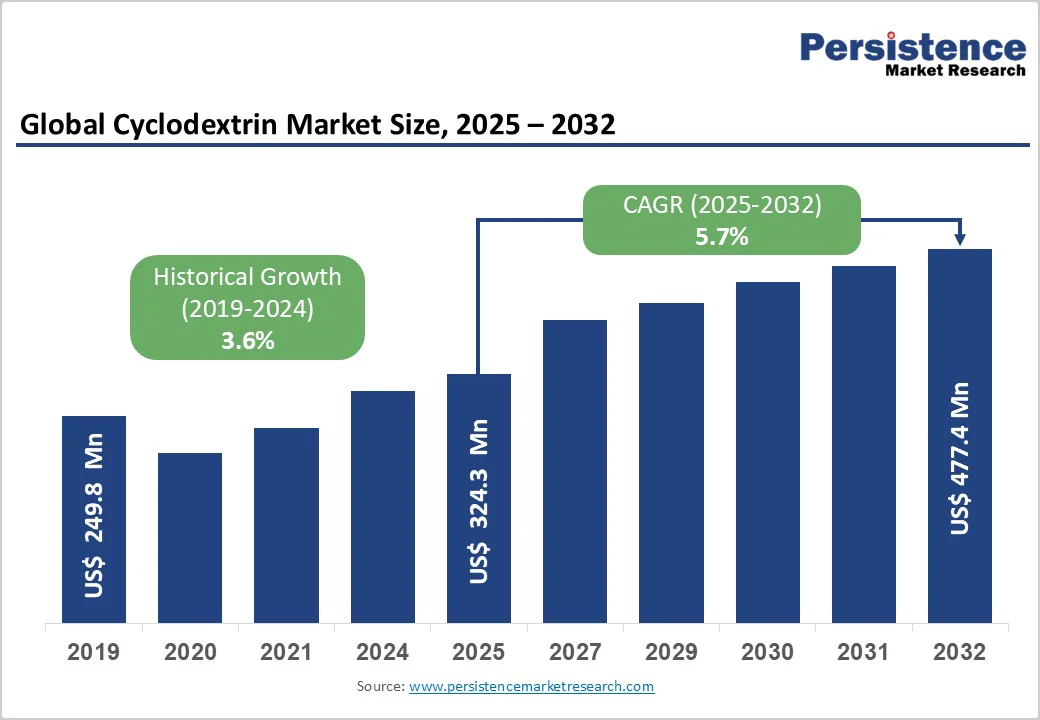
The global cyclodextrin market size is valued at US$ 324.3 million in 2025 and is projected to reach US$ 477.4 million by 2032, growing at a CAGR of 5.7% between 2025 and 2032.
The market growth reflects the increasing adoption of cyclodextrins across pharmaceutical formulations, food and beverage applications, and cosmetic product development. Primary growth factors include the rising demand for enhanced drug delivery systems in pharmaceuticals, where cyclodextrins improve bioavailability of poorly water-soluble drugs by 5-10 times, and expanding applications in functional foods and nutraceuticals. The market benefits from stringent regulatory approvals, with alpha, beta, and gamma-cyclodextrins included on the FDA's GRAS (Generally Recognized As Safe) list and approved as novel food ingredients by the European Commission.
Key Industry Highlights:
- Dominant product segment: Alpha-cyclodextrin commands over 40% revenue share due to superior solubility in pharmaceutical applications; beta-cyclodextrin is fastest-growing segment driven by versatility across pharmaceutical, food, and cosmetic uses
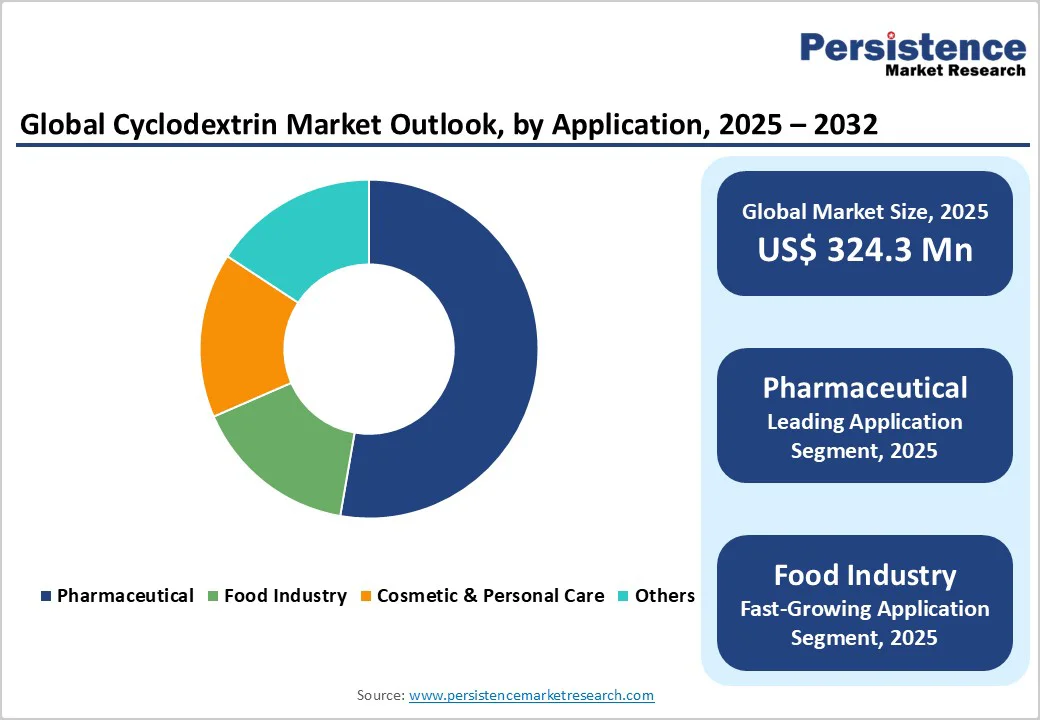
- Leading application: Pharmaceutical segment accounts for over 55% of market revenue, driven by drug solubility enhancement needs for 40% of new drug candidates; food industry represents fastest-growing application with approximately 4.0% CAGR
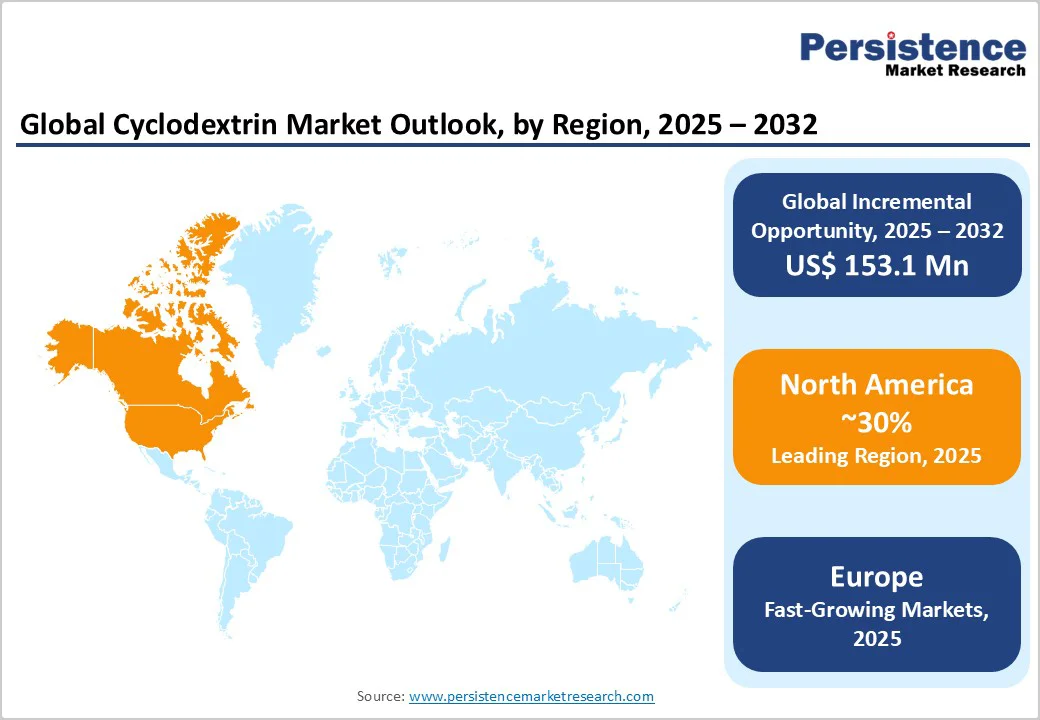
- Regional market leadership: North America dominates with over 30% revenue share supported by advanced pharmaceutical industry; Europe is fastest-growing region with robust expansion in Germany, U.K., and France markets
- Competitive concentration: Top three players—Wacker Chemie AG, Roquette Frères, and Ashland Global Holdings—control over 60% market share; semi-consolidated structure with technology leaders commanding premium pharmaceutical segment
- Strategic developments: 2024 strategic initiatives include Ashland's pharmaceutical excipients expansion, Wacker's modified cyclodextrin innovation, Asia Pacific capacity investments, and biologics application partnerships demonstrating 30-40% protein stability improvements
| Key Insights | Details |
|---|---|
|
Cyclodextrin Market Size (2025E) |
US$ 324.3 Mn |
|
Market Value Forecast (2032F) |
US$ 477.4 Mn |
|
Projected Growth (CAGR 2025 to 2032) |
5.7% |
|
Historical Market Growth (CAGR 2019 to 2024) |
3.6% |
Market Dynamics
Drivers - Expanding Pharmaceutical Applications for Enhanced Drug Solubility and Bioavailability
The pharmaceutical sector represents the dominant application segment, accounting for over 55% of market revenue share in 2025. Cyclodextrins address a critical industry challenge: nearly 40% of new drug candidates exhibit poor water solubility, creating substantial formulation obstacles. Their unique toroidal molecular structure, featuring a hydrophobic central cavity and hydrophilic exterior, enables the formation of inclusion complexes with hydrophobic drugs, enhancing solubility by 5-10 times in many cases. This property proves particularly valuable for biologics and oncology drugs where bioavailability is critical.
The FDA approved 2-hydroxypropyl-β-cyclodextrin (HPβCD) as an orphan drug for Niemann-Pick Disease Type C in 2010, and sulfobutyl ether β-cyclodextrin (SBEβCD) is present in several FDA-approved marketed medications. Recent regulatory approvals of cyclodextrin-based formulations for antiviral and anticancer therapies demonstrate their growing importance in addressing formulation challenges for novel active pharmaceutical ingredients. The global pharmaceutical industry's expansion, driven by aging populations and increased healthcare spending, directly correlates with growth in cyclodextrin demand.
Rising Demand in the Food Industry for Flavor Encapsulation and Product Stabilization
The food and beverage industry is the fastest-growing application segment, driven by increasing consumer demand for functional foods, natural additives, and products with extended shelf life. Cyclodextrins serve as effective encapsulating agents for flavors, stabilizers for volatile compounds, and carriers for active ingredients in nutraceuticals. In functional beverages, beta-cyclodextrin effectively masks the bitter and astringent tastes of plant extracts such as green tea and turmeric while improving their solubility and thermal stability, thereby extending product shelf life.
The global trend toward clean-label products and preference for natural additives over synthetic alternatives further propels market growth. According to industry data, the food and beverage segment is expected to expand at a CAGR of 4.0% from 2024 to 2032, with cyclodextrins' ability to enhance sensory properties while maintaining nutritional value, making them highly valuable. The Joint WHO/FAO Expert Committee on Food Additives (JECFA) regulates native cyclodextrin ingestion, while beta-cyclodextrin is approved in Europe as food additive E459 with an acceptable daily intake (ADI) of 5 mg/kg/day.
Restraints - High Production Costs Limiting Market Penetration in Cost-Sensitive Segments
The production of cyclodextrins involves intricate enzymatic conversion of starch into cyclic oligosaccharides, which contributes to elevated manufacturing costs and creates barriers to widespread adoption, particularly in price-sensitive markets. Cyclodextrins are complex compounds requiring specialized equipment, controlled conditions, and high-purity raw materials, making production resource-intensive. This cost structure disadvantages small to medium-sized enterprises seeking to enter the market and limits adoption in developing regions where budget constraints influence formulation decisions.
The production expense becomes particularly prohibitive for gamma-cyclodextrin and modified derivatives, which command premium prices but offer superior encapsulation efficiency. Industry analysis indicates that cost considerations drive some manufacturers toward alternative encapsulation technologies or synthetic stabilizers, especially in applications where cyclodextrins' unique properties provide incremental rather than transformative benefits.
Regulatory Complexity and Approval Timelines Affecting Product Development Cycles
Despite cyclodextrins' generally favorable regulatory status, navigating approval processes across different jurisdictions presents challenges that can slow product development and market entry. Pharmaceutical applications fall under the purview of the European Medicines Agency (EMA) in Europe and the Food and Drug Administration (FDA) in the United States, each with distinct requirements for excipient approval and safety documentation. For novel cyclodextrin derivatives or new applications, companies must conduct extensive toxicological studies and establish safety profiles, processes that require significant time and capital investment.
The regulatory landscape is particularly complex for parenteral formulations, in which alpha-cyclodextrin, beta-cyclodextrin, and randomly methylated beta-cyclodextrin have demonstrated renal toxicity at relatively low doses, rendering them unsuitable for intravenous administration. These restrictions necessitate development of specialized derivatives like HPβCD and SBEβCD, adding development complexity. Cross-border regulatory harmonization remains incomplete, requiring separate approval processes for different markets and extending commercialization timelines.
Opportunities - Emerging Applications in Biologics and Next-Generation Drug Delivery Systems
The biopharmaceutical sector's rapid expansion presents substantial growth opportunities for cyclodextrin applications beyond traditional small-molecule drugs. Cyclodextrins demonstrate efficacy in stabilizing protein therapeutics, monoclonal antibodies, and mRNA vaccines, with recent studies showing 30-40% improvement in protein stability when using specialized cyclodextrin derivatives. Their unique cavity structure enables the protection of sensitive biologics from degradation while enhancing membrane permeability.
Gamma-cyclodextrin formulations show particular promise for monoclonal antibody and peptide therapeutics, representing nearly 25% of new cyclodextrin applications in drug development pipelines. Several cyclodextrin-based stabilization technologies are entering clinical trials for vaccine formulations, addressing temperature sensitivity challenges in cold-chain distribution. The technology also addresses formulation challenges for temperature-sensitive biologics, creating opportunities in biosimilar development and next-generation vaccine markets. As the biologics market continues to grow robustly, suppliers of cyclodextrins, which are used in biologics, can capture premium value.
Category-wise Analysis
Product Type Insights- Alpha- and Beta-Cyclodextrin Drive Market Leadership in 2025 Through Strong Pharmaceutical Utility and Rapid Multisector Growth
Alpha-cyclodextrin remains the market leader in 2025 with over 40% revenue share, driven by its superior water solubility and strong pharmaceutical relevance. Composed of six glucose units forming the smallest cyclodextrin cavity, it effectively enhances the solubility, stability, and bioavailability of various active pharmaceutical ingredients through inclusion complex formation. Its extensive adoption in oral drug formulations, combined with FDA GRAS status and European Commission approval as a novel food ingredient, reinforces its dominance across pharmaceutical and nutraceutical applications. Continued advancements in drug delivery technologies and expanding global pharmaceutical production further support its sustained leadership.
Beta-cyclodextrin, consisting of seven glucose units, represents the fastest-growing segment due to its versatility across pharmaceuticals, food and beverages, and cosmetics. Its optimal cavity size allows encapsulation of a broad range of molecules, making it the most widely used cyclodextrin type commercially. In pharmaceuticals, it boosts solubility and formulation stability, while in food applications, it helps encapsulate flavors, stabilize sensitive compounds, and improve shelf life. Its role in cosmetics for stabilizing active ingredients and controlling fragrance release further accelerates adoption. Supported by favorable regulatory approvals, including FDA GRAS status and EU designation as food additive E459, beta-cyclodextrin is poised for sustained high growth.
Application Mode Insights - Pharmaceutical Dominance and Rising Food-Beverage Adoption Drive Global Cyclodextrin Market Growth Across Key Applications
The pharmaceutical sector remains the dominant application area for cyclodextrins, accounting for over 55% of global revenue in 2025. Their ability to form inclusion complexes with poorly water-soluble APIs significantly enhances drug solubility, stability, and therapeutic efficacy an essential advantage given that nearly 40% of new drug candidates face solubility challenges. Cyclodextrins support the development of oral formulations with improved absorption and reduced side effects, while regulatory approvals for cyclodextrin-based antiviral, anticancer, and rare-disease therapies highlight their expanding relevance. Advances such as modified beta-cyclodextrins for controlled 24–48-hour release and their superior performance in ocular and nasal delivery systems further strengthen their pharmaceutical importance amid rising chronic disease prevalence and global healthcare spending.
In parallel, the food and beverage industry represents the fastest-growing cyclodextrin application, projected to expand at around 6.1% CAGR. Widely used for flavor encapsulation, odor masking, and stabilization of volatile compounds, cyclodextrins enhance sensory quality and extend shelf life. Their capacity to mask bitterness in functional beverages and protect sensitive nutrients aligns with global clean-label and natural-ingredient trends. Consequently, cyclodextrins are increasingly integrated into fortified foods, dietary supplements, and functional beverages targeting health-conscious consumers.
Regional Insights and Trends
North America strengthens its cyclodextrin market leadership through 2032, driven by pharma innovation and expanding industrial applications
North America commands more than 30% of global cyclodextrin market revenue in 2025, firmly positioning the region as the leading market through 2032. This dominance is driven by the region’s strong pharmaceutical industry, where cyclodextrins are widely used to enhance drug solubility and bioavailability. With nearly 40% of new drug candidates exhibiting poor water solubility, demand for cyclodextrin-based formulation solutions continues to rise, supported by expanding healthcare expenditure and advanced R&D infrastructure across pharma and biotechnology.
Beyond pharmaceuticals, North America’s well-established food and beverage industry leverages cyclodextrins for functional food innovation, while the cosmetics sector increasingly adopts cyclodextrin-based delivery systems to develop premium, high-performance formulations. The regulatory environment further accelerates market growth, with the FDA granting GRAS status to alpha, beta, and gamma-cyclodextrins and approving derivatives such as HPβCD for orphan drug applications. The region also hosts major global manufacturers including Wacker Chemie AG, Ashland Global Holdings, and Roquette Frères whose ongoing investments in capacity expansion and product development strengthen North America’s sustained market leadership.
Europe Emerges as the Fastest-Growing Cyclodextrin Market Driven by Advanced Industries, Regulation, and Innovation Leadership
Europe is the fastest-growing regional market for cyclodextrins, accounting for 18% share, supported by strong market fundamentals across Germany, the United Kingdom, France, Spain, and Italy. Growth is driven by stringent quality and safety standards, advanced pharmaceutical and food industries, and well-established manufacturing capabilities. Germany leads the region, leveraging its sophisticated pharmaceutical and chemical industries, while its food and beverage sector widely adopts cyclodextrins to improve product quality, stability, and clean-label formulation. The UK and France further strengthen regional demand through strong pharmaceutical adoption of cyclodextrin-based drug delivery systems and growing utilization in cosmetics for stabilization and controlled-release applications.
Key growth drivers include Europe’s emphasis on innovative drug formulations addressing solubility challenges, increasing use of cyclodextrins in natural flavor enhancement and food stabilization, and premium cosmetic applications relying on advanced delivery technologies. The region’s sustainability focus aligns strongly with cyclodextrins produced through enzymatic starch processing. A supportive regulatory framework such as EMA guidelines for pharmaceutical excipients, the European Commission’s approval of α- and β-cyclodextrins as novel food ingredients, and β-cyclodextrin’s designation as food additive E459 further enables market growth. Leading producers like Roquette Frères and Wacker Chemie AG continue to advance high-purity and specialized derivatives, supported by EU regulatory harmonization, cross-border trade, and ongoing investments in innovation and capacity expansion.
Competitive Landscape
The global cyclodextrin market is semi-consolidated, with leading players sustaining strong competitive positions through technology leadership, large-scale production, and long-standing customer relationships. As of 2024, the top three manufacturers, Wacker Chemie AG, Roquette Frères, and Ashland Global Holdings, collectively hold over 40% of global market share, reflecting notable concentration in the high-value segments.
Their competitive advantage is reinforced by advanced production technologies, broad product portfolios covering multiple cyclodextrin types and derivatives, robust global distribution networks, and strong technical support that helps customers optimize formulation performance across pharmaceutical, food, and cosmetic applications.
Competitive dynamics vary significantly by region and product segment. European and North American manufacturers dominate the high-purity pharmaceutical-grade cyclodextrin segment, benefitting from superior regulatory compliance and trusted partnerships with leading pharma companies, which allow them to command premium pricing. In contrast, Chinese producers have built a strong foothold in cost-competitive segments, particularly beta-cyclodextrin, leveraging large production capacities and low-cost manufacturing to serve both domestic and export markets. Regional specialization further shapes the landscape, with Japanese companies focusing on technology-intensive gamma-cyclodextrin and advanced derivatives, while Indian manufacturers continue expanding capabilities to meet rising domestic pharmaceutical demand.
Key Industry Developments:
- In October 2025, Roquette Boosts Extensive Cyclodextrins Portfolio with Launch of KLEPTOSE® Crysmeb Methyl-Beta-Cyclodextrin for Oral and Parenteral Formulations
- In August 2024, Rafael Holdings and Cyclo Therapeutics announced a merger to accelerate Phase III development of Trappsol Cyclo, a hydroxypropyl beta-cyclodextrin therapy for Niemann-Pick disease type C1.
Companies Covered in Cyclodextrin Market
- Ashland
- Cyclolab.
- Fengchen Group Co.,Ltd
- Haihang Industry
- Mengzhou Hongji Biology Co
- Okklo Life Sciences
- Roquette Frères
- Shandong Xinda Biotechnology Co.
- TCI
- Tocopharm Co. Limited.
- VIO CHEMICALS
- Wacker Chemie AG
- Xi'an Deli Biochemical Industry Co., Ltd
- Zhonglan Industry Co., Ltd
- Zibo Qianhui
- Other Market Players
Frequently Asked Questions
The global market for cyclodextrin has a value of US$ 8,676.5Mn in 2023.
The global market for cyclodextrin has a value CAGR of ~5.6% from 2018-2022.
The global market for cyclodextrin has a value of US$ 16,043.9 Mn in 2033.
The global market for cyclodextrin has a value CAGR of ~6.3% from 2023-2033.
The top players in the global cyclodextrin market include Wacker Chemie AG, Roquette Frères, Cycolab, and Ashland, among others.


