




- Clothing, Footwear, & Accessories
- Waterproof Boots Market
Waterproof Boots Market Size, Share, and Growth Forecast 2026 - 2033
Waterproof Boots Market by Product Type (Ankle Boots, Mid-Calf Boots, Knee-High Boots, Other), Material (Rubber, Leather, Other), Application (Outdoor & Hiking, Industrial, Military, Agriculture & Fishing, Other), Consumer Type (Men, Women, Kids), Distribution Channel (Online, Specialty Outdoor Stores, Supermarket/Hypermarket), and Regional Analysis for 2026 - 2033

Waterproof Boots Market Size and Trend Analysis
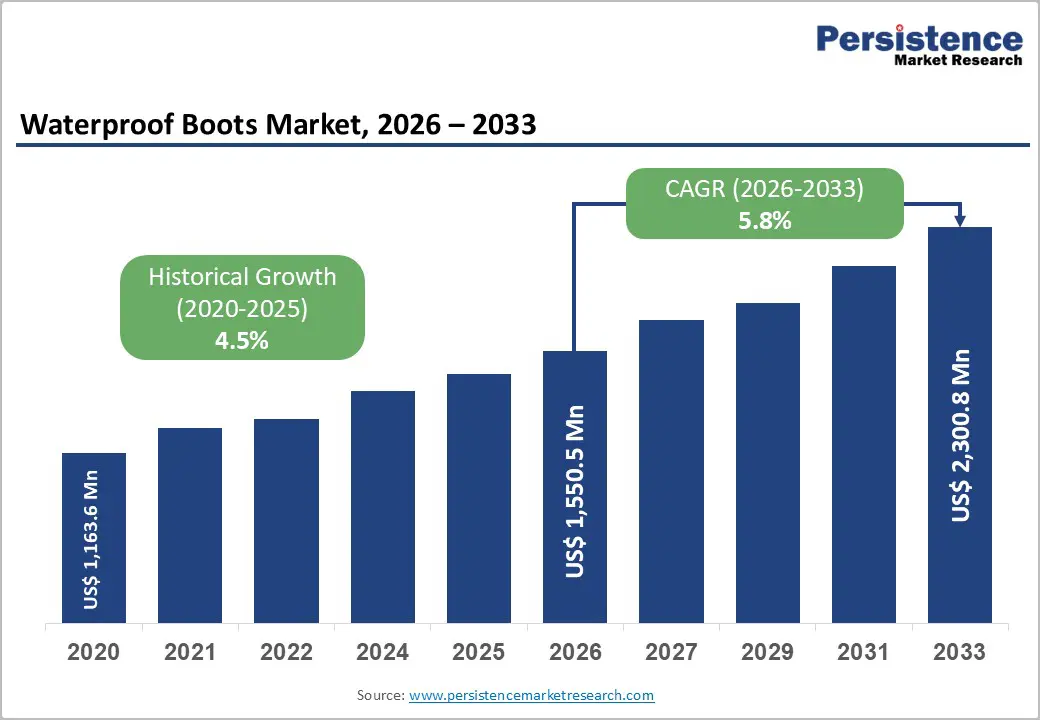
The global waterproof boots market is valued at US$ 1,550.5 million in 2026 and is projected to reach US$ 2,300.8 million by 2033, growing at a CAGR of 5.8% between 2026 and 2033.
The waterproof boots market is experiencing robust growth, primarily propelled by the rise in outdoor recreational participation, rising occupational safety standards, and increasing incidences of extreme weather events globally. Growing adoption of advanced membrane technologies such as Gore-Tex and proprietary waterproofing systems has expanded product appeal across consumer, industrial, and military end-use segments. Accelerated e-commerce penetration and premiumization trends across North America, Europe, and the Asia Pacific are further amplifying market revenue potential, with consumers increasingly prioritizing durability, comfort, and all-weather performance in their footwear purchase decisions.
Key Industry Highlights:
- Leading Region: North America leads the global waterproof boots market, with 38% market share, driven by high outdoor recreation participation, strict OSHA safety mandates, and strong brand presence of key manufacturers, including Columbia Sportswear and Wolverine World Wide across the United States and Canada.
- Fastest-Growing Region: Asia Pacific is the fastest-growing region, fueled by rising middle-class incomes, monsoon-driven demand across South and Southeast Asia, and rapid e-commerce penetration in China and India, creating compelling new demand pockets for waterproof boots manufacturers.
- Dominant Segment: The Rubber segment dominates the material category with approximately 45% market share, attributed to inherent waterproofing properties, high durability, and cost-effectiveness across industrial, agricultural, and consumer footwear applications worldwide.
- Fastest-Growing Segment: The Online distribution channel is the fastest-growing segment, driven by expanding e-commerce adoption, direct-to-consumer brand strategies, and consumer preference for convenience-driven purchasing across global markets.
- Key Market Opportunity: The most significant opportunity lies in eco-friendly product development, with the EU Green Deal, ESPR, and growing consumer sustainability preferences driving investment in PFC-free waterproofing technologies, recycled materials, and circular design principles.
| Key Insights | Details |
|---|---|
| Waterproof Boots Market Size (2026E) | US$ 1,550.5 Mn |
| Market Value Forecast (2033F) | US$ 2,300.8 Mn |
| Projected Growth CAGR (2026 - 2033) | 5.8% |
| Historical Market Growth (2020 - 2025) | 4.5% |
Market Dynamics
Drivers - Rising Outdoor Recreation and Adventure Tourism
The rapid expansion of outdoor recreational activities has become a key catalyst for growth in the waterproof boots market. Data from the Outdoor Industry Association (OIA) indicates that more than 168 million Americans engaged in outdoor recreation in 2023, highlighting a sizable consumer base for advanced waterproof footwear. Similarly, the World Travel & Tourism Council (WTTC) reports that outdoor and nature-based tourism contributes nearly 10% of global tourism GDP, underscoring the sector’s economic significance.
Rising participation in hiking, trekking, camping, and mountaineering has intensified the need for technically sophisticated footwear incorporating enhanced waterproofing and traction technologies. Leading brands employing Gore Tex Extended Comfort membranes, along with proprietary innovations such as Columbia Sportswear’s Omni Tech and KEEN.DRY, continue to address this demand, strengthening the position of performance-grade waterproof boots across global markets.
Stringent Workplace Safety Regulations Driving Industrial Demand
Mandatory occupational safety regulations across major global economies are significantly accelerating the adoption of waterproof work boots within industrial, construction, and agricultural sectors. In the United States, the Occupational Safety and Health Administration (OSHA) requires employers to provide protective footwear under 29 CFR 1910.136, ensuring compliance with ASTM F2413 standards in wet and hazardous environments. Similarly, Europe enforces EN ISO 20345:2011 safety footwear standards across all 27 EU member states.
According to the International Labour Organization (ILO), more than 340 million occupational accidents occur each year, underscoring the critical need for certified protective footwear. This robust regulatory environment supports sustained institutional demand across construction, mining, oil and gas, and chemical processing industries, creating a stable, compliance-driven revenue stream for manufacturers of industrial waterproof boots.
Restraints - High Cost of Premium Waterproofing Technologies
The use of advanced waterproofing membranes such as Gore Tex, eVent, and other proprietary laminates substantially increases manufacturing costs, resulting in retail prices typically ranging from US$150 to over US$400 for premium waterproof boots. This elevated pricing limits adoption among price sensitive consumers, particularly in developing economies where per capita incomes remain comparatively low.
According to the World Bank, approximately 47% of the global population lives on less than US$6.85 per day, significantly restricting discretionary spending on high performance technical footwear. Consequently, the balance between affordability and waterproofing performance presents a persistent commercial challenge for manufacturers aiming to achieve mass market penetration without compromising product quality standards.
Environmental Concerns Over Synthetic Materials and Chemical Coatings
Environmental scrutiny of synthetic materials widely used in waterproof boots, including PVC, polyurethane (PU), and fluorinated durable water repellent (DWR) coatings, is intensifying both regulatory and consumer pressure. The European Chemicals Agency (ECHA) has progressively restricted the use of per and polyfluoroalkyl substances (PFAS) under REACH regulations, requiring manufacturers to reformulate product lines. This shift toward bio based or recycled alternatives elevates R&D and production costs, posing particular challenges for smaller companies.
Growing consumer awareness of environmental impacts, especially among younger demographics, is further influencing purchasing preferences and compelling brands to pursue sustainable yet performance comparable solutions, a transition that remains technically demanding.
Opportunities - E-Commerce Expansion and Direct-to-Consumer Channel Growth
The accelerating expansion of e-commerce continues to create substantial growth prospects for waterproof boot manufacturers globally. In the United States, e-commerce revenue reached approximately US$ 1.1 trillion in 2023, with footwear consistently ranking among the strongest online retail categories. Global online footwear sales are expected to grow at a CAGR exceeding 7% through 2027. Leading brands such as KEEN Footwear and Bogs Footwear have strengthened their direct to consumer (DTC) digital channels, enabling greater consumer engagement while reducing reliance on traditional retail markups.
Furthermore, emerging technologies, including AI enabled fit recommendation systems, virtual try on solutions, and subscription based models, are enhancing digital shopping efficiency and conversion rates. Rapidly digitizing markets in Southeast Asia and Latin America also present significant opportunities, supported by rising internet penetration and expanding middle class purchasing power.
Sustainable and Eco-Friendly Product Innovation
Growing consumer demand for sustainable products is creating a significant opportunity for waterproof boot manufacturers committed to green innovation. The Ellen MacArthur Foundation highlights increasing pressure on the global footwear industry to adopt circular economy principles, reinforcing the need for environmentally responsible production. Findings from the Nielsen Global Sustainability Report show that 73% of consumers worldwide are willing to pay a premium for eco friendly products. Manufacturers are responding through initiatives such as Hunter Boot Ltd.’s use of natural rubber sourced from Forest Stewardship Council (FSC)-certified plantations.
Advancements, including PFC free DWR coatings, recycled rubber outsoles, and bio based TPU uppers, are expanding pathways for product differentiation. Furthermore, regulatory momentum from the EU Green Deal and the Ecodesign for Sustainable Products Regulation (ESPR) is expected to establish mandatory sustainability benchmarks, encouraging early investments in robust, environmentally responsible product portfolios.
Category-wise Analysis
Product Type Insights
The ankle boots segment remains the dominant product category, accounting for approximately 38% of the global waterproof boots market share. This leadership is primarily driven by the segment’s versatility, appealing to both urban consumers and light outdoor users who require reliable weather protection without the added weight of mid calf or knee high designs. Their compact structure enhances mobility while maintaining effective waterproofing, making them suitable for a wide demographic profile.
Additionally, the continued rise of athleisure has blurred distinctions between functional and lifestyle footwear, further supporting adoption for commuting, urban exploration, and light trail activities. Major brands such as Timberland, under VF Corporation, and Columbia Sportswear offer extensive ankle boot portfolios that integrate advanced waterproofing technologies with contemporary styling, effectively meeting growing demand across North America and Europe.
Material Insights
The rubber segment remains the leading material category, accounting for approximately 45% of total market share. Rubber’s natural impermeability, abrasion resistance, chemical durability, and cost effectiveness make it the preferred choice for industrial, agricultural, and fishing applications. Vulcanized rubber boots from manufacturers such as Dunlop Protective Footwear and Hunter Boot Ltd. provide complete waterproofing without reliance on membrane-based technologies, ensuring long term durability under continuous wet conditions.
The International Rubber Study Group (IRSG) reported global natural rubber consumption of about 14.1 million tonnes in 2023, reflecting strong demand across the footwear and industrial sectors. Furthermore, the relatively lower cost of rubber compounds compared to Gore Tex or full grain leather reinforces the segment’s dominance, particularly in developing markets where affordability significantly influences purchasing behavior.
Application Analysis
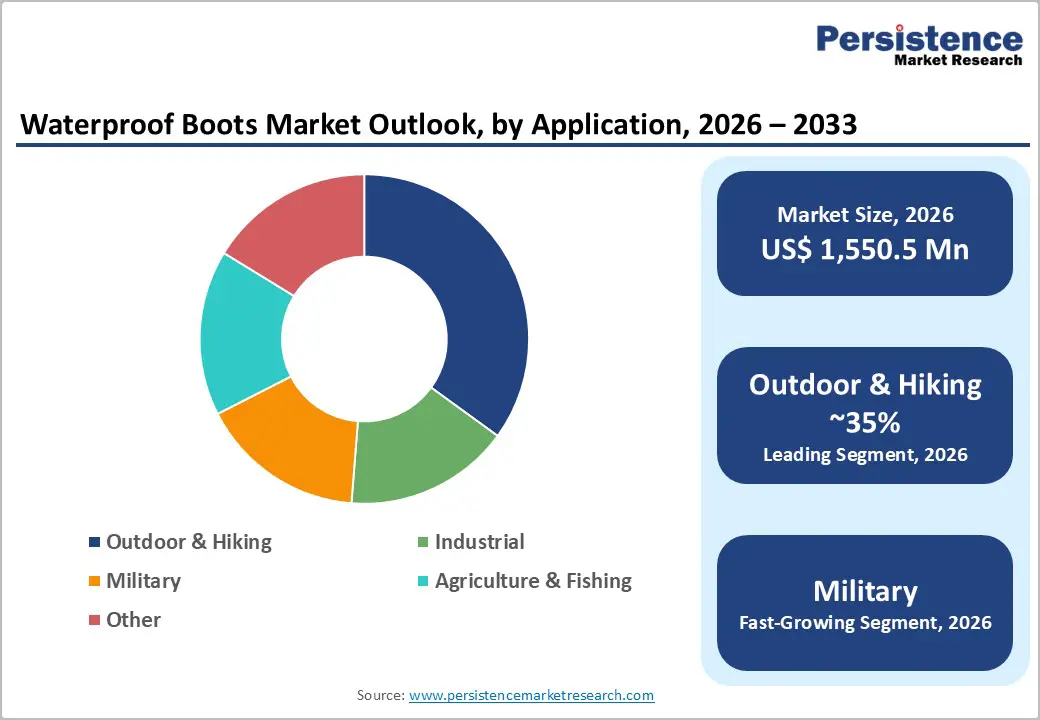
The outdoor & hiking segment represents the leading application category, accounting for approximately 35% of total market share. This dominance is supported by the sustained global rise in outdoor recreational participation, including trail running, trekking, mountaineering, and wilderness camping. The Outdoor Industry Association (OIA) notes that outdoor recreation contributes over US$ 862 billion annually to the U.S. economy, underscoring its substantial economic influence and deep consumer engagement.
Performance oriented features, such as enhanced ankle support, terrain specific outsoles like Vibram, and breathable waterproof membranes, continue to shape consumer preferences. Leading brands, including Salomon Group and KEEN Footwear, maintain strong market positions through continuous product innovation, integrating Gore Tex and proprietary technologies to meet evolving performance and comfort requirements.
Consumer Type Analysis
The men's segment remains the dominant consumer category, accounting for approximately 52% of the total waterproof boots market share. This leadership reflects men’s high participation in outdoor, occupational, and tactical activities that necessitate durable waterproof footwear. Predominantly male oriented sectors such as construction, mining, agriculture, and the military significantly drive both institutional and individual demand for work and tactical boots. According to the U.S. Bureau of Labor Statistics (BLS), men constitute over 70% of employment within construction and extraction occupations, reinforcing their role as a primary end use group.
Conversely, the Women’s segment represents the fastest growing category, supported by increasing female engagement in outdoor recreation and expanding availability of fashion forward waterproof designs from brands such as Hunter Boot Ltd. and Deckers Outdoor Corporation (UGG), addressing both functional and aesthetic needs.
Distribution Channel Insights
The online retail channel remains the dominant distribution avenue, accounting for roughly 42% of total market share. This leadership is reinforced by the rapid digitization of retail, significantly accelerated by the COVID 19 pandemic, which has reshaped global purchasing behavior toward e commerce platforms. Marketplaces such as Amazon, along with brand owned direct to consumer (DTC) websites and social commerce platforms, have become key discovery and purchasing points for consumers.
According to the National Retail Federation (NRF), online footwear sales in the United States grew by approximately 8.6% in 2023, reflecting sustained digital momentum. Convenience-driven factors, including home delivery, extensive product assortments, peer review systems, and competitive pricing, further support channel growth. Leading brands such as Wolverine World Wide and Columbia Sportswear continue to invest heavily in digital infrastructure and personalized marketing to strengthen their online presence.
Regional Insights
North America Waterproof Boots Market Trends
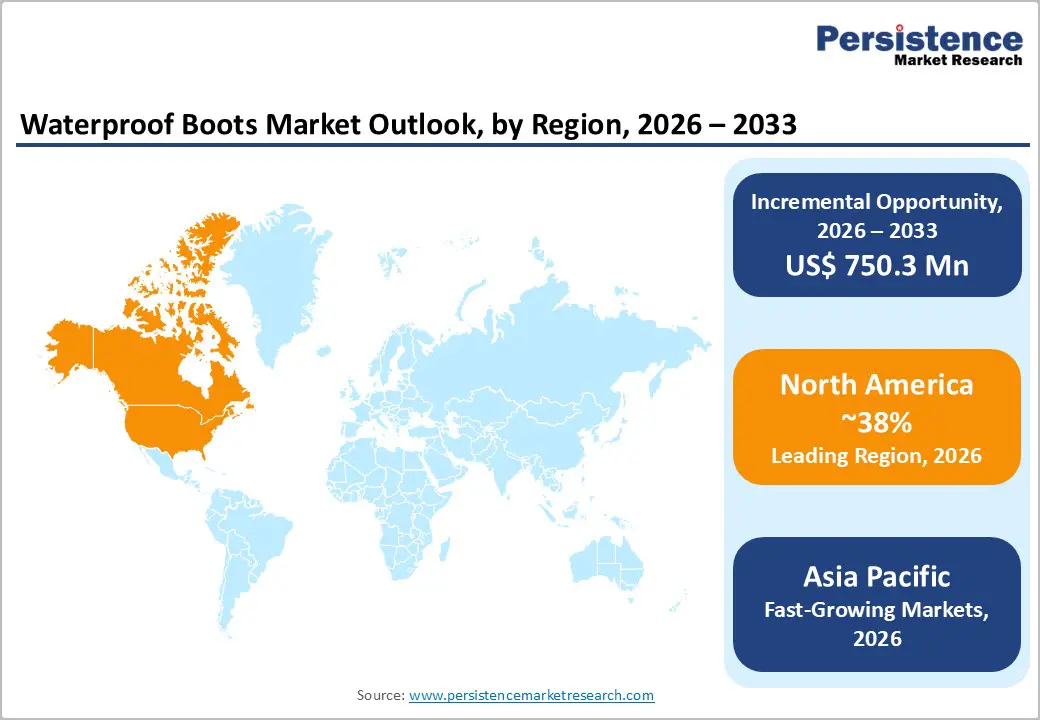
North America constitutes the largest regional market for waterproof boots, with 38% market share, supported by a strong outdoor recreation culture, stringent occupational safety regulations, and elevated consumer purchasing power. The United States accounts for the majority of regional demand, with the Outdoor Industry Association reporting that more than 168 million Americans participate in outdoor activities each year, reinforcing the need for performance driven waterproof footwear. Regulatory oversight by the U.S. Occupational Safety and Health Administration (OSHA) ensures sustained institutional demand for certified waterproof work boots across construction, agriculture, and manufacturing sectors.
Furthermore, severe winter conditions across Canada and the northern U.S. states drive seasonal demand for insulated waterproof boots. Canada further strengthens regional revenue through its vibrant outdoor sporting culture and infrastructure driven construction activity. Leading brands such as Columbia Sportswear, KEEN Footwear, and Wolverine World Wide maintain strong competitive positions through extensive omnichannel retail networks and early adoption of sustainable, PFC free product innovations.
Europe Waterproof Boots Market Trends
Europe represents the second-largest regional market for waterproof boots, supported by a long established outdoor culture, a substantial agricultural workforce, and stringent occupational safety regulations. The United Kingdom remains the leading national market, driven by its climate conditions, strong rural traditions, and the heritage value of brands such as Hunter Boot Ltd. The mandatory enforcement of EN ISO 20345 safety footwear standards across all EU member states ensures consistent institutional demand for certified waterproof work boots. Germany, France, and Scandinavia also contribute significantly, with Germany’s robust manufacturing and construction sectors generating substantial industrial footwear requirements.
Meanwhile, the EU Green Deal and the forthcoming Ecodesign for Sustainable Products Regulation (ESPR) are encouraging manufacturers to adopt PFC free technologies and recycled materials. Growing outdoor lifestyle participation in Spain and Southern Europe further supports demand, creating favorable conditions for eco innovative premium brands to expand their market presence.
Asia Pacific Waterproof Boots Market Trends
Asia Pacific is the fastest growing regional market for waterproof boots, driven by rapid urbanization, rising middle class incomes, and the widespread influence of monsoon climates across South and Southeast Asia. China leads regional demand, supported by its extensive domestic manufacturing base, expanding outdoor recreation culture, and the strong growth of major e commerce platforms such as Tmall and JD.com. Consistent double digit growth in outdoor sports participation, as documented by the China Outdoor Sports Association, continues to expand the consumer base for performance oriented waterproof boots.
Japan and South Korea represent mature markets characterized by strong brand loyalty and a high willingness to invest in premium technical footwear. India offers substantial growth opportunities, strengthened by expanding construction activity and significant demand from the agricultural and military sectors. Meanwhile, Vietnam, Indonesia, and Thailand are emerging as key production hubs and rising consumer markets, supported by improving living standards, outdoor tourism development, and heightened occupational safety awareness.
Competitive Landscape
The global waterproof boots market exhibits moderate fragmentation, characterized by the presence of both established international brands and regional specialty manufacturers competing across varied price points and application categories. Leading companies such as Columbia Sportswear, VF Corporation (Timberland), Wolverine World Wide, and Salomon Group differentiate themselves through proprietary waterproofing technologies, strong brand equity, and extensive global distribution networks. Strategic priorities among these market leaders include advancing sustainable material innovations, expanding into high growth Asia Pacific markets, and strengthening digital commerce capabilities. Licensing of Gore Tex membranes remains a key performance advantage, while private label and value oriented brands increasingly heighten competitive pressure within mid to lower priced segments, particularly through online channels.
Key Market Developments
- January 2025: Columbia Sportswear launched its next-generation Omni-Tech 2.0 waterproofing platform, featuring enhanced breathability and reduced environmental impact through the elimination of PFAS compounds from its membrane coating formulation, reinforcing its sustainability commitment.
- March 2024: Hunter Boot Ltd. expanded its sustainable product portfolio with new boots crafted from Rainforest Alliance-certified natural rubber, targeting environmentally conscious consumers across UK and North American markets, strengthening its brand positioning in the eco-responsible lifestyle footwear segment.
- September 2023: Wolverine World Wide acquired a minority stake in a sustainable footwear startup specializing in bio-based waterproofing compounds, signaling a strategic pivot toward environmentally responsible product development across its diversified multi-brand portfolio including Merrell and Bates.
Top Companies in Waterproof Boots Market
- Columbia Sportswear Company (Portland, Oregon, U.S.) is a foremost player in the waterproof boots market, renowned for its proprietary Omni-Tech waterproofing and Omni-Heat thermal insulation technologies. The company commands a strong presence across outdoor, hiking, and winter boot segments through extensive retail and DTC channels. Its consistent R&D investment and broad product portfolio spanning casual to high-performance categories underpin its competitive market position globally.
- VF Corporation (Denver, Colorado, U.S.) is a globally recognized waterproof footwear brand known for its iconic Timberland PRO work boot series and proprietary TimberDry waterproofing technology. The brand commands distribution across over 50 countries, serving both fashion-conscious lifestyle consumers and occupational end-users. Its strong brand heritage, premium positioning, and commitment to sustainable sourcing have reinforced Timberland's long-term competitive resilience in the global waterproof boots landscape.
- Wolverine World Wide (Rockford, Michigan, U.S.) operates a diversified portfolio including Merrell, Wolverine, and Bates, collectively addressing outdoor, work, and tactical waterproof boot segments. The company's innovation pipeline, sustainability through its ReLeather initiative, and aggressive digital commerce expansion have reinforced its competitive standing.
Companies Covered in Waterproof Boots Market
- Columbia Sportswear Company
- VF Corporation
- Wolverine World Wide
- Deckers Outdoor Corporation
- KEEN Footwear
- Salomon Group
- Dunlop Protective Footwear
- Hunter Boot Ltd.
- Bogs Footwear
- Muck Boot Company
- Rocky Brands
- Aigle
- W.L. Gore & Associates
- Arc'teryx
- LaCrosse Footwear
Frequently Asked Questions
The global Waterproof Boots market is estimated at US$ 1,550.5 Mn in 2026 and is forecast to reach US$ 2,300.8 Mn by 2033, expanding at a CAGR of 5.8% during the forecast period of 2026-2033. The market recorded a historical CAGR of 4.9% between 2020 and 2025.
Key growth drivers include rising global participation in outdoor recreational activities, stringent occupational safety regulations such as OSHA 29 CFR 1910.136 in the U.S. and EN ISO 20345 in Europe, growing adoption of advanced waterproofing technologies like Gore-Tex, and accelerating e-commerce channel expansion, enabling broader consumer access to waterproof footwear globally.
The Ankle Boots segment holds the leading position in the product type category with approximately 38% market share. Their versatility across urban lifestyle and light outdoor applications, combined with growing consumer preference for functional yet aesthetically appealing waterproof footwear, underpins their dominant market position.
North America is the dominant regional market, led by the United States. High outdoor recreation participation rates, with over 168 million Americans engaged in outdoor activities annually per the Outdoor Industry Association (OIA), combined with robust occupational safety enforcement and strong brand ecosystems, sustain North America's market leadership.
Key opportunities include sustainable and eco-friendly product innovation driven by the EU Green Deal and ESPR regulations, expansion of direct-to-consumer e-commerce channels, development of PFC-free DWR coatings, and tapping into high-growth emerging markets in Asia Pacific, including India, Vietnam, and Indonesia.
Leading companies in the global Waterproof Boots market include Columbia Sportswear Company, VF Corporation (Timberland), Wolverine World Wide, Deckers Outdoor Corporation, KEEN Footwear, Salomon Group, Dunlop Protective Footwear, Hunter Boot Ltd., and Bogs Footwear, among others.


