




- Specialty & Fine Chemicals
- Cementitious Waterproofing Market
Cementitious Waterproofing Market Size, Share, and Growth Forecast, 2025 - 2032
Cementitious Waterproofing Market By Product Type (Cementitious Coatings, Cementitious Mortars, Others), Form (Liquid, Powder, Other), Application, End-use, and Regional Analysis for 2025 – 2032

Cementitious Waterproofing Market Size and Trends Analysis
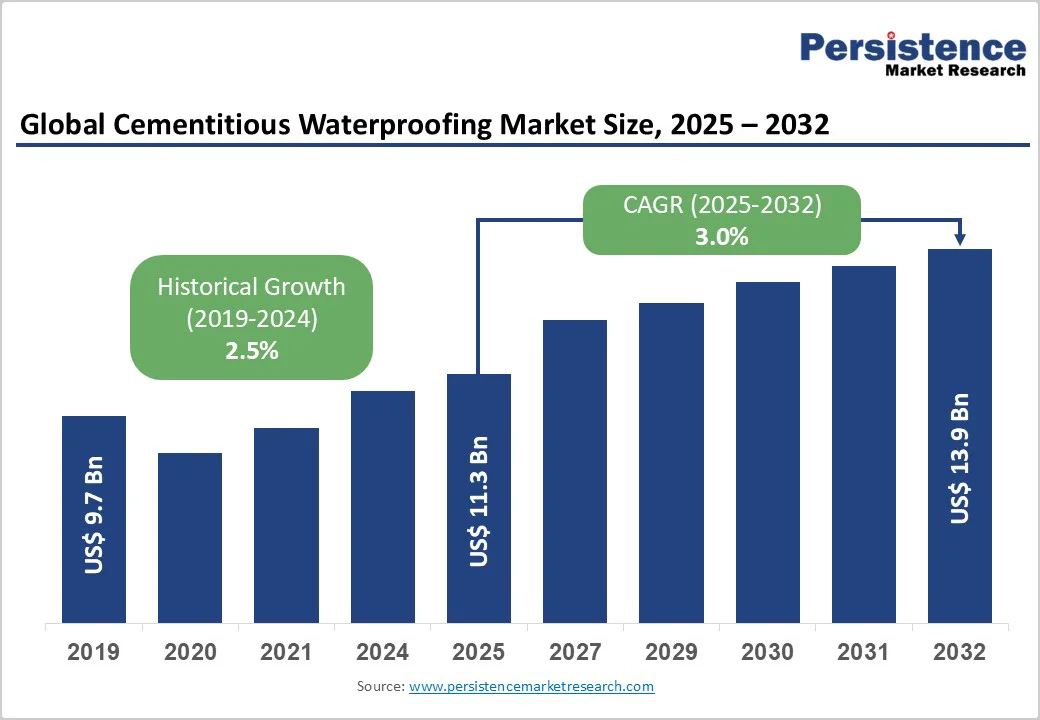
The global cementitious waterproofing market size is likely to be valued US$11.3 Billion in 2025, forecasted to US$13.9 Billion by 2032 growing at a CAGR of 3.0% during the forecast period from 2025 to 2032 driven by the increasing prevalence of urbanization and infrastructure development, rising demand for durable and sustainable building materials, and advancements in cement waterproofing technologies.
The need for effective protection against water damage in construction projects, particularly in flood-prone and humid regions, has significantly boosted the adoption of concrete-basesd waterproofing across various applications. The market is further propelled by innovations in eco-friendly formulations and crystalline additives, catering to preferences for long-lasting and low-maintenance solutions.
Key Industry Highlights:
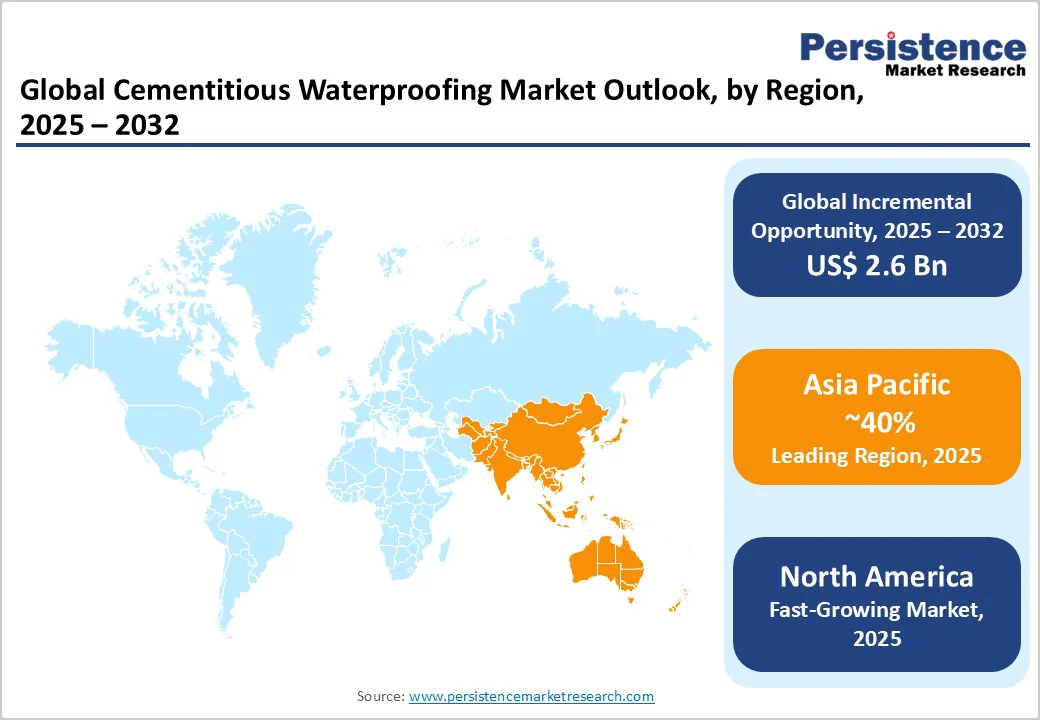
- Leading Region: Asia Pacific, commanding a 40% market share in 2025, driven by rapid urbanization, massive infrastructure investments, and booming construction in countries like China and India.
- Fastest-growing Region: North America, fueled by increasing construction activities, rising awareness of water conservation, and government initiatives for sustainable buildings in emerging economies.
- Dominant Product Type: Cementitious Coatings, holding approximately 50% of the market share, due to their ease of application and versatility in surface protection.
- Leading Form: Powder, accounting for over 45% of market revenue, driven by its long shelf life and mixability with site-specific requirements.
- Leading Application: Basements, contributing nearly 35% of market revenue, owing to the critical need for below-ground moisture control in urban structures.
- Key Market Driver: Global construction market growth to US$ 20.44 Tn by 2029, boosting demand for waterproofing to mitigate annual water damage costs exceeding US$ 100 Bn worldwide.
- Growth Opportunity: Advancements in self-healing cementitious slurries, enabling crack repair and enhanced durability in harsh environments.
| Global Market Attribute | Key Insights |
|---|---|
|
Cementitious Waterproofing Market Size (2025E) |
US$11.3 Bn |
|
Market Value Forecast (2032F) |
US$13.9 Bn |
|
Projected Growth (CAGR 2025 to 2032) |
3.0% |
|
Historical Market Growth (CAGR 2019 to 2024) |
2.5% |
Market Factors – Growth, Barriers, and Opportunity Analysis
Rising Urbanization and Infrastructure Development Demanding Robust Waterproofing
The increasing urbanization and infrastructure boom globally is a primary driver of the cementitious waterproofing market. United Nations, urban populations are projected to reach 68% of the global total by 2050, up from 56% in 2020, necessitating extensive construction of resilient buildings. This surge creates substantial demand for waterproofing solutions to combat water ingress, which causes over US$ 100 Bn in annual global damages to structures.
Cement-based waterproofing offers breathable, compatible protection that integrates seamlessly with concrete, achieving up to 99% moisture resistance in tests. For instance, products from companies such as Sika have demonstrated 50% reduction in repair costs in high-rise projects through preventive application.
The demand for sustainable, low-VOC options, supported by green building certifications such as LEED, continues to propel the market forward, particularly in regions with high flood risks such as Europe and Asia Pacific.
High Initial Costs and Skilled Application Requirements
The high initial costs and need for skilled labour associated with concrete-based waterproofing pose a significant restraint on market growth. While effective, premium formulations and professional installation can add 15-20% to project budgets, deterring adoption in cost-sensitive developing markets.
Application demands precise surface preparation and curing conditions, with errors leading to up to 30% failure rates in humid climates. Regulatory compliance for eco-friendly variants adds further expenses, often exceeding US$ 50,000 per large-scale project.
For example, implementations by BASF in commercial sites have faced delays due to labour shortages, inflating costs by 25%. Smaller contractors struggle against established players such as Pidilite Industries, limiting penetration in residential segments where DIY alternatives prevail.
Advancements in Eco-Friendly and Self-Healing Formulations
Advancements in eco-friendly and self-healing cementitious materials present significant growth opportunities for the cement-based waterproofing market. Crystalline additives enable autonomous crack sealing up to 0.4 mm wide, extending structure lifespan by 40% and reducing maintenance. These innovations align with global sustainability goals, with green construction comprising 60% of projects by 2025.
For instance, companies such as Xypex Chemical are investing in low-carbon powder forms, with trials showing 80% improved water impermeability. Modular mixes cut application times by 30%, and nanotechnology integration enhances adhesion. As urbanization drives US$ 5.3 Tn in Asia Pacific infrastructure by 2025, these opportunities are set to fuel expansion in high-growth regions such as North America and Europe.
Category-wise Analysis
Product Type Insights
Cementitious coatings dominate the market, hold around 50% of the share in 2025. Their popularity stems from easy brush-on application, fast curing times, and excellent compatibility with concrete surfaces. Widely used in basements, wet areas, and water-retaining structures, these coatings provide reliable moisture protection, durability, and cost-effective performance, making them a preferred choice in both residential and commercial projects.
Cementitious mortars are the fastest-growing segment, driven by increasing demand for structural repairs and reinforcement. Their high compressive strength and durability make them ideal for industrial applications, while enhanced flexibility supports use in seismic zones. Rising adoption is fueled by the need for reliable, long-lasting solutions that maintain structural integrity under challenging conditions, ensuring safety and performance in critical constructions.
Form Insights
The powder segment dominates the cement-based waterproofing market, capturing over 45% of the share in 2025. Its advantages include long shelf life, easy dry storage, and customizable mixing ratios, making it suitable for large-scale construction projects. These features ensure consistent performance, cost-effectiveness, and adaptability, driving strong demand across residential, commercial, and infrastructure applications where reliability and scalability are essential.
Liquid cementitious waterproofing segment is the fastest-growing, driven by its user-friendly spray application. Ready-to-use liquid formulations simplify installation, reducing labour requirements by up to 25%, making them highly attractive for residential retrofits and urban construction projects. Their convenience, efficiency, and consistent performance are accelerating adoption, particularly in markets where speed, ease of use, and cost-effective application are key priorities.
Application Insights
Basements dominate the concrete waterproofing market, holding nearly 35% of the share in 2025. Their importance is driven by the need for effective flood and moisture protection in underground spaces, which are highly vulnerable to water ingress. With around 70% of new urban developments including basements, waterproofing solutions are essential to ensure structural integrity and long-term durability in these critical areas.
Rooftops segment is the fastest-growing in the concrete-based waterproofing market, fueled by the rising adoption of green roofing and sustainable construction practices. Waterproof cementitious slurries provide reliable protection while supporting vegetation layers, preventing water ingress and structural damage. Their durability, ease of application, and eco-friendly properties make them ideal for modern rooftop designs with landscaping and energy-efficient features.
End-use Insights
The residential segment dominates the cement-based waterproofing market, accounting for over 40% of revenue in 2025. Homeowners prioritize cost-effective solutions for moisture protection in basements, walls, and roofs. Powder-based cementitious coatings are particularly popular due to their affordability, ease of application, and reliable performance, driving high demand and significant market volume in residential construction and renovation projects across the region.
Industrial segment is the fastest-growing, driven by expanding factories and manufacturing facilities. These structures face harsh environmental and chemical exposures, creating a high demand for durable, long-lasting mortars. Cement-based waterproofing provides strong adhesion, resistance to water ingress, and protection against aggressive conditions, making it ideal for industrial applications requiring reliability and structural integrity.

Regional Insights
Asia Pacific Cementitious Waterproofing Market Trends
Asia Pacific commands around 40% share and is the fastest-growing region, driven by rapid urbanization, expanding infrastructure, and increasing construction activities across emerging economies such as China, India, Indonesia, and Vietnam. Government investments in smart cities, transportation networks, and residential developments are fueling the demand for durable, cost-effective waterproofing solutions.
Concrete-based waterproofing is gaining popularity due to its easy application, strong adhesion, and compatibility with concrete structures, making it ideal for basements, tunnels, water tanks, bridges, and commercial buildings. Additionally, the region’s high humidity levels and growing emphasis on sustainable construction are accelerating market adoption.
Technological advancements, including polymer-modified cementitious coatings, are enhancing flexibility and durability under harsh environmental conditions. Leading companies are focusing on expanding production capacities and introducing eco-friendly, high-performance products to meet regulatory and environmental standards.
North America Cementitious Waterproofing Market Trends
North America is fastest-leading, account 25% market share in 2025, driven by increasing construction activities, urbanization, and the demand for durable, long-lasting building materials. The United States and Canada are the major contributors, with significant demand from residential, commercial, and infrastructure projects such as basements, bridges, tunnels, and water-retaining structures.
Concrete-based waterproofing is preferred for its ease of application, strong adhesion to concrete, and effective protection against water ingress, making it suitable for both new construction and renovation projects. The region’s focus on sustainability, energy efficiency, and adherence to strict building codes further supports market adoption.
Polymer-modified cementitious coatings are increasingly used for their enhanced flexibility, crack resistance, and durability under harsh weather conditions. Additionally, government initiatives for infrastructure modernization and growing awareness of long-term building maintenance are driving demand. Leading manufacturers are investing in research and development to launch high-performance, eco-friendly products and expand production capacities.
Europe Cementitious Waterproofing Market Trends
Europe holds about 25% market share, driven by the region’s emphasis on sustainable construction, renovation of aging infrastructure, and strict building regulations promoting water-resistant structures. Leading countries such as Germany, France, the U.K., and Italy are driving demand through extensive residential, commercial, and civil engineering projects.
Cement-based waterproofing is widely preferred for its easy application, strong adhesion to concrete, and long-lasting protection against moisture, making it suitable for basements, tunnels, bridges, and water-retaining structures. The increasing adoption of green building standards and energy-efficient materials further supports market expansion, as cementitious coatings are durable and environmentally friendly.
Ongoing restoration of historical buildings and modernization of urban infrastructure across Europe are fueling the need for advanced waterproofing solutions. Innovations such as polymer-modified cementitious coatings are enhancing flexibility, crack resistance, and overall performance. Major manufacturers are focusing on sustainable product development and strategic partnerships to strengthen their market presence.
Competitive Landscape
The global cementitious waterproofing market is highly competitive, comprising multinational chemical corporations and regional specialists vying for market share across different regions. In Asia Pacific and Europe, leaders such as Sika and BASF dominate through continuous innovation, technological advancements, and strong distribution networks, while North America features niche players focusing on sustainable, eco-friendly waterproofing technologies to meet environmental and regulatory demands.
Competition is intensified by investments in research and development, strategic mergers, and acquisitions aimed at expanding market presence and product portfolios. Key players adopt diverse strategies to maintain leadership and drive growth. Sika leverages its global distribution network to ensure widespread availability of high-performance solutions, Pidilite focuses on cost-effective, user-friendly innovations for residential and small-scale commercial segments, and BASF emphasizes eco-formulations that comply with stringent environmental regulations.
Companies are also investing in advanced technologies, including nanotechnology-enhanced and polymer-modified coatings, to improve durability, flexibility, and water resistance. Sustainability certifications and green building compliance further strengthen brand credibility.
Key Industry Developments
- In 2025, JSW Cement has launched CHD Water guard, a water-repellent slag-based cement designed for the high-moisture conditions of southern India. The product uses ‘Turbo Gel’ Technology, which the company says ensures a polymer-enriched ‘hydration matrix’ for improved workability and compressive strength.
- In 2024, Shalimar Paints Ltd., with over 120 years of legacy in the Indian paint industry, has introduced two new products, Zero Damp Advance and Zero Damp Smart, as part of their Home Protect Waterproofing range. These products offer superior protection against seepage, with warranties of up to 12 years. The Zero Damp elastomeric waterproof coating is reinforced with fibers, forming a strong shield against internal and external seepage while also reflecting heat to keep indoor spaces cooler.
Companies Covered in Cementitious Waterproofing Market
- AQUAFIN
- BASF
- Clemons Concrete Coating
- Evonik
- Fosroc International
- Mapei
- Pidilite Industries
- Polycoat
- RPM International
- Sika
- W.R. Meadows
- Grace
- Xypex Chemical
- Others
Frequently Asked Questions
The global cementitious waterproofing market is projected to reach US$11.3 Bn in 2025, driven by surging urbanization and demand for durable construction protection.
The market is driven by global construction growth to US$20.44 Tn by 2029 and rising water damage costs over US$ 100 Bn annually, necessitating robust waterproofing solutions.
The market is poised to witness a CAGR of 3.0% from 2025 to 2032, reflecting steady infrastructure investments and sustainable material innovations.
Advancements in eco-friendly and self-healing formulations offer key opportunities, supporting green buildings and reducing long-term maintenance in urban projects.
Sika, BASF, Pidilite Industries, Mapei, and RPM International are key players, leading through R&D in innovative coatings and global distribution networks.


