




- Clothing, Footwear, & Accessories
- Washable Shoes and Clogs Market
Washable Shoes and Clogs Market Size, Share, and Growth Forecast 2026 – 2033
Washable Shoes and Clogs Market by Material (Synthetic/EVA, Rubber, Leather, Others), Product Type (Casual Clogs, Occupational Clogs), Category (Economical, Premium), End-user (Women, Men, Kids), and Regional Analysis 2026 – 2033

Washable Shoes and Clogs Market Size and Trends Analysis
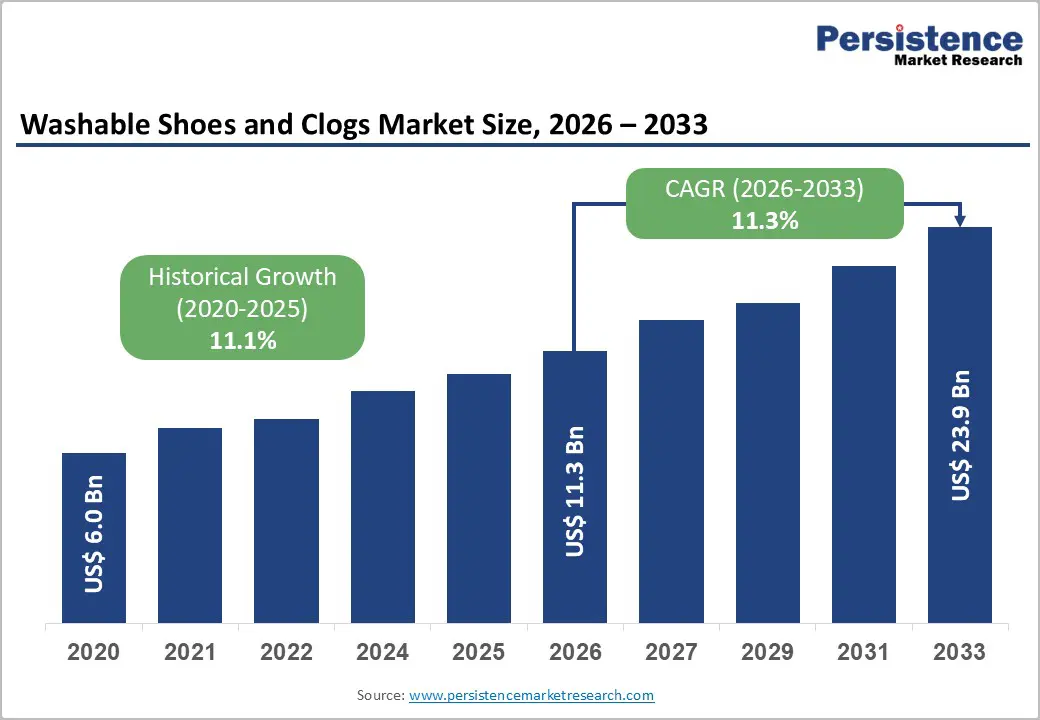
The global washable shoes and clogs market size is likely to be valued at US$11.3 billion in 2026 and is expected to reach US$23.9 billion by 2033, growing at a CAGR of 11.3% during the forecast period from 2026 to 2033, driven by material innovations (bio-based EVA), the expansion of the occupational footwear segment in emerging economies, and the integration of machine-washable technologies by major athletic brands.
The market has demonstrated robust resilience, transitioning from a niche healthcare-focused product to a mainstream lifestyle essential. Demand increases due to heightened post-pandemic focus on hygiene and convenience, alongside athleisure trends that boost casual footwear adoption. The healthcare and hospitality sectors drive occupational use, while synthetic materials facilitate cleaning and enhance affordability.
Key Industry Highlights:
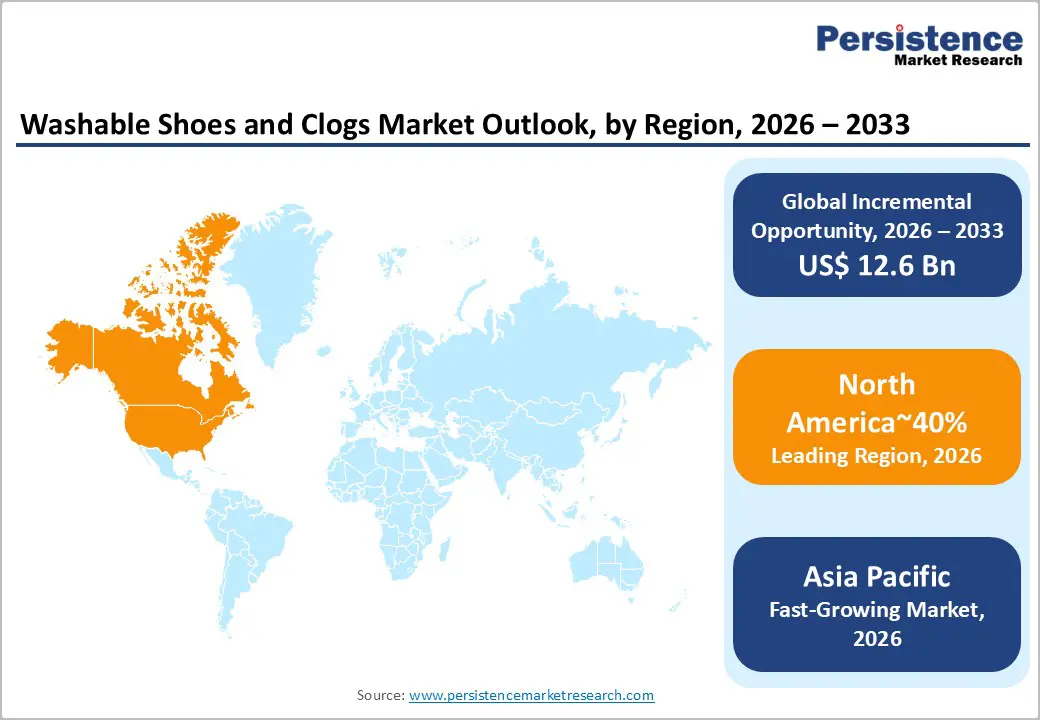
- Leading Region: North America is expected to lead with approximately 40% of revenue, driven by occupational demand, athleisure adoption, ergonomic innovations, and high consumer purchasing power.
- Fastest-growing Region: Asia Pacific is likely to be the fastest-growing region with roughly 24% share, supported by rapid urbanization, rising disposable incomes, digital distribution channels, and hygiene-conscious consumer behavior.
- Leading Product Type: Casual clogs remain the leading segment with roughly 58% share, driven by lifestyle adoption, scalability, comfort, and social-media-amplified fashion validation.
- Leading Category Type: Occupational clogs are the fastest-growing segment, driven by regulatory mandates, ergonomic design, infection-control compliance, and growth in the healthcare and hospitality workforces.
| Key Insights | Details |
|---|---|
| Washable Shoes And Clogs Market Size (2026E) | US$ 11.3 Bn |
| Market Value Forecast (2033F) | US$ 23.9 Bn |
| Projected Growth (CAGR 2026 to 2033) | 11.3% |
| Historical Market Growth (CAGR 2020 to 2025) | 11.1% |
Market Factors – Growth, Barriers, and Opportunity Analysis
Expansion of E-commerce and Direct-to-Consumer (DTC) Channels
The rapid expansion of e-commerce and Direct-to-Consumer channels is structurally reshaping the washable footwear market by reducing reliance on traditional wholesale distribution and physical retail constraints. Washable footwear, particularly molded and standardized formats such as clogs and slip-ons, is inherently well-suited to online retail due to predictable sizing, lower fit-related uncertainty, and reduced return complexity compared to stitched or leather footwear. This compatibility enables brands to scale digitally with greater confidence, leveraging centralized inventory models and faster product refresh cycles. DTC strategies also allow manufacturers to capture higher margins while maintaining direct control over pricing, branding, and customer engagement, reinforcing profitability alongside volume growth.
Digital channels enable brands to communicate functional value propositions such as washability, hygiene, and durability more effectively through visual demonstrations, user reviews, and subscription-style replenishment models. The rise of social commerce, influencer-led discovery, and targeted performance marketing further accelerates consumer adoption, particularly among urban and health-conscious demographics. As omnichannel expectations normalize, washable footwear brands that prioritize DTC infrastructure benefit from faster market feedback loops, improved demand forecasting, and stronger customer lifetime value. Collectively, these dynamics position e-commerce not merely as a sales channel, but as a core growth engine underpinning the category’s transition from niche utility footwear to mainstream everyday wear. Collectively, these dynamics position e-commerce not merely as a sales channel, but as a core growth engine underpinning the category’s transition from niche utility footwear to mainstream everyday wear. This structural shift is already evident in industry findings, with February 2025 reports identifying rising e-commerce penetration as a key driver of growth in the clogs market, materially improving accessibility and accelerating online sales of washable footwear.
Counterfeit Proliferation and Quality Dilution Risks
The widespread availability of counterfeit and low-quality substitutes represents a severe structural restraint on the washable footwear market, particularly across price-sensitive regions in Asia and Latin America. These unbranded imitations, typically manufactured using inferior PVC or low-grade plastics rather than proprietary closed-cell resins, undermine the category’s core value propositions of hygiene, durability, and wash resistance. The result is a persistent “market noise” effect, where consumers struggle to distinguish authentic performance footwear from visual replicas. This erosion of category integrity leads to material revenue leakage for legitimate brands and weakens pricing power, forcing established players to divert resources toward brand defense rather than growth initiatives.
More critically, counterfeit products distort consumer perception of the entire washable footwear category. When low-quality knock-offs deform, lose slip resistance, or degrade after basic sanitation washes, end users often attribute the failure to the product type rather than counterfeit materials. This misattribution suppresses repeat purchase intent and damages long-term brand equity. In digital marketplaces, the problem is amplified by algorithmic visibility and manipulated reviews, where premium brands are buried beneath low-cost substitutes. To counter this, manufacturers are compelled to absorb high legal, compliance, and authentication costs through anti-counterfeiting technologies and enforcement actions. These defensive expenditures compress margins and slow market development, making counterfeit saturation not merely a competitive nuisance but a fundamental constraint on sustainable category expansion.
Sustainable Material Transition and Circular Polymer Adoption
The shift toward sustainable material innovation presents a structurally significant growth opportunity for the washable footwear market, as brands move away from fossil fuel-based plastics toward biobased and circular polymers. Bio-derived EVA materials sourced from sugarcane, agricultural waste, or recycled feedstocks directly address rising consumer environmental awareness and tightening regulatory scrutiny around plastic waste. This transition enables manufacturers to reduce lifecycle carbon intensity while maintaining the durability, washability, and comfort characteristics essential to molded footwear. The sustainable washable footwear segment is therefore positioned to outpace conventional offerings, supported by premium pricing acceptance among eco-conscious consumers and institutional buyers seeking lower environmental footprints. Importantly, sustainability functions not only as a marketing lever but as a long-term risk mitigation strategy against material regulation and supply-chain volatility.
Commercial validation of this opportunity is already visible through leading brands integrating recycled and bio-circular polymers into core product lines rather than limited-edition launches. Adidas has demonstrated scalability through ocean-plastic partnerships, while Crocs and Allbirds have embedded bio-circular and sugarcane-derived EVA into highvolume models. These initiatives support circular economy narratives by reducing landfill waste and dependence on virgin petrochemicals. As material science improves and production costs normalize, sustainable polymers are expected to move from differentiation to baseline expectation. Brands that achieve early scale and material credibility will be better positioned to secure margin resilience, brand trust, and long-term category leadership as sustainability becomes a purchasing prerequisite rather than a niche preference.
Category–wise Analysis
Category Type Insights
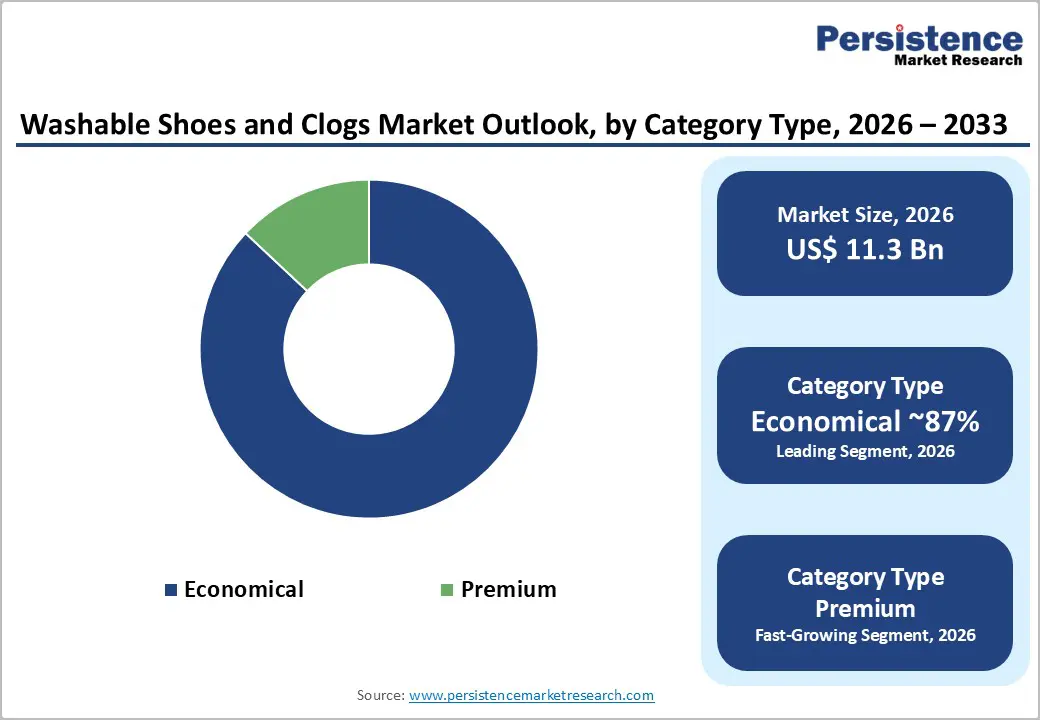
The economical category leads market sales, making up around 87% of total clog sales in 2026, as it effectively meets large-scale, price-driven, utility-focused demand. This segment is anchored in cost sensitivity, where purchasing decisions prioritize affordability, washability, and basic durability over brand or aesthetics. Injection-molded EVA enables extreme material efficiency, allowing manufacturers to produce lightweight, waterproof clogs at minimal unit cost and distribute them globally. These products are commonly treated as replaceable tools rather than durable goods, reinforcing high turnover volumes. The rise of e-commerce platforms has further strengthened this category by intensifying price comparison and rewarding sellers with fast fulfillment and low margins. Generic private-label offerings on marketplaces such as Amazon and regional hardware chains have effectively set the market price floor. The generic EVA garden clog, typically priced in the low double-digit range, functions as the category’s hero product and volume benchmark.
The premium segment is emerging as the fastest-expanding category, fueled by a fundamental shift away from purely utilitarian footwear toward products that blend status, comfort, and orthopedic credibility. Rather than competing on price, growth in this segment is driven by brand equity, perceived craftsmanship, and demand shaped by scarcity and exclusivity. Premium clogs have evolved into lifestyle and fashion symbols, reinforced by designer collaborations, limited-edition drops, and brand narratives that reposition the silhouette beyond its functional origins. Luxury and ergonomics are also converging, with features such as cork footbeds, premium leathers, and sustainably sourced materials providing clear justification for elevated pricing. Established comfort brands such as Birkenstock and Dansko are well-positioned to capitalize on this evolution, leveraging long-standing orthopedic authority while remaining accessible for everyday wear. Fashion houses such as Balenciaga expand cultural relevance through exaggerated aesthetics and aspirational pricing. Within this landscape, the Birkenstock Boston clog functions as a flagship product, serving as a gateway for consumers transitioning from mass-market practicality to premium, comfort-led lifestyle positioning.
End-user Insights
The women segment is estimated to be the leading subsegment in washable footwear, accounting for approximately 52% share in 2026, driven by multi-purpose utility across professional, domestic, and lifestyle contexts. Their dominant position is reinforced by dual-role usage, where footwear must perform for long shifts in healthcare or hospitality settings and seamlessly transition to household or casual wear. Style versatility, orthopedic support, and platform-enhanced designs cater to comfort and aesthetic demands, while high replacement frequency sustains recurring market volume. Flagship products such as the Crocs Siren Clog and Birkenstock Boston Clog exemplify leadership, blending fashion appeal with ergonomic and wellness-focused features. A defining industry trend is the convergence of wellness and lifestyle, where heightened awareness of plantar fasciitis and back health drives product innovation and social-media-amplified adoption among women.
The kids segment represents the fastest-growing segment, fueled by parental demand for durable, hygienic, and easy-to-wear footwear. Growth is supported by EVA clogs’ resistance to wear, ease of cleaning, and the ability for toddlers to self-dress, while licensing and character-themed customization enhance engagement and repeat purchases. Products such as the Crocs Kids’ Classic Clog with Jibbitz and Skechers Foamies illustrate the focus on interactive design, combining durability with playful aesthetics. A key trend is multifunctionality and lifestyle integration, where footwear spans school, playground, and recreational use, positioning kids’ clogs as essential, parent-approved solutions for convenience, safety, and developmental independence.
Regional Analysis
North America Washable Shoes and Clogs Market
North America is expected to maintain its position as the leading market, accounting for 40% market share in 2026, driven by a combination of high consumer purchasing power, established retail infrastructure, and a mature concentration of major brands. The region is likely to continue benefiting from strong occupational demand, particularly in healthcare, hospitality, and industrial sectors, where workplace safety regulations and hygiene protocols require ergonomic, washable, and antimicrobial footwear. Consumer trends indicate a persistent shift toward athleisure and comfort-focused designs, with demand for premium, branded, and customizable options continuing to expand.
Innovation will remain a key driver, as brands headquartered in the region introduce new materials and technology-integrated products. Smart footwear with embedded IoT sensors for monitoring fatigue and environmental hazards is anticipated to grow in adoption. Material advancements, such as lightweight composite toe caps and eco-friendly bio-circular components, are expected to replace conventional designs. Digital channels will further strengthen market reach, with e-commerce and direct-to-consumer platforms likely to dominate distribution. Overall, North America’s leadership will be reinforced by a blend of occupational necessity, technological innovation, sustainability initiatives, and strong consumer engagement across professional and casual footwear segments.
Europe Washable Shoes and Clogs Market
Europe is expected to remain a significant market, driven by a combination of strong heritage craftsmanship, established regulatory frameworks, and high consumer awareness of ergonomic and sustainable designs. The region is likely to continue benefiting from stringent workplace safety and hygiene regulations across healthcare, culinary, and industrial sectors, which require protective, easy-to-clean footwear. European consumers increasingly prioritize foot-health, comfort, and orthopedic support, encouraging the adoption of cork, wood, and advanced composite materials. Consumer behavior is shifting toward a fusion of utility and aesthetics, with premium and heritage-inspired designs gaining traction across professional and casual segments.
Innovation and sustainability will remain key drivers in Europe, as brands integrate high-tech features into traditional designs. Lightweight composite toe caps, anti-static (ESD) compliance, and machine-washable microfibre uppers are expected to expand across healthcare and industrial applications. Eco-certification, such as the EU Ecolabel, will likely influence purchasing decisions and drive brand differentiation. Digital channels, including e-commerce and direct-to-consumer platforms, are anticipated to increase market reach and enable niche premium brands to scale efficiently. Overall, Europe’s market growth will be supported by regulatory adherence, material innovation, sustainability initiatives, and a focus on combining functionality with style.
Asia Pacific Washable Shoes and Clogs Market
Asia Pacific is expected to maintain its position as the fastest-growing regional market, benefiting from rapid urbanization, rising disposable incomes, and a growing middle class in key economies, which is driving demand for branded, comfortable, and hygienic footwear. Health and hygiene awareness, particularly in Japan and South Korea, is expected to sustain high adoption of washable, indoor-appropriate clogs. Industrial demand will expand as manufacturers in China, India, and Vietnam adopt lightweight composite toe caps, antimicrobial microfibers, and anti-static materials to meet workplace safety and sanitation requirements. E-commerce and digital marketing channels are anticipated to strengthen distribution, making global and local brands widely accessible, while personalization trends, such as customizable charms, will continue to influence consumer preferences.
Country-specific developments are likely to reinforce regional growth. China is expected to drive the bulk of production and revenue, leveraging large-scale manufacturing and strong domestic demand. India will likely emerge as a hub for professional and medical footwear, supported by the healthcare sector and a growing diabetic population. Japan and South Korea are anticipated to focus on high-value, hygiene-conscious products, while ASEAN nations are projected to expand in commercial and industrial segments due to infrastructure development and foreign investment. APAC’s growth will be reinforced by manufacturing strength, cultural hygiene practices, technological integration, and rising consumer sophistication.
Competitive Landscape
The global washable shoes and clogs market exhibits moderate consolidation, with the top five players controlling roughly 60% of the total revenue. Crocs leads with an estimated 35% share, leveraging cost-efficient innovation, broad distribution networks, and mass-market appeal. Birkenstock capitalizes on premium heritage, orthotic expertise, and strong brand loyalty, while Dansko focuses on specialized occupational and comfort-oriented segments. The remaining is highly fragmented, distributed across regional manufacturers, private-label supermarket brands, and niche specialists targeting ergonomic or medical footwear requirements.
Competitive positioning reflects a clear divergence between market leaders and smaller players. Global giants compete primarily on brand equity, collaborative collections, and marketing visibility, using partnerships and lifestyle positioning to sustain premium and volume segments simultaneously. In contrast, fragmented players rely on price competitiveness, local availability, and functional differentiation for occupational or therapeutic niches. The market dynamics underscore the ongoing challenge for newcomers to scale, where brand recognition, distribution reach, and design credibility are critical for capturing share within both mass and specialized footwear segments.
Key Industry Developments:
- In January 2026, Crocs and The LEGO Group entered a multi-year global partnership to launch innovative LEGO-themed clogs. This boosts creativity and self-expression in washable footwear, attracting younger consumers and driving novelty-based sales growth.
- In January 2026, Kiko Kostadinov unveiled his inaugural collaboration with Crocs at Paris Fashion Week Fall/Winter 2026. This elevates washable clogs into high-fashion territory, expanding appeal to style-conscious audiences and blending comfort with premium design.
Companies Covered in Washable Shoes and Clogs Market
- Crocs Inc.
- Dansko LLC
- Birkenstock Group
- Sanita
- Alegria
- Skechers U.S.A., Inc.
- Native Shoes
- OOFOS
- Merrell
- Deckers Outdoor Corp
- Haflinger
- Calzuro
- Sandgrens Clogs
- Bata Brand
- Okabashi Brands
Frequently Asked Questions
The global washable shoes and clogs market is projected to be valued at US$11.3 billion in 2026 and is expected to reach US$23.9 billion by 2033, driven by material innovations, occupational demand, and the mainstream adoption of hygiene-focused footwear.
This shift is fueled by post-pandemic hygiene consciousness, the rise of athleisure and comfort-focused fashion, material innovations such as bio-based EVA, and the expansion of occupational footwear mandates in healthcare and hospitality sectors.
The washable shoes and clogs market is forecast to grow at a CAGR of 11.3% from 2026 to 2033, reflecting strong demand across both lifestyle and professional segments.
Asia Pacific is the fastest-growing regional market, supported by rapid urbanization, rising disposable incomes, expanding digital distribution channels, and increasing hygiene-conscious consumer behavior.
The washable shoes and clogs market is moderately consolidated, with major players such as Crocs, Birkenstock, Dansko, Skechers, and Bogs accounting for around 60% of total revenue, competing through brand strength, innovation, and distribution reach.


