




- Healthcare IT
- Triage System Market
Triage System Market Size, Share, and Growth Forecast 2026 - 2033
Triage System Market by System Type (Electronic Triage Systems, Paper-based Triage Systems, Hybrid Systems), by Application (Emergency Services, Hospitals, Military Healthcare), by End User (Hospitals & Clinics, Government Agencies, NGOs, Others), by Regional Analysis, 2026-2033

Triage System Market Outlook (2023-2033)
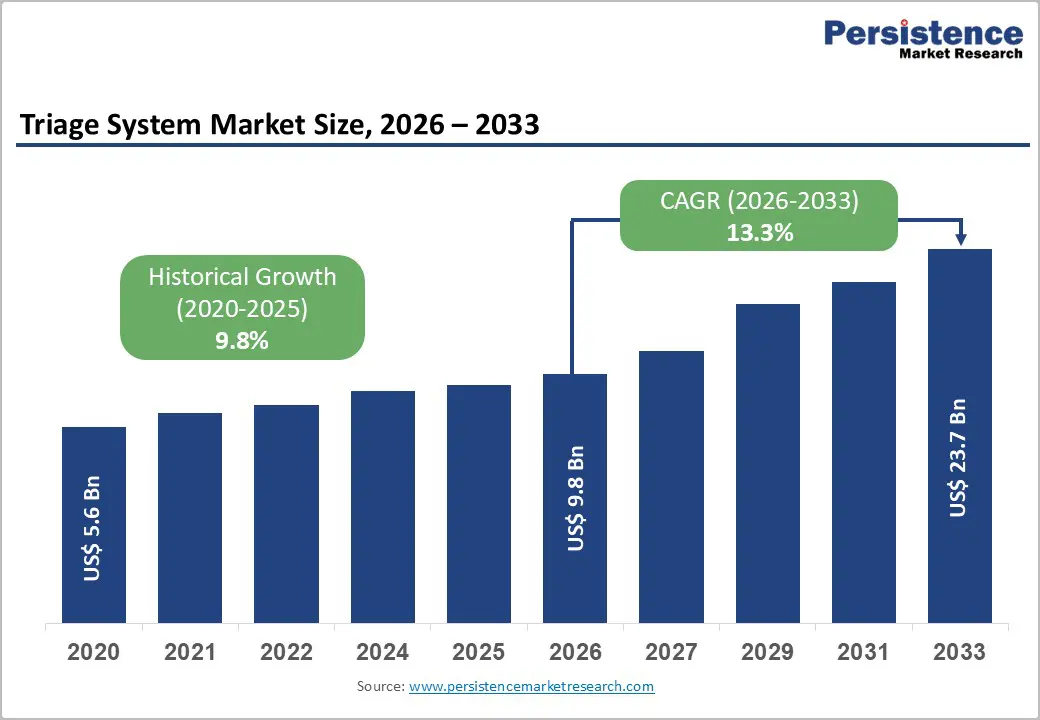
The global triage system market size is expected to be valued at US$ 9.8 billion in 2026 and projected to reach US$ 23.7 billion by 2033, growing at a CAGR of 13.3% between 2026 and 2033.
The global triage system market is being driven by rising patient volumes in emergency departments, increasing demand for operational efficiency, and widespread adoption of digital health technologies. Healthcare organizations worldwide are experiencing unprecedented pressure from aging populations and rising chronic disease prevalence. Electronic triage systems enhance patient prioritization while reducing clinical errors. The integration of artificial intelligence and machine learning algorithms with traditional triage protocols has demonstrated significant improvements in patient risk stratification. According to recent healthcare delivery research, AI-based triage tools have shown an 80% concordance rate with nurse clinical judgment, representing a pivotal development in emergency care management.
Key Market Highlights
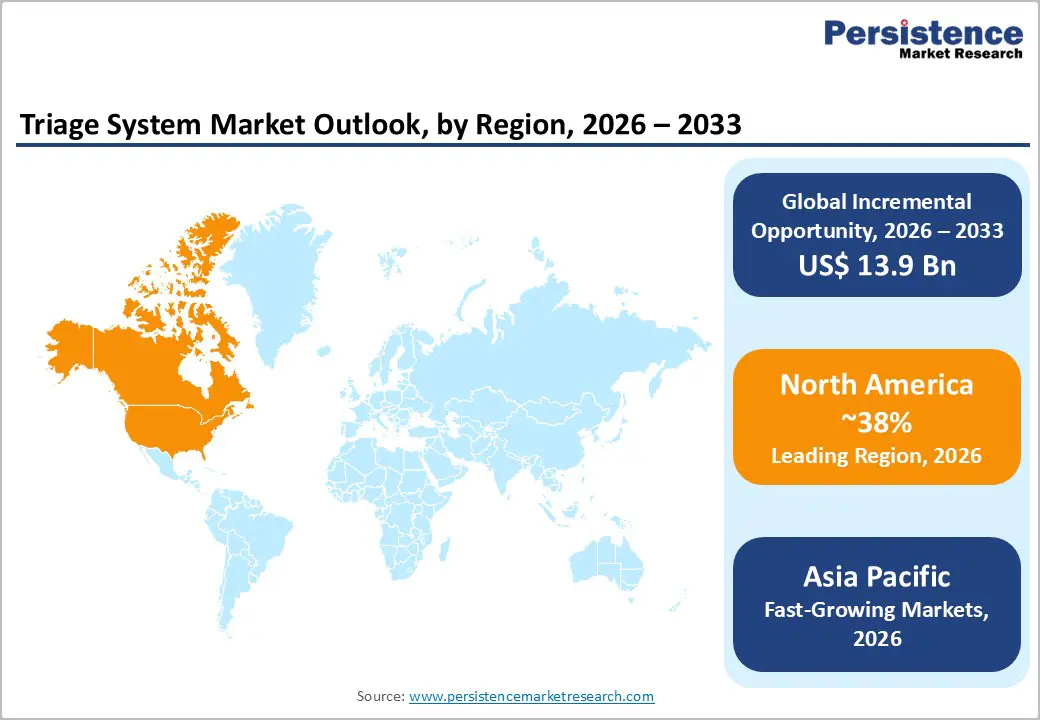
- North America leads the global triage system market with 38% market share in 2025, driven by sophisticated hospital infrastructure, widespread electronic health record adoption, and regulatory support for digital health innovation.
- Asia Pacific represents the fastest-growing regional market, with accelerating adoption of telemedicine platforms, government-mandated digital transformation initiatives, and rising emergency department patient volumes requiring advanced triage capabilities.
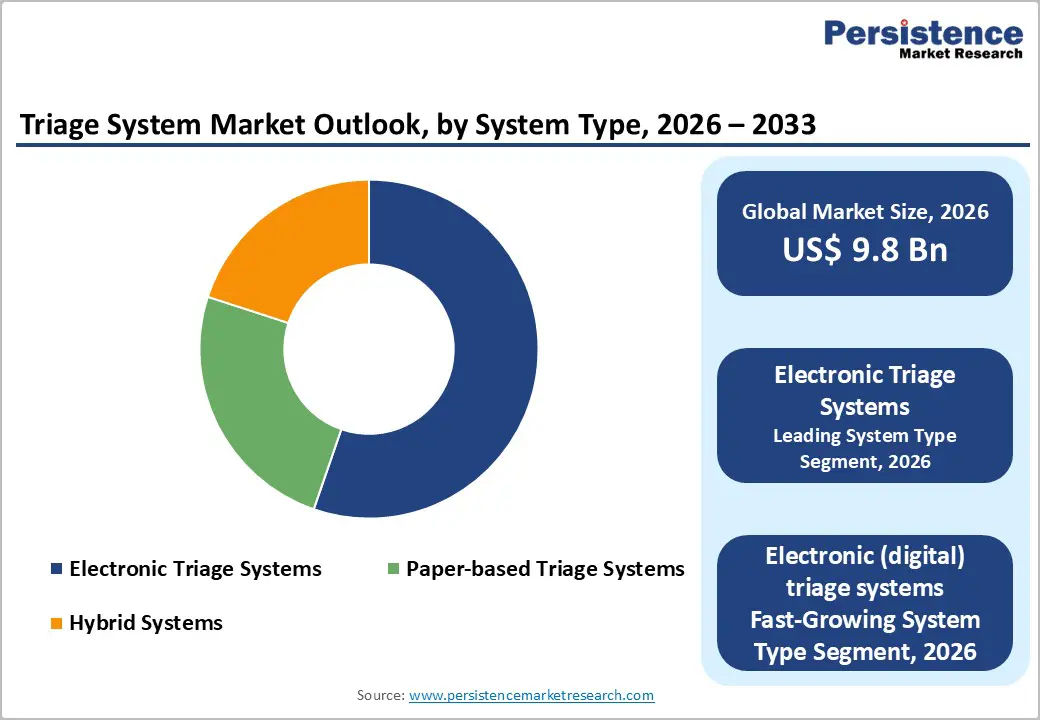
- Electronic Triage Systems dominate the system type category with 47% market share in 2025, reflecting organizational preference for digital solutions offering superior accuracy, real-time data integration, and direct EHR system compatibility.
- AI-powered and predictive analytics-based triage systems emerge as the fastest-growing segment, with projected CAGR of 10.7% through 2035, driven by clinical evidence supporting superior patient risk stratification and improved emergency care outcomes.
| Key Insights | Details |
|---|---|
| Triage System Market Size (2026E) | US$ 9.8 Bn |
| Market Value Forecast (2033F) | US$ 23.7 Bn |
| Projected Growth (CAGR 2026 to 2033) | 13.3% |
| Historical Market Growth (CAGR 2020 to 2025) | 9.8% |
Market Dynamics
Market Growth Drivers
Escalating Emergency Department Patient Volumes and Clinical Demand
Emergency departments across developed and emerging healthcare systems are experiencing unprecedented patient volumes. According to the Australian Institute of Health and Welfare, public hospitals in Australia recorded 8.8 million emergency department presentations in 2023-24, translating to 326 visits per 1,000 population. This surge in patient volume has intensified the need for rapid, accurate patient prioritization systems. Triage systems enable hospitals to systematize patient flow management, ensuring that critical cases receive immediate intervention while efficiently allocating limited clinical resources. The deployment of standardized triage protocols has become essential for maintaining patient safety and care quality amid growing demand. Electronic triage systems provide real-time data analytics that help emergency departments optimize bed utilization and reduce patient wait times by up to 58 minutes, according to outcomes-based research from U.S. healthcare delivery systems. This efficiency gain directly translates to improved patient outcomes and reduced hospital operational costs.
Integration of Advanced Technologies and Clinical Decision Support Systems
The convergence of artificial intelligence, machine learning, and electronic health records has fundamentally transformed triage methodology in emergency care settings. Modern AI-enabled triage tools integrate advanced algorithms with clinical workflows to predict patient risk stratification more accurately than traditional manual approaches. Hospital-based triage systems currently lead the triage type category with 37% market share in 2025, driven by their ability to integrate directly into emergency department workflows and inpatient management systems. Hospitals implementing software-based triage solutions have reported enhanced accuracy in identifying patients requiring immediate emergency intervention. The integration of real-time predictive analytics enables clinicians to identify sepsis, stroke, and other time-sensitive conditions earlier than manual assessment protocols. Cloud-compatible and mobile-based triage platforms have expanded deployment beyond tertiary care centers to community hospitals and regional facilities, democratizing access to advanced triage capabilities across diverse healthcare settings.
Market Restraints
High Implementation and Maintenance Costs Associated with Digital Triage Infrastructure
The initial capital investment required for deploying comprehensive electronic triage systems presents a significant barrier to adoption, particularly in resource-constrained healthcare environments. Implementation costs encompass hardware procurement, software licensing, system integration with existing electronic health record systems, staff training programs, and ongoing technical support. Smaller hospitals and clinics face disproportionate financial burdens when converting from paper-based to digital triage workflows. The complexity of integrating triage systems with existing hospital IT infrastructure, including Cerner, Epic, McKesson, and Siemens platforms, requires specialized technical expertise and extended implementation timelines. Maintenance expenses, cybersecurity upgrades, and periodic system updates represent ongoing operational costs that extend beyond the initial deployment phase. These financial constraints are particularly acute in Latin America, Middle East and Africa, and lower-income regions within Asia Pacific, where healthcare budgets remain limited and competing priorities demand resource allocation.
Data Security, Privacy Concerns, and Regulatory Compliance Challenges
Healthcare organizations implementing digital triage systems face complex regulatory requirements across multiple jurisdictions. The need to comply with HIPAA, GDPR, CCPA, and regional healthcare data protection standards creates substantial operational and technical challenges. Triage systems collect, store, and transmit sensitive patient information including vital signs, medical history, and clinical assessments, requiring robust encryption, access controls, and audit logging mechanisms. Cybersecurity threats targeting healthcare systems have escalated, with potential breaches exposing millions of patient records. Healthcare providers must invest in advanced security infrastructure, including advanced encryption standards, tokenization, and real-time threat monitoring systems. The regulatory landscape continues to evolve, with agencies like the FDA issuing guidance on digital health technologies that introduces additional compliance requirements. These multifaceted security and privacy obligations increase operational complexity and create barriers to rapid digital triage adoption, particularly for resource-constrained healthcare organizations lacking dedicated cybersecurity expertise.
Market Opportunities
Explosive Growth in Telemedicine Platforms and Remote Triage Capabilities
The COVID-19 pandemic catalyzed unprecedented adoption of telemedicine solutions, fundamentally expanding the scope for digital triage applications beyond traditional emergency department environments. Telehealth represents the fastest-growing segment within healthcare IT, with projected growth rates of 22.4% CAGR across Asia Pacific regions. Remote triage capability enables healthcare systems to prioritize patients before they arrive at physical facilities, optimizing emergency resource allocation and reducing crowding. Telemedicine platforms integrating AI-driven diagnostic tools have demonstrated superior accuracy in remote patient assessment. For example, Ping An Good Doctor, a leading Chinese telemedicine provider, leveraged AI algorithms to diagnose chronic conditions with high accuracy, enabling providers to appropriately triage patients for in-person evaluation or direct outpatient management. Indian telemedicine platforms such as Practo reported 500% increase in user registrations during the pandemic, demonstrating the expansive market opportunity for remote triage solutions. Government initiatives across Singapore, Thailand, Australia, and European Union member states are actively promoting telemedicine infrastructure, creating favorable regulatory environments and funding mechanisms for digital triage innovations. Military healthcare and emergency services have begun leveraging remote triage for managing mass casualty events and distributed healthcare delivery across geographically dispersed populations.
Category-wise Insights
System Type Analysis
Electronic Triage Systems represent the leading segment in the system type category, commanding 47% market share in 2025. Electronic systems have achieved market dominance due to their superior accuracy, real-time data integration capabilities, and direct integration with electronic health record platforms used across hospitals globally. The deployment of electronic triage systems has become the standard of care in developed healthcare markets, with hospitals recognizing substantial returns on investment through improved patient outcomes and operational efficiencies. Research comparing electronic triage with traditional manual approaches demonstrated that electronic systems reduced arrival-to-admission decision time by 58 minutes overall and 56 minutes for high-acuity patient groups, representing transformative improvements in emergency department throughput. The adoption of cloud-based electronic triage platforms has enabled smaller hospitals and outpatient facilities to access advanced triage capabilities previously available only at large tertiary care centers. The segment's growth is accelerated by declining technology costs, improving interoperability standards such as FHIR and HL7, and increasing vendor competition driving innovation in user interface design and clinical decision support algorithms.
Application Analysis
Emergency Services and hospital-based acute care represent the primary application domain for triage systems across all regions and market segments. Hospitals prioritize triage system implementation to manage patient flow through emergency departments, optimize clinical resource utilization, and ensure equitable care delivery. The dominance of hospital-based triage reflects the critical importance of rapid patient assessment in acute care settings where clinical decisions directly impact patient survival and morbidity outcomes. Emergency departments utilizing standardized triage protocols experience improved patient safety outcomes, reduced clinical errors, and enhanced provider satisfaction. The integration of emergency severity index scales and other evidence-based triage algorithms into digital platforms has standardized care delivery across diverse healthcare organizations. Military healthcare systems represent an emerging application segment, leveraging triage systems for mass casualty management, field emergency medical services, and distributed battlefield healthcare delivery. Government health agencies are increasingly implementing triage systems to support pandemic preparedness, disaster response, and public health emergency management capabilities.
End User Analysis
Hospitals and Clinics emerge as the dominant end-user category, reflecting the concentration of emergency care services and acute patient assessment needs in inpatient facilities. Large health systems and hospital networks have become early adopters of electronic triage platforms, leveraging these technologies to support integrated care delivery across multiple facilities. The consolidation of healthcare providers into large integrated delivery networks has created economies of scale that favor adoption of enterprise-wide triage system solutions. Government agencies represent a rapidly expanding end-user segment, with national health systems in developed markets mandating triage system implementation to improve emergency response capabilities and standardize care delivery. Nongovernmental organizations operating emergency clinics, humanitarian medical services, and disaster response operations are increasingly adopting simplified triage systems to support patient prioritization in resource-constrained environments. Private healthcare providers and specialty care centers are expanding triage system deployments beyond traditional emergency departments to optimize operations in ambulatory care facilities and urgent care clinics.
Regional Insights
North America Triage System Market Trends and Insights
North America commands 38% market share in 2025, establishing the region as the global market leader in triage system deployment and innovation. The United States healthcare system leads adoption of advanced electronic triage solutions, driven by sophisticated hospital networks, widespread electronic health record adoption, and favorable regulatory frameworks supporting digital health innovation. U.S. healthcare providers implemented the Emergency Severity Index as the standard triage protocol across most emergency departments, creating standardized conditions for digital triage system deployment. Academic medical centers including Mayo Clinic, Cleveland Clinic, and Johns Hopkins Hospital have emerged as innovation leaders, piloting advanced AI-based triage systems and generating clinical evidence supporting technology effectiveness in emergency care settings.
Asia Pacific Triage System Market Trends and Insights
Asia Pacific emerges as the fastest-growing regional market, driven by rapid healthcare infrastructure development, government digital health initiatives, and increasing patient volumes in emergency services. China dominates the Asia Pacific healthcare IT market with 40.6% revenue share in 2024, implementing large-scale smart hospital programs targeting 1,000 public hospitals for digital transformation by 2025. Tsinghua University launched Agent Hospital, the world's first fully AI-powered virtual hospital, demonstrating regional innovation leadership in healthcare technology. India's healthcare technology sector exhibits exceptional growth momentum, with the medical equipment industry projected to reach US$ 50 billion by 2030. Indian telemedicine platforms and healthcare providers are rapidly deploying electronic triage systems to manage surging patient volumes in urban centers like Delhi, Mumbai, and Bangalore.
Competitive Landscape
Market Structure Analysis
The competitive landscape of the global triage system market is dynamic and rapidly evolving. Established companies compete intensely to expand their solution portfolios, often leveraging strategic partnerships, acquisitions, and advanced technology development to gain an edge. Competition is driven by innovation in digital and AI?enabled triage tools, seamless integration with existing healthcare systems, and enhanced interoperability. Larger players benefit from broad market reach and brand recognition, while smaller and niche vendors differentiate through agile, specialized offerings and targeted solutions for specific healthcare needs.
Key Market Developments
- In December 2025, A2z Radiology raised $4.5 million in a seed round to accelerate the commercial deployment of the company’s triage system for abdominal and pelvic CT, as well as to continue R&D toward expanding its imaging capabilities.
Companies Covered in Triage System Market
- Vocera Communications
- HGS
- eConsult
- Nihon Kohden
- Infermedica
- EiT Health
- Allm Inc.
- TriageLogic
- Asymmetrik
- Conduent
Frequently Asked Questions
The global triage system market is expected to be valued at US$ 9.8 billion in 2026.
The primary demand drivers include escalating emergency department patient volumes driven by aging populations and rising chronic disease prevalence, widespread adoption of digital health technologies and electronic health record systems, integration of artificial intelligence and predictive analytics for improved patient risk stratification, government initiatives promoting healthcare digitization, and increasing emphasis on patient safety and care quality standardization. AI-based triage tools have demonstrated 80% concordance with nurse clinical judgment, driving organizational investment in advanced triage platforms.
North America currently leads the global triage system market with 38% market share in 2025. The region's dominance is supported by sophisticated hospital infrastructure, widespread electronic health record adoption, favorable regulatory frameworks from the FDA and Office of the National Coordinator for Health IT, and significant investments in healthcare innovation by leading academic medical centers and health systems.
Key market opportunities include rapid expansion of telemedicine platforms with remote triage capabilities, advancement of artificial intelligence and predictive analytics technologies for enhanced patient risk stratification, integration of Internet of Things sensors and wearable devices for continuous patient monitoring, military and disaster response applications requiring mass casualty management, and expanding deployment in Asia Pacific regions.
Leading market participants include Philips Healthcare, Siemens Healthineers, Cerner Corporation, Epic Systems Corporation, eClinicalWorks, McKesson Corporation, GE Healthcare, Meditech, Allscripts Healthcare Solutions, TeleTracking Technologies, HGS Healthcare, and TriageLogic.


