




- Medical Devices
- Thyroid Function Test Market
Thyroid Function Test Market Size, Share, and Growth Forecast 2026 - 2033
Thyroid Function Test Market by Test Type (TSH, T3, T4, FT3, FT4), by Technology (Immunoassays, Chemiluminescence Immunoassay, Radioimmunoassay, Enzyme-Linked Immunosorbent Assay), by End User (Hospitals, Diagnostic Laboratories, Clinics, Research Institutes), by Regional Analysis, 2026-2033

Thyroid Function Test Market Size and Trend Analysis
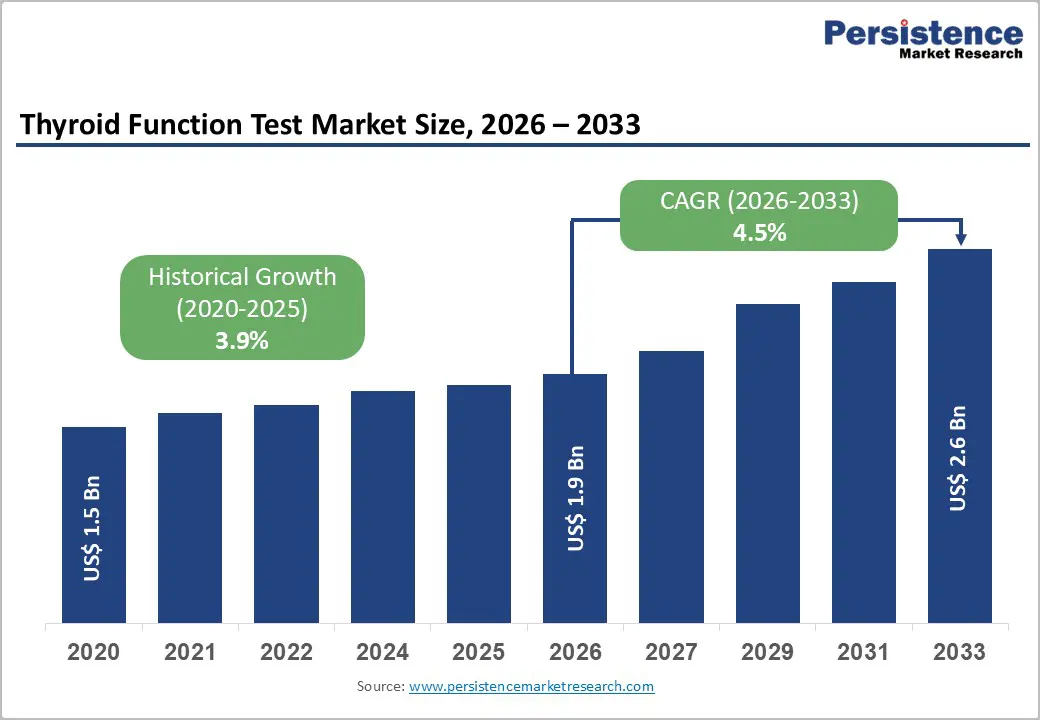
The global Thyroid Function Test (TFT) market is expected to be valued at US$ 1.9 billion in 2026 and projected to reach US$ 2.6 billion by 2033, growing at a CAGR of 4.5% between 2026 and 2033.
The market’s expansion is primarily driven by the escalating prevalence of thyroid disorders worldwide, combined with advancements in diagnostic technologies. Increasing awareness about thyroid health, coupled with government-mandated newborn screening programs for congenital hypothyroidism, significantly boosts demand for thyroid function tests across developed and emerging economies. Additionally, the rising geriatric population and lifestyle-related thyroid dysfunction cases create sustained demand for accurate diagnostic solutions in hospitals, diagnostic laboratories, and clinics globally.
Key Market Highlights
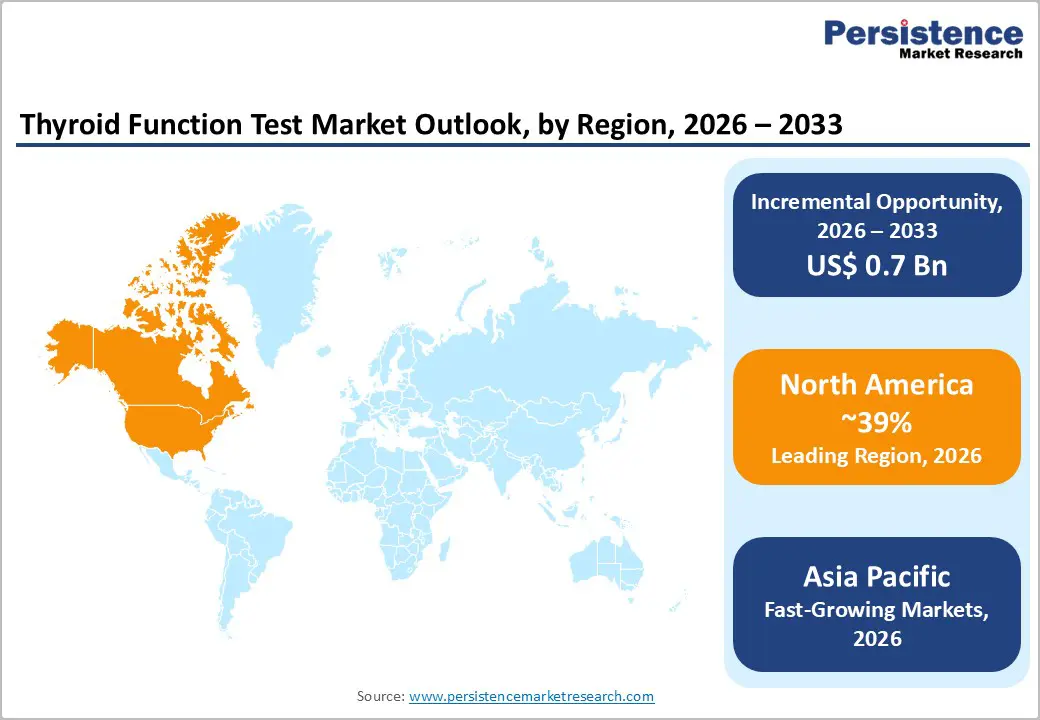
- North America leads the global thyroid function test market, supported by advanced diagnostic infrastructure, comprehensive insurance coverage, and strong regulatory support, holding a 39% market share in 2025.
- Asia Pacific is the fastest-growing region through 2032, driven by population growth, rising thyroid disorder prevalence (10–11% in India and China), government newborn screening programs, and urbanization-related lifestyle disorders.
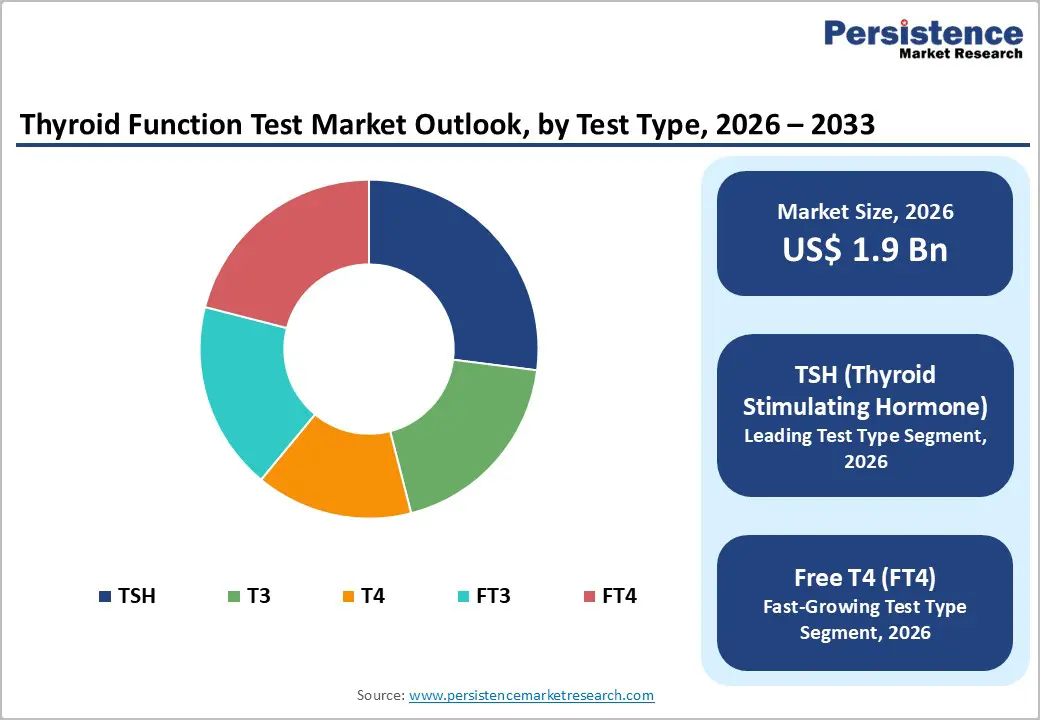
- TSH testing dominates as the leading segment, recognized as the gold-standard first-line thyroid marker and widely integrated into routine and newborn screenings.
- Free T4 (FT4) testing is the fastest-growing segment (CAGR 5.2–5.8%), fueled by autoimmune thyroid disease awareness, dual-panel testing, and telemedicine monitoring.
- Expansion of newborn and NCD screening programs in emerging markets enables large-scale analyzer deployment, creating immediate revenue opportunities for diagnostics companies.
| Global Market Attributes | Key Insights |
|---|---|
| Thyroid Function Test Market Size (2026E) | US$ 1.9 billion |
| Market Value Forecast (2033F) | US$ 2.6 billion |
| Projected Growth CAGR(2026-2033) | 4.5% |
| Historical Market Growth (2020-2025) | 3.9% |
Market Dynamics
Market Growth Drivers
Rising Burden of Thyroid Disorders and Autoimmune Thyroid Diseases
The global prevalence of thyroid disorders has reached epidemic proportions, with approximately 20 million Americans affected by some form of thyroid disease, according to the Centers for Disease Control and Prevention. Hashimoto’s thyroiditis, the most common autoimmune thyroid disease, affects 4.8% to 25.8% in women and 0.9% to 7.9% in men globally, depending on geographic location and iodine status. Thyroid cancer remains the 10th most common cancer worldwide, with 586,202 cases reported in 2020, and incidence rates are projected to increase by 29.9% by 2040. This escalating disease burden necessitates comprehensive thyroid screening, diagnosis, and monitoring, directly driving demand for TSH tests, free T4, free T3, and anti-TPO antibody tests. Healthcare systems increasingly prioritize early detection of thyroid dysfunction to prevent complications such as cardiovascular disease, infertility, and cognitive impairment, particularly in pregnant women and geriatric populations. The diagnostic emphasis on comprehensive thyroid panels over single-marker testing further accelerates market volume and revenue growth globally.
Technological Advancements in Immunoassay Platforms and High-Sensitivity Assays
Modern chemiluminescence immunoassay (CLIA) and electrochemiluminescence (ECLIA) technologies have revolutionized thyroid diagnostics by enabling detection of thyroid-stimulating hormone (TSH) levels below 0.02 mIU/L, facilitating confident diagnosis of subclinical thyroid disorders. Third-generation TSH assays demonstrate superior analytical sensitivity and wider dynamic range compared to radioimmunoassay and traditional ELISA methods, with some platforms achieving zeptomole-level detection (10^-21 mol). Automated diagnostic platforms from Abbott Laboratories, Roche Diagnostics, Siemens Healthineers, and Danaher Corporation now integrate artificial intelligence-assisted interpretation, reducing turnaround time to 30-40 minutes while improving diagnostic accuracy. Innovations in point-of-care testing devices and home-based dried blood spot sampling coupled with telemedicine platforms expand accessibility beyond traditional laboratory settings, enabling patient self-monitoring and remote consultation with healthcare providers. These technological leaps enhance clinical utility, reduce pre-analytical variability, and support real-time monitoring of thyroid hormone levels, compelling laboratories and hospitals to upgrade equipment and adopt integrated diagnostic solutions.
Market Restraints
Biotin Interference and Assay Standardization Challenges
The U.S. Food and Drug Administration (FDA) has issued multiple safety communications warning that biotin, a vitamin B7 commonly found in dietary supplements, significantly interferes with certain immunoassay platforms, causing falsely elevated or depressed thyroid hormone measurements. Studies demonstrate that consuming 10 mg of biotin daily for 7 days produces detectable interference in Roche cobas e602 and Beckman UniCel DxI 800 systems for up to 1-2 days after cessation, leading to potential misdiagnosis of hyperthyroidism or hypothyroidism. The Abbott Architect 2000 platform shows less susceptibility, creating inconsistencies across laboratory networks. Standardization variability between manufacturers regarding reference intervals, calibration curves, and quality control protocols complicates multi-laboratory testing algorithms. These technical limitations require healthcare providers to implement patient education protocols on biotin discontinuation and coordinate testing across platforms, increasing operational complexity and delaying diagnostic confirmation.
Reimbursement Limitations and High Costs in Emerging Markets
Insurance companies in developing nations remain reluctant to reimburse routine TSH screening tests, particularly for asymptomatic populations, citing cost-effectiveness concerns. Genetic testing for thyroid-associated conditions carries costs ranging from US$ 300 to US$ 3,000 per test, limiting accessibility in regions with limited healthcare budgets. Rural healthcare centers in Asia Pacific and Latin America lack infrastructure for automated analyzer deployment, necessitating sample shipment to centralized laboratories and extending turnaround time to 7-14 days. These barriers delay early detection of congenital hypothyroidism, autoimmune thyroid disease, and thyroid cancer, perpetuating undiagnosed populations and constraining market expansion in price-sensitive regions.
Market Opportunities
Expansion of Newborn Screening Programs and Government-Backed Initiatives
Global health organizations, including the World Health Organization (WHO) and the International Atomic Energy Agency (IAEA), actively promote universal newborn screening for congenital hypothyroidism, with numerous countries recently implementing or expanding programs. The Union Health Ministry of India rolled out an Intensified Special NCD Screening Drive in February 2025 targeting individuals aged 30 and above, incorporating thyroid function tests to address non-communicable diseases. Governments in Thailand, Sri Lanka, and other Southeast Asian nations are establishing centralized newborn screening laboratories with standardized TSH testing protocols, unlocking predictable high-volume demand. These initiatives guarantee recurring testing cycles across large populations, create sustainable revenue streams for diagnostics companies, and drive adoption of high-throughput automated analyzers. Public-private partnerships between government health agencies and diagnostic service providers accelerate laboratory infrastructure development, creating immediate opportunities for Danaher, Abbott, Roche, and Siemens Healthineers to supply analyzers and reagents at scale.
Fastest-Growing Segment: Free T4 (FT4) Testing and Autoimmune Thyroid Diagnostics
Free T4 (FT4) testing emerges as the fastest-growing segment, with projected CAGR of 5.2% to 5.8% through 2032, driven by increasing recognition of autoimmune thyroid diseases such as Graves’ disease and Hashimoto’s thyroiditis. Healthcare providers increasingly employ dual-thyroid function panels combining TSH and FT4 measurements to identify non-classical thyroid dysfunctions missed by TSH screening alone, particularly in populations with central hypothyroidism or thyroid hormone replacement therapy monitoring. DiaSorin launched the LIAISON® TSH-R Ab assay in September 2025 to improve Graves’ disease diagnosis through thyroid receptor antibody detection, representing innovative solutions addressing underdiagnosed autoimmune conditions. The expansion of anti-TPO antibody and anti-thyroglobulin (anti-Tg) antibody testing creates additional revenue pockets, as these markers identify patients at risk for thyroid autoimmunity and progression to overt dysfunction. Telemedicine integration with at-home thyroid testing kits enables continuous monitoring of thyroid patients on hormone replacement therapy, supporting dose optimization and reducing clinic visits, thereby expanding the addressable patient population beyond symptomatic individuals to include preventive health-conscious consumers.
Category-wise Insights
Test Type Analysis
Thyroid Stimulating Hormone (TSH) Test: Leading Segment with 27% Market Share
The TSH (Thyroid Stimulating Hormone) test dominates the thyroid function test market, commanding approximately 27% market share in 2025, making it the gold standard first-line screening measure for thyroid dysfunction globally. TSH’s primacy is justified by clinical guidelines from the American Thyroid Association, European Thyroid Association, and endocrinology societies worldwide, which position TSH as the most sensitive biomarker for detecting primary hypothyroidism and hyperthyroidism. The test’s exceptional sensitivity enables detection of subclinical thyroid imbalance before symptomatic presentation, allowing timely intervention and prevention of complications. TSH testing is cost-effective, easy to perform, and widely accessible across urban and rural healthcare settings, making it suitable for population-based screening programs. Additionally, TSH serves as an essential monitoring tool for patients on levothyroxine replacement therapy, with clinicians using TSH values to titrate medication doses and achieve therapeutic targets. The test’s integration into routine health checkups, newborn screening protocols, and geriatric assessment algorithms ensures sustained volume demand, supporting its market leadership position.
Technology Analysis
Chemiluminescence Immunoassay (CLIA): Leading Technology with 52% Market Share
Chemiluminescence Immunoassay (CLIA) technology commands approximately 52% market share in 2025, establishing itself as the preferred diagnostic platform in hospital laboratories, diagnostic centers, and reference laboratories worldwide. CLIA’s superiority stems from its exceptional analytical sensitivity (detection limits below zeptomole concentrations), wide dynamic range enabling measurement of both low and elevated hormone concentrations without sample dilution, and rapid turnaround time of 30-40 minutes on automated platforms. Major diagnostic companies including Abbott Laboratories (Architect series), Roche Diagnostics (cobas platform), and Siemens Healthineers (Atellica system) have standardized on CLIA technology, creating a robust ecosystem of reagents, calibrators, and quality control materials. The technology’s compatibility with automated laboratory workflows, reduced incubation time compared to radioimmunoassay, and superior precision characteristics make it ideal for high-throughput testing in busy hospital environments. Ongoing innovations in signal amplification chemistry and automated calibration protocols continue to enhance analytical performance, ensuring CLIA’s sustained dominance despite competition from point-of-care testing alternatives.
End-User Analysis
Hospitals: Leading End-User with 39% Market Share
Hospitals remain the dominant end-user segment, accounting for 39% of the global thyroid function test market share in 2025, driven by their central role in diagnosing and managing thyroid disorders across diverse patient populations. Hospital laboratories process high volumes of thyroid function tests as part of routine diagnostic protocols, health checkups, inpatient screening, and endocrinology consultations. The adoption of automated diagnostic platforms from Siemens Healthineers, Abbott, and Roche in hospital laboratories enables efficient processing of thousands of samples daily while maintaining clinical accuracy. Hospital endocrinologists and laboratory medicine specialists collaborate to standardize testing algorithms, implement reflex testing protocols for abnormal results, and integrate thyroid diagnostics with electronic health records, ensuring optimal patient outcomes. Growing hospital infrastructure in developing regions of Asia Pacific and Latin America, coupled with increasing patient volumes from thyroid disorders, further strengthens hospital-based diagnostic testing. Hospitals also play a critical role in managing complicated thyroid cases requiring specialist consultation, imaging correlation, and multidisciplinary care coordination.
Regional Insights
North America Thyroid Function Test Market Trends
North America commands 39% of the global thyroid function test market share in 2025, maintaining regional leadership through advanced healthcare infrastructure, high diagnostic test utilization, and robust reimbursement frameworks. The United States, as the largest individual market, benefits from widespread awareness of thyroid disorders, supported by advocacy organizations like the American Thyroid Association, which promote routine screening in primary care settings. Regulatory support from the FDA through streamlined 510(k) clearance pathways for novel thyroid assays and analyzers accelerates innovation adoption in North American laboratories. The region’s mature diagnostics market features integrated laboratory networks operated by companies like Quest Diagnostics and Laboratory Corporation of America, which process millions of thyroid tests annually and drive adoption of high-sensitivity third-generation assays. Medicare and private insurance reimbursement for TSH screening in senior populations and pregnant women ensures consistent demand, while newborn screening programs mandated by state public health agencies create baseline testing volumes. The emergence of consumer-initiated testing platforms paired with telehealth consultations (such as at-home dried blood spot sampling with provider follow-up) represents an innovative care delivery model gaining traction in North America, expanding the addressable market beyond traditional hospital and laboratory settings.
Asia Pacific Thyroid Function Test Market Trends
The Asia Pacific thyroid function test (TFT) market is witnessing rapid expansion, driven by rising thyroid disorder prevalence, increasing health awareness, and improving healthcare infrastructure across emerging economies such as India, China, and Southeast Asia. Growing adoption of routine diagnostic screenings, particularly in urban areas, is fueling demand for TSH, T3, T4, FT3, and FT4 tests. Technological advancements in automated immunoassay systems and cost-effective point-of-care devices are making thyroid testing more accessible to a broader population. Additionally, government initiatives promoting early detection of endocrine disorders and increasing insurance coverage are supporting market growth. Rising incidences of hypothyroidism and hyperthyroidism, combined with the trend of preventive healthcare, are encouraging hospitals, diagnostic centers, and clinics to expand TFT offerings. The market is projected to maintain a strong CAGR as both public and private sectors prioritize thyroid health awareness and diagnostics.
Competitive Landscape
Market Structure Analysis
The thyroid function test (TFT) market features intense competition among global and regional diagnostics firms striving to expand their footprint. Major players like Roche, Abbott, Siemens Healthineers, and Beckman Coulter lead with advanced immunoassay platforms, robust R&D pipelines, and extensive distribution networks. Smaller and regional companies focus on niche segments, cost?effective solutions, and localized customer support to gain market share. Competitive strategies include product innovation, partnerships with healthcare providers, and competitive pricing to attract hospitals and diagnostic labs. Continuous upgrades in assay sensitivity and workflow automation further differentiate offerings, compelling rivals to invest in technology enhancements and strategic alliances to sustain growth.
Key Market Developments
- In January 2026, Orange Health Labs announced the launch of Orange One, a health management product that departed from the traditional pay-per-test model commonly used in the diagnostics industry. Under Orange One, customers received a comprehensive full-body check-up covering over 114 blood markers. These included parameters such as Apo A1 and Apo B, Troponin I for cardiac risk assessment, HOMA-IR to evaluate insulin resistance, and an expanded profile of hormones and vitamins. The offering aimed to provide a more holistic and convenient approach to preventive healthcare, moving beyond the limitations of individual tests.
Companies Covered in Thyroid Function Test Market
- Danaher Corporation
- DiaSorin
- F.Hoffmann-La Roche AG
- Merck KGaA
- Biomerieux
- Abbott Laboratories
- ThermoFisher Scientific
- Qualigen Inc.
- KRONUS
- Diagnostic Automation/Cortez Diagnostics Inc.
Frequently Asked Questions
The global thyroid function test market is projected to reach US$ 1.9 billion in 2026.
Patients and physicians are emphasizing early detection through regular health checkups, driving demand for comprehensive thyroid panels.
North America is expected to maintain market leadership with 39% market share in 2025, supported by advanced diagnostic infrastructure, comprehensive reimbursement coverage, strong regulatory support from the FDA, and high diagnostic test utilization in both primary care and specialist settings across the United States and Canada.
Newborn screening program expansion and government-backed non-communicable disease screening initiatives, particularly in Asia Pacific and Latin America, represent the highest growth potential, as demonstrated by India’s February 2025 Intensified Special NCD Screening Drive, creating demand for automated analyzers and high-throughput testing center infrastructure.
Leading market players include Abbott Laboratories, Roche Diagnostics, Siemens Healthineers, Danaher Corporation, DiaSorin SpA, Thermo Fisher Scientific, Merck KGaA, Bio-Rad Laboratories, Ortho Clinical Diagnostics, and Biomerieux.


