




- Specialty & Fine Chemicals
- Talc Market
Talc Market Size, Share, and Growth Forecast, 2026 - 2033
Talc Market by Product Type (Talc Carbonate, Talc Chlorite, Others), Application (Plastics, Cosmetics & Personal Care, Paint & Coatings, Paper & Pulp, Ceramics, Others), and Regional Analysis for 2026 - 2033

Talc Market Share and Trends Analysis
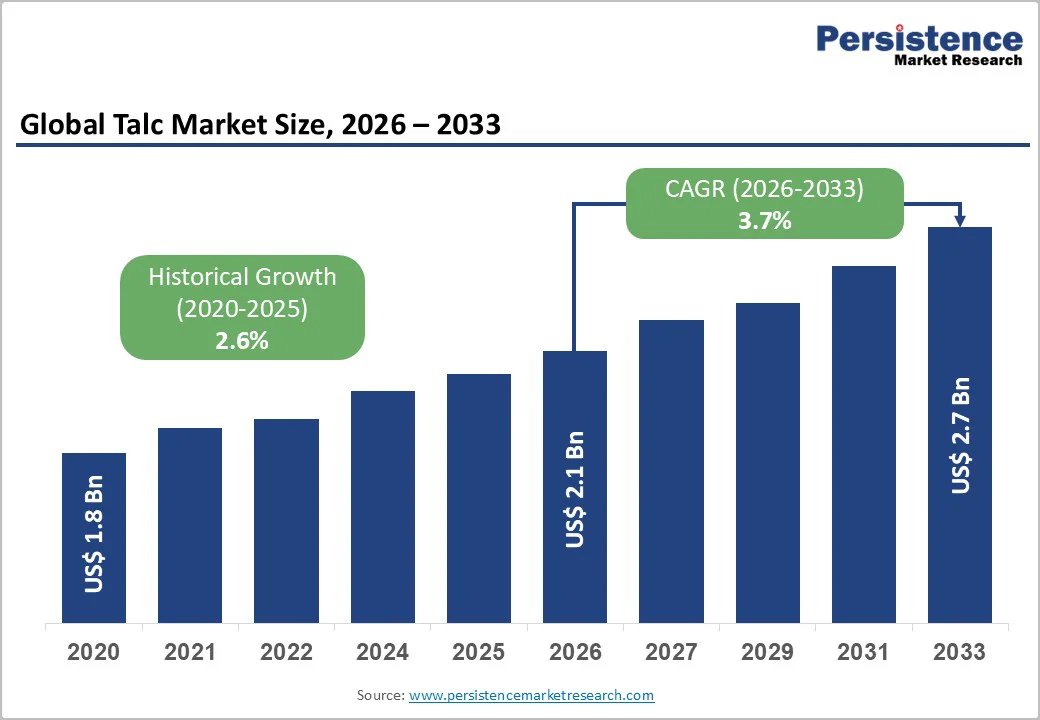
The global talc market size is likely to be valued at US$ 2.1 billion in 2026, and is projected to reach US$ 2.7 billion by 2033, growing at a CAGR of 3.7 % during the forecast period 2026-2033. This growth is underpinned by a rising demand for talc as a performance-enhancing filler in plastics, increasing use in cosmetics and personal care products, and expansion in the paint & coatings and paper industries.
The shift toward lightweight materials, especially in automotive components, and stricter regulatory standards for purity are also driving manufacturers to invest in higher-grade, ultrafine talc.
Key Industry Highlights
- Regional Leadership: Asia Pacific is poised to lead the market in 2026, supported by strong manufacturing capacity and growing industrial demand for specialty chemicals.
- Leading Product Type: Talc carbonate is set to dominate in 2026 due to its widespread use in plastics, ceramics, coatings, and paper.
- Dominant Application: Plastics are likely to dominate the market in 2026, driven by the extensive use of talc in polypropylene (PP) and other polymers for automotive components, packaging, and consumer goods.
- Fastest-growing Application: Cosmetics & personal care applications are expected to grow the fastest through 2033, driven by rising demand for mineral-based powders, high-purity talc, and safe, asbestos-free formulations.
| Key Insights | Details |
|---|---|
|
Talc Market Size (2026E) |
US$2.1 Bn |
|
Market Value Forecast (2033F) |
US$2.7 Bn |
|
Projected Growth (CAGR 2026 to 2033) |
3.7 % |
|
Historical Market Growth (CAGR 2020 to 2024) |
2.6 % |
Market Factors - Growth, Barriers, and Opportunity Analysis
Growing Demand for Lightweight Materials and Industrial Applications in Plastics and Automotive
Talc is widely used as a reinforcing filler in PP and other polymers to enhance stiffness, dimensional stability, and impact resistance, making it critical for lightweight automotive components and industrial applications. The push for fuel-efficient vehicles, including electric vehicles (EVs), along with advancements in polymer processing technologies, has increased talc demand in plastics. This trend not only boosts volume consumption but also drives the development of high-aspect-ratio, premium-grade talc tailored for specific polymer applications. As a result, manufacturers can accrue higher margins and strengthen their position in industrial and automotive supply chains.
Talc’s softness, smooth texture, and oil absorption make it essential for cosmetics, body powders, blushes, and other personal care products. Rising disposable incomes and growing demand for mineral-based, natural beauty products in emerging markets are fueling consumption. Rapid industrialization and urbanization in the Asia Pacific are driving talc use in ceramics, coatings, plastics, and paper. This combination of cosmetic and industrial demand encourages investment in ultra-purified, low-impurity talc grades, strengthening quality control, regulatory compliance, and vendor positioning, while ensuring stable, and high-value market growth over the forecast period.
Asbestos Contamination to Emerge as a Compliance and Liability Burden
The natural tendency of talc to contain asbestos contamination has created a complex regulatory landscape that disproportionately affects the industry's profitability and operational resilience. Stringent safety mandates, particularly in cosmetics, pharmaceuticals, and food applications, impose substantial testing, certification, and compliance burdens that escalate operational costs while simultaneously exposing producers to significant legal and reputational liability. This regulatory tightening reflects legitimate health concerns but creates a dual pressure: manufacturers must invest heavily in advanced purification and quality assurance infrastructure, while simultaneously managing existential litigation risks that can undermine financial performance and investor confidence.
Other than the regulatory hurdle, talc extraction incurs mounting environmental and operational liabilities that further compress already-thin profit margins. Mining activities disrupt ecosystems, generate substantial waste streams, and often trigger local community opposition, forcing producers to invest in remediation and stakeholder engagement initiatives. Compounded by raw material cost volatility and supply chain rigidity, these multifaceted pressures incentivize a shift toward more rigorous quality control and sustainable mining practices, which are investments that are strategically necessary but divert capital from growth initiatives and further pressure near-term profitability, creating a challenging trade-off between long-term risk mitigation and short-term financial performance.
High-Purity and Asbestos-Free Talc for Regulated Sectors
Market dynamics are shifting decisively toward ultrafine, asbestos-free talc formulations, driven by stringent regulatory mandates and heightened consumer safety consciousness across cosmetics, pharmaceuticals, and food sectors. Advanced purification technologies, including ore-sorting and multi-stage refining systems, now enable manufacturers to achieve the purity standards demanded by regulated industries, causing a structural market bifurcation. If even a quarter of the global talc demand migrates toward high-purity grades, the addressable market expands by hundreds of millions of dollars annually, rewarding early-mover producers with premium pricing power, enhanced product differentiation, and durable customer relationships.
The thermal stability and crystallization characteristics of talc can also unlock high-margin opportunities in biodegradable polymers, polymer nanocomposites, and advanced materials. At the same time, Asia Pacific and Latin America's rapid industrialization, urbanization, and rising per capita consumption are driving robust demand for ceramics, coatings, and personal care products, opening up a geographic expansion frontier for strategically positioned producers. Targeted investments in localized mining infrastructure, processing facilities, or regional partnerships position early entrants to capture disproportionate growth, achieve cost advantages through proximity to end-markets, and establish long-term competitive moats, while also aligning with eco-friendly innovation trends and sustainable material paradigms reshaping global supply chains.
Category-wise Analysis
Product Type Insights
Talc carbonate is expected to maintain overwhelming market dominance, backed by its exceptional mechanical properties, superior thermal stability, and versatility across plastics, coatings, ceramics, and paper applications. Its proven performance in demanding automotive-grade composites, industrial filler systems, and high-volume packaging solutions has established it as the de facto standard for large-scale manufacturing operations, creating powerful network effects and customer lock-in through supply chain integration and established qualification processes. This incumbent advantage creates limited margins for substitution, making talc carbonate a mature but stable revenue base.
Talc chlorite is projected to expand the fastest at around 4.9% CAGR through 2033, outpacing the global market. This accelerated growth trajectory is driven by emerging niche applications requiring specialized thermal and electrical properties, advanced insulation systems, and ultra-high-purity formulations that conventional talc carbonate cannot efficiently deliver. Recent technological breakthroughs in ore-sorting and multi-stage purification have dramatically reduced extraction costs and improved economic viability, enabling chlorite talc producers to economically serve tailored, performance-centric applications across aerospace, electronics, energy storage, and advanced materials sectors. This can manufacture a strategic opportunity for agile producers to capture premium valuations through technology differentiation and market specialization, while also signaling a gradual erosion of talc carbonate's monopolistic pricing power in high-performance end-markets.
Application Insights
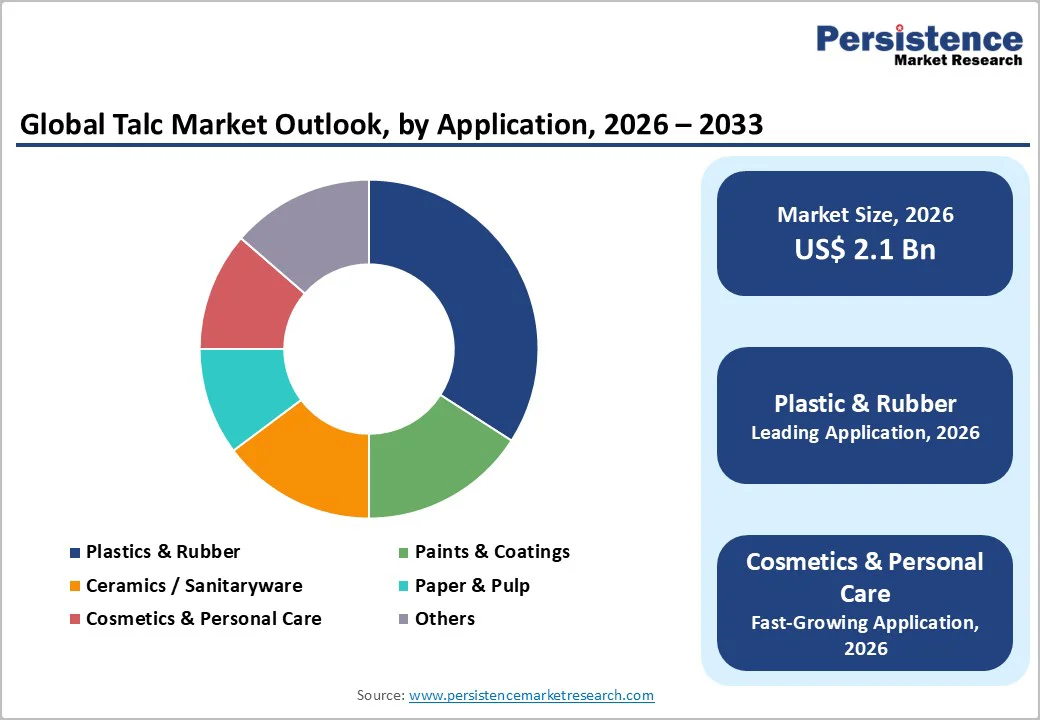
The plastics segment is forecasted to command leadership with over 30% of the talc market revenue share in 2026. Talc's functional superiority in enhancing stiffness, dimensional stability, and enabling lightweighting has made it indispensable across automotive interiors, consumer packaging, and high-volume polymer applications where performance-to-cost ratios are mission-critical. The accelerating transition to EV production and ongoing polymer innovation cycles have created reinforcing tailwinds, ensuring this segment remains a resilient revenue pillar while simultaneously enabling scale economies that benefit entrenched incumbents.
Cosmetics and personal care applications are set to expand at an estimated 5.5% CAGR between 2026 and 2033, signaling a structural shift toward higher-margin, innovation-intensive applications. This acceleration is propelled by the clean beauty trend, which has catalyzed explosive demand for mineral-based powders, premium foundations, and talc-based body formulations that emphasize safety, transparency, and asbestos-free formulations. The convergence of strict regulatory mandates, affluent consumer willingness to pay premiums for clean-label cosmetics, and limited supply of ultrafine, pharmaceutical-grade talc has created a favorable pricing environment. This has also incentivized strategic capital reallocation toward high-purity production, driving portfolio optimization and margin expansion for vertically integrated players.
Regional Insights
North America Talc Market Trends
The North America talc market is mature and heavily regulated, led by the U.S., driven primarily by demand for plastics from automotive & packaging, cosmetics, and specialty industrial applications. Regional market growth is stable but moderate due to stringent regulatory oversight, including asbestos-related quality standards, safety compliance, and ongoing litigation risks. These regulations limit volume growth in consumer-grade talc while encouraging adoption of high-purity, certified talc in pharmaceuticals, food, and personal care.
Major players such as Imerys, Mondo Minerals, and Minerals Technologies dominate, leveraging strong compliance credibility and advanced quality control. Innovation-led growth, including the production of asbestos-free talc and sustainable mining practices, supports value expansion despite regulatory constraints. Investment trends include modernization of purification technology, environmentally friendly mining, and strategic partnerships to serve high-value markets.
Europe Talc Market Trends
The talc market landscape in Europe is shaped by Germany, U.K., France, and Spain, supported by a strong industrial base in automotive, coatings, and ceramics. Regulatory harmonization under REACH and other safety frameworks ensures demand for certified, low-impurity talc, driving product innovation and differentiation. Talc in Europe is increasingly used in high-end coatings, specialty ceramics, and personal care products, emphasizing quality over volume. European players prioritize traceability and adherence to safety standards, resulting in high-value premium talc consumption.
The regional market is also finding support from construction, automotive, and consumer safety-driven cosmetic applications. Large European players are also know to maintain quality credentials to serve regulated markets, creating competitive barriers for smaller entrants. The Europe market emphasizes innovation, regulatory compliance, and premium-grade talc adoption to sustain growth.
Asia Pacific Talc Market Trends
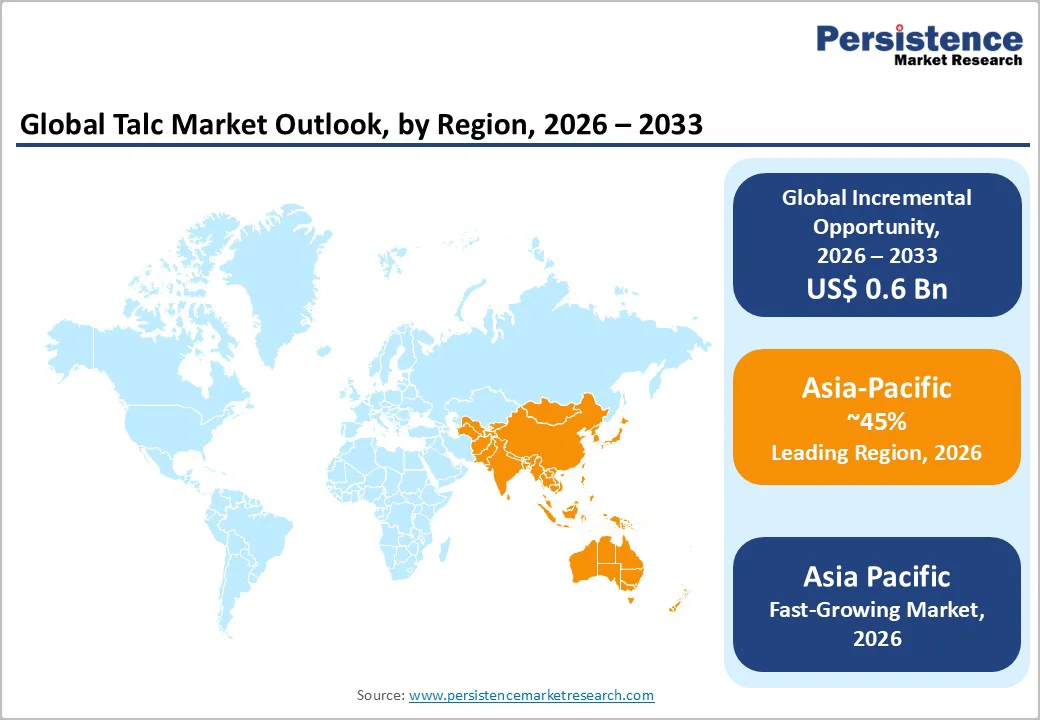
Asia Pacific is slated to be the largest and fastest-growing market, holding over 45% of the talc market share in 2026. Growth is driven by rapid industrialization, urbanization, and expansion in plastics, ceramics, coatings, and automotive manufacturing. China and India are key contributors due to large-scale production, low-cost mining, and proximity to major consuming industries. Rising infrastructure investment, automotive manufacturing, and a growing middle class are fueling demand for both industrial and personal care applications. The region benefits from cost-competitive operations and efficient supply chains, enabling local and international players to scale production and meet regional demand.
The fastest-growing opportunity in Asia Pacific lies in ultrafine, high-purity talc for cosmetics, pharmaceuticals, and specialty polymers. Regulatory oversight is increasing but remains fragmented, providing advantages to local producers. Investment opportunities include capacity expansion, development of specialized talc grades, and integration with polymer and ceramics value chains. Risks include environmental concerns, community opposition, and rising compliance costs.
Competitive Landscape
The global talc market landscape is led by major producers such as Imerys, Mondo Minerals, Minerals Technologies, Golcha Group, LKAB Minerals, Rio Tinto, and Luzenac. These companies leverage large-scale mining and processing capacities, strong R&D capabilities, and extensive global distribution networks. They excel in product quality, regulatory compliance, and long-term supply agreements with key end-use industries including plastics, cosmetics, ceramics, coatings, and paper.
Capacity expansions in the Asia Pacific and North America support the growing demand for high-purity, asbestos-free talc, while innovation in ultrafine grades, surface-treated talc, and eco-friendly processing strengthens market positioning.
Regional producers in China, India, Southeast Asia, and Latin America are rapidly expanding to meet the rising industrial, construction, and personal care demand. They benefit from proximity to raw talc deposits, lower operational costs, and efficient domestic and export supply chains. Many are investing in high-purity, low-impurity talc grades for cosmetics, pharmaceuticals, and specialty industrial applications to access premium-margin segments. Collaborations with local manufacturers, formulators, and downstream industries enhance market reach in emerging economies. Competitive pressures drive product differentiation, sustainable mining practices, and development of value-added, application-specific talc solutions.
Key Industry Developments
- In November 2025, the U.S. Food and Drug Administration (FDA) withdrew its proposed rule that would have required cosmetic companies to test talc-based products for asbestos, citing scientific, technical, and legal complexities. However, under the 2022 Modernization of Cosmetics Regulation Act, the agency is still mandated to issue an asbestos-testing rule for talc cosmetics and plans to introduce a revised proposal later.
- In October 2025, a California jury ordered Johnson & Johnson to pay a record US$ 966 million to the family of Mae Moore, who died of mesothelioma after 80 years of using J&J's talc baby powder and Shower-to-Shower products, finding the company concealed asbestos risks known since the 1970s.
- In June 2025, a Texas bankruptcy judge ordered a District Court to determine if talc from Barretts Minerals Inc.'s now-closed Dillon, Montana mine contained asbestos levels sufficient to cause mesothelioma, amid the company's 2023 Chapter 11 filing to resolve hundreds of related lawsuits.
Companies Covered in Talc Market
- Imerys
- Mondo Minerals
- Beihai Group
- Minerals Technologies Inc.
- IMI Fabi SpA
- Golcha Associated
- Nippon Talc Co., Ltd.
- Xinyu Talc
- Himalaya International
- Talco de Luzenac (Imerys)
- Specialty Minerals Inc.
- Guangxi Longsheng Huamei Talc Development
- Sibelco
Frequently Asked Questions
The global talc market is projected to reach US$ 2.1 billion in 2026.
Growing lightweighting demand in automotive and plastics, widening applications in cosmetics and personal care, and rising need for high-purity, asbestos-free talc are driving the market.
The market is poised to witness a CAGR of 3.7% between 2026 and 2033.
Formulation of high-purity and asbestos-free talc grades, expansion in cosmetics & personal care, and emerging uses in biodegradable polymers and nanocomposites are key market opportunities.
Imerys, Mondo Minerals, Minerals Technologies, and Golcha Group are few of the key players in the market.


