




- Pharmaceuticals
- Submucosal Lifting Agent Market
Submucosal Lifting Agent Market Size, Share, Growth, and Regional Forecast, 2026 to 2033
Submucosal Lifting Agent Market by Ingredient (Poloxamer 188 and Polyoxyl-15-hydroxystearate, Gellan gum and Polysaccharide, Sodium Hyaluronate, Cellulose, Absorbable Starch Polymers, and Poloxamers), Agent Type (Normal Saline, Dextrose Water, Hydroxypropyl Methylcellulose, Hydroxyethyl Starch, Hyaluronic Acid, Fibrinogen Mixture, Succinylated Gelatin, and Eleview and ORISE Gel), Application (Polyps, Adenomas, Early-stage Cancers, Gastrointestinal Mucosal Lesions, and Others) End-user (Hospitals, Specialty Clinics, Surgical Centers, and Others), and Regional Analysis from 2026 to 2033

Submucosal Lifting Agent Market Share and Trend Analysis
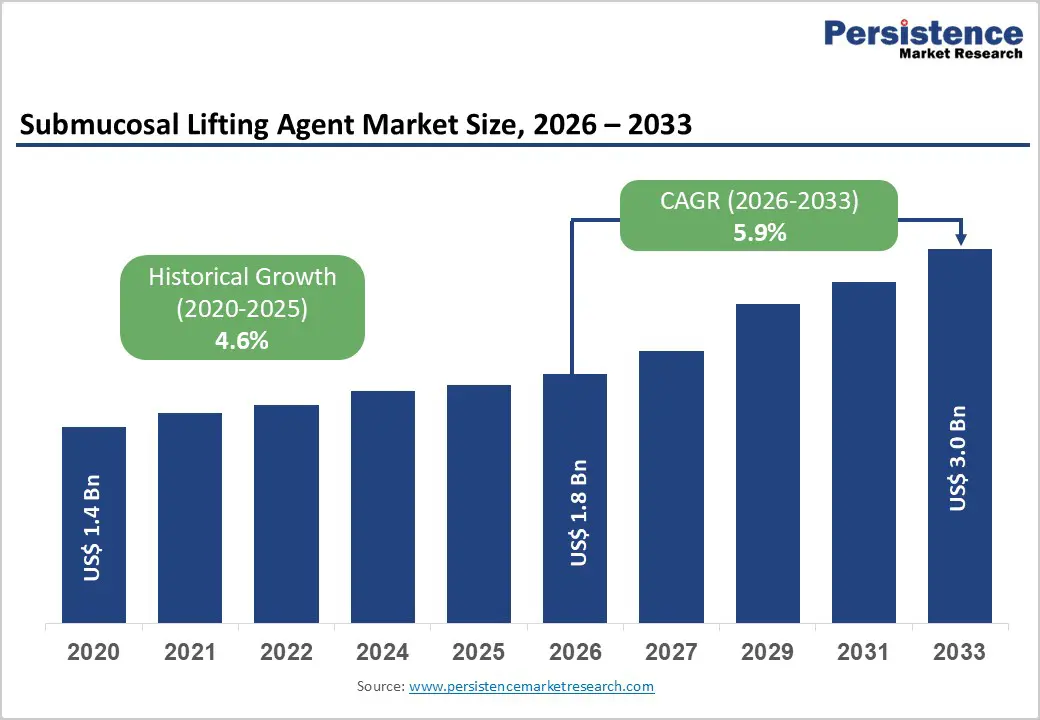
The global submucosal lifting agent market size is estimated to grow from US$ 1.8 Bn in 2026 to US$ 3.0 Bn by Bn 2033. The market is projected to record a CAGR of 5.9% during the forecast period from 2026 to 2033.
The global use of submucosal lifting agents is increasing consistently, supported by the growing incidence of colorectal polyps, early gastrointestinal malignancies, and other mucosal lesions requiring therapeutic endoscopy. Expansion of organized colorectal cancer screening programs has significantly increased colonoscopy volumes, leading to higher detection of precancerous and superficial neoplastic lesions. As endoscopic mucosal resection (EMR) and endoscopic submucosal dissection (ESD) procedures become more widely practiced, the need for reliable and long-lasting mucosal elevation solutions continues to rise. Aging populations, sedentary lifestyles, and dietary risk factors are contributing to a higher burden of gastrointestinal disorders globally. Advancements in formulation science, such as improved viscosity control, enhanced injectability, and prolonged submucosal cushion durability, are improving procedural safety and efficiency.
Key Industry Highlights
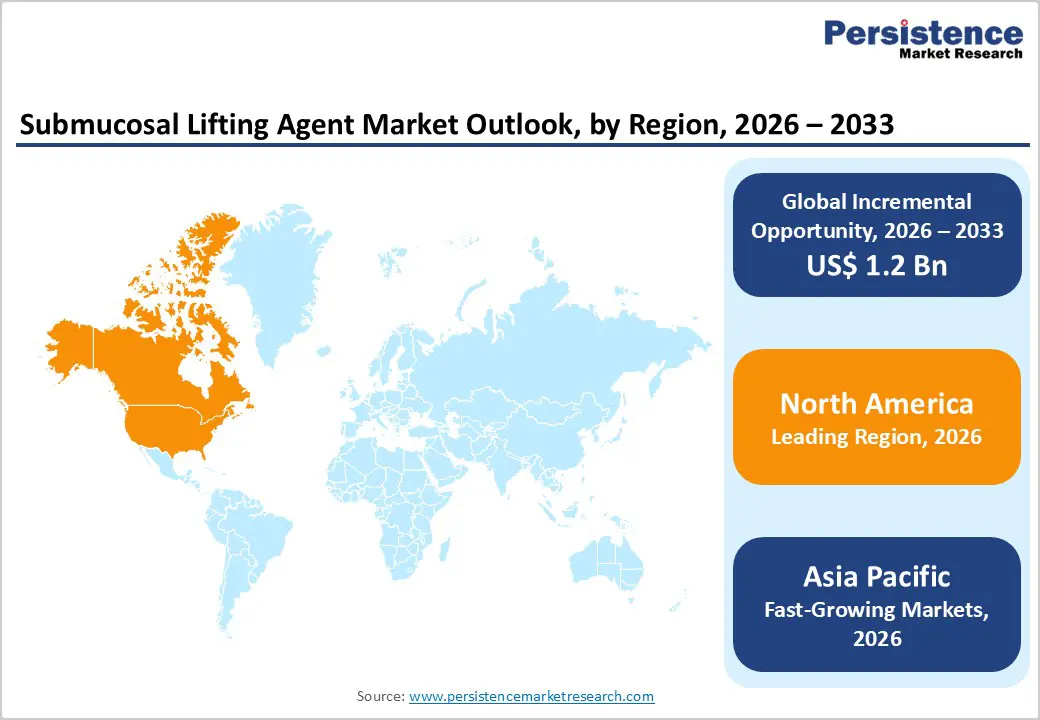
- Leading Region: North America accounts for 48.5% of global revenue, supported by structured colorectal screening programs, sophisticated endoscopy infrastructure, favorable reimbursement frameworks, and the strong presence of leading medical device manufacturers. Fastest-Growing Region: Asia Pacific is advancing at the quickest rate, driven by a large patient population, increasing detection of gastrointestinal lesions, rapid healthcare modernization, and growing investment in advanced endoscopic services.
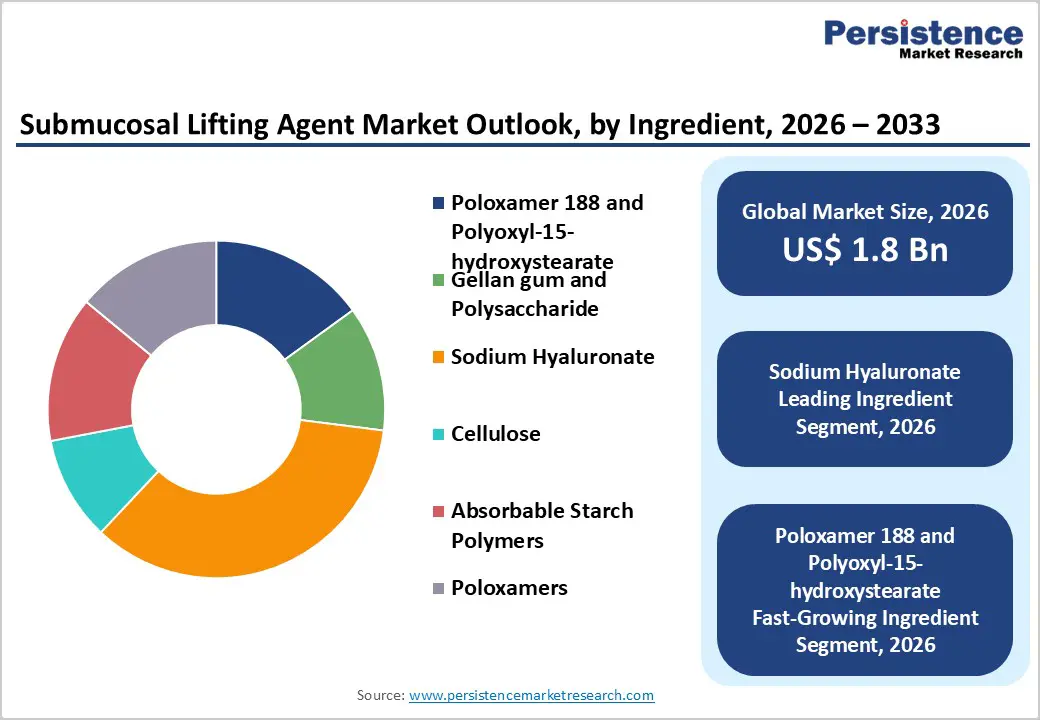
- Leading Ingredient Segment: Sodium Hyaluronate holds the leading position due to its superior viscoelastic characteristics, extended mucosal lift duration, and broad clinical acceptance in EMR and ESD procedures.
- Fastest-Growing Ingredient Segment: Poloxamer 188 and Polyoxyl-15-hydroxystearate are gaining traction as demand for synthetic polymer-based formulations that deliver sustained elevation and procedural efficiency rises.
- Leading Application Segment: Polyps account for the largest share, driven by expanding colonoscopy-based screening initiatives and rising resection of precancerous lesions.
- Fastest-Growing Application Segment: Early-stage Cancers are witnessing accelerated growth as organ-preserving, minimally invasive resection techniques become the preferred therapeutic approach worldwide.
| Key Insights | Details |
|---|---|
| Submucosal Lifting Agent Market Size (2026E) | US$ 1.8 Bn |
| Market Value Forecast (2033F) | US$ 3.0 Bn |
| Projected Growth (CAGR 2026 to 2033) | 5.9% |
| Historical Market Growth (CAGR 2020 to 2025) | 4.6% |
Market Dynamics
Driver - Expanding Gastrointestinal Cancer Screening and Advancements in Therapeutic Endoscopy Fueling Procedural Demand
A major growth catalyst is the rising global incidence of colorectal cancer and other gastrointestinal neoplasms, which has significantly increased demand for early detection and minimally invasive resection techniques. Organized screening initiatives, particularly colonoscopy-based programs, are improving the identification of precancerous polyps and superficial lesions at earlier stages. As detection rates increase, so does the volume of endoscopic mucosal resection (EMR) and endoscopic submucosal dissection (ESD) procedures that require reliable and durable mucosal elevation. Submucosal lifting agents play a critical role in separating the mucosal layer from the muscularis propria, thereby reducing perforation risk and improving resection precision.
Additionally, advances in endoscopic imaging, such as high-definition visualization, narrow-band imaging, and chromoendoscopy, are enabling the identification of complex, flat, and laterally spreading lesions that require advanced lifting solutions. The shift toward organ-preserving interventions instead of surgical resection further supports procedural growth. In addition, increasing availability of trained interventional gastroenterologists and expansion of tertiary endoscopy centers are strengthening utilization rates. Together, rising disease burden and technological evolution in therapeutic endoscopy are generating sustained and procedure-driven demand.
Restraints - Cost Constraints, Product Recalls, and Variability in Clinical Preference Limiting Uniform Adoption
Advanced viscous lifting formulations are priced significantly higher than conventional saline or dextrose solutions, creating cost sensitivity in resource-limited healthcare systems. Budget-constrained hospitals may prefer low-cost injectables, particularly where reimbursement structures do not differentiate between basic and premium agents. In emerging markets, limited insurance penetration further shifts purchasing decisions toward economical alternatives.
Regulatory scrutiny and past product safety concerns have also influenced clinician confidence in certain proprietary gels, leading to temporary hesitancy in adoption. Variability in physician preference, often shaped by training background, procedural familiarity, and institutional procurement policies, results in inconsistent usage patterns across regions. Additionally, the absence of universally standardized guidelines specifying optimal lifting composition for different lesion types contributes to fragmented demand. In some facilities, limited access to advanced ESD expertise reduces the need for long-lasting lifting materials, further constraining uptake. These financial, regulatory, and practice-level inconsistencies collectively temper the pace of expansion despite favorable clinical fundamentals.
Opportunity - Innovation in Long-Lasting Formulations and Emerging Market Penetration, Unlocking Future Potential
Significant opportunities lie in developing next-generation formulations that offer prolonged mucosal elevation, improved injectability, and enhanced safety profiles. Clinicians increasingly seek agents that minimize reinjection frequency, maintain cushion integrity during complex dissections, and reduce overall procedure time. Research into synthetic polymers, combination agents, and bioresorbable materials is opening pathways for differentiated products tailored to specific lesion morphologies. Integration of dye components and hemostatic properties within lifting solutions is also expanding functional versatility.
Geographic expansion presents another major avenue. Rapid improvements in endoscopy infrastructure across the Asia Pacific and Latin America are increasing access to advanced resection procedures. Government-supported cancer screening initiatives and private-sector investments in tertiary care facilities are expanding the addressable patient pool. Training collaborations between global device manufacturers and regional medical institutions are accelerating knowledge transfer and product familiarity. Additionally, growing preference for minimally invasive oncology treatments over surgical interventions aligns strongly with the value proposition of effective submucosal lifting technologies. Continuous innovation combined with expanding procedural ecosystems is expected to create substantial long-term growth momentum.
Category-wise Analysis
By Ingredient Insights
Sodium hyaluronate is expected to account for 35.0% of global revenue in 2026, making it the leading ingredient category. Its dominance is linked to excellent viscoelastic properties that create a durable and well-defined submucosal cushion during endoscopic mucosal resection (EMR) and endoscopic submucosal dissection (ESD). Compared with conventional injectables such as saline, it maintains mucosal elevation for a longer duration, thereby reducing reinjection frequency and improving procedural precision. Strong clinical familiarity among gastroenterologists, favorable safety outcomes, and extensive evidence supporting reduced perforation risk have reinforced its routine use. Increasing colorectal cancer screening programs and rising therapeutic endoscopy volumes further contribute to demand. In addition, ongoing formulation refinements aimed at optimizing viscosity, injectability, and cost-efficiency are expected to sustain segment leadership across both hospital and specialty endoscopy settings.
By Application Insights
The polyp segment is projected to account for 30.0% of the market in 2026, making it the largest application area. This leadership is primarily attributed to the rising volume of colonoscopy-based polypectomy procedures performed for early detection and prevention of colorectal cancer. With national screening initiatives expanding across developed and emerging economies, detection rates of precancerous lesions have increased substantially. Submucosal lifting agents are essential for the safe resection of flat and sessile polyps by separating the mucosa from the muscularis propria. Improved patient awareness, earlier diagnosis, and guideline-driven surveillance intervals are strengthening procedural volumes. Furthermore, technological advancements in endoscopic imaging, such as high-definition visualization and chromoendoscopy, are identifying complex lesions that require advanced lifting solutions. Collectively, these clinical and demographic factors underpin sustained growth within this segment.
By End-user Insights
Hospitals are expected to represent 55.0% of total revenue in 2026, reflecting their central role in therapeutic endoscopy services. Large tertiary and quaternary care institutions handle the majority of complex EMR and ESD procedures, particularly for high-risk adenomas and early-stage gastrointestinal malignancies. These facilities are equipped with advanced endoscopic systems, trained interventional gastroenterologists, anesthesia support, and emergency backup, all of which are critical for managing procedural complications. Higher patient throughput, established reimbursement pathways, and integrated oncology referral networks further strengthen hospital utilization rates. In addition, academic medical centers actively participate in clinical research evaluating newer lifting formulations, accelerating the adoption of premium products. Although ambulatory endoscopy centers are expanding, hospitals continue to dominate due to their capacity to manage technically demanding resections and provide comprehensive peri-procedural care.
Regional Insights
North America Submucosal Lifting Agent Market Trends
North America is projected to account for 48.5% of global revenue in 2026, led predominantly by the United States. The region benefits from well-structured colorectal cancer screening guidelines, widespread insurance coverage, and high awareness regarding preventive gastrointestinal care. Colonoscopy penetration remains strong, with increasing adoption of EMR and ESD techniques for complex lesions. The presence of major medical device manufacturers and consistent product innovation supports the rapid uptake of advanced viscous lifting formulations.
Hospitals and ambulatory endoscopy centers are equipped with state-of-the-art imaging technologies, enhancing the detection of early neoplastic changes that require submucosal injection solutions. Favorable reimbursement policies and structured gastroenterology training programs further reinforce procedural volumes. Additionally, an aging demographic profile and high incidence of colorectal polyps and early malignancies contribute to sustained demand, ensuring continued regional leadership over the forecast period.
Europe Submucosal Lifting Agent Market Trends
Europe demonstrates stable market progression supported by organized cancer screening initiatives and standardized clinical pathways. Countries including Germany, the United Kingdom, France, Italy, and Spain maintain strong public healthcare systems that emphasize early detection of colorectal lesions. Adoption of advanced endoscopic resection techniques has increased steadily, particularly in Western Europe, where trained specialists routinely perform complex dissections. Cost-conscious healthcare frameworks encourage the use of effective and safe lifting agents that minimize complications and repeat interventions.
Furthermore, the region places considerable importance on evidence-based practice, favoring clinically validated formulations with proven mucosal elevation durability. Investments in endoscopy infrastructure, training workshops, and cross-border regulatory harmonization within the European Union enhance product accessibility. Although growth is comparatively moderate relative to the Asia Pacific, consistent procedural demand and aging populations continue to underpin long-term expansion across the region.
Asia Pacific Submucosal Lifting Agent Market Trends
Asia Pacific is forecast to register a CAGR of approximately 7.9% between 2026 and 2033, reflecting accelerating healthcare development and increasing detection of gastrointestinal disorders. Countries such as China, India, Japan, and South Korea are expanding endoscopic screening capacity through public health initiatives and private sector investment. Growing urbanization, dietary transitions, and aging populations have contributed to a higher incidence of colorectal polyps and early neoplasia. Large patient pools combined with improving diagnostic accessibility are generating substantial procedural volumes. Governments are prioritizing the modernization of tertiary hospitals and specialized gastroenterology centers, enhancing the availability of advanced resection techniques.
In addition, collaborations with international medical device manufacturers are facilitating technology transfer and clinician training. Rising healthcare expenditure, expanding medical tourism, and heightened awareness regarding early cancer detection are collectively positioning the region as the fastest-growing market globally.
Competitive Landscape
The global submucosal lifting agent market is highly competitive, with strong participation from companies such as Laborie Medical Technologies Corp., STERIS plc., Olympus America Inc., Medtronic plc., and Boston Scientific Corporation. These players leverage extensive endoscopy and gastrointestinal intervention portfolios, established relationships with gastroenterologists and endoscopic surgeons, advanced formulation capabilities, and robust global distribution networks.
Competitive strategies focus on expanding high-viscosity and long-lasting lifting formulations, enhancing procedural efficiency and mucosal elevation durability, and supporting minimally invasive resection techniques. Companies are investing in clinical validation, product innovation, physician training programs, and expansion into emerging markets, intensifying competition and driving sustained market growth.
Key Industrial Developments
- In April 2024, FUJIFILM India launched Tracmotion at Endocon 2024 in Delhi, introducing a Red Dot Award-winning Endoscopic Submucosal Dissection (ESD) device designed for single-operator use. Featuring 360° rotatable retraction, Tracmotion enables precise tissue manipulation independent of endoscope movement, enhancing procedural control and efficiency in advanced therapeutic endoscopy.
- In January 2023, the Blue Eye submucosal injection agent received clearance from the U.S. Food and Drug Administration (FDA), authorizing its clinical use in endoscopic procedures. This approval enhanced its commercial positioning and supported wider adoption in advanced mucosal resection and therapeutic endoscopy applications across the U.S.
Companies Covered in Submucosal Lifting Agent Market
- Laborie Medical Technologies Corp.
- STERIS plc.
- Olympus America Inc.
- Medtronic plc.
- Boston Scientific Corporation
- Omnimed Ltd™
- Cosmo Pharmaceuticals N.V.
- Micro-Tech (Nanjing) Co., Ltd.
- Ovesco Endoscopy AG
- Fujifilm Holdings Corporation
- KARL STORZ SE & Co. KG
- PENTAX Medical (HOYA Corporation)
- Stryker Corporation
- Cook Medical, Inc.
- Ambu A/S
- Others
Frequently Asked Questions
The global submucosal lifting agent market is projected to be valued at US$ 1.8 Bn in 2026.
Rising prevalence of gastrointestinal diseases and increased adoption of minimally invasive endoscopic procedures that require effective submucosal lifts to improve safety and outcomes.
The global submucosal lifting agent market is poised to witness a CAGR of 5.9% between 2026 and 2033.
Innovation in novel formulations with improved lifting duration and safety profiles that meet unmet clinical needs and expand clinical adoption.
Laborie Medical Technologies Corp., STERIS plc., Olympus America Inc., Medtronic plc., and Boston Scientific Corporation are some of the key players in the submucosal lifting agent market.


