




- Hardware & Software IT Services
- Sports Management Software Market
Sports Management Software Market Size, Share, and Growth Forecast, 2026 - 2033
Sports Management Software Market by Sport Type (Team Sports, Individual Sports, Others), Application (Player & Team Management, Event & League Management, Others), Deployment, End-user, and Regional Analysis for 2026 - 2033

Sports Management Software Market Size and Trends Analysis
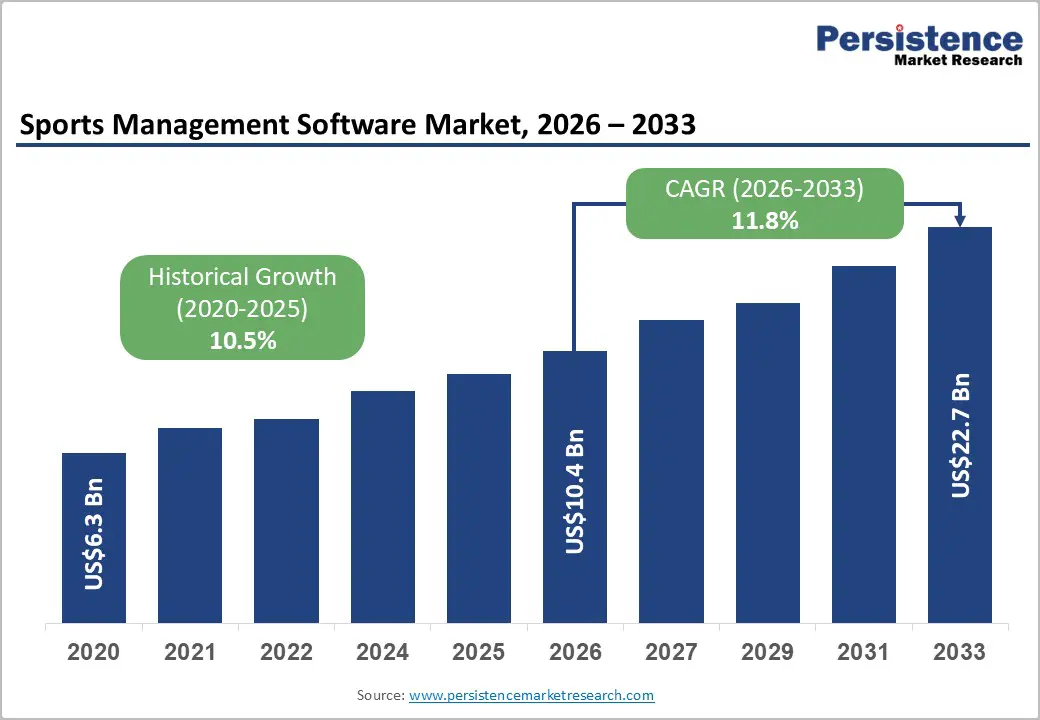
The global sports management software market size is likely to be valued at US$10.4 billion in 2026 and is expected to reach US$22.7 billion by 2033, growing at a CAGR of 11.8% between 2026 and 2033, driven by the increasing shift of sports organizations from manual processes to comprehensive digital platforms that streamline functions such as registration, scheduling, payments, communication, analytics, and fan engagement.
Market expansion is further supported by rising participation in both team and individual sports, growing demand for automation, and the widespread adoption of SaaS-based enterprise solutions. Consistent participation in sports activities, along with accelerating cloud adoption, continues to strengthen the long-term demand for sports management software.
Key Industry Highlights
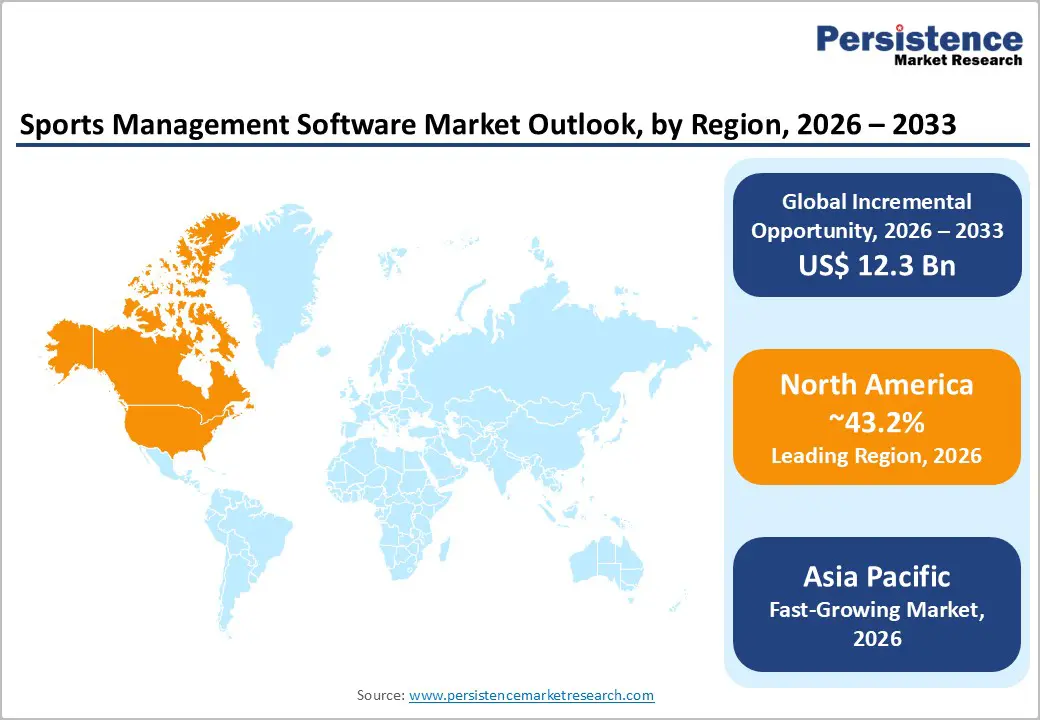
- Leading Region: North America is projected to account for 43.2% of the market share, driven by strong sports participation, early SaaS adoption, and the presence of advanced sports technology ecosystems.
- Fastest-growing Region: Asia Pacific is the fastest-growing region, supported by rapid digitalization, expanding sports infrastructure, and increasing adoption of cloud-based platforms across emerging economies.
- Investment Plans: Market investments are increasingly focused on AI-driven scheduling, integrated SaaS platforms, and cloud infrastructure, with companies expanding capabilities through product innovation and strategic collaborations to enhance operational efficiency and user engagement.
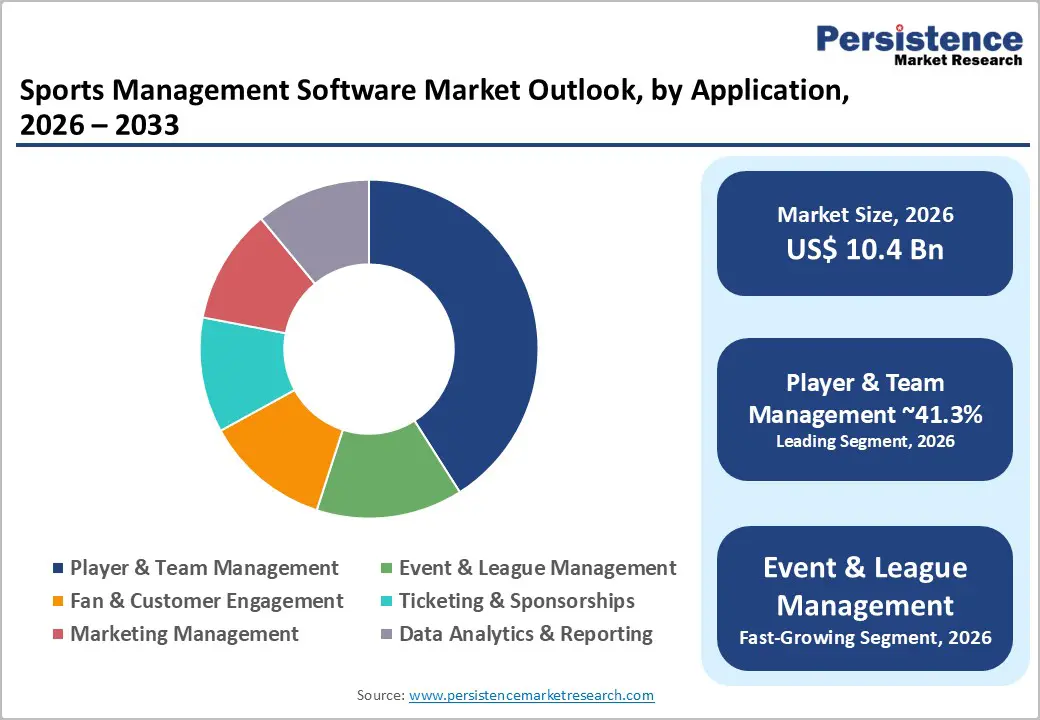
- Dominant Application: Player & team management is anticipated to dominate, holding an anticipated share of approximately 41.3%, as it forms the core operational layer for sports organizations with high user dependency and recurring usage.
- Leading Deployment: Cloud deployment leads the market with an anticipated share of 54.8%, driven by scalability, cost efficiency, and growing demand for real-time, multi-location access to sports management systems.
| Key Insights | Details |
|---|---|
| Sports Management Software Market Size (2026E) | US$10.4 Bn |
| Market Value Forecast (2033F) | US$22.7 Bn |
| Projected Growth (CAGR 2026 to 2033) | 11.8% |
| Historical Market Growth (CAGR 2020 to 2025) | 10.5% |
DRO Analysis
Driver Analysis - Rising Participation in Organized Sports and League Activities
The demand for sports management software is directly correlated with participation levels in organized sports. Increasing involvement across youth, amateur, and recreational segments has significantly expanded the operational burden on sports organizations. Higher participation results in greater volumes of registrations, scheduling updates, roster management, and payment processing. Team sports, in particular, require structured coordination across multiple stakeholders, including players, coaches, parents, and administrators. This complexity drives the need for digital platforms that automate repetitive tasks and improve coordination. As participation continues to expand globally, especially in emerging markets and community-level programs, software adoption is expected to grow proportionally, creating a stable and recurring revenue base for vendors.
Cloud Adoption and SaaS-Based Delivery Models
Cloud computing has become a foundational driver of the sports management software market. Organizations increasingly prefer SaaS-based platforms due to lower upfront costs, reduced IT maintenance, and the ability to scale operations dynamically. Cloud deployment enables real-time data access across devices, supporting distributed teams and multi-location events. It also facilitates seamless updates, integrations, and remote collaboration. The growing adoption of cloud services across enterprises, particularly among large organizations, demonstrates a broader shift toward digital infrastructure, which is being mirrored in sports ecosystems. This transition significantly expands the addressable market, especially among small and mid-sized organizations that benefit from affordable, subscription-based solutions.
Integration of AI and Advanced Analytics
The integration of artificial intelligence and analytics is transforming sports management software from administrative tools into decision-support systems. AI-powered scheduling, predictive analytics, and performance tracking capabilities are improving operational efficiency and strategic planning. Advanced platforms can now automate complex scheduling tasks, optimize resource allocation, and provide actionable insights for coaches and administrators. These capabilities reduce manual effort, minimize errors, and enhance user experience. Vendors offering integrated analytics and automation features are gaining a competitive advantage by increasing customer retention and enabling higher-value use cases across sports organizations.
Restraint Analysis - Data Privacy, Security, and Compliance Challenges
Sports organizations manage sensitive personal data, including information related to minors, athletes, and staff. This creates significant compliance requirements related to data protection, privacy regulations, and cybersecurity. Cloud-based systems, while efficient, increase exposure to potential data breaches if not properly managed. Organizations must implement strict access controls, data encryption, and compliance frameworks, which can increase operational complexity. Smaller organizations, in particular, may lack the resources to manage these requirements effectively, leading to slower adoption of comprehensive software platforms.
Cost Sensitivity and Fragmented Customer Base
The market serves a diverse range of users, from small community clubs to large professional organizations. This diversity results in varying budget constraints and purchasing behaviors. Smaller organizations often prioritize cost-effective solutions and may resist adopting full-featured platforms unless there is a clear return on investment. Pricing pressure remains a challenge for vendors, as they must balance affordability with feature-rich offerings. This fragmentation also leads to longer sales cycles and increased competition, particularly in price-sensitive segments.
Opportunity Analysis - Expansion of Event and League Management Solutions
Event and league management represents a significant growth opportunity due to increasing complexity in organizing tournaments and multi-team competitions. As the number of participants, venues, and scheduling variables grows, manual coordination becomes inefficient and error-prone. Software solutions that automate scheduling, logistics, and communication offer clear value by reducing administrative workload and improving operational accuracy. Vendors focusing on this segment can capture substantial demand from youth leagues, amateur tournaments, and regional competitions.
Growth in Emerging Markets and Digital Infrastructure Development
Emerging economies in Asia Pacific, Latin America, and parts of Africa present strong growth opportunities due to increasing digitalization and expanding sports participation. Improvements in cloud infrastructure, mobile connectivity, and digital payment systems are enabling broader adoption of sports management platforms. These markets often adopt mobile-first solutions, creating demand for scalable, user-friendly applications tailored to local needs. Vendors that localize their offerings and address region-specific requirements can gain a competitive advantage in these high-growth markets.
Monetization through Fan Engagement and Data Integration
Sports organizations are increasingly leveraging software platforms to enhance revenue generation through fan engagement, sponsorship management, and digital content. Integrated solutions that combine operational data with fan interaction tools enable organizations to create personalized experiences, improve marketing effectiveness, and attract sponsors. This convergence of operations and monetization presents a significant opportunity for vendors to expand beyond administrative functions and deliver higher-value solutions.
Category-wise Analysis
Application Insights
Player & team management is anticipated to account for approximately 41.3% of the market share during the forecast period. This segment remains the backbone of sports management software, covering essential functions such as roster management, scheduling, attendance tracking, communication, and payment processing. These capabilities are critical for day-to-day operations and are often the first modules adopted by sports organizations transitioning from manual systems. Platforms such as TeamSnap and SportsEngine exemplify this segment by offering integrated solutions that connect coaches, players, and administrators in real time. The centrality of these functions ensures high user engagement, recurring usage, and long-term dependency, making this segment the primary revenue generator for vendors.
Event & league management is anticipated to witness the fastest growth, with its share steadily increasing across the forecast period. This segment is expanding due to the rising complexity of organizing tournaments, leagues, and multi-venue competitions. Automated scheduling, bracket generation, venue allocation, and real-time updates are becoming essential as participation scales. Solutions such as those offered by Fastbreak AI demonstrate how AI-driven scheduling can significantly reduce planning time and operational errors. The integration with ticketing, sponsorship management, and live event tracking enhances revenue generation opportunities. As sports organizations increasingly host large-scale and recurring events, demand for comprehensive league management platforms is expected to accelerate.
Deployment Insights
Cloud deployment is anticipated to maintain a dominant share of over 54.8% during the forecast period, while also being the fastest-growing deployment model. Its rapid adoption is driven by scalability, cost efficiency, and ease of implementation compared to traditional on-premise systems. Cloud-based platforms enable real-time data access, automatic updates, and seamless integration with third-party tools such as payment gateways and analytics engines. Companies such as Oracle and SAP support this ecosystem by providing robust cloud infrastructure and enterprise-grade solutions. Cloud deployment is particularly advantageous for sports organizations operating across multiple locations, as it supports mobile accessibility and remote coordination. As digital transformation accelerates globally, cloud-based solutions are expected to remain the preferred choice for both small clubs and large professional organizations.
Regional Insights
North America Sports Management Software Market Trends - SaaS Leadership with Platform Consolidation and AI-Driven Innovation
North America is projected to lead the market with a 43.2% share, driven by high sports participation rates, advanced digital infrastructure, and strong adoption of technology solutions. The U.S. remains the largest contributor, supported by a well-established ecosystem of youth leagues, professional sports organizations, and collegiate programs. The region benefits from early adoption of SaaS platforms and continuous innovation in sports technology. Companies such as TeamSnap and SportsEngine have built large-scale user bases across amateur and youth sports, reinforcing North America’s leadership in operational software adoption.
Recent developments highlight the region’s innovation-driven growth. The launch of integrated platforms like TeamSnap ONE reflects a shift toward unified ecosystems that combine registration, communication, and streaming. At the same time, Fastbreak AI introduced AI-driven scheduling solutions to address the complexity of large-scale tournaments. The strategic combination of PlayMetrics and Stack Sports has further strengthened platform consolidation, enabling broader service offerings across clubs and leagues. Regulatory requirements related to data privacy and digital payments continue to influence software design and deployment. Vendors prioritize compliance, cybersecurity, and user experience to meet evolving standards. Investment activity remains strong, particularly in youth sports platforms, performance analytics, and event management tools. The presence of global cloud providers such as Oracle also supports scalable infrastructure, reinforcing North America’s position as the most mature and innovation-intensive market.
Europe Sports Management Software Market Trends - Governance-Led Market with Secure Cloud Adoption and Fan Engagement Focus
Europe represents a mature and highly regulated market characterized by structured sports organizations and strong governance frameworks. Countries such as Germany, the U.K., France, and Spain are key contributors, with widespread adoption of digital solutions across both professional and amateur sports ecosystems. The region’s sports culture, particularly in football (soccer), drives consistent demand for software platforms that manage leagues, clubs, and fan engagement.
Cloud adoption is steadily increasing, supported by regulatory initiatives promoting secure and interoperable digital infrastructure. European organizations place a strong emphasis on data protection and compliance, which directly influences vendor selection and system architecture. Companies such as Deltatre play a significant role in shaping the regional landscape by delivering advanced digital experiences, streaming solutions, and fan engagement platforms for major sports organizations. Deltatre’s expansion in digital broadcasting and fan experience solutions reflects the region’s growing focus on monetization through technology. Another key trend is the increasing use of data analytics and performance tracking tools in professional sports. Platforms like Genius Sports are enhancing how leagues and federations manage data, integrity, and fan interaction. These developments support the commercialization of sports through better sponsorship targeting and audience insights. Europe’s regulatory harmonization and emphasis on secure digital ecosystems continue to create a stable environment for long-term software adoption and innovation.
Asia Pacific Sports Management Software Market Trends - Fastest Growth Driven by Mobile-First Adoption and Expanding Sports Ecosystems
Asia Pacific is the fastest-growing region, driven by rapid digitalization, expanding sports participation, and increasing investment in infrastructure. Countries such as China, Japan, and India are leading growth, supported by large populations and rising interest in organized sports at both grassroots and professional levels. The region’s diversity creates a wide range of opportunities, from school and academy management systems to large-scale league and event platforms. The region benefits from mobile-first adoption and rapidly expanding cloud infrastructure, enabling scalable and cost-effective software deployment. Governments are actively supporting digital transformation initiatives, which indirectly boost the adoption of sports management solutions. In India, for example, the expansion of digital infrastructure and data center investments is enabling broader SaaS adoption across sectors, including sports.
Global and regional players are actively strengthening their presence in Asia Pacific. Companies such as Catapult are expanding performance analytics solutions across professional teams in Australia and Asia, while Hudl continues to grow its footprint in athlete performance and video analysis across schools and clubs. These solutions are helping teams improve training outcomes and competitive performance. Localized platforms and mobile applications are gaining traction among grassroots organizations, particularly in India and Southeast Asia. Vendors entering the region must prioritize localization, affordability, and mobile usability to succeed. The combination of rising participation, government support, and increasing digital maturity positions Asia Pacific as the most dynamic growth engine for the sports management software market.
Competitive Landscape
The global sports management software market is fragmented but evolving toward consolidation, with a mix of global platforms and specialized vendors. Leading players are expanding their capabilities through product innovation and strategic partnerships, while smaller vendors focus on niche segments or specific sports. Platform-based solutions are gaining prominence as organizations seek integrated systems rather than standalone tools.
Key strategies include platform integration, AI-driven innovation, subscription-based pricing models, and geographic expansion. Market leaders are focusing on enhancing user experience, increasing customer retention, and expanding into high-growth regions.
Key Industry Developments:
- In November 2025, TeamSnap launched TeamSnap ONE, an end-to-end sports management platform integrating registration, scheduling, communication, training content, and live streaming into a single unified system, aiming to streamline operations and enhance user experience across youth sports organizations.
- In June 2025, Fastbreak AI launched an AI-powered scheduling engine within its Fastbreak Compete platform, enabling tournament organizers to generate complex, competition-ready schedules in minutes, significantly improving operational efficiency for large-scale sports events.
Companies Covered in Sports Management Software Market
- TeamSnap
- SportsEngine
- Stack Sports
- PlayMetrics
- LeagueApps
- Active Network
- Jonas Software
- Hudl
- Catapult
- Genius Sports
- Deltatre
- Teamworks
- Omnify
- EZFacility
- Virtuagym
- PerfectMind
Frequently Asked Questions
The sports management software market is estimated to be valued at US$10.4 billion in 2026.
The sports management software market is projected to reach US$22.7 billion by 2033.
Key trends include the shift toward cloud-based SaaS platforms, increasing adoption of AI-driven scheduling and analytics, rising demand for integrated all-in-one management solutions, and growing focus on fan engagement and data monetization.
Player & team management is the leading segment, accounting for an anticipated 41.3% share, due to its central role in daily sports operations such as scheduling, communication, and roster management.
The sports management software market is expected to grow at a CAGR of 11.8% from 2026 to 2033.
Some of the major players include TeamSnap, Hudl, SportsEngine, Genius Sports, and Deltatre.


