




- Biotechnology
- Sperm Function Testing Market
Sperm Function Testing Market Size, Share, and Growth Forecast, 2026 - 2033
Sperm Function Testing Market by Testing Type (Computer-Assisted Semen Analysis (CASA), Differential Interference Contrast (DIC) Microscopy, Others), Sperm Function Parameters (Concentration, Motility, Others), and Regional Analysis for 2026 - 2033

Sperm Function Testing Market Size and Trends Analysis
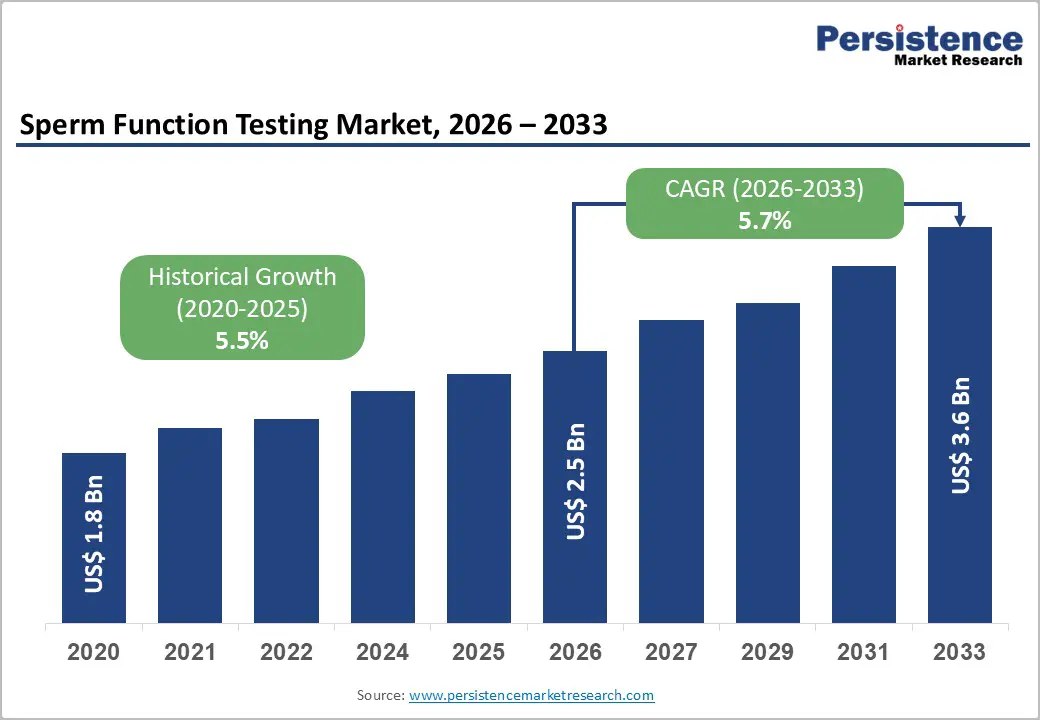
The global sperm function testing market size is likely to be valued at US$2.5 billion in 2026 and is expected to reach US$3.6 billion by 2033, growing at a CAGR of 5.7% during the forecast period from 2026 to 2033, driven by the increasing demand for comprehensive sperm evaluation that goes beyond basic semen analysis, incorporating advanced functional assessments such as DNA fragmentation, motility patterns, and morphology analysis. Infertility continues to represent a significant public health challenge.
According to the World Health Organization (WHO), approximately one in six people of reproductive age worldwide had experienced infertility as of 2020, underscoring sustained global demand for reproductive diagnostic services. Male factors account for a considerable share of infertility cases, reinforcing the importance of accurate and detailed sperm function testing in clinical decision-making. Technological advancements, including Computer-Assisted Semen Analysis (CASA), fluorescence-based assays, and advanced microscopy techniques, are further enhancing diagnostic precision, reproducibility, and reliability across both clinical and research applications.
Key Industry Highlights:
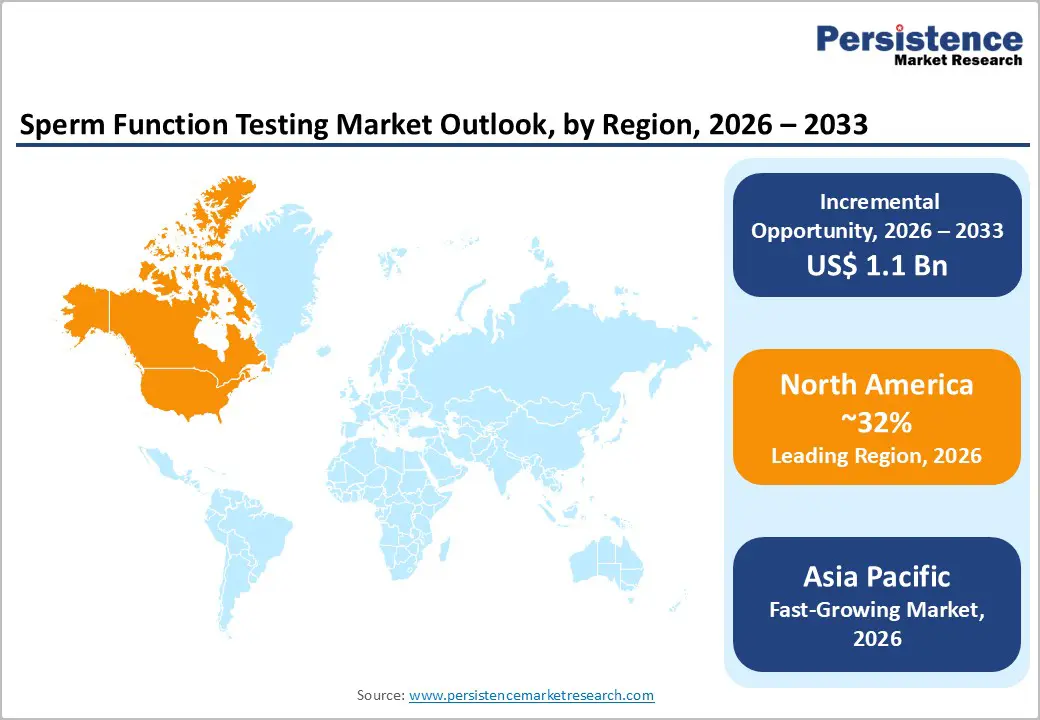
- Leading Region: North America, accounting for a market share of 32% in 2026, driven by strong clinic density, advanced research, early adoption of innovative technologies, and a supportive regulatory and reimbursement environment.
- Fastest-growing Region: Asia Pacific, supported by rapid clinic expansion, rising infertility awareness, manufacturing advantages, and growing adoption of advanced testing technologies.
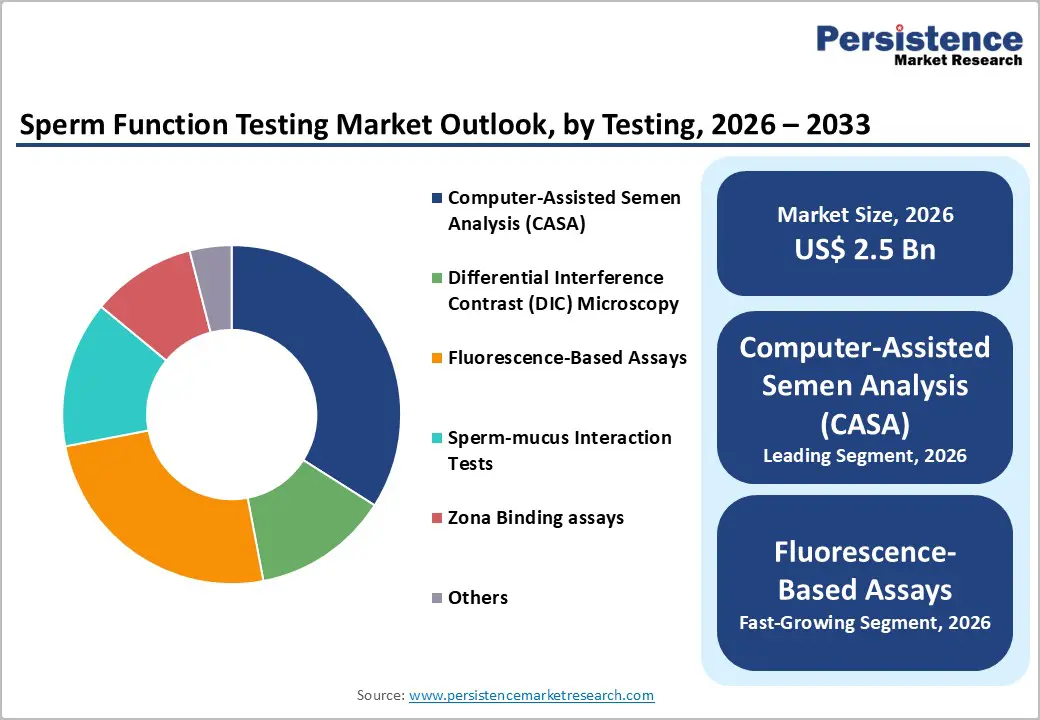
- Leading Testing Type: Computer-assisted semen analysis (CASA), accounting for 45% of the revenue share, driven by widespread clinical adoption and standardized high-throughput evaluation.
- Leading Sperm Function Parameters: Motility, accounting for over 40% of the revenue share in 2026, supported by its central role in routine semen analysis and ART assessment.
| Key Insights | Details |
|---|---|
|
Sperm Function Testing Market Size (2026E) |
US$2.5 Bn |
|
Market Value Forecast (2033F) |
US$3.6 Bn |
|
Projected Growth (CAGR 2026 to 2033) |
5.7% |
|
Historical Market Growth (CAGR 2020 to 2025) |
5.5% |
Market Factors - Growth, Barriers, and Opportunity Analysis
Growth Analysis - Rising Infertility Rates and ART Adoption
Male infertility contributes significantly to overall reproductive challenges, prompting demand for advanced diagnostic tools. Fertility clinics and hospitals are increasingly adopting comprehensive semen and sperm function evaluations to support assisted reproductive technologies (ART) such as IVF and ICSI. Rising awareness of male reproductive health, along with government initiatives promoting fertility assessment, fuels market adoption. As more couples seek fertility solutions, the need for accurate and detailed sperm functional analysis grows, positioning this market as an essential component of modern reproductive healthcare.
Coupled with the surge in assisted reproductive technologies (ART) procedures, the demand for precise sperm evaluation continues to expand. Clinics aim to improve success rates by integrating functional tests, including DNA fragmentation, motility, and morphology assessments. The adoption of sperm function testing ensures better patient stratification, reduces trial-and-error in ART procedures, and supports personalized fertility treatment plans. Growing urbanization, delayed parenthood, and lifestyle-related fertility challenges contribute to the rising need for laboratory-based male fertility assessment.
Technological Advancements in CASA Systems
Advances in computer-assisted semen analysis (CASA) systems have significantly expanded sperm function testing. Modern CASA platforms offer automated evaluation of sperm motility, concentration, morphology, and kinematic parameters with high precision and reproducibility. Integration with electronic medical records and laboratory information systems allows clinicians to maintain standardized reporting while improving workflow efficiency. Enhanced imaging technologies, AI-assisted tracking, and multi-parameter analysis have made CASA indispensable for high-volume fertility laboratories. These innovations reduce manual errors, shorten analysis time, and support comprehensive functional assessment, driving adoption in both established and emerging markets seeking accurate, reproducible male fertility diagnostics.
Technological evolution, such as the incorporation of AI algorithms and machine learning models, enables predictive insights into sperm quality and fertilization potential. Continuous improvements in hardware, optics, and software have expanded CASA system capabilities, including high-throughput analysis and compatibility with advanced functional assays. As laboratories aim for faster, more reliable results, the adoption of cutting-edge CASA platforms ensures precise evaluation, standardized reporting, and enhanced patient management. This technological progression strengthens confidence in sperm function testing and supports research in reproductive health.
Barrier Analysis - Lack of Standardization across Testing Protocols
Variability in sample preparation, assay methods, and interpretation criteria can lead to inconsistent results, impacting clinical decision-making. Differences in equipment calibration, operator expertise, and laboratory procedures reduce comparability and reproducibility, limiting trust in functional assessments. Regulatory bodies have yet to fully harmonize guidelines for advanced sperm testing, which slows adoption in certain markets. The absence of universal standards also complicates integration with assisted reproductive technologies (ART), creating barriers for both clinical and research applications.
This lack of standardization affects both emerging and mature markets, as laboratories face challenges in validating new assays and ensuring consistent results. Discrepancies between manual and automated methods, varying thresholds for parameters such as DNA fragmentation, and inconsistent motility grading exacerbate the issue. These inconsistencies can reduce clinician confidence and patient acceptance of sperm function testing as a routine diagnostic tool. Overcoming this restraint requires collaborative efforts to develop recognized protocols, proficiency testing programs, and training initiatives that ensure reliability, reproducibility, and wider adoption of advanced sperm function assays.
Supply Chain Constraints for Specialized Reagents and Equipment
The sperm function testing market relies heavily on specialized reagents, consumables, and high-precision instruments. Disruptions in the supply chain, such as limited production capacity, shipping delays, or geopolitical factors, can hinder laboratory operations. Shortages of key materials such as fluorescent dyes, cell culture media, and disposable chambers may delay testing or increase operational costs. Small and medium-sized diagnostic laboratories are particularly affected, as they often lack inventory buffers and alternative suppliers. Such constraints can slow adoption rates, affect patient throughput, and reduce market expansion opportunities, especially in regions with limited domestic production capabilities.
The reliance on manufacturers for advanced instruments such as CASA systems and CO incubators increases vulnerability to supply chain bottlenecks. Maintenance, calibration, and timely access to replacement parts are critical to sustaining laboratory productivity. Delays can impact test accuracy, reduce clinical confidence, and force laboratories to rely on manual methods with lower precision. To mitigate these challenges, manufacturers and distributors must develop robust logistics networks, diversify sourcing strategies, and ensure reliable regional availability of reagents and equipment.
Opportunity Analysis - Technological Convergence with Artificial Intelligence and Predictive Analytics
AI-enabled platforms can analyze complex sperm motility patterns, morphology, and DNA integrity with higher accuracy and speed than traditional methods. Predictive models provide actionable insights into fertilization potential, ART outcomes, and patient-specific treatment planning. This technological convergence enhances clinicians' decision-making, improves patient counseling, and increases overall success rates. As laboratories and fertility centers adopt AI-assisted systems, the market is positioned to benefit from the growing demand for data-driven, high-precision male fertility diagnostics.
The combination of AI and analytics also enables remote or automated monitoring of sperm samples, streamlines workflow, and reduces operator-dependent variability. Machine learning algorithms can continuously improve over time, learning from historical data to refine predictions and enhance test reliability. Such platforms facilitate integration with electronic health records and telemedicine applications, extending accessibility to remote and underserved regions. The opportunity for AI-driven sperm function testing supports innovation and encourages partnerships between technology providers and laboratories.
Rise of At-Home and Point-of-Care (POC) Sperm Testing Solutions
Consumers increasingly seek convenient, private, and rapid assessment of male fertility without visiting clinical laboratories. These solutions offer initial screening for sperm concentration, motility, and viability, guiding decisions on whether to pursue comprehensive laboratory testing or ART procedures. Increased awareness of male reproductive health, coupled with user-friendly digital interfaces and mobile app integration, is driving adoption. Fertility clinics and telemedicine providers can leverage these tools to expand their patient base and enhance early intervention strategies.
Point-of-care (POC) and at-home testing also support preventive healthcare by encouraging routine monitoring, particularly among couples delaying parenthood. Partnerships between diagnostic manufacturers and healthcare providers enhance the reliability and clinical validation of these tests. The scalability and lower cost of at-home kits compared to laboratory-based assessments make them attractive in emerging markets with limited access to fertility clinics. By complementing traditional laboratory diagnostics, these solutions expand market reach, improve patient engagement, and create additional revenue streams, reinforcing growth prospects for the sperm function testing industry.
Category-wise Analysis
Testing Type Insights
Computer-assisted semen analysis (CASA) is expected to lead the sperm function testing market, accounting for approximately 45% of revenue in 2026, driven by its widespread clinical adoption and reliability in high-throughput fertility laboratories. CASA systems allow automated evaluation of sperm motility, concentration, morphology, and kinematic parameters with high precision and reproducibility. Their ability to integrate with electronic medical records ensures consistent reporting, streamlines workflow, and reduces human error, which is essential for large-scale fertility clinics. For example, Hamilton Thorne’s CEROS CASA system is widely used in U.S. and European fertility centers for objective sperm analysis, supporting both clinical diagnostics and ART procedures.
Fluorescence-based assays are likely to represent the fastest-growing segment in 2026, supported by increasing clinical focus on functional markers beyond conventional semen analysis. These assays assess parameters such as DNA fragmentation, oxidative stress, capacitation status, and acrosome integrity, which are critical for predicting ART success. For example, the Sperm Chromatin Structure Assay (SCSA) uses fluorescent probes to evaluate DNA fragmentation, helping clinicians identify male fertility risks that routine motility or morphology testing cannot detect. Rising evidence linking DNA integrity and oxidative stress to embryo development and pregnancy outcomes has encouraged greater adoption in fertility clinics worldwide.
Sperm Function Parameters Insights
Motility is projected to lead the market, capturing around 40% of the revenue share in 2026, supported by its foundational role in routine semen analysis and direct correlation with natural conception and ART outcomes. Motility assessment is a standard part of initial fertility evaluation, providing critical information about the sperm’s ability to reach and fertilize the oocyte. For example, Microptic’s SCA (Sperm Class Analyzer) is widely used in European and Asian fertility clinics for automated motility assessment, generating precise kinematic data that inform ART planning. Integration of motility analysis across laboratory platforms ensures standardized reporting and comparability across time.
DNA fragmentation is likely to be the fastest-growing segment of the sperm parameter space, driven by its clinical relevance for predicting ART success and its growing recognition. Unlike motility or morphology, DNA fragmentation reveals the genetic integrity of sperm, which is crucial for embryo quality and pregnancy outcomes. For example, the Halosperm® kit is increasingly used in fertility clinics in North America and Asia to detect sperm DNA fragmentation efficiently and reliably. Adoption is expanding due to improved availability of commercial kits, inclusion in clinical protocols, and patient demand for comprehensive evaluation. Fertility centers are leveraging DNA fragmentation results to personalize ART strategies, select appropriate sperm, and increase IVF/ICSI success rates.
Regional Insights
North America Sperm Function Testing Market Trends
North America is anticipated to be the leading region, accounting for a market share of 32% in 2026, driven by strong healthcare infrastructure, early adoption of advanced reproductive diagnostics, and high awareness of male fertility issues among clinicians and patients alike. In the United States and Canada, fertility clinics and diagnostic laboratories increasingly incorporate comprehensive sperm function assessments beyond basic semen analysis, reflecting clinical demand for precise evaluation of motility, morphology, DNA integrity, and oxidative stress. The region’s emphasis on data-driven diagnostics dovetails with broader trends in personalized medicine and reproductive health.
Rising parental age, lifestyle-related fertility disruptions, and expanding use of assisted reproductive technologies (ART) such as IVF and ICSI are increasing the demand for detailed sperm evaluation. Telehealth and digital health platforms also contribute to market expansion by enabling remote consultation and pre-screening, encouraging earlier engagement with fertility services. Point-o-care and near-patient testing solutions are gaining traction as clinics seek streamlined workflows and rapid turnaround, reducing barriers to testing for patients in suburban and rural areas. For example, CooperSurgical, Inc. has broadened its portfolio to include advanced sperm function tests and integrated laboratory solutions, helping clinics deliver comprehensive fertility assessments.
Europe Sperm Function Testing Market Trends
Europe is likely to be a significant market for sperm function testing in 2026, due to advanced healthcare systems, well-established fertility clinics, and strong clinical research networks focused on reproductive health. Countries such as the United Kingdom, Germany, France, and Spain are leading the adoption of comprehensive sperm function diagnostics beyond conventional semen analysis due to rising infertility awareness and increasing use of assisted reproductive technologies (ART). For example, Microptic S.L., a Spain-based company specializing in automated sperm analysis systems such as Sperm Class Analyzer (SCA), has strengthened its presence in European fertility centers by offering robust imaging and diagnostic platforms tailored to regional lab workflows.
Societal trends such as delayed childbearing, lifestyle impacts on fertility, and increasing demand for fertility preservation have encouraged both public and private sectors to invest in male fertility evaluation. In several European countries, government-backed awareness campaigns and subsidized fertility programs are expanding access to advanced sperm testing services, particularly in urban centers. Telemedicine and digital fertility platforms are facilitating broader engagement with diagnostics, allowing patients to consult specialists and interpret sperm function results remotely.
Asia Pacific Sperm Function Testing Market Trends
The Asia Pacific region is likely to be the fastest-growing region in 2026, driven by increasing infertility awareness, rising disposable incomes, and the expansion of fertility clinics in countries such as China, India, Japan, and ASEAN nations. Urbanization, lifestyle changes, and delayed parenthood are contributing to higher demand for male fertility diagnostics and assisted reproductive technologies (ART). For example, Beijing Weili New Century Science & Technology Co., Ltd., a China-based company, supplies advanced CASA systems and laboratory equipment, supporting the increasing number of fertility clinics in the region.
Telemedicine platforms and at-home sperm testing kits are gaining traction, enabling convenient preliminary screening and earlier engagement with fertility services. Integration of automated analysis systems and AI-enhanced platforms enhances the accuracy, standardization, and reproducibility of test results. Regulatory alignment with international standards in select APAC countries accelerates the introduction of innovative diagnostic devices, while government-supported public health campaigns improve access to fertility evaluation.
Competitive Landscape
The global sperm function testing market exhibits a moderately fragmented structure, driven by a mix of established diagnostics companies, specialist reproductive technology firms, and niche innovators focused on fertility assessment. Growth in male infertility awareness, demand for advanced functional diagnostics, and expansion of assisted reproductive technologies (ART) have lowered barriers to entry and attracted regional players. With increasing adoption of automated semen analysis systems, DNA fragmentation assays, and fluorescence-based evaluation tools, competition has expanded beyond traditional clinical laboratories to include technology-led solutions providers.
With key leaders including CooperSurgical, Inc., Hamilton Thorne Inc., Medical Electronic Systems (MES), Microptic S.L., and ProFertility/ORIGIO (CooperSurgical), the competitive landscape reflects both legacy diagnostics expertise and cutting-edge technological innovation. These players compete through product differentiation, regional reach, and ecosystem engagement, offering a range of instruments, software, and consumables for fertility clinics, hospitals, and diagnostic laboratories.
Key Industry Developments:
- In January 2026, Legacy, Inc. introduced a comprehensive motility testing solution designed to set a new clinical standard for at-home semen analysis, offering clinicians and patients the most complete motility profile available outside traditional labs. This kit provides estimated initial motility, progressive motility, and post-thaw motility in a single test, addressing diagnostic gaps in remote sperm evaluation and enabling more informed fertility treatment decisions.
- In October 2025, researchers at Columbia University Fertility Center reported the first successful pregnancy using an AI-guided sperm recovery method, known as the STAR (Sperm Tracking and Recovery) system. This technology assists men with azoospermia, a condition where ejaculate contains very few or no sperm, by combining advanced imaging, AI algorithms, and microfluidic chips to identify and isolate viable sperm cells. In a landmark case, STAR scanned millions of images from a semen sample, retrieved two healthy sperm cells, and successfully created embryos, leading to pregnancy.
- In July 2025, Medical Electronic Systems (MES) launched MaleMan, an innovative semen analysis reference lab service that combines clinical-grade testing with at-home sample collection. The MaleMan program allows patients to collect semen samples privately at home and ship them to MES’s CLIA-certified, CAP-accredited reference laboratory for comprehensive analysis, including WHO-compliant semen evaluation, DNA fragmentation, vitality testing, and high-definition imaging. Designed for fertility clinics, diagnostic labs, and patients alike, the service extends sample stability for up to 30 hours to ensure accurate results and provides secure online ordering, tracking, and report access.
Companies Covered in Sperm Function Testing Market
- CooperSurgical, Inc.
- Hamilton Thorne Biosciences
- Medical Electronic Systems (MES)
- Microptic S.L.
- ProFertility/ORIGIO (CooperSurgical)
- SCSA Diagnostics Pty Ltd
- Andrology Solutions Ltd.
- ContraVac / SpermCheck Fertility
- Beijing Weili New Century Science & Technology Co., Ltd.
Frequently Asked Questions
The global sperm function testing market is projected to reach US$2.5 billion in 2026.
The sperm function testing market is driven by the rising prevalence of male infertility and increasing adoption of advanced assisted reproductive technologies (ART).
The sperm function testing market is expected to grow at a CAGR of 5.7% from 2026 to 2033.
Key market opportunities in sperm function testing include the adoption of AI-driven diagnostics, at-home testing solutions, and predictive analytics for personalized fertility care.
CooperSurgical, Inc., Hamilton Thorne Biosciences, Medical Electronic Systems (MES), and Microptic S.L are the leading players.


