




- Off-Road Equipment & Machinery
- Soil Mixers Market
Soil Mixers Market Size, Share, and Growth Forecast, 2026 – 2033
Soil Mixers Market by Product Type (Vertical Soil Mixers, Horizontal Soil Mixers, Deep Soil Mixing Equipment, Shallow Soil Mixing Equipment), Capacity (Small, Medium, Large), Application (Agriculture, Horticulture, Construction, Manufacturing), and Regional Analysis for 2026-2033

Soil Mixers Market Share and Trends Analysis
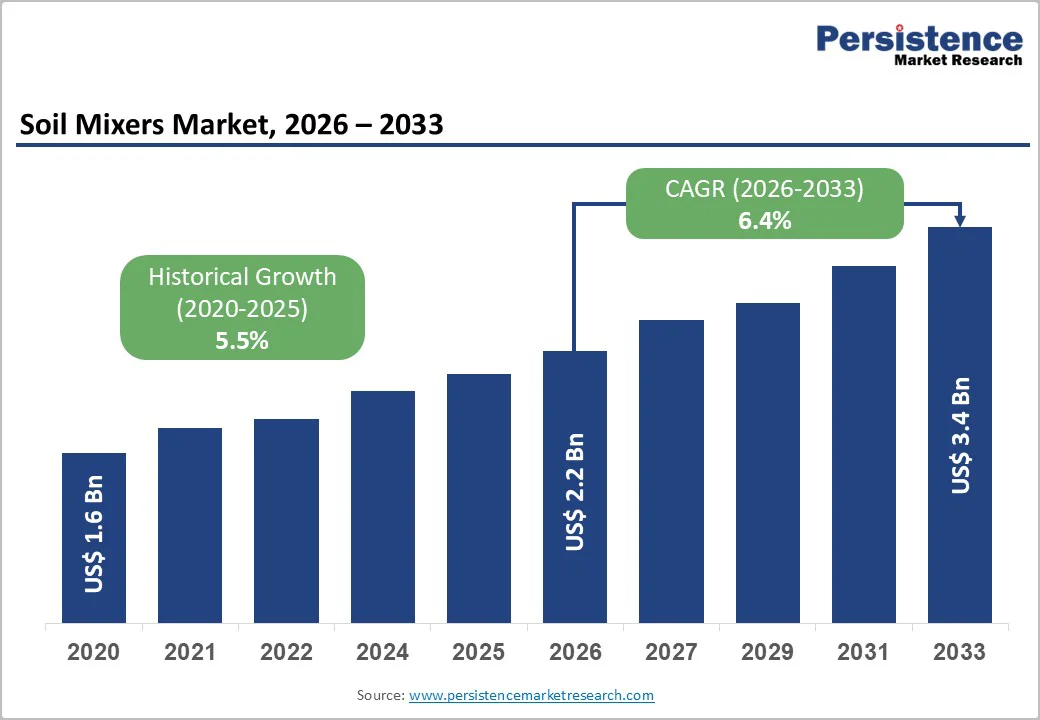
The global soil mixers market size is likely to be valued at US$ 2.2 billion in 2026 and is estimated to reach US$ 3.4 billion by 2033, growing at a CAGR of 6.4% during the forecast period 2026−2033. Mechanization of agricultural practices, rising infrastructure development activities, and increased focus on soil health management and land productivity enhancement are primarily driving market growth. Governments and international organizations such as the Food and Agriculture Organization (FAO) and national agriculture departments continue to promote sustainable soil management practices, directly supporting demand for efficient soil mixing equipment. Technological advancements, including automated and high-capacity soil mixers, have further improved productivity, operational efficiency, and consistency of soil preparation. Rapid urbanization and large-scale construction projects in emerging economies are expanding the application base of soil mixers beyond traditional farming, reinforcing long-term market growth.
Key Industry Highlights
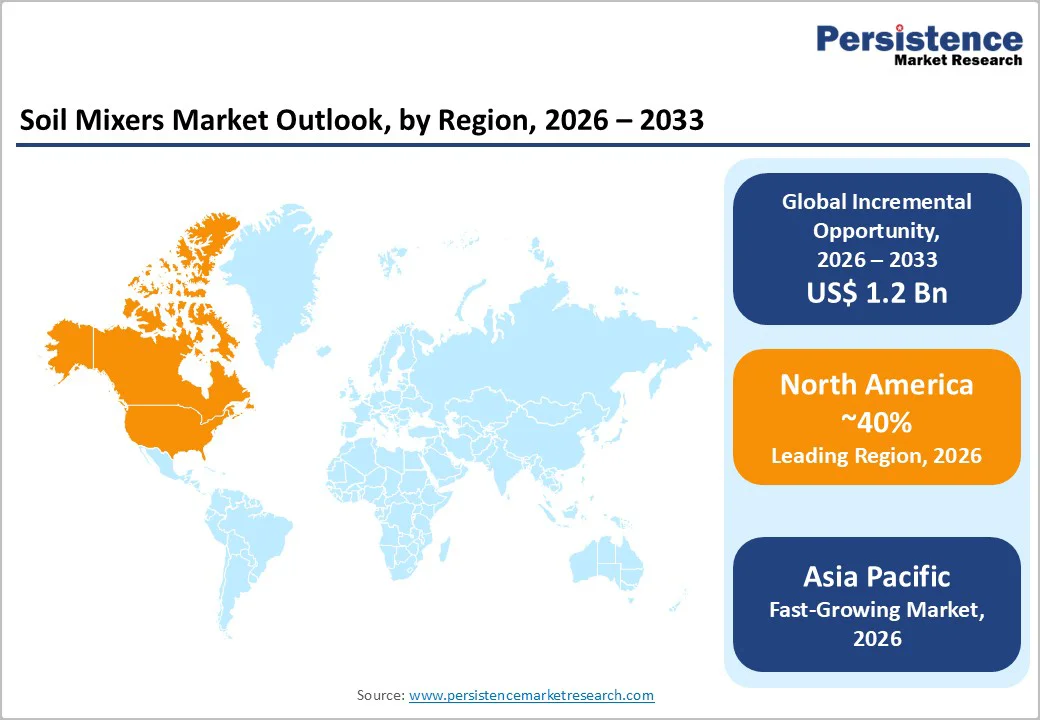
- Dominant Region: North America is estimated to lead in 2026 with about 40% share, propelled by advanced mechanization in agriculture and construction.
- Fastest-growing Regional Market: Asia Pacific is projected to be the fastest-growing market through 2033, powered by commercial agriculture expansion and adoption of mechanized soil preparation solutions.
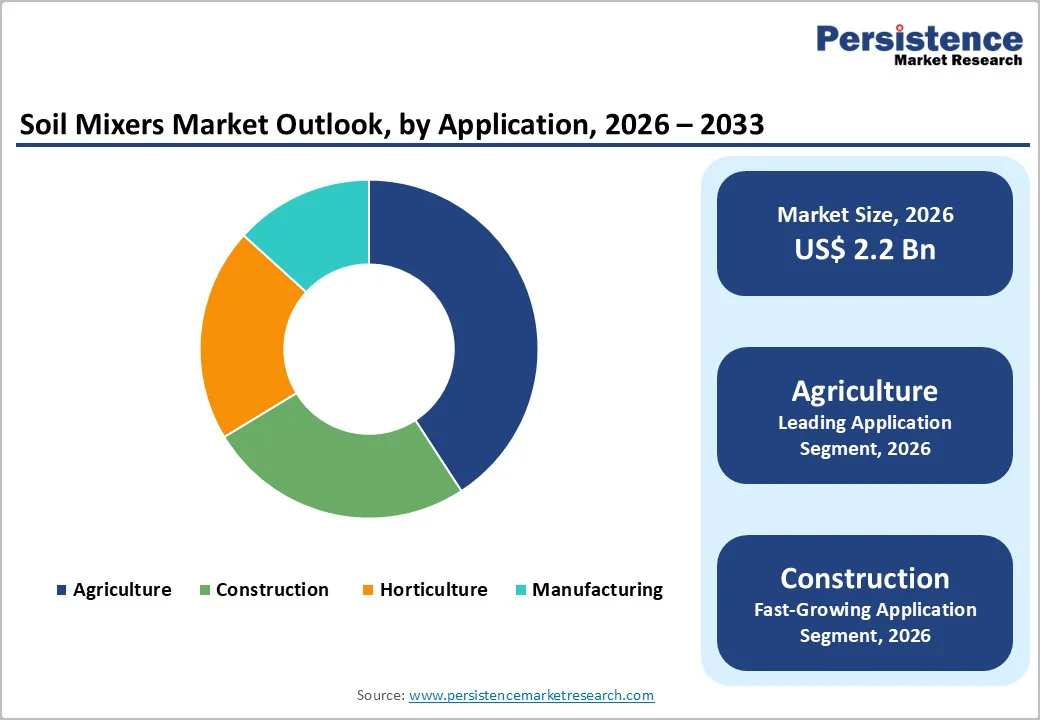
- Leading Application: In 2026, agriculture is anticipated to capture around 40% revenue share, fueled by the increasing uptake of advanced mechanized solutions for sustainable and consistent productivity.
- Fastest-growing Application: Construction is projected to be the fastest-growing segment through 2033, driven by infrastructure expansion and a strong demand for soil stabilization in large-scale civil projects.
- Key Driver: Expansion of high-capacity mechanized mixers supports large-scale farming and industrial operations while promoting sustainable soil management.
| Report Attribute | Details |
|---|---|
|
Soil Mixers Market Size (2026E) |
US$ 2.2 Bn |
|
Market Value Forecast (2033F) |
US$ 3.4 Bn |
|
Projected Growth (CAGR 2026 to 2033) |
6.4% |
|
Historical Market Growth (CAGR 2020 to 2025) |
5.5% |
Market Factors – Growth, Barriers, and Opportunity Analysis
Increasing Global Food Demand and Sustainable Farming Practices
Rising global food demand is intensifying pressure on agricultural systems to achieve higher productivity from finite land resources. For example, according to the 2025 State of Food Security and Nutrition in the World (SOFI) Report, published by five specialized agencies of the United Nations (UN), around 733 million people suffered from hunger in 2023. This environment has heightened the need for efficient soil preparation, where uniform mixing enhances nutrient distribution, moisture balance, and root development. Consistent soil conditions support predictable yields and operational efficiency, which aligns with commercial farming objectives focused on output reliability and cost optimization. Mechanized soil treatment plays a central role in enabling large-scale cultivation practices that meet growing consumption requirements while maintaining production consistency.
Sustainable farming practices further strengthen this driver through emphasis on long-term soil quality and responsible resource use. Precision soil mixing supports controlled incorporation of organic matter and soil conditioners, improving structure and fertility while minimizing degradation. Enhanced aeration and stability reduce erosion and input losses, reinforcing compliance with environmental and regulatory frameworks. Adoption of advanced soil management solutions reflects a strategic transition toward resilient agricultural systems that balance productivity with sustainability. These practices support long-term land viability and reinforce the role of mechanized soil preparation as a foundational element in modern agricultural operations.
Shortage of Skilled Operators and Technical Expertise
Limited availability of trained professionals capable of operating advanced mixing equipment constrains effective deployment across projects. Modern systems rely on precise control mechanisms, automation features, and digitally enabled interfaces that require specialized operational knowledge. Training ecosystems in many regions remain misaligned with these technical demands, leading to a mismatch between equipment sophistication and workforce capability. As experienced operators retire and fewer new entrants receive adequate technical exposure, execution efficiency declines and operational errors increase, affecting project timelines and quality outcomes.
Training intensity and cost further reinforce this restraint within project-driven industries. Skill development programs demand extended learning cycles and practical exposure, which conflict with tight construction schedules and short-term contracting models. Rapid technological upgrades increase the frequency of retraining needs, placing pressure on employers to maintain workforce readiness. Inconsistent access to manufacturer-led training amplifies dependence on a limited group of specialists, raising labor expenses and limiting scalability. These workforce constraints restrict optimal equipment utilization and slow adoption across complex applications, reinforcing technical skill shortages as a persistent operational challenge.
Adoption of Automated and Digitally Controlled Mixing Systems
Increasing demand for precision-driven operations has elevated automated and digitally controlled mixing systems as a high-potential opportunity. Controlled automation enables consistent material blending and accurate parameter management, supporting stable output quality across diverse application environments. Digital control platforms strengthen process visibility through real-time feedback, allowing operators to maintain performance standards with minimal manual dependency. This approach supports efficiency gains, reduces material variability, and aligns with growing expectations for reliability and standardized execution in complex projects.
Integration of digital control technologies unlocks long-term operational value through intelligent system management. Embedded sensors and software analytics enable condition monitoring, early fault detection, and optimized maintenance planning, leading to improved equipment availability and cost discipline. Automated operation frameworks also mitigate labor constraints and enhance workplace safety through reduced manual exposure. As performance accountability and execution speed gain importance, digitally enabled mixing systems emerge as a strategic pathway toward operational resilience and scalable growth.
Category-wise Analysis
Product Type Insights
Horizontal soil mixers are poised to dominate with a forecasted market share of 35% in 2026, driven by superior performance in high-volume agricultural operations. The horizontal configuration enables uniform blending through continuous paddle movement, supporting consistent soil texture and nutrient dispersion. This reliability aligns with large-scale farming and commercial horticulture requirements, where throughput and quality control influence profitability. Widespread use in greenhouse cultivation and open-field preparation highlights preference for equipment that reduces cycle time, limits material loss, and supports standardized output across repeated mixing processes during seasonal planting and soil conditioning programs globally.
Deep soil mixing equipment is anticipated to be the fastest-growing segment through 2033, propelled by the rising demand for ground stabilization in construction and infrastructure projects. The technology supports in situ reinforcement of weak soils, enhancing load-bearing capacity and structural reliability. Growth is particularly fueled by urban development, including metro systems, high-rise foundations, and transport corridors. Applications such as tunnel foundations and coastal redevelopment illustrate its value in minimizing excavation, controlling settlement, and ensuring predictable execution, making it a strategic solution for complex ground improvement challenges by 2033.
Capacity Insights
Medium-capacity soil mixers are forecasted to lead the market with a 40% share in 2026, owing to their balance of operational efficiency and cost-effectiveness. The segment is favored by medium-sized farms, commercial nurseries, and smaller construction projects where flexibility, manageable power requirements, and consistent output are critical. For instance, regional horticulture operations prefer medium-capacity systems to prepare bulk soil mixes without overcommitting resources, ensuring timely planting schedules and optimized material usage. Broad applicability across diverse operations reinforces its dominant market position.
Large-capacity soil mixers are set to emerge as the fastest-growing segment between 2026 and 2033, supported by rising demand in commercial agriculture, large-scale government infrastructure projects, and industrial construction. High-volume systems provide economies of scale, enabling efficient handling of extensive soil volumes while reducing labor intensity and operational time. Projects such as industrial park development and large-scale greenhouse installations exemplify adoption, where consistent, high-capacity mixing ensures productivity, minimizes project delays, and supports cost-effective execution, making this segment a key growth driver.
Application Insights
Agriculture is likely to be the leading segment in 2026, projected to hold an estimated 40% of the soil mixers market revenue share, propelled by extensive soil amendment requirements across global farmland. The segment benefits from initiatives aimed at improving crop yield, soil fertility, and sustainable farming practices. For instance, large-scale cereal and vegetable farms adopt advanced soil mixers to ensure uniform nutrient distribution and optimal soil structure, enhancing productivity. Consistent performance, broad applicability, and alignment with food security goals reinforce agriculture as the dominant end-use segment, supporting steady investment and adoption across diverse farming regions.
Construction is anticipated to be the fastest-growing segment through 2033, fueled by rapid urbanization and infrastructure expansion. Demand for soil stabilization and ground improvement is increasing across active project sites, particularly in metro rail, highway development, and commercial complexes. Large-scale civil projects use soil mixers to ensure structural integrity, reduce settlement, and maintain project timelines. Applications such as foundation strengthening for high-rise buildings and industrial parks demonstrate efficiency gains, highlighting construction’s role in driving future market growth and reinforcing adoption of advanced soil mixing solutions.
Regional Insights
North America Soil Mixers Market Trends
North America is estimated to lead in 2026, capturing approximately 40% of the soil mixers market share in 2026, reflecting strong adoption across both agriculture and construction sectors. The region’s dominance is driven by integration of advanced mechanization and precision farming technologies that enhance soil management efficiency and crop productivity. Large-scale commercial farms rely on high-capacity mixers for uniform soil conditioning and nutrient distribution, reducing variability in yield outcomes. In construction, urbanization and redevelopment projects require soil stabilization for complex foundations and infrastructure development, further reinforcing consistent demand. Access to modern equipment, well-developed logistics networks, and a high concentration of skilled operators ensures efficient deployment of advanced soil mixing systems, creating operational reliability that competitors find difficult to match.
Substantial investment in research and innovation, facilitating the development of automated and digitally controlled soil mixers, is a prominent factor favoring North America’s top position in the market. The dedicated implementation of IoT-enabled systems has enabled real-time monitoring, predictive maintenance, and data-driven operational optimization, delivering quantifiable productivity and cost efficiencies. Regulatory frameworks promoting sustainable land use, coupled with financial incentives for advanced agricultural practices and environmentally conscious construction techniques, support widespread adoption. Strategic collaborations between equipment manufacturers and large-scale commercial operators ensure continuous product adaptation and efficient deployment, reinforcing market dominance.
Europe Soil Mixers Market Trends
Europe is predicted to hold a significant position in the market through 2033, supported by advanced agricultural practices and stringent environmental regulations. The adoption of precision farming techniques, including automated soil preparation and nutrient management, supports consistent crop yield and efficient land use. Governments across Europe incentivize sustainable agricultural practices, encouraging investment in high-efficiency soil mixers that minimize resource consumption and reduce environmental impact. In horticulture and specialty crop production, mechanized soil mixers enable uniform soil conditioning, optimize planting schedules, and ensure quality standards, reinforcing the region’s focus on productivity and sustainability.
Infrastructure development in Europe also contributes to demand for soil mixers in construction and land stabilization projects. Urban redevelopment, high-speed rail networks, and commercial construction require reliable soil mixing solutions to ensure structural integrity and minimize settlement risks. Advanced construction regulations and strict quality control standards encourage the use of automated and high-capacity soil mixers, enhancing project efficiency. Integration of IoT and digital monitoring systems in equipment deployment allows real-time tracking of operations, predictive maintenance, and cost optimization, positioning Europe as a technologically sophisticated market with stable and growing demand.
Asia Pacific Soil Mixers Market Trends
Asia Pacific is forecasted to be the fastest-growing regional market for soil mixers between 2026 and 2033, powered by rapid urbanization and expanding commercial agriculture. Growing population density and rising demand for food security are creating pressure on agricultural operations to adopt mechanized and high-efficiency soil preparation solutions. Governments across the region are implementing initiatives to modernize farming practices, enhance soil fertility, and promote sustainable land management. Large-scale farms and commercial horticulture operations increasingly rely on advanced soil mixers to improve productivity, optimize resource use, and maintain consistent soil quality, making mechanization a key factor supporting market growth in Asia Pacific.
Infrastructure development further accelerates demand for soil mixing equipment in Asia Pacific. Rapid expansion of transportation networks, metro systems, and commercial complexes requires reliable soil stabilization and ground improvement solutions. Large construction projects benefit from automated and high-capacity soil mixers, which reduce operational time, enhance safety, and minimize settlement risks. Investments in modern construction technologies, combined with government-backed urban development programs, support adoption of advanced soil preparation equipment. Strategic deployment of these technologies across agricultural and construction sectors positions Asia Pacific as a primary growth engine, with consistent demand anticipated to sustain rapid market expansion through 2033.
Competitive Landscape
The global soil mixers market structure is moderately consolidated, with a few established players accounting for significant revenue while numerous regional original equipment manufacturers maintain competitive pressure. Leading companies such as Mitchell Ellis Products, Bouldin and Lawson, C?Mac Industries, H.C. Davis Sons Manufacturing, and Kase Horticulture hold strong positions in high-capacity and technologically advanced product segments. These companies leverage innovation, precision engineering, and product customization to meet the diverse requirements of agriculture, horticulture, and construction applications.
Large agricultural equipment manufacturers focus on mechanization and operational efficiency, while specialized engineering firms emphasize durability, automation, and digital integration. The presence of regional manufacturers ensures competitive pricing and localized solutions, creating a dynamic market environment. Strategic collaborations, investments in research and development, and expansion of distribution networks further strengthen leadership positions, allowing these companies to capture emerging opportunities, adapt to evolving customer needs, and maintain a balance between technological advancement and operational efficiency across global markets.
Key Industry Developments
- In December 2025, the Gateway Development Commission has completed manufacturing and factory testing of the first two tunnel boring machines (TBMs) for the Hudson Tunnel Project, marking a major construction milestone on the New Jersey side of the Hudson River. These custom-built TBMs will be shipped from Germany to New Jersey in early 2026 to excavate roughly 1.6 kilometres (about one mile) of new twin rail tubes while installing concrete liners, advancing the broader Gateway rail capacity upgrade between New Jersey and New York.
- In September 2025, SANY India launched the SSR110C-10 PRO, a vibratory soil compactor engineered for demanding road projects, featuring a 132 horsepower (HP) fuel-efficient engine, dual-frequency vibration, 2,134 millimeter drum width, and optional compaction meter for real-time soil density monitoring. The model features an ergonomic operator station, touchscreen controls, and MachineLink+ telematics with a service-friendly design, positioning SANY as a strong partner for India’s infrastructure modernization vision.
- In May 2025, at bauma, RTG Rammtechnik showcased its eRG 21 T hybrid piling rig, which combines a diesel engine with an electric motor to cut fuel use, noise, and emissions by up to 68%.?
The company also highlighted its multi-shaft mixing system (MSM), which offers flexible, high-precision soil mixing for cut-off walls, groundwater barriers, and soil improvement with real-time monitoring through Bauer’s B-Tronic control.
Companies Covered in Soil Mixers Market
- Mitchell Ellis Products
- Bouldin & Lawson
- C‑Mac Industries
- H.C. Davis Sons Manufacturing
- Kase Horticulture
- Pack Manufacturing
- Gothic Arch Greenhouses
- Alpine Sales & Rental
- HETO Agrotechnics
- Deep Soil Mixing, Inc.
- Kubota Corporation
- John Deere
Frequently Asked Questions
The global soil mixers market is projected to reach US$ 2.2 billion in 2026.
Rising demand for mechanized soil preparation, construction stabilization, and advanced agricultural productivity drives the market.
The market is poised to witness a CAGR of 6.4% from 2026 to 2033.
Integration of IoT-enabled monitoring, sustainable soil management solutions, and expansion in urban infrastructure projects can create significant market opportunities.
Mitchell Ellis Products, Bouldin & Lawson, C‑Mac Industries, H.C. Davis Sons Manufacturing, Kase Horticulture, Pack Manufacturing, Gothic Arch Greenhouses are few of the key players in the market.


