




- Hardware & Software IT Services
- Sentiment Analysis Software Market
Sentiment Analysis Software Market Size, Trends, Share, and Growth Forecast, 2026 – 2033
Sentiment Analysis Software Market by Deployment Type (Cloud-Based, On-Premises, Hybrid), Technology (NLP, ML, AI, Rule-Based Systems), End-User (Retail & E-Commerce, BFSI, Information Technology & Telecommunications, Healthcare & Life Sciences, Media & Entertainment, Government & Public Sector, Manufacturing, Travel & Hospitality), and Regional Analysis for 2026-2033

Sentiment Analysis Software Market Share and Trends Analysis
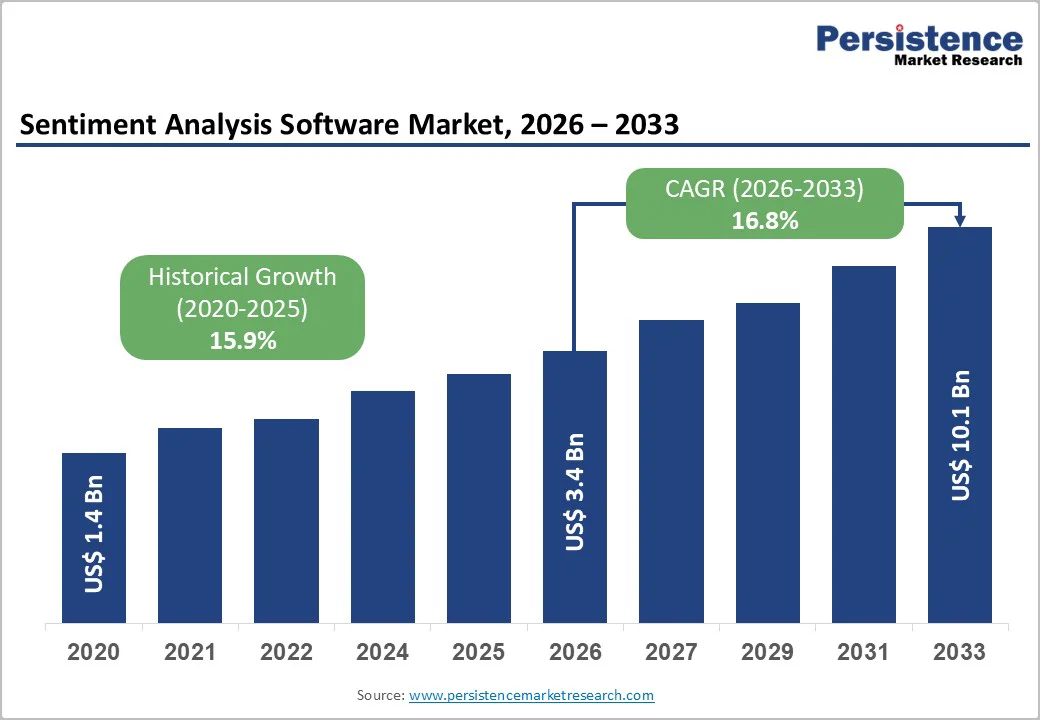
The global sentiment analysis software market size is likely to be valued at US$ 3.4 billion in 2026 and is estimated to reach US$ 10.1 billion by 2033, growing at a CAGR of 16.8% during the forecast period 2026−2033. The market is likely to gain strong momentum, stimulated by rising adoption of advanced analytics across retail, banking, and digital media sectors. Organizations increasingly leverage sentiment intelligence to enhance customer experience management, strengthen brand monitoring, and support real-time, data-driven decision-making. As digital engagement expands, sentiment analysis plays a critical role in interpreting customer perceptions and managing reputational risk. The market benefits from growing preference for cloud-based deployment models due to scalability, flexibility, and cost efficiency, particularly among small and medium-sized enterprises (SMEs). At the same time, advancements in natural language processing (NLP), machine learning (ML), and artificial intelligence (AI) have improved analytical accuracy across multilingual and context-rich datasets. Regulatory emphasis on customer protection, data transparency, and service quality measurement further reinforces demand, positioning the market as a core component of modern enterprise analytics infrastructure.
Key Industry Highlights
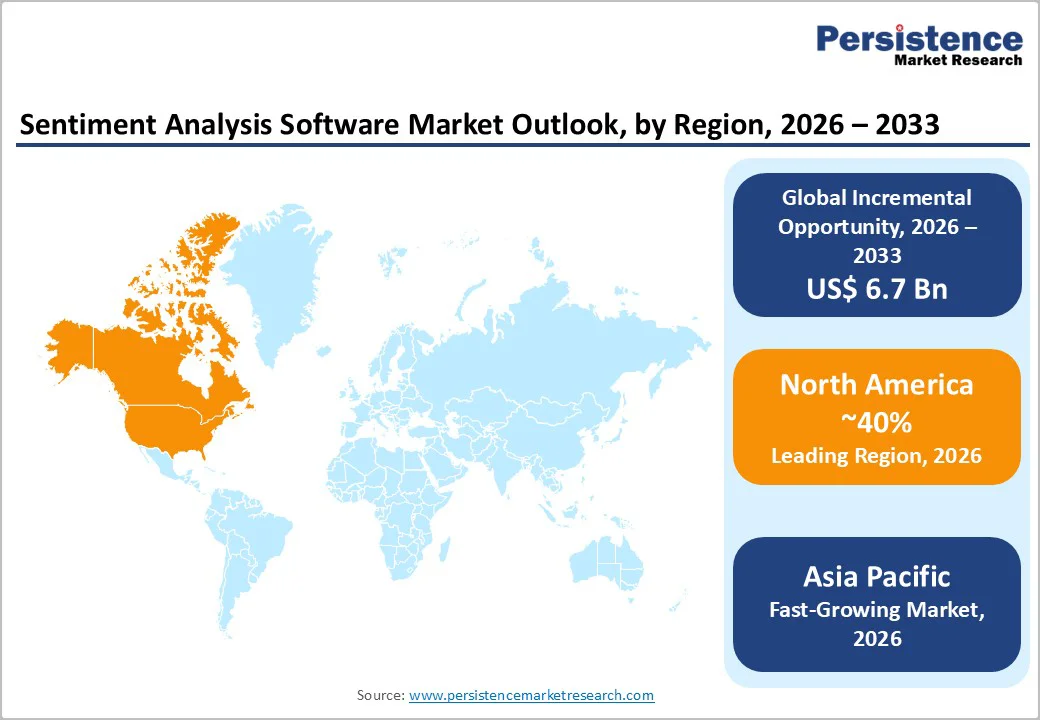
- Dominant Region: North America is expected to hold about 40% of the market share in 2026, driven by strong digital maturity and widespread cloud adoption.
- Fastest-growing Regional Market: Asia Pacific is projected to be the fastest-growing market from 2026 to 2033, propelled by widening digital adoption and rapid e-commerce growth.
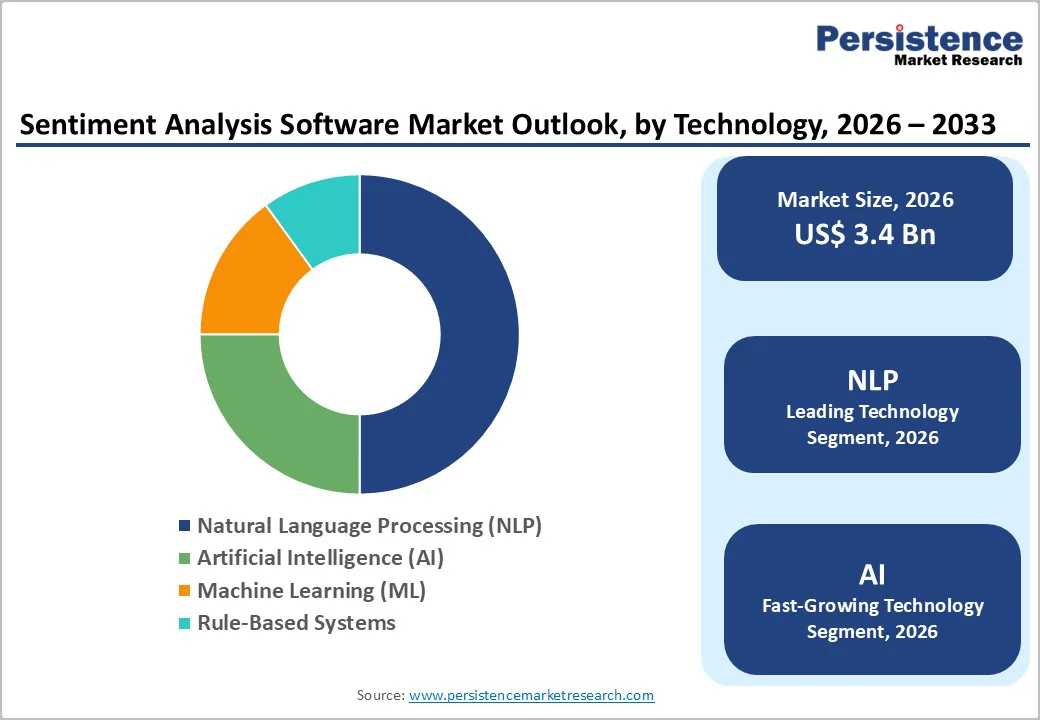
- Leading Technology: Natural language processing (NLP) is forecasted to hold a 50% share of the technology segment in 2026, as it enables effective analysis of unstructured and multilingual data.
- Fastest-growing Technology: AI-driven sentiment analysis is expected to be the fastest-growing segment from 2026 to 2033, driven by self-learning algorithms and broad enterprise adoption beyond rule-based approaches.
- Market Drivers: Rapid growth of digital data, social media engagement, and demand for real-time customer insights are propelling the market forward.
- July 2025: GGWP launched Pulse, a real-time sentiment analysis and insights tool that transforms anonymized in-game text and voice chats into actionable business intelligence for game studios.
| Key Insights | Details |
|---|---|
| Sentiment Analysis Software Market Size (2026E) | US$ 3.4 Bn |
| Market Value Forecast (2033F) | US$ 10.1 Bn |
| Projected Growth (CAGR 2026 to 2033) | 16.8% |
| Historical Market Growth (CAGR 2020 to 2025) | 15.9% |
Market Factors – Growth, Barriers, and Opportunity Analysis
Mounting Volume of Unstructured Data
The rapid expansion of unstructured data acts as a primary growth catalyst as enterprises face increasing volumes of text, voice, and digital interactions generated across daily operations. Emails, social media posts, customer reviews, chat transcripts, and survey comments create data streams that traditional analytics tools cannot process efficiently. Manual analysis lacks scalability and consistency, leading organizations to adopt automated language intelligence systems. These tools convert fragmented human expressions into structured insights that support decision making, service optimization, and reputation management. IBM estimates that over 90% of global data is unstructured, highlighting the scale challenge faced by modern enterprises and reinforcing the need for advanced analytical solutions.
Unstructured data carries direct signals related to customer emotion, intent, and perception, making it strategically valuable for competitive differentiation. Enterprises prioritize real time interpretation of this data to identify dissatisfaction, detect emerging trends, and align offerings with market expectations. Automation through advanced language models enables faster insight extraction, reduced operational effort, and standardized interpretation across business units. This capability supports leadership teams in aligning strategy with real market sentiment, improving responsiveness, and strengthening long term customer engagement. The growing reliance on digital communication channels continues to elevate the strategic relevance of unstructured data analytics in enterprise intelligence frameworks.
Data Privacy and Accuracy Challenges in Multilingual Contexts
Data privacy and accuracy challenges in multilingual environments act as a key restraint due to the complex interaction between regulatory pressure and data handling limitations. Sentiment interpretation relies on large volumes of textual and voice-based data sourced from customers, employees, and public platforms. This data often contains sensitive or personally identifiable information, triggering strict compliance requirements under global and regional regulations such as data protection and cross-border data transfer laws. Compliance obligations restrict data collection, storage, and processing flexibility, leading to limited training datasets and constrained analytical depth. Reduced access to diverse datasets weakens model robustness and slows enterprise adoption across regulated industries.
Accuracy challenges intensify in multilingual contexts due to linguistic diversity, cultural subtlety, and semantic variation. Language structures, idioms, sarcasm, and context differ significantly across regions, creating inconsistency in sentiment classification outcomes. Automated models trained primarily on dominant languages struggle to interpret low-resource languages and mixed-language content commonly used in digital communication. Misclassification risks rise when tone, emotion, or intent varies by cultural context, affecting decision reliability for business strategy, customer engagement, and risk assessment. Enterprises hesitate to scale deployment when analytical outputs lack consistency across geographies, limiting confidence in insights and reducing overall commercial value for global operations.
Digitalization of Economic Activities in Developing Nations
Expansion across emerging digital economies represents a major growth opportunity driven by accelerating digital engagement and rising volumes of online consumer interactions. Enterprises across these regions generate large volumes of unstructured text through e-commerce reviews, social media engagement, digital payments, and online customer support. This data creates a strong demand for automated tools that can interpret public opinion and consumer emotions at scale. Growing adoption of cloud computing and Software as a Service models reduces entry barriers, allowing organizations to deploy advanced analytics without heavy infrastructure investment. Rising awareness of customer-centric strategies further increases interest in data-driven insight solutions.
Newly digitalized economies also present favorable conditions through evolving enterprise maturity and competitive intensity. Companies aim to differentiate brands, improve service quality, and strengthen customer loyalty in fast-growing markets. Real-time insight into consumer sentiment supports faster decision-making and agile response to shifting preferences. Multilingual and regional language support enhances relevance in diverse populations, strengthening adoption potential. Expanding startup ecosystems and digital transformation initiatives across banking, retail, healthcare, and telecommunications accelerate the integration of intelligent analytics tools. These factors together position emerging digital economies as a long-term growth engine and strategic focus area for advanced sentiment intelligence solutions.
Category-wise Analysis
Deployment Type Insights
Cloud-based deployment is poised to lead with a forecasted 55% of the sentiment analysis software market revenue share in 2026, driven by scalability, cost efficiency, and ease of implementation across diverse enterprise environments. Organizations can integrate analytics capabilities rapidly without significant infrastructure investment, enabling faster time-to-insight. Cloud models support efficient management of variable data volumes, ranging from social media feeds to customer feedback channels, while offering remote accessibility for distributed teams. Enterprises operating across multiple regions increasingly favor cloud deployment for centralized data management and real-time sentiment evaluation.
Hybrid deployment is anticipated to be fastest-growing segment between 2026 and 2033, fueled by organizations in regulated sectors such as healthcare and banking that require sensitive information to remain on-premises while leveraging cloud-based analytics engines for large-scale processing. Hybrid models offer a balance of compliance, flexibility, and operational efficiency. Companies can maintain control over critical data and simultaneously benefit from advanced AI and NLP capabilities. For instance, financial institutions adopt hybrid solutions to analyze customer sentiment without compromising regulatory obligations, accelerating adoption trends.
Technology Insights
Natural language processing is slated to hold a dominant position, with an anticipated 45% share of the sentiment analysis software market revenue in 2026. Its strength lies in interpreting unstructured text, detecting sentiment nuances, and delivering contextually accurate scoring. Enterprises use NLP for multilingual content analysis, gaining insights across diverse customer bases. Advanced language modeling enables detection of sarcasm, idioms, and domain-specific terminology. For example, e-commerce platforms analyze thousands of daily product reviews with NLP, converting sentiment into actionable service improvements.
AI-driven sentiment analysis is expected to be the fastest-growing segment, forecast to expand rapidly from 2026 to 2033. Growth is fueled by self-learning algorithms that continuously enhance accuracy, automation of sentiment extraction, and integration with predictive and prescriptive analytics. AI models efficiently handle large-scale data and detect subtle sentiment shifts in real time. Financial institutions implement AI engines to anticipate customer churn from textual feedback, demonstrating superior performance over traditional rule-based approaches, encouraging adoption across multiple sectors.
End-User Insights
The retail and e-commerce sector is anticipated to remain the largest among all end-user segments, estimated to hold around 35% in 2026. Leadership is supported by the ability to monitor customer sentiment across multiple digital touchpoints, including online reviews, social media discussions, and feedback forms. Organizations convert insights into product improvements, personalized marketing strategies, and enhanced service delivery. For example, global e-commerce platforms analyze customer comments in real time to adjust inventory, optimize recommendations, and strengthen engagement, maintaining competitive advantage in dynamic online markets.
Banking, financial services, & insurance (BFSI) is likely to represent the fastest-growing end-user vertical, expected to grow at a robust pace during the 2026-2033 forecast period. Growth is stimulated by regulatory compliance monitoring, fraud detection, and customer experience enhancement across digital channels. Financial institutions utilize sentiment analysis to interpret client feedback, assess satisfaction levels, and detect early signs of churn. For example, banks analyze chat transcripts and service emails to forecast account closures, enabling proactive retention strategies. The increasing reliance on digital interactions accelerates adoption across the sector.
Regional Insights
North America Sentiment Analysis Software Market Trends
North America is forecast to dominate in 2026, with an estimated 40% of the sentiment analysis software market share in 2026. Dominance is reinforced by the concentration of leading technology firms and analytics service providers that continuously develop advanced solutions integrating artificial intelligence and natural language processing. High enterprise digital maturity allows rapid adoption of cloud-based and hybrid deployment models, enabling organizations to process massive volumes of unstructured data efficiently. Corporations leverage sentiment intelligence to monitor brand perception, evaluate customer feedback, and inform strategic decision-making. Early adoption of AI-driven predictive analytics enhances the ability to anticipate market trends and consumer behavior, creating a competitive edge for regional enterprises.
Another critical factor sustaining the leadership of North America is the prevalence of omnichannel customer engagement strategies. Organizations increasingly integrate social media, email, chat, and survey data to generate holistic sentiment insights. Investment in research and development, coupled with availability of skilled data science talent, accelerates innovation and improves analytical accuracy. Large-scale adoption of Software-as-a-Service (SaaS) models further reduces entry barriers for mid-market and emerging companies. Strategic partnerships between analytics vendors and industry-specific platforms enhance solution customization, ensuring relevance across diverse enterprise operations. Real-time analytics capabilities provide actionable insights for marketing, customer experience, and risk management initiatives, solidifying regional dominance in 2026.
Europe Sentiment Analysis Software Market Trends
Europe represents a significant and steadily growing market for sentiment analysis software, powered by high digital adoption across enterprises and government initiatives promoting data-driven decision-making. Organizations in retail, financial services, telecommunications, and healthcare increasingly rely on sentiment intelligence to enhance customer experience, monitor brand reputation, and optimize marketing campaigns. Strong regulatory frameworks, including data privacy and cybersecurity standards, encourage adoption of advanced analytics while ensuring compliance, making European enterprises more confident in deploying cloud-based and hybrid solutions at scale.
Technological innovation also fuels growth in Europe, with AI and natural language processing being widely integrated into analytics platforms. Multilingual capabilities are critical, allowing organizations to analyze feedback across diverse linguistic and cultural contexts, from Western to Eastern Europe. Companies leverage real-time sentiment insights to respond quickly to market trends, identify service gaps, and improve engagement strategies. Collaboration between technology providers, research institutions, and enterprise clients accelerates the development of specialized tools tailored to industry needs, positioning Europe as a mature and strategically important market in the global sentiment analysis landscape
Asia Pacific Sentiment Analysis Software Market Trends
Asia Pacific is forecasted to be the fastest-growing regional market for sentiment analysis software between 2026 and 2033, supported by rapid digital adoption, expanding e-commerce ecosystems, and increasing reliance on social media for customer engagement. High smartphone penetration and growing internet access enable organizations to collect large volumes of consumer-generated data, creating demand for advanced analytics solutions. Enterprises use insights to optimize product strategies, enhance marketing effectiveness, and improve customer service across diverse markets, driving accelerated adoption of sentiment intelligence tools throughout the region.
Multilingual and culturally contextual analytics further strengthen growth prospects. Companies in retail, financial services, telecommunications, and travel increasingly integrate sentiment analysis into digital platforms to monitor consumer preferences and anticipate behavior in real time. Technology-driven startups leverage AI and cloud infrastructure to deliver scalable solutions, while government initiatives promoting digital transformation and smart city projects create an enabling environment for adoption. These combined factors position Asia Pacific as a strategic growth engine for the sentiment analytics market over the forecast period.
Competitive Landscape
The global sentiment analysis software market structure demonstrates moderate consolidation, with IBM, SAS Institute, Oracle, SAP SE, and Salesforce capturing a significant portion of total revenue. Dominance is propelled by these established technology firms offering comprehensive sentiment analysis solutions. Market dynamics reflect a transition from smaller startups to integrated platforms capable of handling large-scale data, supporting enterprise-wide deployment across industries.
Competitive strategies in the sentiment analysis software market focus on enhancing AI accuracy and platform scalability. Leaders differentiate through advanced analytics capabilities, delivering precise sentiment insights that inform strategic decision-making. Emphasis on performance benchmarks, reliability, and seamless integration across digital channels reinforces market positioning, enabling top firms to maintain an advantage while meeting growing demand for real-time, actionable sentiment intelligence solutions.
Key Industry Developments
- In November 2025, Search Party launched the new Sonar platform, an AI-driven tool that enhances control over AI visibility. The platform helps organizations track sentiment trends, monitor brand perception, and refine messaging strategies, solidifying its position as a leading solution for managing AI-driven insights.
- In October 2025, Yoast launched a new AI Visibility tool to help websites improve search engine performance by analyzing content visibility and optimization. The tool tracks brand mentions, performs sentiment analysis, benchmarks competitors, and provides actionable insights, enabling marketers and content creators to enhance rankings and better reach target audiences
- In October 2025, SAP expanded its Business AI portfolio with new Joule Agents and AI Assistants across finance, supply chain, HR, customer service, and sustainability. Key updates include AI-assisted mobile execution, sentiment analysis from unstructured feedback, and workflow automation, enhancing productivity, decision-making, and operational efficiency for enterprises globally.
Companies Covered in Sentiment Analysis Software Market
- IBM Corporation
- SAS Institute Inc.
- Oracle Corporation
- SAP SE
- Salesforce Inc.
- Clarabridge
- Lexalytics
- Brandwatch
- Meltwater
- NetOwl
- OpenText Corporation
- Medallia Inc.
- MonkeyLearn
- Repustate Inc.
- Infogain Corporation
Frequently Asked Questions
The global sentiment analysis software market is projected to reach US$ 3.4 billion in 2026.
Rapid growth of digital data, social media engagement, AI and NLP advancements, and demand for real-time customer insights drive the market.
The market is poised to witness a CAGR of 16.8% from 2026 to 2033.
Expansion across emerging digital economies, AI-driven solutions, cloud and hybrid deployments, and multilingual analytics present key market opportunities.
IBM Corporation, SAS Institute Inc., Oracle Corporation, SAP SE, Salesforce Inc., Clarabridge, Lexalytics, Brandwatch, Meltwater are some of the key players in the market.


