




- Biotechnology
- Restriction Enzymes Market
Restriction Enzymes Market Size, Share, and Growth Forecast, 2026 - 2033
Restriction Enzymes Market by Product Type (Type II, Type IV, Others), Application (Cloning, Sequencing, Others), End-user, and Regional Analysis for 2026 - 2033

Restriction Enzymes Market Size and Trends Analysis
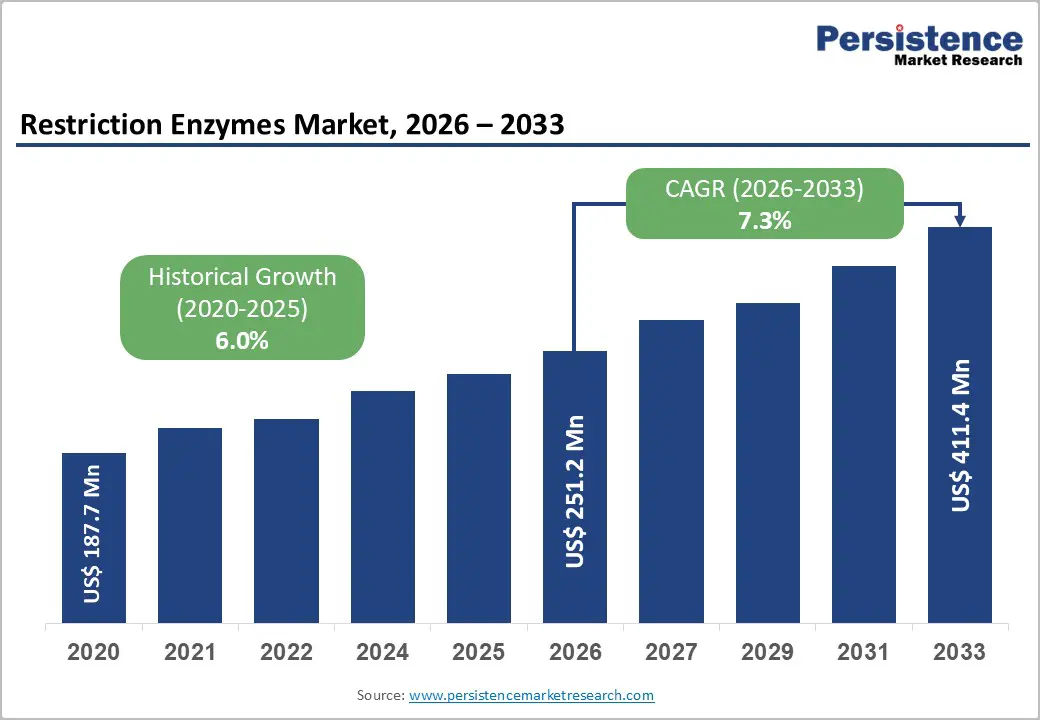
The global restriction enzymes market size is likely to be valued at US$251.2 million in 2026 and is expected to reach US$411.4 million by 2033, growing at a CAGR of 7.3% between 2026 and 2033, driven by sustained demand for cloning, plasmid linearization, sequencing library preparation, and molecular diagnostics.
The continued dominance of Type II enzymes ensures strong baseline consumption across laboratories, while emerging applications in epigenetics, mRNA manufacturing, and precision medicine are expanding the market scope.
Key Industry Highlights:
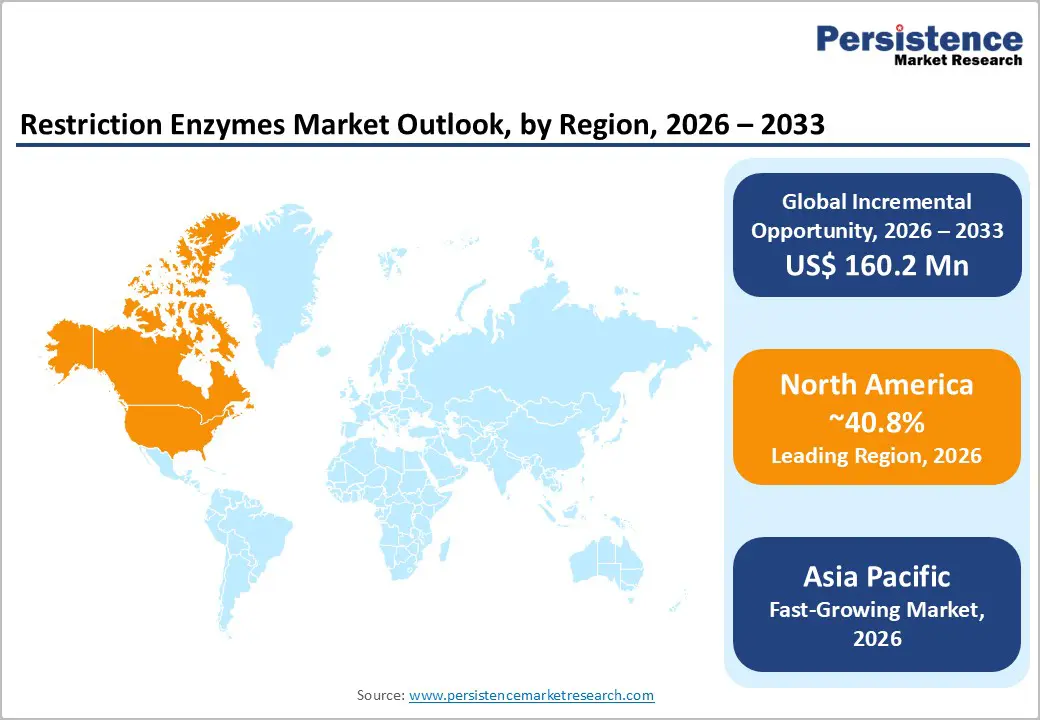
- Leading Region: North America is projected to account for 40.8% of the market share, supported by strong research infrastructure, advanced biotechnology capabilities, and the presence of leading life sciences companies.
- Fastest-growing Region: Asia Pacific is projected to be the fastest-growing region, driven by rising biotechnology investments, expanding genomics research, and increasing pharmaceutical manufacturing activity across countries such as China, India, and Japan.
- Investment Plans: Major industry participants are actively investing in enzyme innovation, GMP-grade production capabilities, and regional expansion, particularly in Asia Pacific, to strengthen supply chains and address growing demand in molecular diagnostics and therapeutic applications.
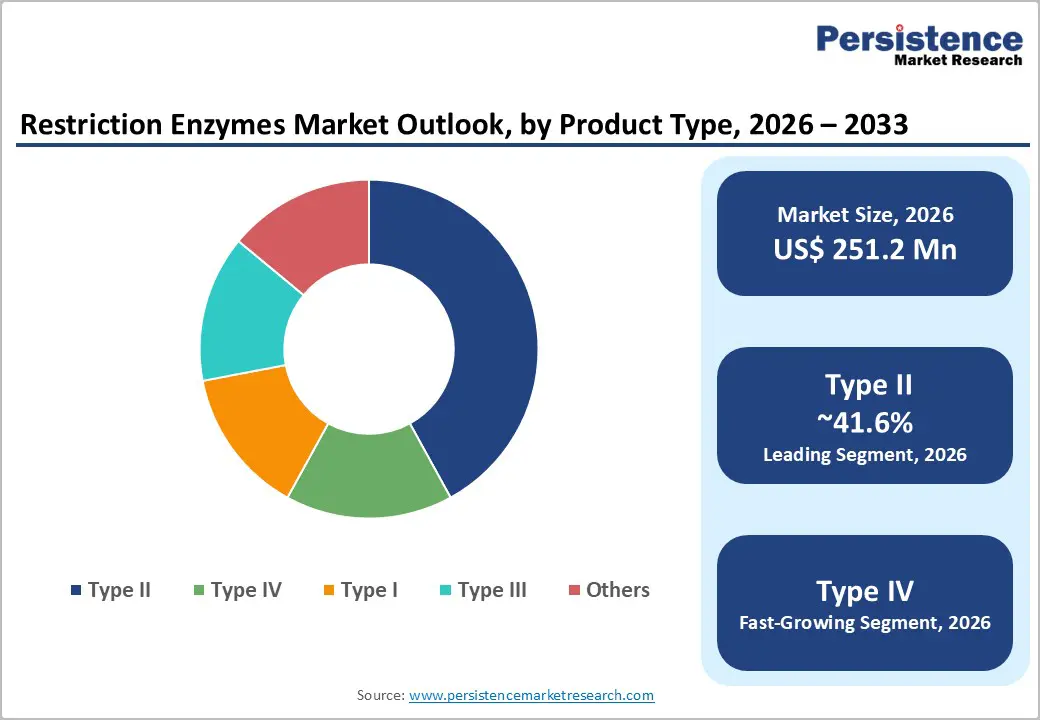
- Dominant Product Type: Type II restriction enzymes are anticipated to lead, holding 41.6% market share, due to their extensive use in DNA digestion, cloning, and routine molecular biology workflows.
- Leading Application: Cloning remains the leading application segment, estimated to account for 39.2% of the market share, driven by its critical role in recombinant DNA technology, gene expression studies, and plasmid construction.
| Key Insights | Details |
|---|---|
| Restriction Enzymes Market Size (2026E) | US$251.2 Mn |
| Market Value Forecast (2033F) | US$411.4 Mn |
| Projected Growth (CAGR 2026 to 2033) | 7.3% |
| Historical Market Growth (CAGR 2020 to 2025) | 6.0% |
DRO Analysis
Driver Analysis - Restriction Enzymes Remain Foundational To Recombinant DNA and Cloning Workflows
Restriction enzymes, particularly Type II enzymes, continue to play a central role in molecular biology due to their ability to cleave DNA at specific recognition sequences. These enzymes enable precise DNA manipulation, supporting cloning, vector construction, genome editing, and synthetic biology applications. The availability of hundreds of commercially validated enzymes ensures flexibility across research workflows. Their continued integration into standard laboratory protocols reinforces consistent demand, making them indispensable tools across academic, clinical, and industrial research environments.
Expansion of mRNA Manufacturing and Therapeutic Template Preparation
The rise of mRNA-based therapeutics and vaccines has introduced a new layer of demand for restriction enzymes. These enzymes are essential for plasmid linearization prior to in vitro transcription, a critical step in mRNA production. The growing need for high-purity, GMP-compliant enzymes has shifted demand toward premium-grade products with strict quality specifications. This transition is moving restriction enzymes from traditional research use into regulated biomanufacturing environments, increasing their commercial value and strategic importance.
Growth in Precision Medicine, Epigenetics, and Next-Generation Sequencing (NGS)
Global healthcare systems are increasingly investing in precision medicine and genomic diagnostics, which rely heavily on molecular tools for DNA analysis. Restriction enzymes are used in sequencing workflows, methylation studies, and diagnostic assay development. Advancements in enzyme-based epigenetic technologies are replacing traditional chemical methods, improving data accuracy and sample integrity. The expansion of NGS-based diagnostics and personalized medicine continues to broaden the application scope for restriction enzymes, driving sustained market growth.
Restraint Analysis - Shift toward Seamless Cloning and Enzyme-Free DNA Assembly Technologies
Modern molecular biology techniques such as seamless cloning, Gibson Assembly, and enzyme-free ligation methods are reducing reliance on traditional restriction enzyme-based workflows. These technologies enable faster, more flexible DNA assembly without the need for restriction digestion. While restriction enzymes remain relevant for many applications, the adoption of these alternatives is limiting growth in conventional cloning workflows, particularly in high-throughput and synthetic biology environments.
Increasing Complexity in Regulatory Compliance and Product Formulation
The growing demand for high-quality, contamination-free enzymes has increased manufacturing and regulatory requirements. Factors such as animal-free formulations, impurity control, and reproducibility standards add complexity to production processes. These requirements raise costs for manufacturers and create adoption barriers for smaller laboratories with limited budgets. As regulatory scrutiny increases, especially in therapeutic applications, suppliers must invest heavily in quality assurance and compliance infrastructure.
Opportunity Analysis - High-Value Applications in RNA Therapeutics and Advanced Biomanufacturing
The development of RNA-based therapeutics presents a significant opportunity for restriction enzyme manufacturers. Enzymes used in plasmid preparation and template linearization are critical for scalable RNA production. High-performance enzymes that offer precision, consistency, and regulatory compliance can command premium pricing. As biopharmaceutical companies expand RNA pipelines, demand for specialized enzyme solutions is expected to increase significantly.
Expansion in Epigenetics and Molecular Diagnostics
Epigenetics and diagnostic applications are emerging as high-growth, high-margin segments within the broader life sciences tools market. Enzyme-based DNA modification and methylation analysis techniques are gaining strong traction due to their ability to preserve DNA integrity, enhance sensitivity, and improve analytical accuracy in complex biological samples. These capabilities are particularly critical in oncology, where early detection and precise biomarker identification directly impact treatment outcomes. The expanding use of genomic testing in cancer diagnostics, rare genetic disorders, and infectious disease surveillance is accelerating the need for highly specific and reliable enzyme systems. As clinical laboratories and diagnostic companies increasingly adopt next-generation sequencing (NGS) and molecular diagnostic workflows, restriction enzymes are becoming core components of advanced diagnostic platforms, supporting applications such as gene mapping, mutation detection, and epigenetic profiling.
Rapid Growth in Asia Pacific Biotechnology and Research Ecosystems
Asia Pacific is rapidly establishing itself as a key growth hub for biotechnology and life sciences research, driven by rising investments in R&D, expanding academic infrastructure, and increasing activity in the biopharmaceutical sector. Countries such as China, Japan, and India are making substantial progress in strengthening their genomics capabilities through government-backed initiatives, research funding, and public-private partnerships. The region is also witnessing growth in contract research organizations (CROs), biotechnology startups, and clinical research activities, which are collectively driving demand for advanced molecular biology tools. In addition to strong demand fundamentals, Asia Pacific offers cost-efficient manufacturing and a skilled scientific workforce, making it an attractive destination for global companies seeking supply chain optimization and regional expansion.
Category-wise Analysis
Product Type Insights
Type II enzymes are anticipated to maintain their leadership position, accounting for over 41.6% of the market share, due to their widespread use in DNA digestion, cloning, and molecular analysis. Their precision, reliability, and compatibility with standardized laboratory protocols make them the preferred choice across academic and commercial laboratories. These enzymes generate predictable DNA fragments with either sticky or blunt ends, enabling efficient ligation and recombinant DNA construction. Widely used enzymes such as EcoRI and HindIII remain staples in cloning workflows, plasmid mapping, and gene expression studies. Their integration into routine molecular biology kits and educational laboratory protocols further reinforces their sustained demand and dominant market position.
Type IV enzymes are expected to be the fastest-growing segment, driven by increasing demand for specialized DNA analysis. These enzymes recognize and cleave modified DNA, including methylated and hydroxymethylated sequences, making them highly relevant for epigenetics and advanced genomic research. Their role is expanding in applications such as DNA methylation profiling, cancer biomarker discovery, and gene regulation studies. For example, methylation-sensitive restriction enzymes are increasingly used in epigenetic assays to differentiate between normal and disease-associated DNA patterns. As research focus shifts toward understanding gene expression regulation and epigenetic modifications, Type IV enzymes are gaining importance in both research and emerging clinical diagnostics.
End-user Insights
Academic and research institutes are anticipated to continue dominating the market, holding approximately 46.8% share, driven by the extensive use of restriction enzymes in fundamental research and education. These institutions rely heavily on enzyme-based workflows for gene cloning, sequencing preparation, and experimental validation. Restriction enzymes are also core tools in undergraduate and postgraduate laboratory training programs, ensuring consistent usage across generations of researchers. Public funding initiatives supporting genomics, molecular biology, and life sciences research further sustain demand. For instance, large-scale genome projects and university-led synthetic biology programs continue to depend on restriction digestion for DNA manipulation and verification processes.
Biotechnology and pharmaceutical companies are projected to be the fastest-growing end-user segment, due to increasing use of restriction enzymes in drug development, diagnostics, and biomanufacturing. These organizations require high-quality, reproducible enzymes for regulated workflows such as plasmid linearization in mRNA production, gene therapy vector development, and quality control in biologics manufacturing. For example, restriction enzymes are routinely used in preparing DNA templates for in vitro transcription in mRNA vaccine production. The growing pipeline of nucleic acid-based therapeutics and precision medicine initiatives is accelerating demand for advanced, GMP-grade enzyme solutions, positioning this segment as a key growth driver in the market.
Regional Insights
North America Restriction Enzymes Market Trends - Innovation-Driven Growth with Strong Genomics and Automation Integration
North America leads the restriction enzymes market with a 40.8% share in 2026, driven by strong research infrastructure, high R&D spending, and advanced biotechnology capabilities. The U.S. serves as the primary market, supported by a robust ecosystem of academic institutions, biotechnology firms, and diagnostic laboratories. Major industry players such as Thermo Fisher Scientific, New England Biolabs, and Promega Corporation are headquartered in the region, which strengthens supply chain integration, innovation pipelines, and rapid commercialization of enzyme technologies.
The region benefits from early adoption of genomic technologies and a strong focus on precision medicine. Government-backed initiatives, including large-scale genomic sequencing and cancer research programs, continue to drive demand for molecular biology tools. For example, the expansion of next-generation sequencing (NGS)-based diagnostics across U.S. clinical laboratories has increased the use of enzymes in sample preparation and validation workflows. In parallel, companies such as New England Biolabs have introduced advanced enzyme-based solutions like enzymatic methylation sequencing kits, improving workflow efficiency and replacing traditional chemical-based methods. Recent developments include the continuous expansion of enzyme portfolios and the integration of automation platforms. Thermo Fisher Scientific has strengthened its cloning and synthetic biology toolkits, while automation-compatible reagents are being widely adopted in high-throughput labs. These developments reinforce North America’s position as a global innovation hub, where technological advancements directly influence global market trends and product standards.
Europe Restriction Enzymes Market Trends - Regulation-Focused Market with High-Purity Enzyme Innovation
Europe represents a mature market characterized by strong regulatory frameworks and consistent research activity. Countries such as Germany, the U.K., France, and Spain play significant roles in shaping regional demand. The presence of major companies like QIAGEN and Roche Diagnostics supports a well-established ecosystem for molecular diagnostics and life sciences research. The region’s emphasis on regulatory compliance and quality standards significantly influences product development and commercialization strategies. Regulations related to chemical safety and environmental impact require manufacturers to adopt high-purity, animal-free enzyme formulations. This has led to innovation in enzyme stabilization and formulation, particularly among European and global suppliers operating in the region. For example, enzyme manufacturers are increasingly aligning their products with stringent European compliance standards, improving product traceability and consistency for clinical and industrial use.
Investment in biotechnology and healthcare innovation continues to support market growth. Collaborative research programs funded by the European Union, along with cross-border academic partnerships, are driving advancements in genomics and molecular biology. Companies such as QIAGEN are actively expanding their sample-to-insight workflows, integrating enzymes into broader diagnostic platforms. This integration strengthens demand for restriction enzymes as part of complete molecular testing solutions, ensuring steady market expansion across the region.
Asia Pacific Restriction Enzymes Market Trends - Rapid Expansion Fueled by Investment, Local Manufacturing, and NGS Adoption
Asia Pacific is expected to be the fastest-growing region, driven by increasing investment in biotechnology, expanding academic research, and growing pharmaceutical manufacturing capabilities. China, Japan, and India are key contributors to regional growth, supported by government initiatives aimed at strengthening genomics and life sciences infrastructure. The presence of regional players such as Takara Bio and Enzynomics highlights the region’s growing capability in enzyme production and innovation.
The region offers strong growth potential due to rising demand for molecular diagnostics, genomics research, and biopharmaceutical production. For instance, Takara Bio continues to expand its genomics and PCR-related product lines, supporting research and clinical applications across Asia. At the same time, increasing adoption of NGS technologies in countries like China and India is driving higher consumption of enzymes used in sequencing workflows and DNA analysis. Asia Pacific also provides cost advantages in manufacturing and operations, making it an attractive destination for global companies.
A notable development includes the expansion of New England Biolabs into India through a dedicated subsidiary, improving local distribution and customer support. This move reflects a broader trend of global players strengthening their presence in the region to capture growing demand. As local capabilities continue to improve and investments increase, Asia Pacific is expected to play a critical role in both the production and consumption of restriction enzymes, shaping the future dynamics of the global market.
Competitive Landscape
The global restriction enzymes market is fragmented, with a mix of global leaders and regional players competing across different segments. Major companies maintain strong positions through extensive product portfolios, global distribution networks, and technical expertise. Competition is driven by product quality, enzyme performance, pricing strategies, and customer support capabilities. Key players focus on innovation, product quality, and market expansion. Strategies include the development of high-performance enzymes, integration with advanced workflows, expansion into emerging markets, and strengthening distribution networks. Companies are also emphasizing regulatory compliance and premium product offerings to differentiate themselves in a competitive landscape.
Key Industry Developments:
- In September 2025, Promega Corporation entered a strategic partnership with Watchmaker Genomics, licensing advanced enzyme technology to improve RNA analysis accuracy, supporting next-generation sequencing and transcriptomics applications.
- In April 2025, Promega Corporation announced a collaboration with EditCo Bio to advance biologically relevant cell-based research, integrating enzyme technologies into more complex molecular and cellular analysis workflows.
Companies Covered in Restriction Enzymes Market
- Thermo Fisher Scientific
- New England Biolabs
- Promega Corporation
- Takara Bio
- Bio-Rad Laboratories
- QIAGEN
- Agilent Technologies
- Merck KGaA
- Roche Diagnostics
- Jena Bioscience
- Enzynomics
- Nippon Gene
- Lucigen
- GeneDireX
- SibEnzyme
- Canvax Biotech
Frequently Asked Questions
The global restriction enzymes market is estimated to be valued at US$251.2 million in 2026.
The restriction enzymes market is projected to reach US$411.4 million by 2033.
Key trends include the growing adoption of restriction enzymes in mRNA therapeutics, increasing use in epigenetics and next-generation sequencing (NGS), and a shift toward high-purity, GMP-grade enzyme formulations for regulated applications.
Type II restriction enzymes are the leading segment, accounting for 41.6% of the market share, due to their widespread use in DNA cloning and molecular biology workflows.
The restriction enzymes market is expected to grow at a CAGR of 7.3% from 2026 to 2033.
Major players include Thermo Fisher Scientific, New England Biolabs, Promega Corporation, Takara Bio, and QIAGEN.


