




- Plastics, Polymers & Resins
- Polyoxymethylene Market
Polyoxymethylene Market Size, Share, and Growth Forecast, 2026 - 2033
Polyoxymethylene Market by Product Type (Homopolymer POM, Copolymer POM), Grade (Standard Grade POM, Other), Processing Method (Injection Molding, Extrusion), End-use Industry (Automotive industry, Other), and Regional Analysis for 2026 – 2033

Polyoxymethylene Market Size and Trends Analysis
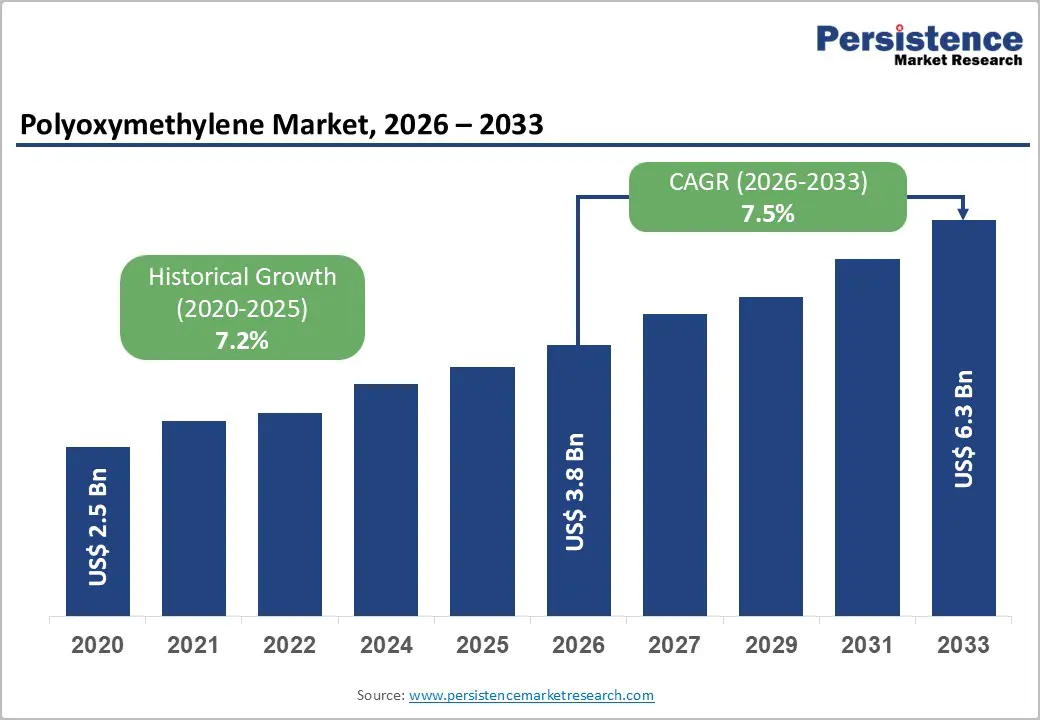
The global polyoxymethylene market size is likely to be valued at US$3.8 billion in 2026, and is expected to reach US$6.3 billion by 2033, growing at a CAGR of 7.5% during the forecast period from 2026 to 2033.
Driven by the increasing prevalence of lightweight engineering plastics demand in automotive and electrical & electronics industries, rising replacement of metals with high-performance polyoxymethylene (POM) in precision components, and growing adoption of copolymer POM for improved chemical resistance and dimensional stability. Growing demand for reinforced and medical-grade polyoxymethylene in automotive and healthcare applications is driving market growth. Advances in impact-modified and UV-stabilized grades improve toughness, weatherability, and compliance. Its role as a high-strength, low-friction material in electric vehicles, medical devices, and consumer durables is a key growth driver.
Key Industry Highlights:
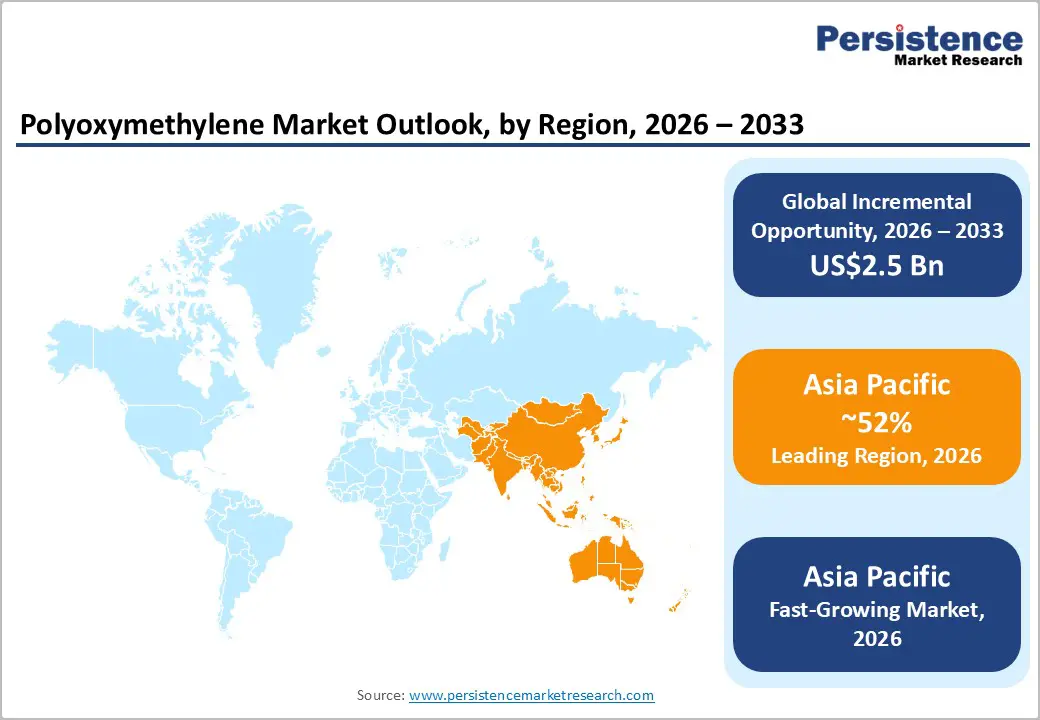
- Leading Region: Asia Pacific, anticipated to account for a 52% market share in 2026, driven by dominant automotive and electronics manufacturing, rapid urbanization, and strong demand in China and India.
- Fastest-growing Region: Asia Pacific, fueled by expanding EV production, rising medical device output, and growing investments in high-precision molding capacity.
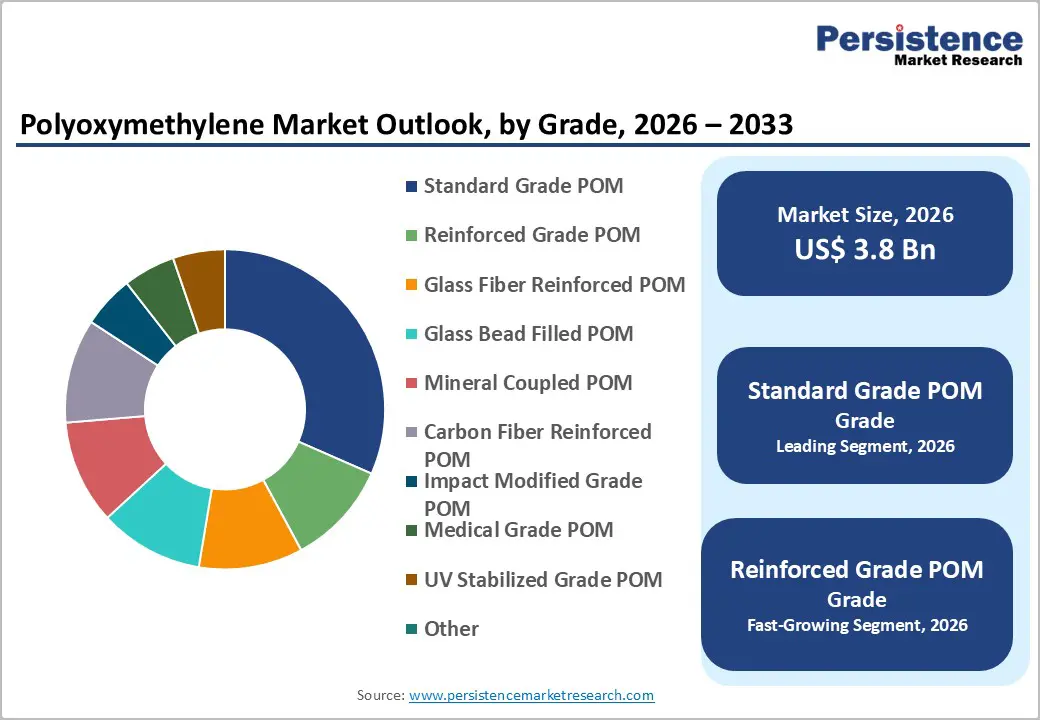
- Dominant Product Type: Copolymer POM, to hold approximately 68% of the market share, as it offers superior chemical resistance and processability.
- Leading End-use Industry: Automotive industry, contributing nearly 38% of the market revenue, due to extensive use in fuel systems, gears, and interior components.
- Trend: Artificial Intelligence (AI) is revolutionizing the POM manufacturing process by enhancing production efficiency, minimizing defects, and improving quality control.
| Key Insights | Details |
|---|---|
| Polyoxymethylene Market Size (2026E) | US$3.8 Bn |
| Market Value Forecast (2033F) | US$6.3 Bn |
| Projected Growth (CAGR 2026 to 2033) | 7.5% |
| Historical Market Growth (CAGR 2020 to 2025) | 7.2% |
Market Factors – Growth, Barriers, and Opportunity Analysis
Growth Analysis - Rising Lightweighting Trend in Automotive and Electrical Industries
The rising lightweighting trend in the automotive and electrical industries is being driven by the need for improved energy efficiency, enhanced performance, and compliance with increasingly stringent environmental regulations. In the automotive sector, reducing vehicle weight directly contributes to lower fuel consumption and extended driving range, particularly for electric vehicles where battery efficiency is critical. Lightweight materials also support better acceleration, braking, and handling without compromising safety or durability.
As a result, manufacturers are increasingly replacing traditional metals with high-performance engineering plastics and composites in both structural and functional components. In the electrical and electronics industry, lightweighting enables the development of compact, portable, and ergonomically designed devices. Lighter components help reduce assembly complexity and transportation costs while supporting miniaturization and high-density circuit integration. Advanced lightweight materials offer excellent electrical insulation, dimensional stability, and heat resistance, which are essential for reliable electronic performance.
Advancements in Processing Technologies
Advancements in processing technologies are playing a crucial role in accelerating the adoption of polyoxymethylene across diverse end-use industries. Modern injection molding systems now offer higher precision, tighter tolerances, and improved cycle-time control, enabling manufacturers to produce complex POM components with consistent quality and minimal material waste. Enhanced temperature and pressure management during processing has reduced issues such as warpage and dimensional instability, making POM more reliable for high-performance applications.
Improvements in extrusion and compounding technologies have also allowed better dispersion of reinforcements such as glass fibers, minerals, and impact modifiers, resulting in grades with tailored mechanical and tribological properties. In addition, automation and digital monitoring in processing lines have increased production efficiency while lowering defect rates and operational costs.
Barrier Analysis - High Raw Material Price Volatility and Energy-Intensive Production
High raw material price volatility and energy-intensive production present significant challenges for the polyoxymethylene market. POM is primarily derived from formaldehyde-based feedstocks, which are closely linked to petrochemical value chains. Fluctuations in crude oil and natural gas prices directly impact the cost of these inputs, leading to unpredictable production expenses and pressure on manufacturers' margins. Sudden price swings make long-term pricing agreements difficult and increase financial risk for both producers and downstream users.
POM manufacturing is an energy-intensive process that requires precise temperature control and continuous operation to maintain polymer quality. Rising electricity and fuel costs further elevate production expenses, especially in regions with limited access to low-cost energy. These factors can limit capacity expansions, reduce cost competitiveness against alternative materials, and constrain market growth, particularly in price-sensitive applications and emerging economies.
Environmental and Regulatory Concerns
Environmental and regulatory concerns represent a notable restraint for the polyoxymethylene market due to the material’s chemical origin and manufacturing process. POM is produced using formaldehyde-based intermediates, which are subject to strict regulations owing to their potential health and environmental risks. Governments and regulatory bodies have imposed tight limits on formaldehyde emissions, workplace exposure, and effluent discharge, increasing compliance requirements for manufacturers.
Meeting these standards often requires investment in advanced emission control systems, continuous monitoring, and process optimization, which adds to operational costs. Growing emphasis on sustainability and circular economy practices has placed pressure on materials that are perceived as less environmentally friendly. While POM is recyclable, its recycling rates remain limited compared to commodity plastics, raising concerns among regulators and environmentally conscious end users. These factors can slow approvals, restrict capacity expansions, and influence material selection decisions in regulated industries.
Opportunity Analysis - Developments in High-Performance Reinforced Grades and Medical-Grade POM
Developments in high-performance reinforced grades and medical-grade polyoxymethylene (POM) are shaping the material’s appeal across demanding applications. Reinforced POM formulations such as glass fiber, carbon fiber, and mineral-filled variants have been engineered to improve stiffness, dimensional stability, and wear resistance. These enhancements address performance gaps that traditional POM faces in heavy-load or high-temperature environments.
For example, glass fiber reinforcement significantly increases tensile strength and rigidity, making POM suitable for structural components in automotive powertrains and industrial machinery where metal replacement delivers weight savings without sacrificing durability. Carbon fiber and mineral fillers further tailor properties such as creep resistance and thermal expansion, allowing designers to optimize parts for sustained performance under mechanical or thermal stress.
Advancements in medical-grade POM focus on biocompatibility, cleanliness, and sterilization resistance. Manufacturers are refining polymerization and purification processes to minimize residual monomers and additives that could trigger adverse biological responses. The result is POM that meets stringent regulatory standards for use in healthcare settings—such as surgical instruments, diagnostic device housings, and fluid handling components—without compromising mechanical performance. These medical grades are designed to withstand repeated sterilization cycles, maintaining dimensional integrity and surface quality.
Advancements in Processing Technologies
Advancements in processing technologies are significantly strengthening the competitiveness and application range of polyoxymethylene across multiple industries. Modern injection molding equipment now incorporates precise temperature, pressure, and cooling controls, which are critical for processing POM due to its narrow thermal processing window. These improvements help reduce internal stresses, warpage, and dimensional variation, resulting in parts with high accuracy and repeatability. Faster cycle times and multi-cavity tooling have also improved production efficiency, making large-scale manufacturing more cost-effective.
Advances in compounding technologies have enabled uniform dispersion of reinforcements such as glass fibers, carbon fibers, and impact modifiers within the POM matrix. This has led to consistent mechanical performance and improved wear and fatigue resistance in reinforced grades. Digitalization and automation in processing lines, including real-time monitoring and predictive maintenance, have further reduced defects and downtime. Simulation software and mold-flow analysis are also being widely adopted, allowing manufacturers to optimize part design before production.
Category-wise Analysis
Product Type Insights
Copolymer POM is anticipated to dominate the market, accounting for 68% of the market share in 2026. Its dominance is driven by its balanced combination of performance, processing stability, and long-term reliability. Compared to homopolymer grades, copolymer POM offers better resistance to thermal degradation, oxidation, and hydrolysis, making it suitable for applications exposed to moisture, chemicals, and fluctuating temperatures. Its improved dimensional stability and lower risk of porosity or void formation enhance part consistency during high-volume manufacturing.
Duracon® Copolymer POM from Polyplastics Co., Ltd., which is widely used in automotive components such as fuel pump modules, door locks, and seat belt mechanical parts due to its excellent chemical resistance, dimensional stability, and wear performance. These properties make it suitable for parts exposed to fuel, mechanical stress, and varying temperatures in vehicles.
Homopolymer POM is the fastest-growing segment due to its high rigidity, excellent surface finish, and superior machinability at a competitive cost. Its simple structure allows for efficient processing with fewer additives, making it ideal for high-volume production. Advances in stabilizers and processing controls have improved its reliability, expanding its use in precision parts previously reserved for copolymer variants. Acetron® POM-H from Mitsubishi Chemical is commonly used in bearings, bushings, gears, and fluid handling components requiring strength, stiffness, and wear resistance, especially in automotive and industrial machinery.
End-use Industry Insights
The automotive industry is expected to dominate the market, contributing nearly 38% of revenue in 2026, due to the increasing use of high-performance engineering plastics in vehicle components. POM’s high strength, dimensional stability, and low friction make it ideal for critical applications such as fuel systems, powertrain components, door locks, and interior mechanisms. The ongoing shift toward lightweighting and electric vehicles is driving the replacement of metals with POM to improve fuel efficiency and battery performance.
Celanese Corporation’s Celcon® POM is widely used to manufacture window lift plates and other precision automotive components due to its strength, dimensional stability, and wear resistance. At industry forums, Celanese highlighted Celcon® POM for automotive applications such as window lift plates on models such as the VW Amarok, demonstrating how POM replaces metal parts while reducing weight and maintaining performance.
The medical & healthcare industry represents the fastest-growing segment, driven by the material’s strength, chemical resistance, and dimensional precision, which align with the stringent demands of medical devices. Medical-grade POM can be sterilized repeatedly without significant degradation, making it suitable for surgical instruments, diagnostic housings, fluid-handling components, and drug-delivery systems. Its low friction and wear resistance also improve the reliability and lifetime of moving parts in equipment such as infusion pumps and laboratory analyzers.
Polyplastics Co., Ltd.’s DURACON® POM PM series is a medical-grade polyoxymethylene specifically developed for healthcare applications such as drug contact and delivery components. These grades (PM09S01N and the high-flow PM27S01N) are designed to meet global biocompatibility and regulatory requirements, including ISO 10993, USP Class VI, and FDA compliance, making them suitable for precision parts in injectors, inhalers, and other medical devices that require high strength, low friction, and sterilization resistance.
Regional Insights
North America Polyoxymethylene Market Trends
North America benefits from strong automotive and medical device manufacturing, advanced R&D capabilities, and high public awareness of lightweighting advantages. The production systems in the U.S. and Canada support extensive POM applications, making it widely accessible across industries such as automotive, healthcare, and electronics. Rising demand for copolymer and easy-to-mold forms is further driving adoption, as these formats enhance performance and ease metal substitution.
Ongoing innovations in polyoxymethylene technology, such as stable reinforced grades and improved medical-grade formulations, are attracting significant investment from both public and private sectors. Government initiatives and DOE campaigns are promoting its use to address weight, fuel efficiency, and electrification challenges, sustaining market demand. The growing focus on medical grades and specialized applications, especially in automotive, is broadening polyoxymethylene's target market.
Europe Polyoxymethylene Market Trends
Europe’s growth is driven by increasing awareness of lightweighting benefits, strong regulatory frameworks, and government-led automotive electrification initiatives. Countries, including Germany, France, Italy, and Spain, have established manufacturing infrastructures that support the widespread use of POM and encourage the adoption of innovative material solutions. These high-performance formulations are particularly attractive to the automotive industry, regulation-focused OEMs, and medical users, enhancing efficiency and performance.
Technological advancements in polyoxymethylene, including improved reinforcement, targeted delivery methods, and enhanced medical grades, are further expanding market potential. European authorities are increasingly backing research and trials for POM to meet both general and specialized needs, boosting market confidence. The region’s focus on low-weight, sustainable options aligns with its goals for CO2 reduction and electrification. Public awareness campaigns are broadening the material’s reach in both urban and rural areas, while suppliers invest in compounding and new variants to enhance effectiveness.
Asia Pacific Polyoxymethylene Market Trends
The Asia Pacific region is expected to lead and be the fastest-growing market, capturing 52% of the revenue by 2026. This growth is driven by increasing awareness in the automotive sector, expanding government initiatives, and broader application programs across the region. Countries, including China, India, Japan, and South Korea, are actively promoting POM to meet the rising demand in automotive and medical devices. POM is particularly attractive in these regions due to its cost-effectiveness, ease of molding, and suitability for large-scale automotive and electronics production in both urban and rural areas.
Technological advancements are enabling the development of stable, efficient, and easy-to-process polyoxymethylene, capable of withstanding tough molding conditions and minimizing warpage. These innovations are key to reaching domestic OEMs and improving component coverage. The growing demand across automotive, medical, healthcare, and electronics sectors is driving market expansion. Public-private partnerships, increased manufacturing investments, and rising funding in POM research and compounding capabilities are further fueling growth. The convenience of POM delivery, along with enhanced strength and reduced risk of failure, makes it a preferred material choice.
Competitive Landscape
The global polyoxymethylene market features competition between established resin giants and emerging regional suppliers. In North America and Europe, Celanese Corporation and BASF SE lead through strong R&D, distribution networks, and OEM ties, bolstered by innovative copolymer and reinforced programs.
In Asia Pacific, Polyplastics Co., Ltd. and LG Chem advance with localized solutions, enhancing accessibility. Reinforced delivery boosts mechanical performance, cuts weight risks, and enables mass integrations across components. Strategic partnerships, collaborations, and acquisitions merge expertise, expand portfolios, and speed commercialization. Medical-grade formulations solve biocompatibility issues, aiding penetration in healthcare applications.
Key Industry Developments
- In July 2025, Celanese and Li Auto launched Hostaform® POM XAP3, an ultra-low formaldehyde emission copolymer for vehicle air outlet components, improving air quality without compromising performance.
- In March 2024, BASF’s Monomers division achieved ISCC PLUS and REDcert2 certifications for its production sites, offering around 345 certified sustainable products, including recycled and biomass-based isocyanates and polyamides.
Companies Covered in Polyoxymethylene Market
- Henan Energy Group Co., Ltd.
- Celanese Corporation
- Polyplastics Co., Ltd.
- BASF SE
- Mitsubishi Chemical Group of Companies
- LG Chem
- Formosa Plastics Corporation
- Asahi Kasei Corporation
- SABIC
- LyondellBasell Industries
- Daicel Corporation
- Kolon Plastics, Inc.
- Ensinger GmbH
- RTP Company
- Yunnan Yuntianhua
Frequently Asked Questions
The global polyoxymethylene market is projected to reach US$3.8 billion in 2026.
The polyoxymethylene market is driven by lightweighting in the automotive and electrical industries, as well as the shift from metal to plastic.
The polyoxymethylene market is poised to witness a CAGR of 7.5% from 2026 to 2033.
Key market opportunities lie in high-performance reinforced grades and medical-grade POM.
Celanese Corporation, Polyplastics Co., Ltd., BASF SE, Mitsubishi Chemical Group, and LG Chem are the key players.


