




- Telecommunications
- Point-to-Multipoint Microwave Backhaul Market
Point-to-Multipoint Microwave Backhaul Market Size, Share, and Growth Forecast, 2026 - 2033
Point-to-Multipoint Microwave Backhaul Market by Frequency Band (6–42 GHz, 42–66 GHz, 66–86 GHz, Misc.), Capacity (Up to 1 Gbps, 1–5 Gbps, Above 5 Gbps, Misc.), Deployment Mode (Urban, Suburban, Rural), End User Telecom Operators / Mobile Network Operators, Enterprise Networks, Government & Defense, Misc.) and Regional Analysis for 2026 - 2033

Point-to-Multipoint Microwave Backhaul Market Size and Trends Analysis
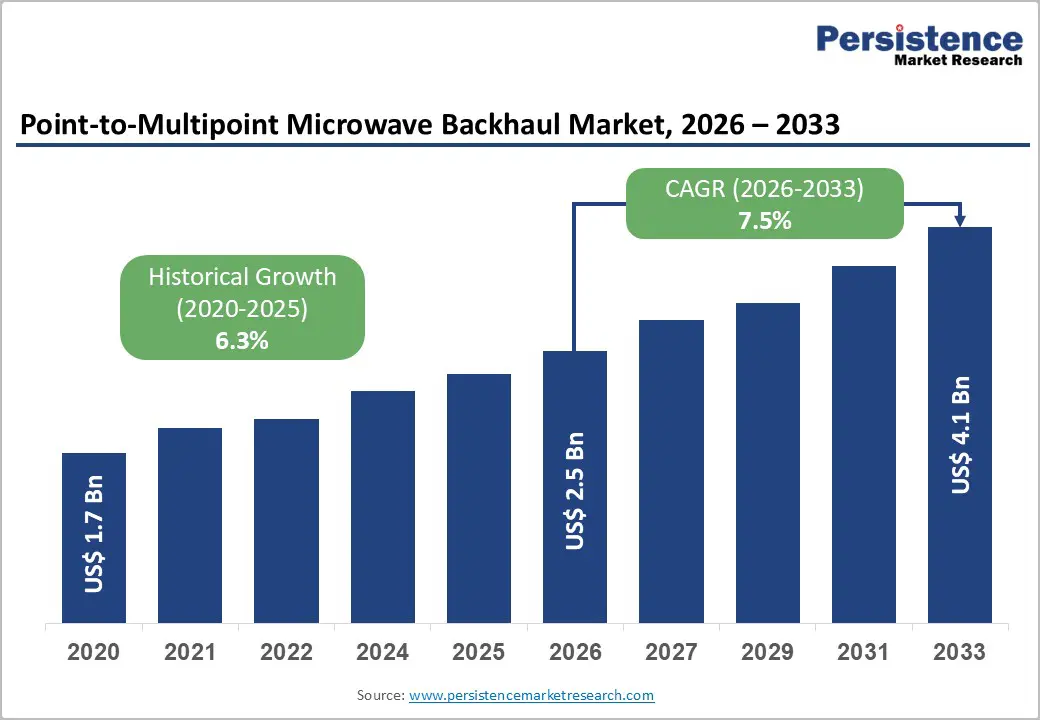
The Global Point-to-Multipoint Microwave Backhaul Market size was valued at US$2.5 billion in 2026 and is projected to reach US$4.1 billion by 2033, growing at a CAGR of 7.5% between 2026 and 2033.
Market expansion is driven by accelerating 5G network densification requirements, the expansion of enterprise private network demand, and cost-efficient backhaul alternatives to fiber infrastructure deployment. Telecom operators represent the dominant end-user segment, leveraging point-to-multipoint solutions for rural connectivity and for urban small-cell aggregation. The convergence of spectrum availability across multiple frequency bands, carrier aggregation technology advancements, and regulatory reforms supporting dynamic spectrum access create sustained adoption momentum for microwave backhaul solutions throughout the forecast period.
Key Industry Highlights:
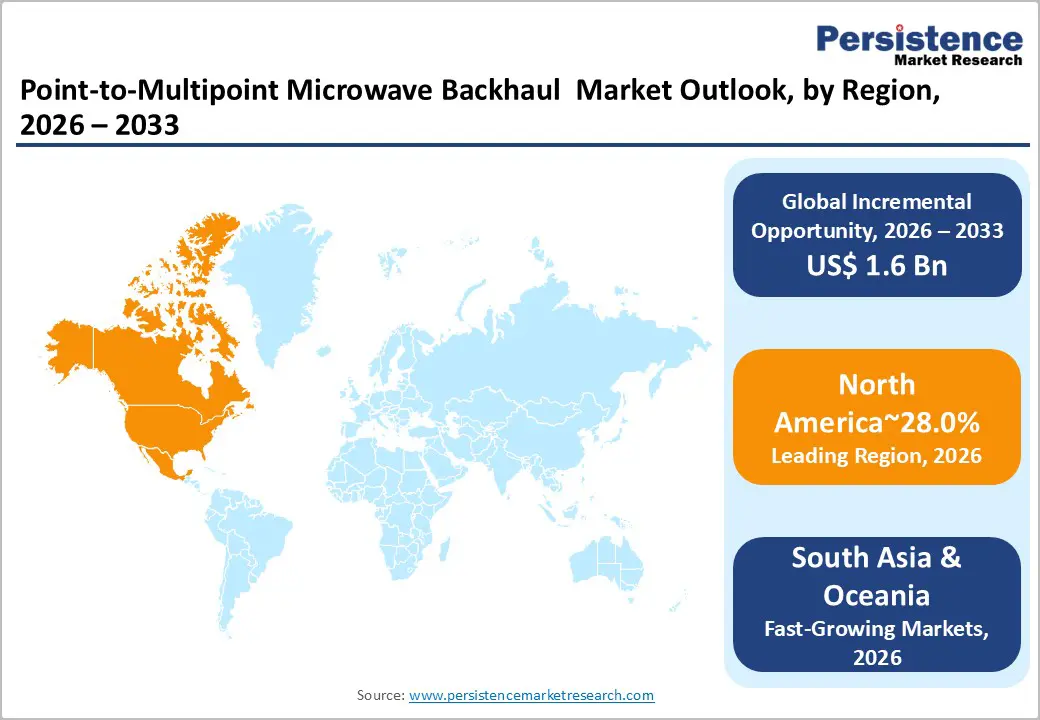
- Regional Leadership: North America leads the global Point-to-Multipoint Microwave Backhaul Market with a 28% share, driven by mature 5G infrastructure, extensive small-cell deployments, and regulatory support for E-band and millimeter-wave backhaul.
- Strong European Presence: Europe accounts for 22% of the market, supported by advanced regulatory frameworks, rural coverage expansion initiatives, and growing adoption of enterprise private networks for Industry 4.0 digital transformation.
- High-Growth East Asia Market: East Asia holds a 26% share and is the fastest-growing region, fueled by China’s 5G expansion, India’s telecom densification, and Japan’s adoption of advanced network technologies.
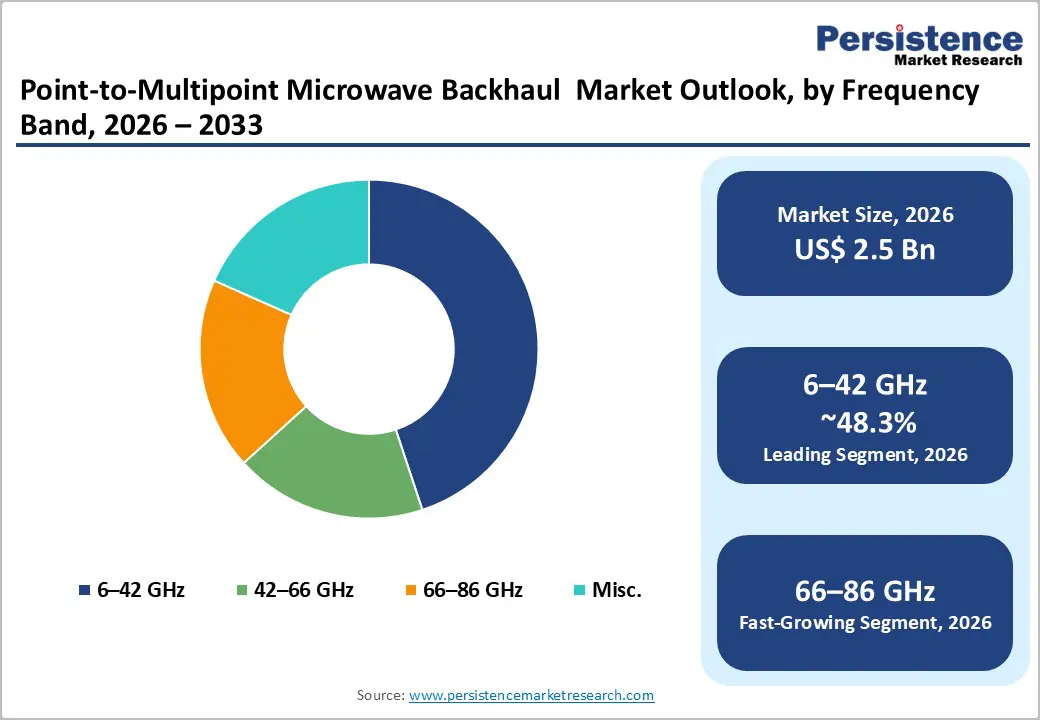
- Leading Technology Segment: Traditional microwave frequencies (6–42 GHz) dominate with 48.3% share, reflecting proven deployment maturity, regulatory familiarity, and widespread adoption by telecom operators.
- Fastest-Growing Technology Type: E-band and V-band millimeter-wave frequencies represent the fastest-growing segment, enabling ultra-high-capacity urban backhaul, multi-band carrier aggregation, and dense metropolitan small cell deployments.
| Key Insights | Details |
|---|---|
|
Point-to-Multipoint Microwave Backhaul Market Size (2026E) |
US$ 2.5 Bn |
|
Market Value Forecast (2033F) |
US$ 4.1 Bn |
|
Projected Growth (CAGR 2026 to 2033) |
7.5% |
|
Historical Market Growth (CAGR 2020 to 2025) |
6.3% |
Market Dynamics
Growth Drivers
5G Network Densification Requirements Demanding High-Capacity, Rapidly Deployable Backhaul Infrastructure
Global 5G network deployment has accelerated substantially, with over 1.1 million 5G base stations operational globally by 2025, requiring synchronized backhaul infrastructure expansion supporting data traffic aggregation and network performance optimization. The Ericsson Microwave Outlook reports that 5G-enabled site backhaul capacity requirements reach 5–20 Gbps per urban site by 2025, establishing demand for high-throughput backhaul solutions exceeding traditional sub-6 GHz microwave capabilities. Point-to-multipoint microwave backhaul systems directly address this capacity demand through carrier aggregation technologies enabling multiple frequency bands simultaneously from centralized hub sites, reducing required infrastructure footprint compared to point-to-point alternatives.
The Market benefits directly from 5G densification momentum, as operators deploy thousands of small cells requiring coordinated backhaul connectivity in urban and suburban deployment scenarios. North American and European markets demonstrate accelerated small cell deployment, with dense metropolitan areas deploying 10-15 small cells per macro cell to address capacity constraints and coverage gaps.
India's 5G rollout expansion, with commercial deployments reaching significant coverage milestones, creates complementary demand for high capacity backhaul infrastructure supporting network performance standards. Rural 5G coverage expansion, particularly in developing regions, requires cost-efficient backhaul solutions where fiber deployment timelines create operational constraints, establishing point-to-multipoint microwave as essential enabler for universal 5G service delivery.
Enterprise Private Network Adoption and Mission-Critical Industrial Connectivity Requirements
Enterprise demand for private wireless networks has emerged as substantial growth catalyst, driven by digital transformation initiatives across manufacturing, utilities, logistics, and public safety sectors requiring dedicated, low-latency connectivity infrastructure. Enterprises increasingly implement private LTE/5G networks supporting critical operations, autonomous systems, and real-time monitoring applications demanding high-reliability connectivity independent from public network dependencies. Point-to-multipoint microwave backhaul systems enable cost-effective enterprise campus interconnectivity, remote site aggregation, and disaster recovery networking capabilities supporting business continuity objectives.
The Market directly benefits from enterprise network expansion, as organizations deploy hybrid connectivity architectures combining fiber backbone with wireless last-mile and middle-mile microwave links. Industrial sectors including oil and gas operations, mining enterprises, and transportation infrastructure utilize microwave backhaul for remote telemetry, environmental monitoring, and autonomous vehicle connectivity supporting operational efficiency.
Government and defense agencies increasingly adopt point-to-multipoint systems for mission-critical communications, emergency response coordination, and strategic infrastructure protection requiring resilient, independently operated backhaul networks resistant to public network disruptions. Educational institutions and healthcare networks implement point-to-multipoint microwave systems for campus connectivity optimization, research data aggregation, and telemedicine application support, establishing emerging vertical market opportunities.
Spectrum Availability Expansion and Regulatory Reforms Supporting Flexible Frequency Band Deployment
Regulatory frameworks across North America, Europe, and the Asia-Pacific regions have systematically expanded spectrum availability across multiple frequency bands, including E-band (71–86 GHz), V-band (57–66 GHz), and traditional microwave frequencies (6–42 GHz), establishing a platform for advanced microwave backhaul deployment.
The European Telecommunications Standards Institute (ETSI) and Federal Communications Commission (FCC) have established regulatory pathways enabling dynamic spectrum access and regional licensing models supporting point-to-multipoint system deployment flexibility. India's July 2025 TRAI spectrum recommendations explicitly emphasized point-to-point and point-to-multipoint microwave backhaul criticality for commercial telecom networks and enterprise services, establishing a regulatory environment supporting licensed band assignments across 6 GHz, 7 GHz, 13 GHz, 18 GHz, 21 GHz, and E-band frequencies.
The Point-to-Multipoint Microwave Backhaul Market benefits directly from regulatory clarity, as operators implement multi-band deployment strategies optimizing spectrum utilization and capacity delivery. Technology advancements enabling simultaneous multi-band transmission from single-antenna platforms reduce deployment complexity and site footprint requirements, supporting rapid system rollout. Emerging unlicensed spectrum opportunities in the 5 GHz and mmWave bands create market expansion pathways for cost-optimized deployments, particularly for rural connectivity initiatives and enterprise network applications that require flexible licensing arrangements.
Market Restraining Factors
Fiber Infrastructure Competition and Extended Fiber Deployment Timelines Creating Market Uncertainty
Fiber optic deployment initiatives across developed markets, supported by government broadband expansion programs and corporate investment commitments, create structural competition for point-to-multipoint microwave backhaul adoption. Fiber infrastructure programs in North America, Europe, and Asia-Pacific allocate substantial capital to fiber-to-the-tower deployments, reducing the need for microwave backhaul for infrastructure operators with fiber access.
Right-of-way acquisition complexity, municipal approval delays, and site acquisition challenges extend fiber deployment timelines, creating temporary competitive windows for microwave solutions but establishing long-term fiber transition uncertainty. Fiber cost reduction through manufacturing efficiency improvements and deployment automation technologies compresses microwave value proposition margins, particularly in accessible metropolitan areas where fiber infrastructure development is economically justified.
Key Market Opportunities
Unlicensed Spectrum Deployment and Cost-Optimized Connectivity Solutions for Developing Markets
Unlicensed spectrum availability in 5 GHz, 60 GHz, and emerging bands presents substantial opportunity for cost-optimized point-to-multipoint microwave backhaul deployment addressing rural and underserved market connectivity requirements. Developing market telecommunications operators in India, Southeast Asia, and Sub-Saharan Africa face capital constraints limiting fiber infrastructure investment, establishing market demand for economical unlicensed-spectrum microwave solutions supporting broadband universal service objectives.
HFCL's April 2024 deployment of unlicensed band radio (UBR) point-to-multipoint solutions for Indian telecom operators demonstrates commercial viability of cost-optimized microwave backhaul supporting rural connectivity expansion without licensed spectrum acquisition costs. Element Management System innovations, including zero-touch provisioning and automated network planning, reduce operational complexity and capital deployment requirements for emerging market operators.
Government digital inclusion initiatives across India, Southeast Asia, and Latin America establish a policy environment supporting unlicensed spectrum utilization for broadband access, creating market expansion opportunities for manufacturers developing economical point-to-multipoint platforms optimized for developing market applications.
E-Band and Millimeter-Wave Integration Enabling Ultra-High-Capacity Metropolitan Backhaul Networks
E-band (71–86 GHz) spectrum integration into point-to-multipoint microwave platforms creates a substantial capacity expansion opportunity, particularly supporting dense urban network densification scenarios requiring 10-plus Gbps backhaul capacity from centralized hub sites. Nokia's November 2022 successful trial combining E-band (80 GHz) with traditional microwave frequencies (18 GHz) through dual-band antenna aggregation demonstrated technical feasibility of multi-band carrier aggregation supporting 20 Gbps throughput over moderate distances.
Huawei's March 2025 introduction of an innovative Uranus point-to-multipoint solution, enabling simultaneous multi-band transmission across multiple frequency bands from a single antenna, represents a breakthrough technology, reducing site footprint requirements and deployment complexity. Dense metropolitan deployment scenarios where tower space and permitting constraints limit traditional point-to-point infrastructure create compelling use cases for advanced multi-band point-to-multipoint systems.
Spectrum efficiency improvements through carrier aggregation and software-defined radio platforms establish capacity expansion opportunities without proportional infrastructure investment, supporting metropolitan small cell aggregation and enterprise campus interconnectivity applications. High-capacity private enterprise networks requiring 1–5 Gbps throughput supporting video analytics, real-time monitoring, and autonomous system connectivity create vertical market opportunities for E-band point-to-multipoint deployments.
Category-wise Analysis
Frequency Band Insights
Traditional microwave frequency bands spanning 6–42 GHz command share of 48.3% market leadership through proven deployment maturity, regulatory familiarity, extensive equipment ecosystem, and established operator relationships. These frequency bands provide medium-to-long range link capabilities up to 25 km over favorable terrain supporting traditional backhaul architectures for macro cell aggregation and metropolitan network connectivity.
Licensed spectrum allocation across 6 GHz, 7 GHz, 13 GHz, 15 GHz, 18 GHz, and 21 GHz provides regulatory certainty and interference protection supporting mission-critical backhaul deployment confidence. Point-to-multipoint implementations within 6–42 GHz bands leverage mature software-defined networking architectures and carrier-class availability standards supporting telecom operator service level agreement compliance. Market dominance reflects infrastructure investment momentum across established telecom markets, with operators maintaining substantial point-to-multipoint deployment portfolios in traditional frequency bands supporting legacy network architecture integration and gradual network modernization.
E-band and V-band millimeter-wave frequencies represent fastest-adoption segments, driven by substantial bandwidth availability up to 10 GHz continuous spectrum compared to 500 MHz traditional microwave channels supporting ultra-high-capacity point-to-multipoint deployments. E-band point-to-multipoint systems deliver 10–20 Gbps aggregate throughput enabling dense metropolitan small cell to backhaul, enterprise campus interconnectivity, and carrier aggregation platforms supporting 5G-Advanced network requirements.
Nokia and Huawei technology development in multi-band point-to-multipoint systems leveraging E-band frequencies represents market inflection demonstrating commercial viability and operator adoption readiness. Regulatory pathways establishing E-band spectrum availability across North America, Europe, and Asia-Pacific support accelerating adoption momentum. Antenna technology advancement enabling small form-factor, high-gain directional systems supports dense metropolitan point-to-multipoint deployment in space-constrained environments.
End User Insights
Telecom operators command share of 55% through extensive small cell deployment requirements, rural coverage expansion initiatives, and urban network densification momentum demanding high-capacity, cost-efficient backhaul solutions. Mobile network operators implement point-to-multipoint systems addressing thousands of small cell aggregation requirements supporting femtocell, picocell, and distributed antenna system connectivity from centralized hub sites.
Global telecom sector value reached €667 billion in EU markets with employment exceeding 7.2 million professionals, establishing substantial institutional infrastructure supporting point-to-multipoint deployment ecosystem. India's telecom sector representing the world's second-largest telecommunications market demonstrates accelerating point-to-multipoint adoption for 4G network densification and emerging 5G deployments, with operators including Reliance Jio, Bharti Airtel, and Vodafone Idea implementing unlicensed spectrum microwave backhaul for rural connectivity. Point-to-multipoint market leadership reflects telecom operator prioritization of capital-efficient backhaul solutions supporting network capacity expansion without proportional fiber investment requirements.
Enterprise private network segment represents fastest-adoption category, driven by organizational digital transformation initiatives, mission-critical connectivity requirements, and competitive advantages from proprietary network infrastructure. Manufacturing enterprises implementing Industry 4.0 automation, real-time production monitoring, and autonomous logistics systems require low-latency, high-reliability backhaul connectivity supporting industrial IoT deployments and real-time data aggregation. Utilities, oil and gas, and transportation sectors implement point-to-multipoint microwave backhaul supporting remote asset monitoring, grid management systems, and critical infrastructure protection objectives.
Regional Insights and Trends
North America Market Trend
North America represents 28% global market share, characterized by mature 5G infrastructure, extensive small cell deployment, and regulatory environment supporting advanced microwave backhaul technology adoption. U.S. telecommunications infrastructure investment reached substantial commitments in 2024-2025, with leading operators prioritizing network densification supporting broadband capacity requirements across urban and rural markets.
Accelerating 4G/5G densification requirements across metropolitan areas and rural underserved regions create sustained point-to-multipoint deployment demand. Commercial operators including Verizon, AT&T, and T-Mobile implement network modernization strategies leveraging high-capacity microwave backhaul supporting small cell aggregation. Enterprise private network adoption demonstrates robust momentum, with North American manufacturing, utilities, and logistics sectors implementing dedicated wireless connectivity supporting operational efficiency and competitive differentiation. Spectrum allocation clarity through FCC regulatory actions supporting E-band deployment expansion creates technology adoption pathway clarity attracting operator capital investment.
FCC regulatory frameworks establish E-band and millimeter-wave spectrum availability supporting high-capacity microwave backhaul deployment, while dynamic spectrum access initiatives create emerging opportunities for flexible frequency utilization. Infrastructure regulatory environment emphasizing network resilience and redundancy supports microwave backhaul adoption as complementary fiber alternative ensuring service continuity.
East Asia Market Trend
East Asia represents 26% global market share with fastest regional growth momentum, driven by China's telecommunications infrastructure expansion, India's rapidly expanding telecom sector, and Japan's advanced network technology adoption leadership.
China's government initiatives supporting 5G network deployment and rural broadband access create substantial point-to-multipoint microwave backhaul demand supporting network densification across diverse geographic terrain. Indian telecommunications sector growth, with subscriber base reaching 1.21 billion by June 2025 and tele-density of 86.09 percent, drives accelerating point-to-multipoint adoption for 4G densification and emerging 5G deployments.
Japan's technology leadership in microwave communications and advanced manufacturing sectors creates innovation ecosystem supporting next-generation microwave backhaul platform development.
Europe Market Trend
Europe represents 22% global market share, characterized by advanced regulatory environment, stringent environmental and reliability standards, and leadership in telecommunications technology innovation.
European operators implement 5G network densification supporting broadband universal service objectives and competitive market positioning. Rural coverage expansion initiatives, particularly in Central and Eastern European markets, create point-to-multipoint deployment opportunities supporting digital inclusion objectives. Enterprise private network adoption demonstrates accelerating momentum across manufacturing, utilities, and logistics sectors supporting Industry 4.0 digital transformation initiatives. Regulatory harmonization through ETSI standards supports interoperable point-to-multipoint deployment across European markets.
Competitive Landscape
The global Point-to-Multipoint Microwave Backhaul market is moderately consolidated, with a few major players holding significant market share. Leading companies like Ubiquiti, Cambium Networks, Ceragon Networks, Airspan Networks, Ericsson, and Huawei dominate through strong product portfolios, global distribution, and 5G-ready solutions. These players focus on high-capacity millimeter-wave technology, spectral efficiency, and scalable deployments for urban, suburban, and rural areas. Regional and niche vendors like RADWIN, Aviat Networks, and Intracom Telecom compete on specialized applications and local markets. Competitive intensity is high, driven by ongoing R&D, innovation, and strategic partnerships, but the market is clearly influenced by a concentrated group of major players.
Key Industry Developments
- March 5, 2025, Huawei introduced the innovative Uranus point-to-multipoint (PtMP) solution for hub sites during MWC 2025, enabling a single antenna to transmit signals in multiple directions across several frequency bands simultaneously. This breakthrough in PtMP microwave technology reduces the number of antennas required, cuts engineering and operational costs, saves site space, and simplifies deployment, representing a significant advancement for operators seeking efficient and cost-effective microwave backhaul solutions for 5G-Advanced networks.
- July 2, 2025, Tata Communications Limited submitted inputs to TRAI on the assignment of microwave spectrum across key bands (6 GHz, 7 GHz, 13 GHz, 15 GHz, 18 GHz, 21 GHz, E-band, and V-band), emphasizing the critical role of spectrum in supporting point-to-point and point-to-multipoint (PtMP) microwave backhaul for commercial telecom and enterprise networks. The company highlighted the importance of sufficient spectrum for high-capacity, low-latency backhaul links, enabling reliable last-mile connectivity, private networks, and X-haul applications, while supporting the growing demand from enterprise services, cloud applications, and IoT deployments.
Companies Covered in Point-to-Multipoint Microwave Backhaul Market
- Nokia OYJ
- Ericsson AB
- Dragonwave Inc.
- Redline Communications Group Inc.
- NEC Corporation
- Exalt Wireless, Inc.
- Intracom S.A. Telecom Solutions
- Huawei Technologies Co., Ltd.
- Cambridge Communication Systems Limited
- Cambridge Broadband Network Limited
Frequently Asked Questions
The global Point-to-Multipoint Microwave Backhaul Market is projected to be valued at US$ 2.5 Bn in 2026.
The 6–42 GHz segment is expected to account for approximately 48.3% of the Global Point-to-Multipoint Microwave Backhaul Market by Frequency Band in 2026.
The market is expected to witness a CAGR of 7.5% from 2026 to 2033.
The Point-to-Multipoint Microwave Backhaul market is driven by 5G network densification, enterprise private network adoption, and expanded spectrum availability, enabling high-capacity, rapidly deployable backhaul for urban, suburban, rural, and mission-critical applications.
The Point-to-Multipoint Microwave Backhaul market growth is driven by unlicensed spectrum deployment for cost-effective rural connectivity and E-band/millimeter-wave integration enabling ultra-high-capacity urban and enterprise backhaul networks.
Key players in the Point-to-Multipoint Microwave Backhaul Market include Ubiquiti, Cambium Networks, Ceragon Networks, Airspan Networks, Ericsson, and Huawei.


