




- Food Ingredients & Additives
- Palm Stearin Market
Palm Stearin Market Size, Share, and Growth Forecast, 2026 - 2033
Palm Stearin Market by Product Type (Soft Stearin, Hard Stearin), Application (Food & Beverages Industry, Personal Care & Cosmetic Industry, Agrochemical Industry, Energy & Biomass Industry), and Regional Analysis for 2026 – 2033

Palm Stearin Market Size and Trends Analysis
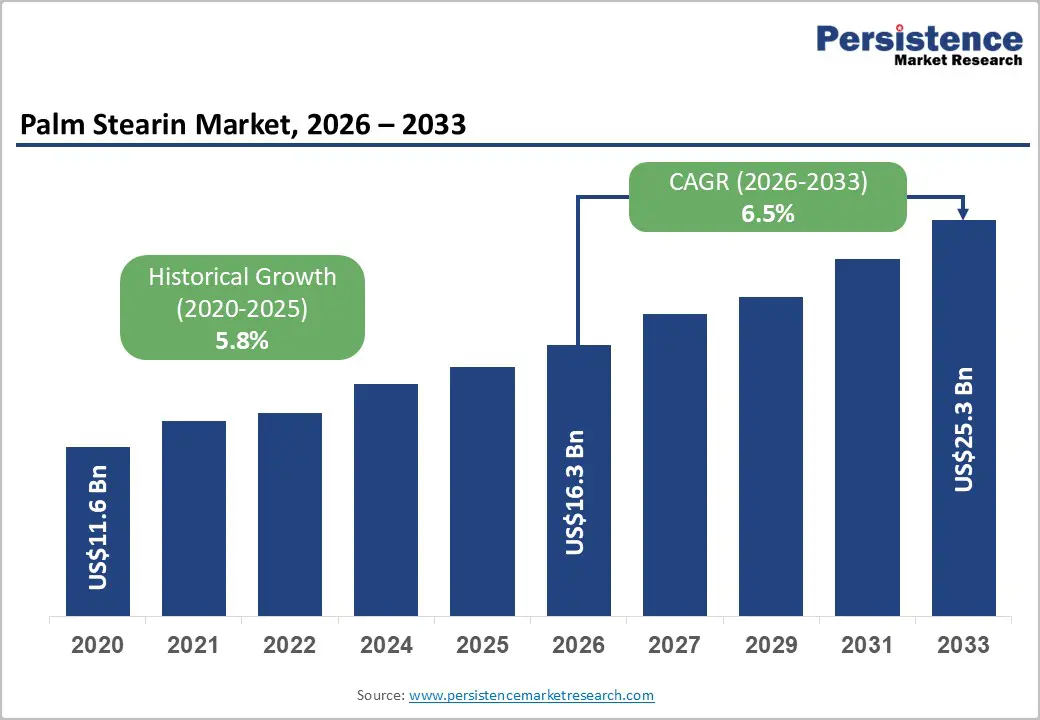
The global palm stearin market size is likely to be valued at US$16.3 billion in 2026, and is expected to reach US$25.3 billion by 2033, growing at a CAGR of 6.5% during the forecast period from 2026 to 2033, driven by increasing demand for cost-effective hard fat in margarine, shortening, and bakery products, rising consumption in personal care formulations as an emollient and thickener, growing use in oleochemicals and biodiesel production, and expanding food processing industry in emerging economies. Increasing recognition of palm stearin as a versatile, economical alternative to animal fats and other hard oils in emerging bakery, confectionery, and green energy markets remains a major driver of market growth.
Key Industry Highlights:
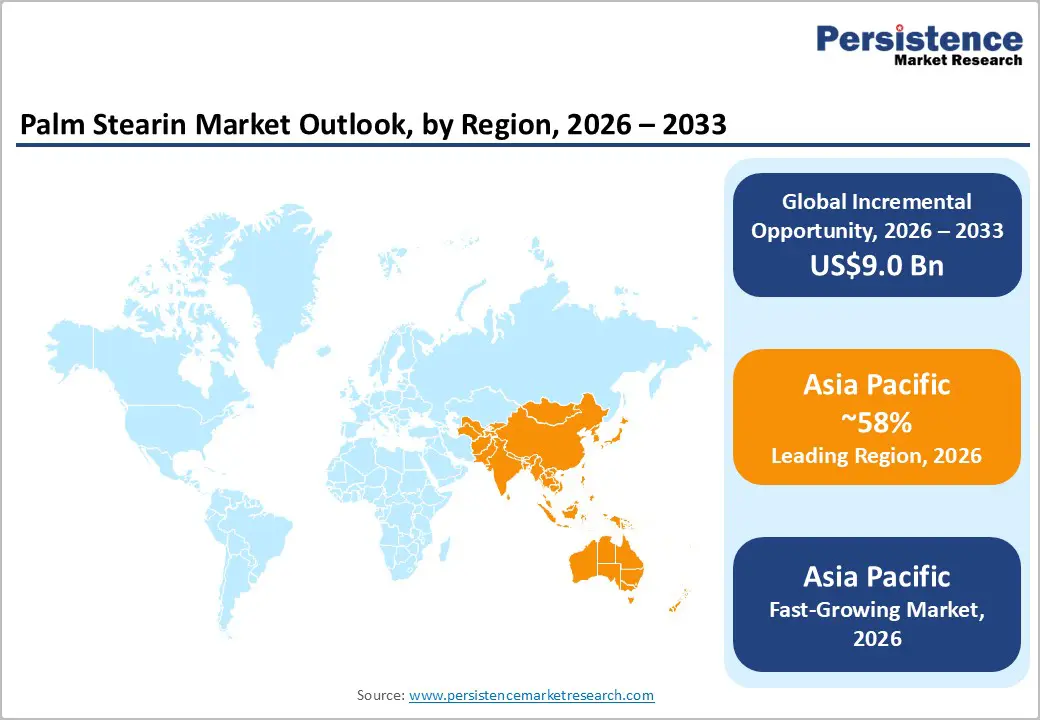
- Leading Region: Asia Pacific, anticipated to account for a 58% market share in 2026, driven by dominant palm oil production, massive food processing, and strong demand in Indonesia and Malaysia.
- Fastest-growing Region: Asia Pacific, fueled by rapid urbanization, expanding bakery & confectionery sectors, and increasing oleochemical demand.
- Dominant Product Type: Hard stearin, to hold approximately 65% of the market share, as it remains the preferred choice for high-melting applications.
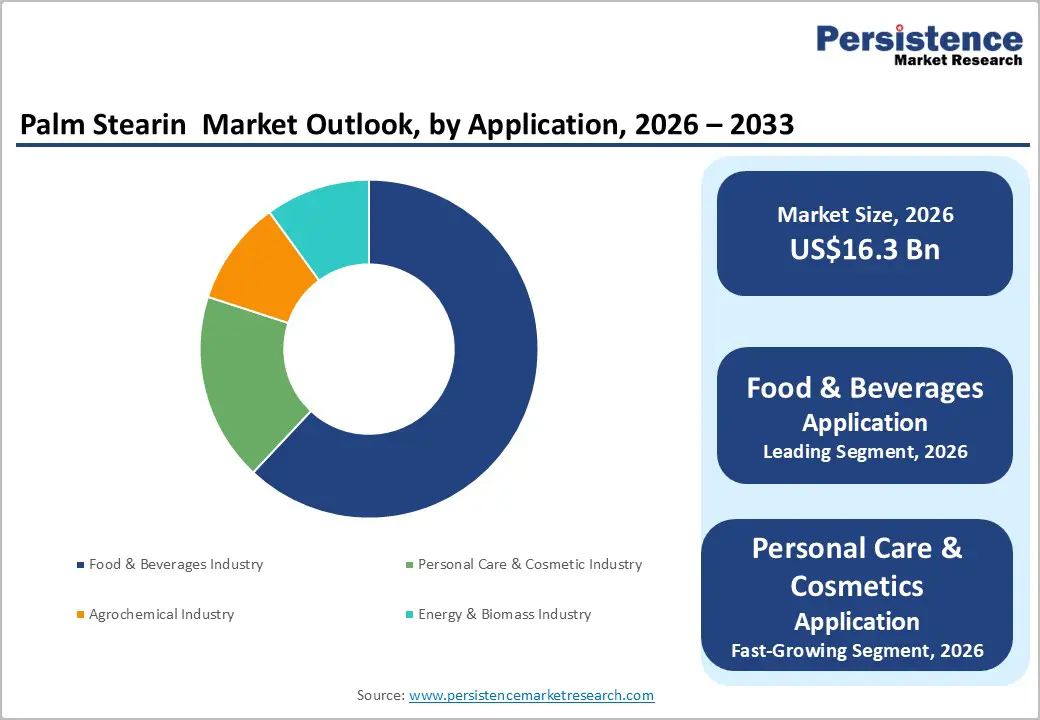
- Leading Application: The food & beverages industry, contributing nearly 62% of the market revenue, due to the highest consumption of margarine, shortening, and frying fats.
| Key Insights | Details |
|---|---|
|
Palm Stearin Market Size (2026E) |
US$16.3 Bn |
|
Market Value Forecast (2033F) |
US$25.3 Bn |
|
Projected Growth CAGR (2026-2033) |
6.5% |
|
Historical Market Growth (2020-2025) |
5.8% |
Market Factors – Growth, Barriers, and Opportunity Analysis
Growth Analysis – Bakery & Margarine Demand and Oleochemical Expansion
Rising consumer preference for convenience foods and baked goods has significantly driven the demand for bakery products and margarine in recent years. Urbanization, changing lifestyles, and growing disposable incomes have led to increased consumption of bread, pastries, cakes, and spreads, with margarine being a preferred alternative to traditional butter due to its affordability, extended shelf life, and perceived health benefits. Food manufacturers are responding by innovating with fortified, low-fat, and plant-based margarine options to cater to health-conscious consumers while maintaining taste and texture in baked goods.
The oleochemical industry has witnessed notable expansion, fueled by its versatile applications in food, personal care, and industrial sectors. Oleochemicals derived from natural oils, such as palm, coconut, and soybean, serve as key ingredients in margarines, shortenings, and emulsifiers, as well as in soaps, detergents, and lubricants. The shift toward sustainable and renewable raw materials has encouraged investment in oleochemical production, with companies upgrading processing facilities and exploring novel feedstocks.
Personal Care & Biodiesel Feedstock Demand
The growing global emphasis on sustainability and renewable resources has fueled demand for feedstocks used in both personal care products and biodiesel production. In the personal care sector, natural oils and derivatives such as coconut oil, palm oil, and shea butter are increasingly incorporated into skincare, haircare, and cosmetic formulations due to their moisturizing, emollient, and antioxidant properties. Consumers are favoring products that are plant-based, ethically sourced, and free from synthetic additives, prompting manufacturers to expand sourcing of high-quality oils and fats to meet these expectations.
Biodiesel production has seen accelerated growth as governments and industries worldwide push for cleaner energy alternatives to reduce carbon emissions and dependency on fossil fuels. Vegetable oils, animal fats, and other renewable feedstocks are processed into biodiesel, which offers lower greenhouse gas emissions compared to conventional diesel. This dual use of feedstocks has created a balancing act for suppliers, as both personal care manufacturers and energy producers compete for high-demand oils. Technological improvements in feedstock processing, along with the exploration of non-food sources such as algae or waste oils, are helping to address supply constraints.
Barrier Analysis – Sustainability Concerns and Certification Costs
Growing awareness of environmental impact and ethical sourcing has made sustainability a key concern across industries, particularly in food, personal care, and oleochemical sectors. Companies are increasingly expected to adopt responsible practices, such as sourcing raw materials from certified sustainable plantations, reducing carbon emissions, and minimizing waste. While these initiatives enhance brand reputation and meet consumer expectations, they often come with high costs.
Certification processes covering standards like RSPO for palm oil or organic and fair-trade labels require rigorous audits, compliance documentation, and sometimes modifications to production and supply chain practices. These expenses can strain smaller manufacturers or those operating on thin margins. Investing in sustainability certifications can provide long-term benefits by ensuring market access, fostering consumer trust, and mitigating regulatory risks. Balancing the upfront costs with strategic advantages remains a central challenge for businesses navigating sustainability priorities in an increasingly eco-conscious marketplace.
Price Volatility and Substitution Threat
Price volatility and substitution threat are significant challenges for industries relying on agricultural oils, fats, and other raw materials. Fluctuations in global commodity prices, driven by seasonal variations, weather disruptions, and geopolitical factors, can sharply affect production costs and profit margins. For instance, sudden increases in palm oil or soybean oil prices can directly impact margarine, bakery, and biodiesel manufacturing. Availability of alternative ingredients creates a constant substitution risk.
Manufacturers may switch to cheaper or more stable feedstocks, such as replacing palm oil with sunflower or canola oil, to control costs, which can disrupt demand patterns for specific raw materials. Companies must adopt strategic sourcing, long-term contracts, and flexible formulations to mitigate these risks. Effectively managing both price fluctuations and substitution pressures is essential for maintaining operational stability, protecting profitability, and sustaining supplier relationships in a competitive market environment.
Opportunity Analysis – Growth in Fractionated High-IV Stearin and Sustainable Sourcing
The demand for fractionated high-Iodine Value (IV) stearin has been rising, driven by its versatility in applications such as confectionery fats, margarine, bakery shortenings, and personal care formulations. High-IV stearins offer improved plasticity, better melting profiles, and enhanced texture in food products, making them a preferred choice for manufacturers aiming to deliver consistent quality and sensory appeal. The fractionation process allows producers to separate solid and liquid components from palm or palm kernel oil, creating specialized stearin grades tailored to specific functional needs. This customization enhances product performance while enabling cost-efficient utilization of raw materials.
Alongside product innovation, sustainable sourcing has emerged as a central focus. Companies are increasingly committed to procuring palm oil and other feedstocks from certified sustainable plantations to address environmental concerns such as deforestation, biodiversity loss, and carbon emissions. Sustainable sourcing initiatives, including RSPO and other certifications, ensure traceability and transparency across the supply chain, which strengthens brand reputation and meets consumer demand for ethically produced goods.
Advancements in Personal Care & Biodiesel
Innovations in personal care products and biodiesel production are transforming both industries by improving performance, sustainability, and efficiency. In personal care, manufacturers are leveraging advanced formulations and high-quality natural oils to create products that deliver enhanced skin hydration, hair nourishment, and overall sensory appeal. Technologies such as microencapsulation, bioactive ingredient stabilization, and plant-based emulsifiers allow for longer shelf life, better absorption, and reduced use of synthetic additives. There is also a growing focus on multifunctional products, such as moisturizers with antioxidant or UV-protective properties, reflecting evolving consumer demands for efficacy and natural ingredients.
In the biodiesel sector, technological advancements are optimizing feedstock utilization and conversion processes. Innovations in transesterification, enzymatic catalysis, and waste oil recycling have increased production efficiency, reduced costs, and minimized environmental impact. Research into alternative feedstocks, including algae and non-food oils, is helping to diversify supply and reduce competition with food sources. Integration of advanced monitoring and processing technologies ensures consistent fuel quality, supporting wider adoption in transportation and industrial sectors.
Category-wise Analysis
Product Type Insights
Hard stearin is anticipated to dominate the market, accounting for 65% of the market share in 2026. Its dominance is driven by its functional advantages and broad industrial applications. Its solid, stable structure makes it ideal for producing margarine, bakery shortenings, confectionery fats, and various oleochemical products. Manufacturers prefer hard stearin for its excellent melting characteristics, consistent texture, and ability to enhance product shelf life. Additionally, its versatility in both food and non-food sectors, including personal care and soap production, strengthens its demand. Wilmar International is a major global producer of palm?derived specialty fats and oleochemicals. Wilmar processes crude palm oil into Refined, Bleached and Deodorised (RBD) palm stearin, which is then further formulated into specialty fats used in margarines, shortenings, and bakery fats that food manufacturers use for breads, cakes, and pastries.
Soft stearin represents the fastest-growing product type, due to its adaptable melting profile and suitability for specialty applications. Unlike hard stearin, it offers a softer, more plastic texture, making it ideal for products such as spreads, fillings, and confectionery fats that require smooth consistency and easy workability. Its compatibility with blending allows manufacturers to customize fat formulations for specific functional and sensory properties. IOI Group and its associate Bunge Loders Croklaan, which supply plant?based specialty fats, including soft stearin fractions, used by food manufacturers to formulate margarines and spreads that require softer, plastic fat profiles for good spreadability and texture in products such as tub margarine and bakery fillings.
Application Insights
The food & beverages industry is expected to dominate the market, contributing nearly 62% of revenue in 2026, fueled by its essential role in bakery, confectionery, margarine, and snack production. Palm stearin provides hardness, stability, and consistent melting properties, making it ideal for spreads, shortenings, and specialty fats used in baked goods and processed foods. Its functionality ensures desirable texture, shelf life, and processing performance, which are critical for large-scale food manufacturing. Wilmar International is one of the world’s largest processors of palm oil and its fractions. Wilmar produces RBD palm stearin that is widely used by food manufacturers in margarine, shortenings, and bakery fat formulations because of its solid texture and stability, which help deliver consistent spreadability and structural performance in baked goods and processed foods.
The personal care & cosmetic industry represents the fastest-growing application, propelled by its functional and emollient properties. Palm stearin provides hardness, structure, and stability in products such as soaps, lotions, creams, and balms, while also enhancing texture and skin feel. Its natural origin and compatibility with other oils make it ideal for formulating plant-based and sustainable personal care products, aligning with rising consumer demand for eco-friendly and clean-label cosmetics. Mars Oleochemicals™ Malaysia, which supplies RBD palm stearin used as a base ingredient in formulations for soaps, lotions, and creams. Palm stearin contributes emollient properties, firmness, and improved texture in these products, helping cosmetic manufacturers achieve desired stability and skin?feel characteristics in their personal care lines.
Regional Insights
North America Palm Stearin Market Trends
The North America market is shaped by demand dynamics, sustainability requirements, and pricing trends. The U.S. and Canada are major consumers, primarily relying on imports of palm stearin fractions from Southeast Asia due to the lack of domestic palm oil production base. North American usage remains strong in food processing and food ingredient applications, especially in bakery fats, shortenings, and confectionery products that benefit from palm stearin’s solid structure and melting properties.
A growing trend is the emphasis on certified sustainable and traceable supply chains, driven by consumer and regulatory concerns about environmental impacts such as deforestation and habitat loss. This has led buyers in the region to increasingly seek RSPO?certified palm stearin or other responsibly sourced alternatives. Recent pricing trends show upward pressure on palm stearin prices in the U.S., influenced by robust food and bioenergy demand alongside higher feedstock and production costs. Despite cost fluctuations, demand has remained resilient, supported by solid retail sales and ongoing consumption in the food and industrial sectors.
Europe Palm Stearin Market Trends
Market growth in Europe is influenced by evolving consumer preferences, regulatory focus on sustainability, and shifts in food manufacturing practices. European food processors use palm stearin extensively in bakery products, confectionery, and margarines because of its functional advantages, such as solid structure, stable melting behavior, and extended shelf life, which help achieve consistent texture and product performance in finished goods. Manufacturers are increasingly blending palm stearin with other vegetable fats to tailor functionality in response to specific product requirements.
Sustainability has become a defining theme in the European market. Consumer awareness and stringent environmental standards have pushed many buyers to prioritize certified sustainable palm stearin with traceable origins. This is especially evident among retailers and food brands that have made public commitments to reduce deforestation and improve supply chain transparency. Demand for responsibly sourced palm fractions has grown faster than for non?certified material. Regulatory pressures around labeling, carbon footprint reporting, and sustainable sourcing also shape procurement strategies, encouraging suppliers to offer compliant, higher?value products.
Asia Pacific Palm Stearin Market Trends
Asia Pacific is projected to dominate and be the fastest-growing, capturing 58% revenue in 2026, driven by its role as both a production powerhouse and a major consumption base. Countries such as Indonesia and Malaysia dominate global palm oil output, supplying abundant raw material for palm stearin production and giving the region a cost?competitive edge in refining and export logistics. This ready supply supports strong downstream demand from food processors, particularly in bakery, confectionery, and margarine applications, where palm stearin’s stable texture and performance are valued. Domestic consumption in populous markets like India and China further fuels regional growth as processed food demand rises with urbanization and changing diets.
Sustainability and traceability are increasingly shaping market dynamics across Asia Pacific. Buyers and brands are placing greater emphasis on certified sustainable palm stearin, responding to environmental concerns and global supply chain transparency expectations. This is encouraging processors and refiners to adopt responsible sourcing practices and improve sustainability credentials. The region’s expanding oleochemical industry and growing interest in biodiesel and personal care applications are broadening uses for palm stearin beyond traditional food sectors, capturing diverse end-use demand.
Competitive Landscape
The global palm stearin market is shaped by intense competition between integrated palm oil producers and specialized fractionators, each leveraging their strengths to capture market share. In the Asia Pacific, companies like Wilmar International, Golden Agri-Resources, and Sime Darby dominate due to their captive plantations, extensive fractionation capacities, and strong connections to both food and oleochemical industries. These players have also invested in RSPO-certified hard stearin programs, ensuring sustainable production and meeting growing consumer and regulatory expectations.
In Europe and North America, global traders focus on sustainable sourcing, traceability, and providing technical support to food manufacturers, improving product accessibility and adoption. The use of hard stearin enhances bakery product stability, reduces trans-fat content, and allows for seamless integration across large-scale food processors. Core strategies in the market include achieving sustainability certifications, strengthening downstream integration, and developing regional supply-chain partnerships, all aimed at securing long-term demand while fulfilling the increasing need for clean-label, responsibly sourced products.
Key Industry Developments
- In February 2025, Engineers India Ltd planned a sustainable aviation fuel (SAF) refinery in Mangalore by 2026, prioritizing palm stearin as feedstock. The 20 kiloliters?per?day HEFA?based plant aimed to validate technology and support India’s SAF mandate. EIL emphasized palm stearin due to its wide availability and continued engineering and procurement work. Officials highlighted that government incentives and carbon credits would be key to offsetting higher SAF costs and encouraging airline adoption.
Companies Covered in Palm Stearin Market
- Wilmar International Ltd.
- Cargill, Incorporated
- Golden Agri-Resources Ltd.
- Musim Mas Holdings
- IOI Corporation Berhad
- Sime Darby Oils
- Fuji Oil Holdings Inc.
- Apical Group Ltd.
Frequently Asked Questions
The global palm stearin market is projected to reach US$16.3 billion in 2026.
Bakery and margarine applications, along with the expanding oleochemical industry, are the primary drivers of the palm stearin market.
The palm stearin market is poised to witness a CAGR of 6.5% from 2026 to 2033.
Key market opportunities include the development of fractionated high-IV stearin, increased focus on sustainable sourcing, expansion across the Asia Pacific region, and growing applications in personal care and biodiesel sectors.
Wilmar International, Golden Agri-Resources, Sime Darby, IOI Corporation, and Musim Mas are the key players.


