




- Hardware & Software IT Services
- Outbound Call Tracking Software Market
Outbound Call Tracking Software Market Size, Share, and Growth Forecast 2026 – 2033
Outbound Call Tracking Software Market by Deployment Mode (Cloud-based (SaaS), On-premise, and Hybrid), Function (Call Recording and Monitoring, Conversation Analytics, Interactive Voice Response (IVR), Call Routing and Management, and Others), Platform (Large Enterprises and Small & Medium-sized Enterprises (SMEs)), Industry, and Regional Analysis for 2026 - 2033

Outbound Call Tracking Software Market Size and Share Analysis
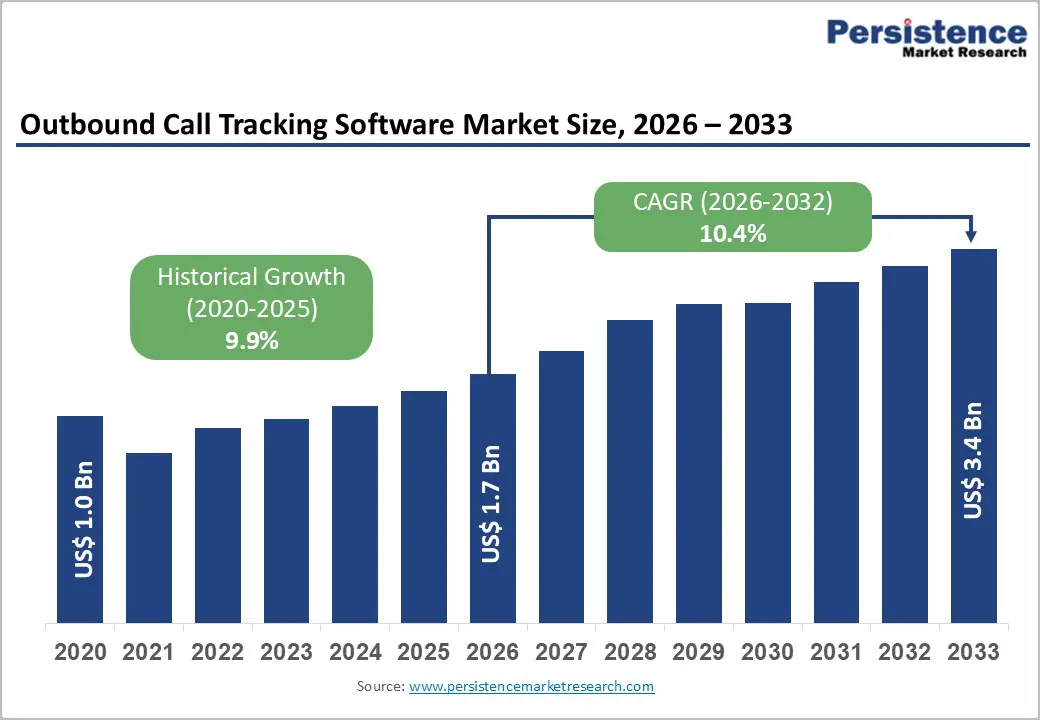
The global outbound call tracking software market size is likely to be valued at US$ 1.7 billion in 2026 and is projected to reach US$ 3.4 billion by 2033, growing at a CAGR of 10.4% between 2026 and 2033.
Strong demand for data-driven sales optimization, AI-based call analytics, and cloud-based contact center architectures is accelerating adoption across industries such as BFSI, telecommunications and IT, retail and e-commerce, and BPO and telemarketing. Growing pressure to demonstrate marketing ROI, comply with tightening telemarketing and data-privacy regulations, and orchestrate omnichannel customer journeys further reinforces sustained investment in outbound call tracking platforms.
Key Industry Highlights:
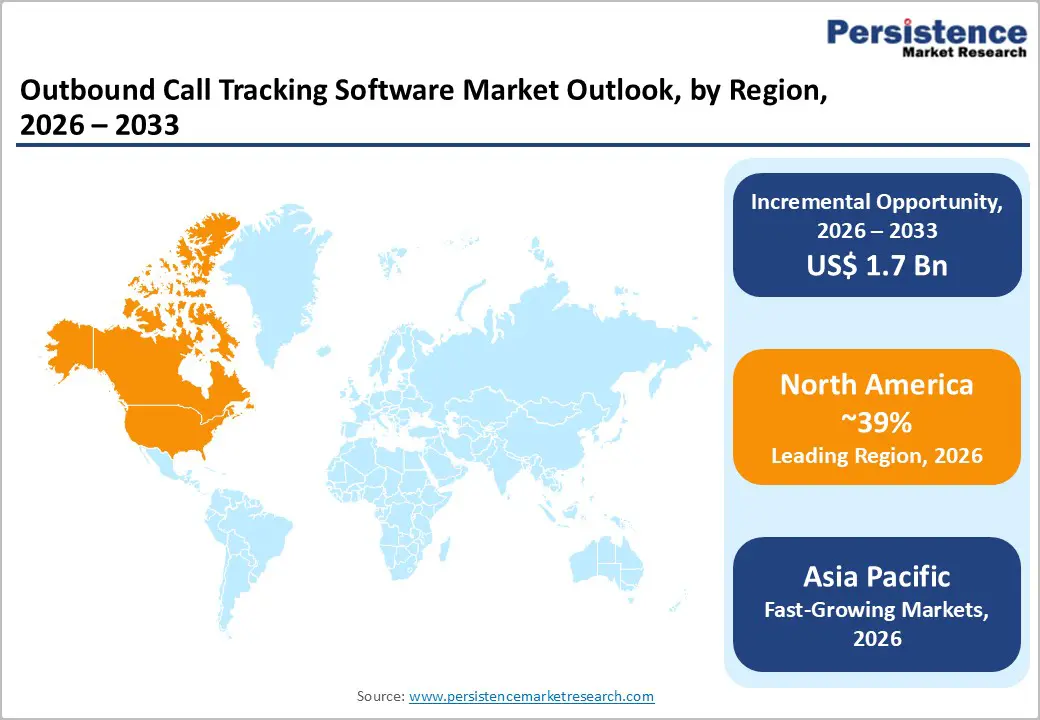
- Leading Region: North America remains the largest market for outbound call tracking software, supported by advanced cloud adoption, stringent regulatory frameworks, and the concentration of leading vendors, which drive rapid innovation in AI-driven contact center solutions.
- Fastest Growing Region: Asia Pacific is expected to post the fastest growth, propelled by rising digital marketing spend, expanding e-commerce, and large-scale BPO and contact center operations across China, India, and ASEAN markets, adopting cloud-based outbound tracking tools.
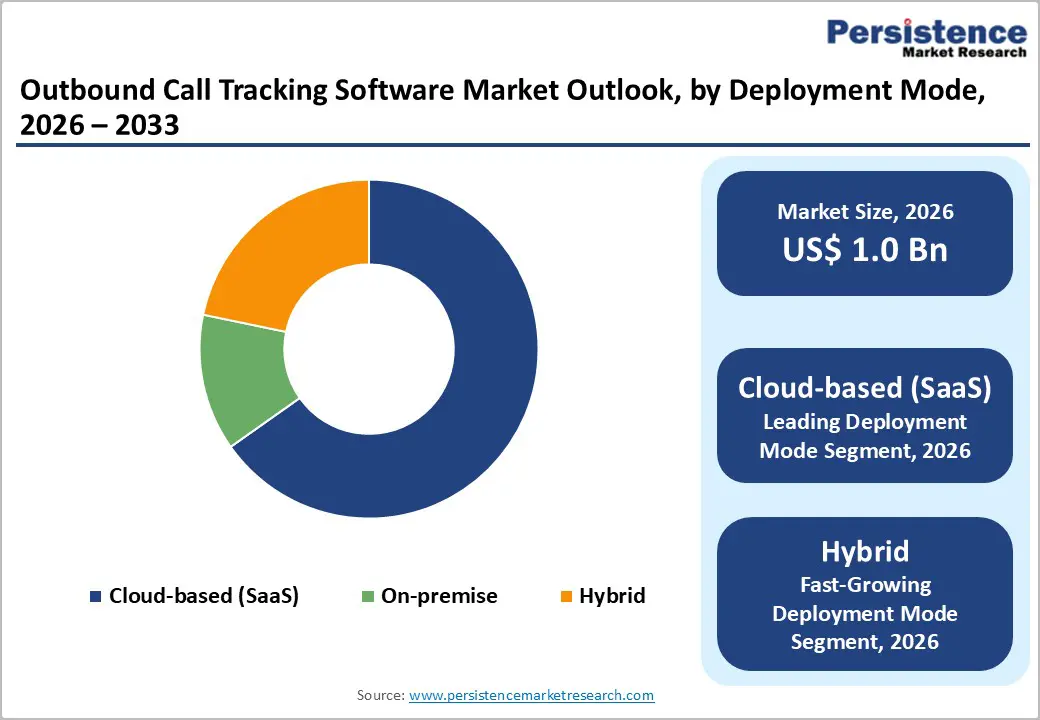
- Dominant Components: The cloud-based (SaaS) deployment mode dominates the market share, as enterprises prioritize scalability, remote-work support, and seamless integration with CRM and marketing stacks to enable advanced analytics and omnichannel outbound engagement.
- Dominant Function: Conversation analytics and call transcription functions are the fastest-growing capabilities, as organizations seek deeper insight into customer intent, agent performance, and compliance through automated, large-scale analysis of voice interactions.
- Key Market Opportunity: Vertical-specific, AI-driven outbound call tracking solutions for BFSI, healthcare, and retail & e-commerce present significant growth opportunities.
| Key Insights | Details |
|---|---|
| Outbound Call Tracking Software Market Size (2026E) | US$ 1.7 Bn |
| Market Value Forecast (2033F) | US$ 3.4 Bn |
| Projected Growth CAGR(2026 - 2033) | 10.4% |
| Historical Market Growth (2020 - 2026) | 9.9% |
Market Dynamics
Drivers - Growing Need for Measurable Sales and Marketing ROI
Enterprises across industries are under increasing pressure to justify marketing and sales investments with quantifiable outcomes, making measurable ROI a central decision-making criterion. As digital advertising spending continues to rise, particularly across search, social media, and performance-based campaigns, a significant portion of customer engagement still converts through voice calls, especially in high-value sectors such as BFSI, healthcare, real estate, automotive, and B2B services. Outbound call tracking software addresses a critical gap by enabling businesses to attribute calls and call-driven conversions to specific campaigns, channels, keywords, or customer touchpoints. This capability allows marketing teams to understand which initiatives drive qualified leads, while sales teams can prioritize outreach based on data-backed insights.
The integration of outbound call tracking with CRM systems, marketing automation platforms, and revenue intelligence tools has elevated its role from a tactical add-on to a strategic performance management solution. By combining call metadata (call duration, call outcome, agent performance) with customer profiles and deal-stage data, organizations can directly link call activity to pipeline progression and closed revenue. This level of transparency supports better budget allocation, improves sales forecasting accuracy, and enables continuous optimization of outbound campaigns. As enterprises move toward revenue operations (RevOps) models that align marketing, sales, and customer success under shared KPIs, outbound call tracking software becomes essential for maintaining accountability, improving conversion efficiency, and maximizing lifetime customer value.
Rapid Adoption of AI, Analytics, and Cloud-Based Contact Center Architectures
The accelerating shift toward AI-driven, cloud-based contact center architectures is a powerful catalyst for the adoption of outbound call tracking software. Organizations are increasingly replacing legacy, on-premise dialers and call management systems with cloud-first platforms that support scalability, remote workforces, and omnichannel engagement. Within these modern environments, outbound call tracking is no longer limited to basic call logging; it is deeply integrated with AI-powered analytics, enabling real-time insights into agent behavior, customer sentiment, call intent, and predicted outcomes. This transformation allows enterprises to move from reactive call reporting to proactive decision-making.
AI-driven capabilities such as intelligent call routing, predictive dialing, speech-to-text transcription, and sentiment analysis significantly enhance outbound sales and service efficiency. Outbound call tracking software leverages these technologies to identify high-intent leads, recommend next-best actions to agents, and continuously refine dialing strategies based on historical performance data. Cloud deployment further accelerates adoption by reducing upfront infrastructure costs, enabling faster implementation, and supporting seamless integration with CRM, workforce management, and customer analytics platforms. As enterprises pursue digital transformation and omnichannel customer engagement strategies, outbound call tracking solutions embedded within cloud-based contact centers become critical enablers of scalable, data-driven, and AI-optimized sales and customer outreach operations.
Restraints - Stringent Data Privacy and Telemarketing Regulations
Stringent data privacy and outbound calling regulations pose a significant restraint. Frameworks such as GDPR in Europe, TCPA in the U.S., and national “Do-Not-Call” registries limit unsolicited outbound outreach, mandate explicit consent, and impose heavy penalties for non-compliance. In some mature markets, regulators have issued fines in the millions of dollars to brands for improper calling practices or the misuse of customer data. These rules increase compliance costs for outbound call tracking vendors and their customers, necessitating sophisticated consent management, call recording controls, and audit trails. Smaller enterprises may delay adoption or restrict usage to avoid perceived regulatory risk, thereby tempering market growth.
Integration Complexity and Legacy Infrastructure Constraints
The complexity of integrating outbound call tracking software with fragmented legacy IT and telephony infrastructure is another key barrier. Many organizations still run on-premise PBX systems, custom-built CRM platforms, or siloed databases that do not easily interoperate with modern SaaS-based tracking tools. Industry surveys on contact center modernization indicate that a sizable proportion of enterprises cite integration challenges and migration risk as top obstacles to cloud and analytics adoption, often leading to multi-year transformation timelines rather than rapid rollouts. This complexity can increase implementation costs, extend deployment cycles, and limit the depth of analytics achievable in the short term, especially for resource-constrained SMEs.
Market Opportunities
Accelerated Adoption Among SMEs via Cloud-Based, Usage-Driven Pricing
A major opportunity lies in expanding deployment among small and medium-sized enterprises (SMEs) through affordable cloud-based offerings and usage-based pricing. Government and multilateral digital economy reports show that over one-third of businesses, often rising beyond 40% in some regions, now use some form of cloud services, with adoption particularly strong among SMEs due to lower capital requirements and flexible subscription models. Outbound call tracking providers can tap this base by offering simplified onboarding, pre-built integrations with popular CRM tools, and pay-as-you-go pricing to reduce adoption barriers. As more SMEs move from manual spreadsheets and basic dialers to integrated contact center stacks, outbound call tracking will become a standard feature for sales and support teams seeking to professionalize and gain better customer insight.
Expansion of Outbound Call Tracking in Data-Driven Sales Enablement and RevOps Platforms
The integration of outbound call tracking software with sales enablement and Revenue Operations (RevOps) platforms represents a significant growth opportunity for the global outbound call tracking software market. As organizations increasingly adopt RevOps models to unify sales, marketing, and customer success functions, there is a growing demand for a single, reliable source of revenue intelligence. Outbound call tracking solutions that seamlessly integrate with CRM systems, sales enablement tools, marketing automation platforms, and analytics dashboards can provide end-to-end visibility into the customer journey, from initial outreach to deal closure. By capturing granular call data, such as call duration, frequency, outcomes, and conversation insights, and synchronizing it with pipeline and revenue metrics, these platforms enable sales leaders to better assess rep performance, optimize outreach strategies, and improve forecasting accuracy.
For RevOps teams, integrated call tracking enhances attribution modeling by linking outbound calling activity directly to revenue outcomes, helping justify investments in specific campaigns, channels, or sales motions. Moreover, AI-driven call analytics embedded within sales enablement workflows can deliver real-time coaching, content recommendations, and compliance monitoring, increasing sales productivity and win rates. As enterprises continue to prioritize data-driven decision-making and cross-functional alignment, outbound call tracking vendors that position their solutions as native components of the broader RevOps and sales enablement ecosystem are likely to experience stronger adoption, higher customer retention, and expanded enterprise contract values.
Category-wise Analysis
Deployment Mode Insights
Cloud-based (SaaS) outbound call tracking software is the leading segment, estimated to account for around 62% of global deployments in 2026, closely mirroring broader contact center trends where cloud-based platforms hold more than 60% share of new installations. Enterprises are increasingly shifting from on-premise dialers to cloud architectures to gain scalability, rapid feature updates, and easier integration with digital channels and CRM systems.
Industry studies on contact center software show cloud solutions capturing the highest growth rates, often above 11% CAGR, due to the ability to centralize data, support remote agents, and provide advanced analytics. For outbound call tracking, this translates into faster roll-outs of features such as AI-based call routing, automated and predictive dialing, and real-time dashboards, reinforcing cloud’s leadership over on-premise and hybrid models.
Function Insights
Call recording and monitoring, coupled with conversation analytics forms the dominant functional cluster, collectively accounting for an estimated 40% share of outbound call tracking deployments. Modern contact centers prioritize high-quality recordings and analytics to support compliance, training, and performance optimization. Industry analyses show that AI-based analytics adoption in contact centers has climbed from around 59% to nearly 90% usage in some surveys over the last few years, underlining the strategic importance of capturing and analyzing voice data.
By layering transcription, sentiment analysis, and keyword spotting on top of recording, outbound call tracking platforms enable supervisors to review a fraction of calls while still obtaining statistically robust quality insights. This functional segment’s leadership is further reinforced by regulatory requirements demanding accurate records of financial, healthcare, and telemarketing conversations.
Organization Size Insights
Large enterprises represent the leading segment, with an estimated market share of about 60–65% of outbound call tracking software spending. In the broader contact center and customer interaction software markets, large enterprises typically account for more than 60% of revenues due to their scale, complexity, and regulatory responsibilities. Large organizations operate multi-site or global contact centers, often supporting thousands of agents and high-volume outbound campaigns across sales, collections, renewals, and upselling.
These enterprises demand advanced capabilities such as multi-level analytics, integration with ERP and enterprise CRM, complex role-based access controls, and robust data-sovereignty configurations, which favor full-featured outbound call tracking suites. While SMEs are growing faster from a smaller base, large enterprises remain the primary contributors to revenue and influence product roadmaps.
Industry Insights
Among industries, BFSI and telecommunications and IT emerge as leading adopters of outbound call tracking software, with BFSI alone accounting for roughly 22% of contact center software spending in recent benchmarks. Financial institutions rely heavily on outbound calls for loan sales, collections, cross-selling, and advisory outreach, operating in strict regulatory environments that demand detailed recording, audit trails, and consent management.
Telecommunications and IT providers, on the other hand, handle massive subscriber bases and continuous upsell campaigns for new data plans, enterprise services, and value-added offerings. Both sectors are advanced users of AI, predictive analytics, and omnichannel engagement, making them natural early adopters of sophisticated outbound call-tracking functions such as lead scoring, intelligent call routing, and automated compliance checks. This entrenched reliance on telephony-based engagement sustains their leadership among vertical segments.
Regional Insights
North America Outbound Call Tracking Software Market Trends
North America is the leading regional market for outbound call tracking software, underpinned by its advanced digital infrastructure, high cloud adoption, and strong innovation ecosystem in SaaS and contact center platforms. Recent analyses of contact center software indicate that North America accounts for about 39% of global revenues, supported by the presence of major vendors and high enterprise technology spending.
U.S. businesses have aggressively adopted cloud services, surveys from federal economic and business agencies show that well over 35% of companies use cloud services, with larger enterprises significantly above this average, creating a fertile environment for cloud-based outbound call tracking tools integrated into broader customer experience stacks. Regulatory frameworks such as TCPA, state privacy laws, and sector-specific rules in financial services and healthcare have also shaped how outbound campaigns are executed, driving demand for compliant call tracking, consent management, and recording solutions.
Europe Outbound Call Tracking Software Market Trends
Europe represents a significant and steadily expanding market, characterized by stringent data-protection regulations and progressive digital transformation agendas. The GDPR framework, together with local telecom and consumer-protection rules, requires detailed handling of consent, call recording, and data retention, which in turn increases the need for sophisticated outbound call tracking platforms that provide fine-grained control and auditability.
Key markets such as Germany, the U.K., France, and Spain have robust contact center and BPO industries, where enterprises are modernizing from legacy telephony to integrated cloud and hybrid contact center architectures. In contact center software, Europe typically holds a substantial share following North America, with cloud-based deployments gaining momentum due to scalability and remote-work requirements. European enterprises often emphasize omnichannel engagement, combining outbound calls with email, messaging apps, and web interactions. This favors outbound call tracking solutions that integrate tightly with CRM and marketing automation tools, provide multilingual analytics, and support distributed operations across the European Economic Area.
Asia Pacific Outbound Call Tracking Software Market Trends
Asia Pacific is poised to be the fastest-growing regional market for outbound call tracking software, supported by rapid digitization, expanding e-commerce, and the region’s role as a global hub for contact centers and BPO operations. Digital economy reports across China, India, Japan, and ASEAN countries highlight annual increases of around 20–25% in digital marketing and online commerce expenditures, directly increasing the volume of calls triggered by digital campaigns and customer inquiries.
Manufacturing and service outsourcing advantages in markets such as India and the Philippines have made the region a major base for global outbound sales and support centers. These operations demand advanced dialers, call recording, and analytics to manage high call volumes cost-effectively. Growing adoption of cloud services and mobile broadband further accelerates the shift from basic telephony to cloud-based contact center platforms, where outbound call tracking is embedded as a core capability.
Competitive Landscape
The outbound call tracking software market is moderately fragmented, with a mix of specialized call tracking vendors, broader contact center suite providers, and CRM-integrated platforms. Market concentration is higher in enterprise segments where a handful of established players dominate complex, large-scale deployments, but SME adoption is served by a long tail of niche SaaS providers.
Key competitive differentiators include depth of analytics (AI-based transcription and sentiment analysis), breadth of integrations with CRM, marketing automation, and advertising platforms, scalability of cloud infrastructure, and regulatory compliance features such as consent management, audit trails, and data sovereignty options. Vendors increasingly focus on verticalized solutions, outcome-based pricing, and partnerships with ecosystem players to enhance stickiness and expand addressable markets.
Key Market Developments:
- In March 2024, Invoca introduced enhanced conversational AI capabilities for sales and marketing teams, improving real-time call scoring and revenue attribution.
- In May 2024, CallRail Inc. expanded its cloud-based analytics suite with deeper integrations into leading CRM and marketing automation platforms, targeting SME customers.
- In September 2023, SalesLoft, Inc. enhanced its sales engagement platform with advanced outbound call tracking, coaching analytics, and integrated dialer capabilities to boost sales productivity.
Companies Covered in Outbound Call Tracking Software Market
- Call Box
- CallRail Inc.
- ConnectAndSell
- Groove
- Gryphon Networks Corp.
- InsideSales.com, Inc.
- PersistIQ
- PhoneBurner
- RingDNA
- Salesforce
- SalesLoft, Inc.
- Salesmate.io
- Invoca
- Phonexa
- Marchex
Frequently Asked Questions
The global outbound call tracking software market is valued at around US$ 1.7 Bn in 2026 and is projected to reach approximately US$ 3.4 Bn by 2033, reflecting a robust forecast CAGR of about 10.4% between 2026 and 2033.
Key demand drivers include the growing need to measure marketing and sales ROI, increased digital advertising and e-commerce activity, and rising integration of AI and analytics in contact centers, which enable better attribution, higher conversion rates, and improved regulatory compliance in outbound campaigns.
The cloud-based (SaaS) deployment mode leads the market, benefiting from more than 60% share in new contact center software deployments, while functionally, call recording and monitoring combined with conversation analytics forms the dominant feature cluster for enterprises.
North America is the leading region, supported by advanced technology infrastructure, high cloud and AI adoption in contact centers, and stringent regulatory frameworks that drive demand for compliant, analytics-rich outbound call tracking solutions.
A major opportunity lies in developing vertical-specific, AI-driven outbound call tracking and conversation intelligence solutions for sectors such as BFSI, healthcare, retail and e-commerce, and BPO, enabling higher conversion, better compliance, and richer customer insights from every call.
Key players include Call Box, CallRail Inc., ConnectAndSell, Groove, Gryphon Networks Corp., InsideSales.com, Inc., PersistIQ, PhoneBurner, RingDNA, Salesforce, SalesLoft, Inc., Salesmate.io, Invoca, Phonexa, Marchex, alongside other notable vendors such as ZoomInfo, Twilio Inc., RingCentral, Inc., Five9, Inc., and Genesys.


