




- Specialty & Fine Chemicals
- Organo Modified Siloxanes Market
Organo Modified Siloxanes Market Size, Share, and Growth Forecast, 2026 – 2033
Organo Modified Siloxanes Market by Structure Type (Comb-like Structure, Linear Structure, Combined Structure, Others), Physical State (Solid, Liquid, Gel, Foam), Application (Adhesives & Sealants, Coatings & Paints, Others), and Regional Analysis for 2026 – 2033

Organo Modified Siloxanes Market Size and Trends Analysis
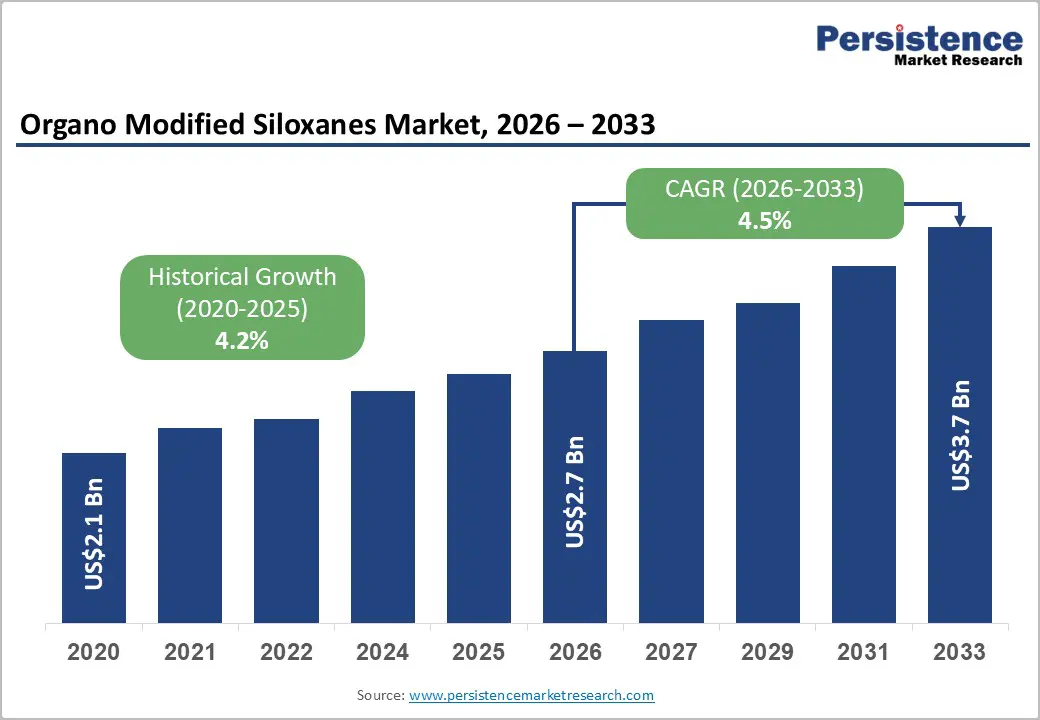
The global organo modified siloxanes market size is likely to be valued at US$2.7 billion in 2026 and is expected to reach US$3.7 billion by 2033, growing at a CAGR of 4.5% during the forecast period from 2026 to 2033, driven by increasing demand for high-performance silicone-based additives across multiple industrial sectors.
Organo modified siloxanes are widely valued for their ability to enhance surface properties such as hydrophobicity, lubrication, thermal stability, and adhesion, making them essential ingredients in advanced coatings, sealants, and specialty formulations. Rapid development in construction and infrastructure projects continues to support demand for siloxane-based waterproofing agents, protective coatings, and sealants used to improve durability and resistance against moisture and environmental exposure. The personal care industry also contributes significantly to market growth, as organo-modified siloxanes are widely incorporated into skincare, haircare, and cosmetic formulations to improve spreadability, conditioning performance, and sensory characteristics.
Key Industry Highlights:
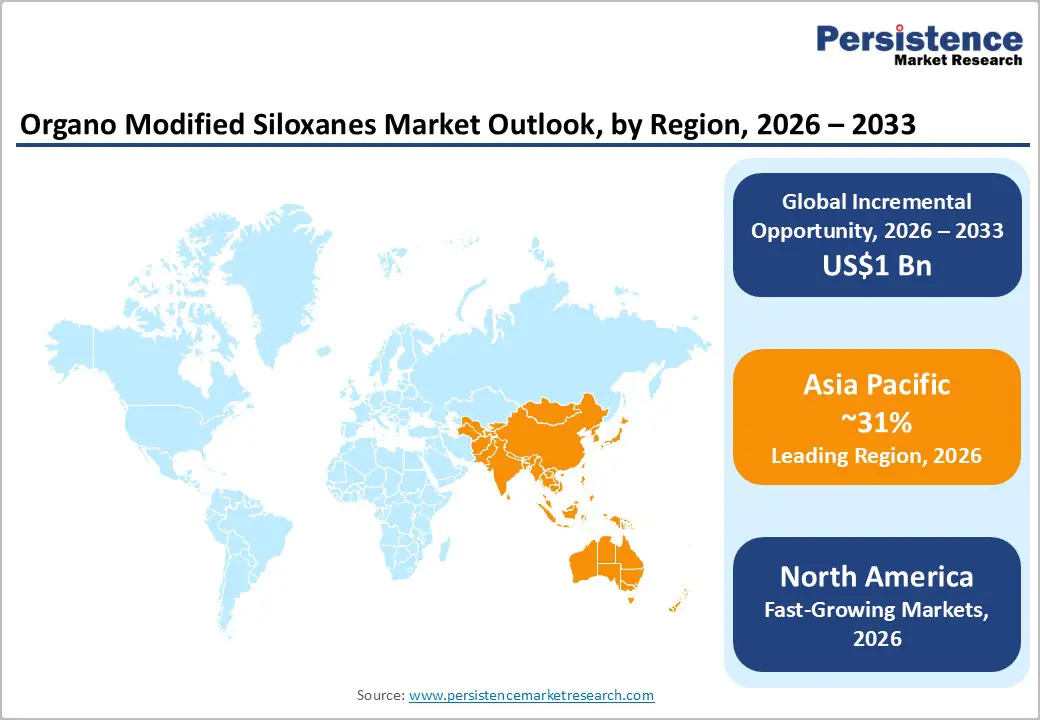
- Leading Region: Asia Pacific is anticipated to be the leading region, accounting for a market share of 31% in 2026, driven by manufacturing scale, electronics demand, infrastructure growth, and expanding textiles and personal care sectors.
- Fastest-growing Region: North America is likely to be the fastest-growing region, supported by U.S. leadership in specialty chemicals, automotive electrification, and advanced construction and electronics applications.
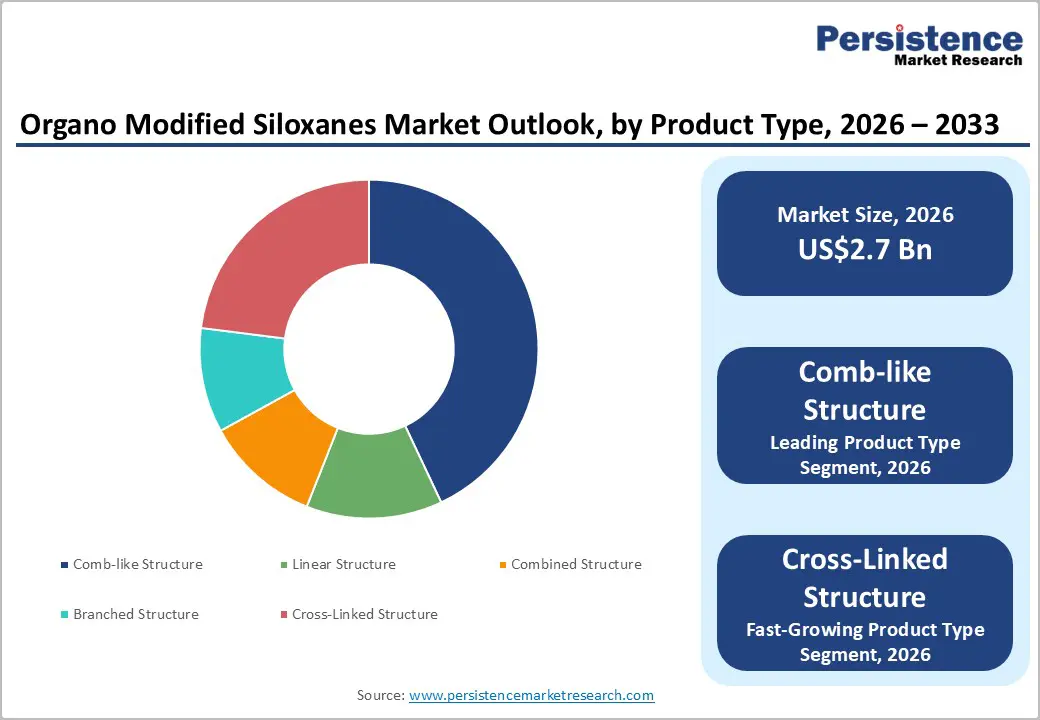
- Leading Structure Type: Comb-like structures are projected to represent the leading structure type in 2026, accounting for 43% of the revenue share, driven by superior surface activity and compatibility with diverse polymer systems in coatings, adhesives, and personal care applications.
- Leading Application: Adhesives & sealants are anticipated to be the leading end-user, accounting for over 38% of the revenue share in 2026, supported by widespread use in construction, infrastructure, and automotive assembly applications.
| Key Insights | Details |
|---|---|
|
Organo Modified Siloxanes Market Size (2026E) |
US$2.7 Bn |
|
Market Value Forecast (2033F) |
US$3.7 Bn |
|
Projected Growth (CAGR 2026 to 2033) |
4.5% |
|
Historical Market Growth (CAGR 2020 to 2025) |
4.2% |
Market Factors – Growth, Barriers, and Opportunity Analysis
Growth Analysis- Expansion in Personal Care and Biomedical Formulations
Organo-modified siloxanes are increasingly adopted in personal care and biomedical sectors due to their unique properties, such as skin compatibility, spreadability, and chemical stability. In cosmetics, shampoos, conditioners, and skincare formulations benefit from improved texture, moisturizing, and conditioning effects. In biomedical applications, these compounds are used in implants, drug-delivery coatings, and medical-grade adhesives, owing to their biocompatibility and stability. Rising consumer awareness of premium personal care products, coupled with growing demand for advanced medical devices, drives sustained growth. Manufacturers are investing in R&D to develop multifunctional siloxane variants, strengthening market penetration in these high-value segments.
The market trajectory also benefits from increasing regulatory approvals for biomedical applications, facilitating the adoption of organo-modified siloxanes in hospital and healthcare settings. Hospitals and research institutions are integrating these materials into implant coatings, wound dressings, and drug carriers, enhancing patient outcomes and product performance. The personal care segment witnesses innovation in lightweight, non-greasy, and long-lasting formulations, where siloxanes impart desirable sensory properties. Steady growth in disposable income and lifestyle-driven consumption in emerging economies fuels expansion.
Rise in Coatings and Automotive Applications
In construction, these materials are incorporated into weatherproofing membranes, protective coatings, and sealants to extend the life of structures and reduce maintenance costs. In automotive manufacturing, siloxane-based adhesives and coatings are used in EV battery insulation, body coatings, and interior components, contributing to durability and safety. Growing electrification in vehicles, along with stricter regulatory standards for emissions and corrosion resistance, is increasing the adoption of high-performance siloxane formulations in coatings and the automotive sectors.
Manufacturers are focusing on developing advanced siloxane blends that optimize performance while reducing volatile organic compounds (VOCs), aligning with sustainability initiatives. Coatings industry growth, especially in industrial and protective applications, benefits from enhanced surface smoothness, anti-fouling, and anti-staining properties imparted by organo-modified siloxanes. Automotive OEMs and tier-1 suppliers are increasingly relying on these specialty materials to meet regulatory requirements for thermal stability and chemical resistance. Expansion in infrastructure projects and rising automotive production in emerging economies stimulate market uptake.
Barrier Analysis - Competition from Alternative Surface-Modifying Technologies
The organo-modified siloxanes market faces competition from alternative surface-modifying chemistries, including fluoropolymers, acrylics, and polyurethane-based coatings. These alternatives offer comparable hydrophobicity, adhesion, and surface protection in specific applications, sometimes at lower costs or with simpler processing. Industries such as construction, textiles, and automotive prefer conventional polymer treatments, especially where regulatory compliance and environmental standards limit specialty chemical use. This competition can slow market adoption, requiring siloxane manufacturers to continuously innovate and differentiate their products based on performance benefits, chemical stability, and multifunctionality to maintain market share and justify premium pricing.
The presence of well-established substitutes also challenges new entrants and smaller players in the organo-modified siloxanes market. Market penetration depends heavily on demonstrating superior long-term performance, compatibility with polymers, and eco-friendly characteristics. Manufacturers need to invest in marketing, certification, and application support to overcome customer hesitancy toward switching from alternative technologies. While siloxanes offer unique advantages in personal care and biomedical sectors, broader industrial applications face price sensitivity and technical competition.
Technological Complexity in Customization
Developing customized organo-modified siloxanes involves high technological complexity, requiring precise chemical modifications to achieve targeted properties such as viscosity, hydrophobicity, or thermal resistance. Tailoring formulations for specific applications such as biomedical implants, electronics encapsulation, or automotive coatings demands advanced R&D, skilled personnel, and specialized equipment. This complexity increases production costs and limits scalability for small manufacturers, potentially restricting market expansion.
Complexity in formulation also influences innovation cycles, as small variations in polymer compatibility, cross-linking, or functional group incorporation can significantly impact performance. End-users often require application-specific trials and validation, which can prolong adoption timelines. Biomedical coatings or high-performance automotive adhesives must meet strict mechanical, thermal, and chemical standards. Manufacturers face the challenge of balancing advanced customization with cost-effectiveness, production efficiency, and regulatory approvals.
Opportunity Analysis - Biomedical and Healthcare Convergence
The convergence of biomedical and healthcare sectors presents a significant opportunity for organo-modified siloxanes, particularly in implantable devices, drug delivery systems, wound care, and medical coatings. Their biocompatibility, chemical inertness, and flexibility make them ideal for applications requiring long-term stability inside the human body. Rising healthcare investments, aging populations, and increasing demand for minimally invasive medical devices are driving adoption. Collaboration between chemical manufacturers and medical device companies allows the development of tailored siloxane-based solutions, enabling safer and more efficient healthcare products that meet stringent regulatory requirements across markets.
The expanding biomedical market encourages multifunctional siloxane formulations, such as antimicrobial coatings, controlled release matrices, and flexible implantable devices. Hospitals and research centers are increasingly testing organo-modified siloxanes for advanced wound dressings, surgical adhesives, and biocompatible coatings. This sector not only offers high-value applications but also provides long-term recurring demand due to regulatory approvals, repeat usage, and continuous medical innovation. Strategic partnerships, technology licensing, and targeted R&D investment can position siloxane manufacturers to capitalize on this convergence, expanding their footprint in the healthcare and biomedical industry.
Sustainability-Driven Product Innovation
Sustainability concerns are creating opportunities for organo-modified siloxanes in eco-friendly formulations, low-VOC coatings, biodegradable personal care products, and energy-efficient construction materials. Manufacturers are developing siloxanes with reduced environmental impact, improved recyclability, and compatibility with green polymers. Consumers and industries increasingly prefer sustainable solutions that comply with environmental regulations, such as reduced carbon footprint, lower toxicity, and safer manufacturing processes. This trend encourages innovation in formulation design and drives market differentiation for companies offering high-performance yet environmentally responsible products.
Sustainability-driven innovation also opens new markets in packaging, textiles, and automotive industries where eco-compliance is increasingly mandatory. Low-impact siloxane formulations can replace traditional coatings, adhesives, and sealants without compromising performance. Government incentives, environmental standards, and green certification programs accelerate adoption. Companies investing in R&D for renewable raw materials, energy-efficient processes, and multifunctional, sustainable siloxane products can capture emerging market opportunities while strengthening brand reputation. This alignment with sustainability goals positions organo-modified siloxanes as a preferred choice in environmentally conscious applications.
Category-wise Analysis
Structure Type Insights
Comb-like structures are expected to lead the organo modified siloxanes market, accounting for approximately 43% of revenue in 2026, driven by their superior surface activity and compatibility with a wide range of polymer systems. These structures offer excellent flow, wetting, and adhesion properties, making them highly suitable for coatings, adhesives, and personal care formulations. For example, in the coatings industry, comb-like siloxanes are incorporated into exterior paints to improve water repellency and durability, enabling surfaces to resist dirt accumulation and environmental degradation. Their ability to integrate seamlessly with both hydrophobic and hydrophilic polymer matrices enhances performance in complex formulations.
Cross-linked structures are likely to represent the fastest-growing segment in 2026, supported by their enhanced mechanical strength, thermal stability, and specialized functional properties. These structures are increasingly adopted in high-performance applications such as biomedical implants and electronic encapsulants. For example, in biomedical devices, cross-linked siloxanes are used in implant coatings and drug delivery systems as they maintain structural integrity under mechanical stress while providing biocompatibility and chemical resistance. Similarly, branched siloxanes in electronic encapsulation protect sensitive circuitry from heat, moisture, and chemical exposure, ensuring reliability in advanced consumer electronics and EV battery systems.
Application Insights
Adhesives & sealants are projected to lead the market, capturing around 38% of the revenue share in 2026, supported by their extensive use in construction, infrastructure, and automotive assembly. These formulations provide superior adhesion, elasticity, and weather resistance, making them essential for sealing joints, structural bonding, and protective coatings. For example, in the construction sector, siloxane-based sealants are applied to exterior facades and concrete surfaces to prevent water ingress, protect against weathering, and extend building lifespan. In automotive applications, they are used in assembly lines to bond panels, gaskets, and interior components, enhancing durability and vibration resistance.
Biomedical & healthcare is likely to be the fastest-growing application in 2026, driven by increasing demand for biocompatible, durable, and chemically stable materials in medical devices and drug delivery systems. For example, siloxane-based coatings are widely used on implantable devices such as catheters and orthopedic implants, providing chemical inertness, flexibility, and reduced tissue irritation. Drug delivery systems also benefit from controlled release and compatibility with active pharmaceutical ingredients. The growth in this segment is accelerated by rising healthcare expenditure, aging populations, and the expansion of minimally invasive surgical procedures requiring high-performance materials.
Regional Insights
North America Organo Modified Siloxanes Market Trends
North America is likely to be the fastest-growing region in organo-modified siloxanes in 2026, driven by rising demand from the automotive, construction, and electronics sectors. In the U.S., the rapid adoption of electric vehicles and increasing infrastructure projects are stimulating the use of high-performance siloxane-based adhesives, sealants, and coatings. These materials provide thermal stability, chemical resistance, and hydrophobic properties, which are essential for EV battery insulation, automotive body coatings, and weatherproofing in infrastructure. For example, Momentive Performance Materials Inc. has introduced specialty organo-modified siloxanes for automotive coatings and electronics encapsulants, enhancing durability and performance in high-demand applications.
Growth trends are supported by the increasing need for lightweight, durable, and environmentally compliant materials across multiple industries. The electronics sector, in particular, is driving demand for encapsulants and coatings that protect sensitive circuitry from thermal, moisture, and chemical exposure, critical in semiconductors and advanced consumer electronics. Construction projects also rely on siloxane-based sealants for long-term protection against weathering and structural degradation. Sustainability trends encourage manufacturers to develop eco-friendly siloxane formulations with reduced VOC emissions, recyclability, and energy-efficient production processes.
Europe Organo Modified Siloxanes Market Trends
Europe is likely to be a significant market for organo modified siloxanes in 2026, due to strong demand in the construction, automotive, and personal care sectors. In the construction industry, siloxane-based coatings and sealants are widely adopted for façade protection, waterproofing, and long-term durability against harsh weather conditions, particularly in urban infrastructure projects. The automotive sector also contributes significantly, with siloxanes used in adhesives, coatings, and electrical insulation for both traditional and electric vehicles. For example, Wacker Chemie AG has developed specialty organo-modified siloxanes for coatings and personal care applications, emphasizing performance, environmental compliance, and multifunctionality, reinforcing its strong presence in the European market.
Europe’s market trends are also shaped by sustainability and advanced material requirements. Growing emphasis on energy-efficient buildings, lightweight automotive components, and high-performance industrial applications is increasing the adoption of siloxane-based materials. The electronics and semiconductor sectors benefit from siloxanes used in encapsulants, thermal interface materials, and protective coatings, which provide chemical resistance, thermal stability, and electrical insulation. Innovation in bio-based and environmentally friendly siloxanes is accelerating, with manufacturers investing in R&D to meet stringent environmental regulations and evolving consumer preferences.
Asia Pacific Organo Modified Siloxanes Market Trends
The Asia Pacific region is anticipated to be the leading region, accounting for a market share of 31% in 2026, driven by rapid industrialization, infrastructure development, and increasing consumption across key end?use industries. Urbanization and government?led construction projects have bolstered demand for siloxane?enhanced waterproofing and protective coatings, particularly in commercial buildings and transport infrastructure. For example, Shin?Etsu Chemical Co., Ltd. has strengthened its Asia Pacific footprint by supplying tailored organo?modified siloxanes for coatings, electronics, and personal care segments, leveraging its technological expertise and localized production networks.
As semiconductor fabrication and consumer electronics manufacturing increase across China and Southeast Asia, siloxanes are deployed as encapsulants and protective coatings that improve thermal resistance and moisture protection. Infrastructure expansion and residential construction demand resilient siloxane?based sealants and additives for cement and concrete protection. Sustainability trends are also shaping product development, with manufacturers formulating low?VOC, eco?compliant siloxane products that align with tightening regional environmental regulations.
Competitive Landscape
The global organo modified siloxanes market exhibits a moderately fragmented structure, driven by a mix of multinational chemical giants and specialized regional players competing across diverse end?use applications such as coatings, personal care, automotive, and industrial formulations. The competitive dynamics also include regional manufacturers targeting niche applications, aggressive pricing strategies from Asia?based producers, and R&D collaborations with end users for co?developed solutions.
Key leaders, including Dow Inc., Wacker Chemie AG, Momentive Performance Materials Inc., Shin?Etsu Chemical Co., Ltd., and Evonik, hold substantial market positions by leveraging extensive R&D, broad product portfolios, and distribution networks to meet varied customer needs. These companies are investing heavily in new siloxane technologies, sustainable formulations, and production capacity expansions to strengthen their foothold in key regional markets and address growing demand for advanced, high?performance materials across sectors ranging from personal care to industrial coatings.
Key Industry Developments:
- In November 2025, Dow Inc. unveiled four new personal care ingredients at in?cosmetics Asia 2025 in Bangkok, including DOWSIL™ FC?5012 ID Resin Gum, a flexible silicone resin film former that enhances sebum and water repellency in color cosmetics, and DOWSIL™ CB?2251 Fluid, a silicone?based hair conditioning agent designed to improve moisture and softness. These launches reflect Dow’s commitment to advancing high?performance silicone technologies, tailored to regional beauty trends and sustainability goals.
- In January 2025, Shin?Etsu Chemical Co., Ltd. launched a siloxane?based transparent adhesive designed for advanced electronics, including OLED displays, offering enhanced durability and optical clarity. This product supports expanding applications of organo?modified siloxanes in high-tech electronics, reflecting growing demand for specialty siloxanes in display, semiconductor, and other downstream electronic markets.
- In May 2025, Dow Inc. unveiled its first low?carbon DOWSIL™ silicone elastomer blends under the Decarbia™ reduced carbon platform at the New York Society of Cosmetic Chemists (NYSCC) Suppliers’ Day. The new silicone elastomers offer sustainable, high?performance options for skin, hair, and color cosmetics formulations, empowering cosmetic formulators with conditioning, film?forming, and water repellency benefits aligned with evolving consumer and regulatory demand for eco?friendly materials.
Companies Covered in Organo Modified Siloxanes Market
- Dow Inc.
- Supreme Silicones
- Wacker Chemie AG
- Shin-Etsu Chemical Co., Ltd.
- Momentive Performance Materials Inc.
- Evonik Industries AG
- Elkem ASA
- Siltech Corporation
- Gelest, Inc.
- CHT Silicones
- BRB International BV
- KCC Corporation
Frequently Asked Questions
Organo modified siloxanes are silicon-based compounds with organic groups attached, offering diverse properties such as water repellency, lubrication, and surface modification, crucial for industries like construction, automotive, and personal care.
Factors include increasing demand for specialty chemicals, growing applications in coatings, adhesives, and sealants, and advancements in silicone chemistry enabling tailored formulations for various industries.
Industries such as construction, automotive, electronics, and personal care rely heavily on organo-modified siloxanes for applications like water-resistant coatings, anti-foaming agents, and skincare formulations.
Challenges include competition from alternative materials, regulatory hurdles regarding environmental and health concerns, and the need for continuous innovation to meet evolving industry requirements.
Emerging trends include the development of eco-friendly and bio-based siloxane derivatives, customization of siloxane structures for specific applications, and the integration of nanotechnology for enhanced performance in advanced materials.


