




- Hardware & Software IT Services
- Operational Predictive Maintenance Market
Operational Predictive Maintenance Market Size, Share, and Growth Forecast, 2026 - 2033
Operational Predictive Maintenance Market by Component Type (Software, Hardware, Services), Deployment Mode (On-Premises, Cloud-Based), Deployment Mode (Cloud-Based, On-Premises), End Use Industry (Manufacturing, Energy & Utilities, Oil & Gas, Transportation & Logistics, Automotive, Aerospace & Defense, Misc.) and Regional Analysis for 2026 - 2033

Operational Predictive Maintenance Market Size and Trends Analysis
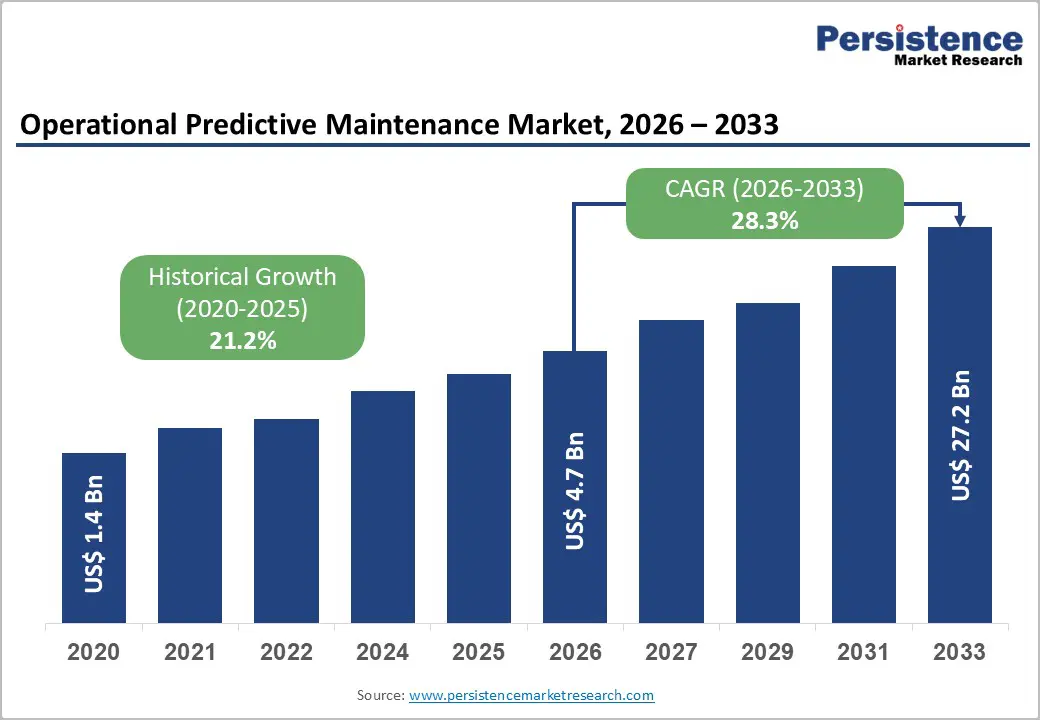
The Global Operational Predictive Maintenance Market size was valued at US$ 4.7 Bn in 2026 and is projected to reach US$ 27.2 Bn by 2033, growing at a CAGR of 28.3% between 2026 and 2033. This robust expansion is driven by the accelerating digital transformation across industrial sectors, mandatory adoption of Industry 4.0 technologies, and the critical need to minimize unplanned equipment downtime.
The market's trajectory reflects a fundamental shift from reactive to predictive maintenance strategies, supported by advancements in artificial intelligence, machine learning algorithms, and Internet of Things (IoT) sensor networks. With manufacturing, energy, and transportation sectors collectively accounting for over 60 percent of market demand, the integration of predictive analytics into operational frameworks has become essential for maintaining competitive advantage and operational efficiency.
Key Industry Highlights:
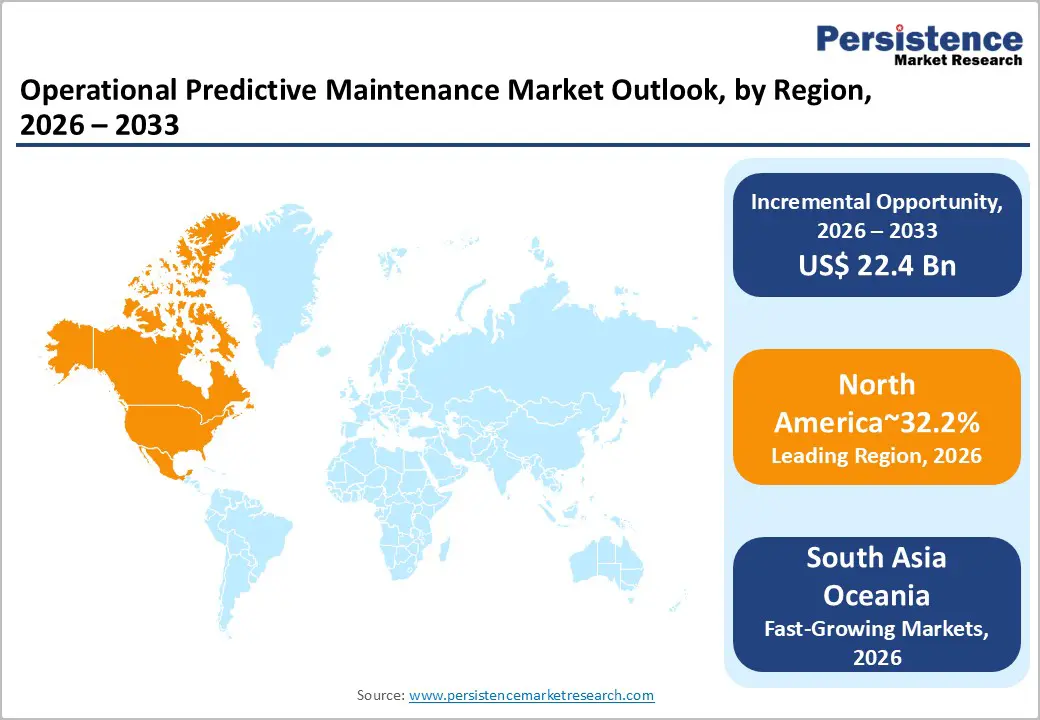
- Regional Leadership: North America leads the global Operational Predictive Maintenance Market with 32.2% share, supported by advanced industrial infrastructure, extensive transportation networks, and strong digital transformation initiatives across manufacturing and energy sectors.
- Strong European Presence: Europe holds 27% share, driven by mature industrial ecosystems, stringent regulatory frameworks, decarbonization mandates, and collaborative innovation in predictive maintenance adoption.
- High-Growth East Asia Market: East Asia accounts for 22% share and remains a rapidly expanding region, powered by rapid industrialization, massive renewable energy deployment, and government-backed infrastructure modernization in China, Japan, and South Korea.
- Leading Solution Type: The Software segment dominates with 52.4% share, enabled by widespread adoption of AI-driven analytics, predictive algorithms, and cloud-based maintenance platforms.
- Fastest-Growing Solution Type: The Services segment emerges as the fastest-growing category, fueled by consulting, implementation, training, and managed services addressing skills gaps and system complexity.
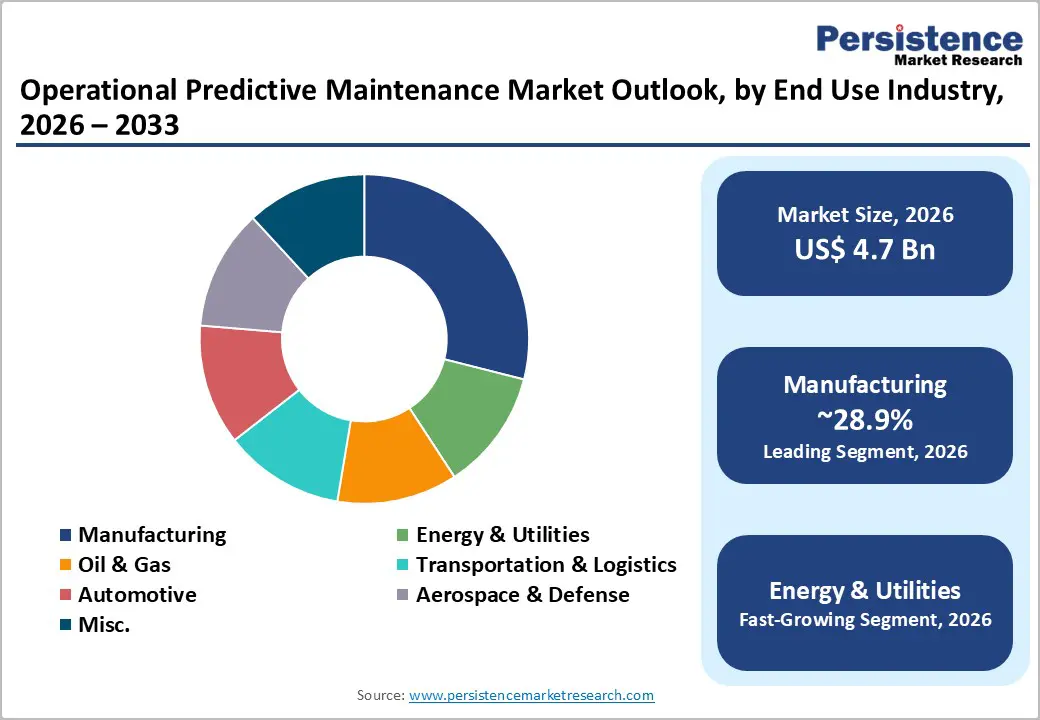
- Leading End-User Segment: Manufacturing holds 28.9% share, reflecting high dependence on continuous production uptime, complex machinery, and Industry 4.0 adoption for predictive maintenance integration.
| Key Insights | Details |
|---|---|
|
Operational Predictive Maintenance Market Size (2026E) |
US$ 4.7 Bn |
|
Market Value Forecast (2033F) |
US$ 27.2 Bn |
|
Projected Growth (CAGR 2026 to 2033) |
28.3% |
|
Historical Market Growth (CAGR 2020 to 2025) |
21.2% |
Market Dynamics
Growth Drivers
Surge in Global Energy Demand and Infrastructure Modernization
The proliferation of energy infrastructure modernization initiatives directly impacts the Operational Predictive Maintenance Market as utilities and power generation facilities prioritize asset reliability. According to the International Energy Association, global energy demand grew by 2.2 percent in 2024, outpacing the average growth over the past decade, with electricity demand surging by 4.3 percent, well above the 3.2 percent growth in global GDP. This unprecedented rise was fueled by record temperatures, electrification, and digitalization across all economic sectors.
Global electricity consumption surged by nearly 1,100 terawatt-hours (TWh) in 2024, more than double the annual average of the past decade, marking the largest increase outside post-recession rebound years. China contributed over half of this growth, while emerging and developing economies saw 4 percent increases, and advanced economies reached record electricity consumption levels. The renewable energy and nuclear sector accounted for 80% of electricity generation growth in 2024, with new renewable capacity additions reaching a record 700 GW.
This massive infrastructure expansion necessitates sophisticated predictive maintenance solutions to ensure operational continuity, optimize asset performance, and prevent costly equipment failures across generation, transmission, and distribution networks, thereby creating sustained demand within the Operational Predictive Maintenance Market.
Expansion of Transportation Infrastructure and Asset Management Requirements
The substantial expansion of transportation networks globally creates critical demand for predictive maintenance technologies to manage increasingly complex infrastructure assets. Between 2013 and 2023, inland transport infrastructure in the European Union showed significant regional variation and growth, with motorway density highest around capitals and economic hubs, including regions like Utrecht, Zuid-Holland, Budapest, Vienna, Berlin, and Madrid. Spain, Slovakia, Czechia, Romania, Bulgaria, and Türkiye experienced the largest motorway expansions during this decade, reflecting substantial investment in previously underdeveloped networks.
As of August 2025, China's road network totals 6.49 million km, up from 5.2 million km in 2020, providing an average of 4.61 meters of road per inhabitant for its 1.41 billion population. The United States operates over 4.19 million miles of roads, including nearly 50,000 miles of major arterials, while railroads have consolidated to approximately 91,000 miles.
This massive infrastructure base, combined with vehicle ownership reaching approximately 0.31 vehicles per person in China totaling around 440 million vehicles nationwide and supporting 340 million residents across 132.7 million households in the United States, demands advanced maintenance strategies to ensure safety and operational efficiency, directly benefiting the Operational Predictive Maintenance Market.
Acceleration of Grid-Scale Energy Storage Deployment and Clean Energy Transitions
The rapid deployment of energy storage systems and renewable energy infrastructure necessitates sophisticated predictive maintenance capabilities to ensure grid reliability and asset longevity. Grid-scale battery storage is projected to expand nearly 35-fold between 2022 and 2030, reaching nearly 970 GW globally, with 170 GW expected to be added in 2030 alone, according to the International Energy Agency's Tracking Clean Energy Progress report.
This expansion is critical for addressing the hour-to-hour variability of renewables and ensuring grid reliability as the share of variable renewable energy increases. Global investment in battery energy storage exceeded USD 20 billion in 2022, with grid-scale projects accounting for over 65 percent of total spending, and investment is expected to exceed USD 35 billion in 2023. China announced plans to install over 30 GW of energy storage by 2025, while the United States' Inflation Reduction Act provides investment tax credits for standalone storage, boosting grid-scale storage competitiveness.
India and Australia have set ambitious national targets for battery energy storage deployment, complemented by funding programs and policy support. The European Commission has issued recommendations to enhance energy storage deployment across the EU. The complexity of managing lithium-ion batteries, flow batteries, and pumped-storage hydropower systems combined with challenges related to battery minerals supply, performance degradation monitoring, and temperature management creates substantial opportunities for predictive maintenance solutions in the Operational Predictive Maintenance Market.
Market Restraining Factors
High Initial Capital Investment and Implementation Complexity
The deployment of comprehensive predictive maintenance systems requires substantial upfront investment in sensor infrastructure, data analytics platforms, connectivity networks, and workforce training programs. Small and medium-sized enterprises, particularly in emerging markets, face significant financial barriers when transitioning from traditional maintenance approaches to advanced predictive systems.
The integration complexity increases when existing legacy equipment lacks digital connectivity, requiring costly retrofits or complete system replacements. Additionally, organizations must invest in cybersecurity measures to protect operational technology environments from potential vulnerabilities introduced through increased connectivity and data exchange protocols.
Key Market Opportunities
Artificial Intelligence and Machine Learning Algorithm Advancement
The rapid evolution of artificial intelligence and machine learning technologies presents transformative opportunities for the Operational Predictive Maintenance Market by enabling more accurate failure prediction, automated anomaly detection, and self-optimizing maintenance schedules. Advanced neural networks and deep learning algorithms can now process multi-dimensional sensor data from industrial equipment, identifying subtle patterns indicative of impending failures that traditional rule-based systems cannot detect.
The convergence of edge computing with AI-powered analytics allows real-time decision-making at the asset level, reducing latency and bandwidth requirements while improving response times to critical equipment conditions. Organizations implementing these advanced solutions benefit from reduced false positives, optimized spare parts inventory management, and extended equipment lifecycles. The development of explainable AI models addresses previous concerns about black-box decision-making, enabling maintenance teams to understand and trust algorithmic recommendations. As computational costs decline and pre-trained models become more accessible, even smaller organizations can leverage sophisticated predictive capabilities, democratizing access to advanced maintenance technologies within the Operational Predictive Maintenance Market.
Industrial Internet of Things and Sensor Technology Proliferation
The widespread adoption of Industrial Internet of Things (IIoT) ecosystems and advanced sensor technologies create unprecedented opportunities for comprehensive asset monitoring and predictive maintenance capabilities across the Operational Predictive Maintenance Market. Modern wireless sensor networks, utilizing protocols such as LoRaWAN, 5G, and Wi-Fi 6, enable cost-effective deployment of monitoring systems across geographically dispersed assets without extensive cable infrastructure investments.
The miniaturization of sensors combined with energy harvesting technologies allows continuous monitoring of previously inaccessible equipment components, including rotating machinery, underground pipelines, and remote renewable energy installations. The integration of thermal imaging, vibration analysis, acoustic monitoring, and chemical sensors provides multi-parameter health assessment capabilities, enabling holistic equipment condition understanding.
Cloud-based data platforms facilitate centralized monitoring of global asset portfolios, while digital twin technologies enable virtual simulation and testing of maintenance strategies before physical implementation. These technological convergences reduce monitoring costs, improve data granularity, and extend predictive maintenance applications to asset classes previously considered economically unfeasible, substantially expanding the addressable market for the Operational Predictive Maintenance Market.
Category-wise Analysis
Component Type Insights
Software solutions dominate the Operational Predictive Maintenance Market with 52.4% market share in 2026, driven by the critical role of analytics platforms, machine learning algorithms, and enterprise integration capabilities in delivering actionable maintenance insights. Advanced software platforms process vast data streams from connected assets, applying statistical models and artificial intelligence to identify failure patterns, optimize maintenance schedules, and provide prescriptive recommendations to operations teams.
The software segment's leadership reflects the transition from hardware-centric monitoring systems to intelligence-driven maintenance ecosystems where value creation occurs through data interpretation rather than sensor deployment alone. Cloud-based software-as-a-service models reduce implementation barriers by eliminating on-premises infrastructure requirements, while application programming interfaces facilitate integration with existing enterprise resource planning, computerized maintenance management systems, and manufacturing execution systems.
The scalability of software solutions allows organizations to expand predictive maintenance programs across multiple facilities and asset types without proportional cost increases, enhancing return on investment and accelerating adoption across diverse industrial applications. Services represent the fastest-growing component within the Operational Predictive Maintenance Market, encompassing consulting, implementation, training, and managed services that address the skills gap and implementation complexity challenges facing organizations.
End Use Industry Insights
Manufacturing companies command the largest share of the Operational Predictive Maintenance Market at 28.9% in 2026, reflecting the sector's critical dependence on continuous production uptime, stringent quality requirements, and capital-intensive equipment investments. Modern manufacturing facilities operate complex machinery including CNC machines, robotic systems, injection molding equipment, and automated assembly lines where unplanned downtime directly impacts production output, delivery commitments, and profitability metrics.
The manufacturing sector's leadership position stems from early adoption of Industry 4.0 principles, established smart factory initiatives, and existing investments in industrial automation infrastructure that facilitate predictive maintenance integration. Discrete manufacturing operations benefit from equipment-specific failure mode analysis, while process manufacturers leverage predictive analytics to optimize continuous production lines and minimize quality deviations.
Energy & Utilities represents the fastest-growing end-user segment within the Operational Predictive Maintenance Market, propelled by unprecedented electricity generation expansion, renewable energy integration challenges, and critical infrastructure modernization requirements. The sector's rapid adoption reflects the operational complexity of managing diverse generation assets including thermal power plants, nuclear facilities, wind farms, solar installations, and hydroelectric stations, each requiring specialized predictive maintenance approaches tailored to specific failure modes and operational profiles.
Grid-scale battery storage expansion, projected to reach nearly 970 GW globally by 2030 with 170 GW additions in 2030 alone, introduces new maintenance challenges requiring sophisticated thermal management, capacity degradation monitoring, and cycle life optimization capabilities. Transmission and distribution infrastructure, experiencing record electricity demand growth of 4.3 percent in 2024 driven by electrification and digitalization, necessitates advanced monitoring of transformers, circuit breakers, and power lines to prevent cascading failures and ensure grid stability.
Regional Insights and Trends
North America Market Trend
North America dominates the Global Operational Predictive Maintenance Market with 32.2% share, driven by advanced industrial infrastructure, high technology adoption rates, and substantial investments in digital transformation initiatives across manufacturing, energy, and transportation sectors. The region benefits from established Industry 4.0 ecosystems, widespread cloud computing infrastructure, and favorable regulatory environments supporting predictive maintenance technology deployment.
The United States transportation system, spanning 3.8 million square miles and serving 340 million residents across 132.7 million households in 2024, operates one of the world's most complex multimodal networks requiring sophisticated asset management solutions. The highway network encompasses over 4.19 million miles of roads including nearly 50,000 miles of major arterials, while railroads comprise approximately 91,000 miles dominated by six Class, I freight carriers and Amtrak for passenger services.
Air transport infrastructure includes 5,000 public-use and 14,400 private-use airports, with 31 major hubs handling commercial traffic. Maritime transport operates through 299 ports including 150 major facilities, complemented by extensive pipeline networks totaling 83,200 miles of crude oil, 64,200 miles of petroleum products, 300,900 miles of natural gas transmission, and 1.4 million miles of distribution mains. This massive infrastructure base, with the transportation sector contributing $2.5 trillion to GDP in 2024 or 10.8 percent of national output, creates substantial demand for predictive maintenance solutions ensuring operational reliability and safety compliance.
East Asia Market Trend
East Asia represents 22% of the Global Operational Predictive Maintenance Market, characterized by rapid industrialization, massive infrastructure investments, and government-led initiatives promoting manufacturing modernization and clean energy transitions. The region's growth trajectory reflects substantial manufacturing capacity expansion, aggressive renewable energy deployment targets, and strategic emphasis on achieving technological self-sufficiency in critical industrial technologies.
China announced plans to install over 30 GW of energy storage by 2025, with pumped-storage hydropower investment heavily concentrated in the country, which has dominated final investment decisions for new capacity since 2015. New renewable capacity additions reached a record 700 GW globally in 2024, with 80 percent comprising solar PV installations, and China's renewables reaching nearly 20 percent of total generation. Nuclear power expansion included over 7 GW of new capacity brought online globally in 2024, with construction starts for new nuclear plants increasing by 50 percent using exclusively Chinese and Russian designs. This comprehensive infrastructure expansion across power generation, transportation networks, and industrial manufacturing creates substantial demand for predictive maintenance solutions addressing asset reliability, operational efficiency, and safety compliance requirements throughout East Asia's rapidly evolving industrial landscape.
This comprehensive infrastructure expansion across power generation, transportation networks, and industrial manufacturing creates substantial demand for predictive maintenance solutions addressing asset reliability, operational efficiency, and safety compliance requirements throughout East Asia's rapidly evolving industrial landscape.
Europe Market Trend
Europe accounts for 27% of the Global Operational Predictive Maintenance Market, supported by stringent regulatory frameworks, sustainability mandates, and established industrial ecosystems emphasizing operational excellence and environmental responsibility. The region's market characteristics reflect mature industrial bases undergoing digital transformation, aggressive decarbonization commitments, and collaborative innovation frameworks connecting equipment manufacturers, technology providers, and end-user industries.
The European Union posted its first energy demand growth since 2017 outside the post-Covid rebound, with electricity consumption reaching record levels driven by extreme temperatures, industrial activity, and data center expansion. The European Union and the United States witnessed solar and wind generation surpass coal generation in 2024, reflecting successful renewable energy transition strategies.
Europe's competitive advantages include established industrial research capabilities, government support for digital manufacturing initiatives, and collaborative ecosystems fostering innovation partnerships, positioning the region for sustained market growth aligned with decarbonization objectives and operational efficiency imperatives through 2033.
Competitive Landscape
The Global Operational Predictive Maintenance (OPM) market is moderately concentrated, with a few leading players holding significant market influence while numerous smaller and niche vendors contribute to competitive pressure. Key market leaders include Siemens, IBM, GE Digital, Schneider Electric, SAP SE, and Rockwell Automation, who leverage advanced AI driven analytics, IoT integration, and cloud-based platforms to provide comprehensive operational maintenance solutions.
Mid-sized and specialized players like SAS Institute, PTC, eMaint by Fluke, and Bosch compete by offering flexible, industry-specific tools, keeping the market dynamic and innovation-driven. The market is neither purely oligopolistic nor entirely fragmented, reflecting a moderately fragmented structure where top vendors dominate overall share, but smaller competitors influence niche segments. Strategic alliances, technology partnerships, and acquisitions are common, enabling companies to enhance predictive capabilities and expand operational integration.
Key Industry Developments
- 15 January 2026, Wärtsilä signed a 10-year Lifecycle Agreement with MOL Global Ship Management to provide predictive maintenance, dynamic maintenance planning, and 24/7 remote operational support for 12 new LNG carriers. The agreement integrates Wärtsilä’s Expert Insight predictive maintenance solution to anticipate failures, reduce downtime, and enhance operational efficiency, delivering higher reliability, flexible maintenance scheduling, and reduced spare parts consumption across the fleet.
- September 4, 2025, BlueScope implemented Siemens’ Senseye predictive maintenance technology across multiple manufacturing facilities, achieving ~2,000 hours of avoided unplanned downtime since 2022. This initiative enabled early detection of equipment degradation using AI-driven analytics, improved operational efficiency, reduced production interruptions, and supported BlueScope’s global digital transformation strategy.
Companies Covered in Operational Predictive Maintenance Market
- IBM Corporation
- Software AG
- SAS Institute Inc.
- PTC, Inc
- General Electric
- Robert Bosch GmbH
- Rockwell Automation
- Schneider Electric
Frequently Asked Questions
The global Operational Predictive Maintenance Market is projected to be valued at US$ 4.7 Bn in 2026.
The Manufacturing segment is expected to account for approximately 28.9% of the Global Operational Predictive Maintenance Market by End Use Industry in 2026.
The market is expected to witness a CAGR of 28.3% from 2026 to 2033.
The Operational Predictive Maintenance Market growth is driven by rising global energy demand and infrastructure modernization, expanding transportation networks requiring advanced asset management, and rapid deployment of grid-scale energy storage and renewable energy systems necessitating sophisticated predictive maintenance solutions.
Key market opportunities in the Operational Predictive Maintenance Market lie in leveraging advanced AI and machine learning for accurate failure prediction and automated maintenance, along with widespread adoption of IIoT and sensor technologies enabling comprehensive, real-time asset monitoring and predictive insights across diverse industrial assets.
Key players in the Operational Predictive Maintenance Market Siemens, IBM, GE Digital, Schneider Electric, SAP SE, and Rockwell Automation.


