




- Automation & Robotics
- Non-Medical Biomimetic Robots Market
Non-Medical Biomimetic Robots Market Size, Share, and Growth Forecast 2026 - 2033
Non-Medical Biomimetic Robots Market by Robot Type (Autonomous Robots, Remote-Controlled Robots), Application (Inspection, Surveillance & Reconnaissance, Warehouse & Logistics, Material Handling, Manufacturing Automation, Others), Industry (Government Agencies, Defense & Military, Industrial, Water Treatment & Utilities, Mining & Infrastructure, Warehousing & Distribution, Others), and Regional Analysis, 2026 - 2033

Non-Medical Biomimetic Robots Market Size and Trend Analysis
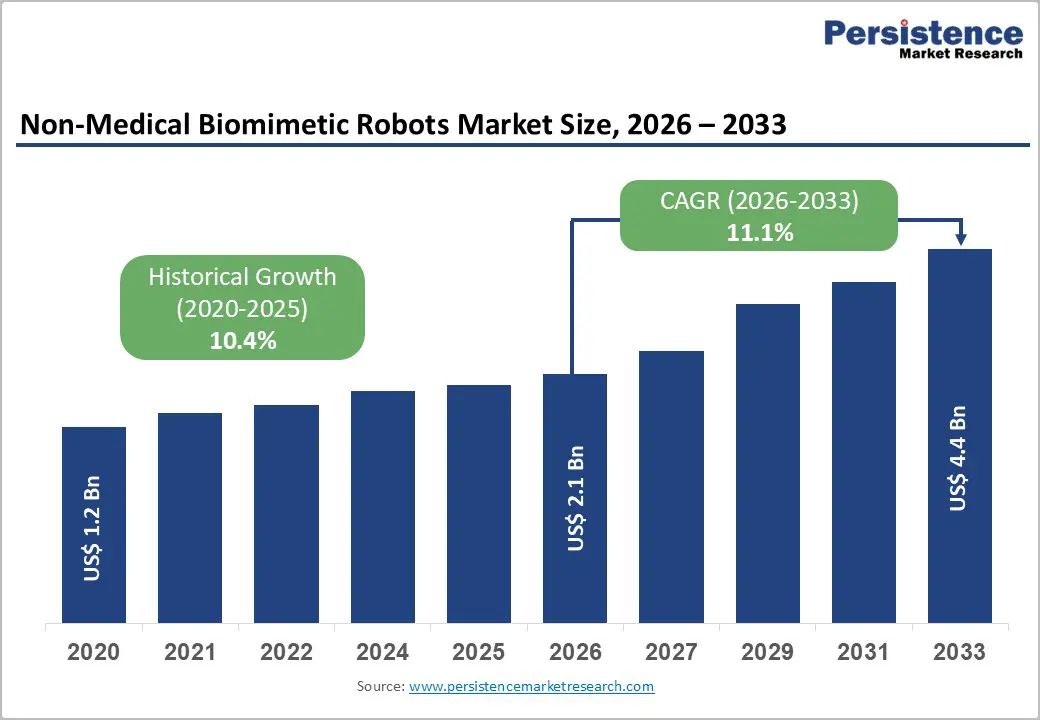
The global non-medical biomimetic robots market size is expected to be valued at US$ 2.1 billion in 2026 and projected to reach US$ 10.1 billion by 2033, growing at a CAGR of 25.1% between 2026 and 2033.
This strong growth is driven by rapid advances in artificial intelligence, robotic control systems, and advanced materials, which enable robots to replicate natural movement, adaptability, and agility. Rising defense applications such as surveillance, reconnaissance, and autonomous mobility, along with increasing industrial automation requirements for precision handling in complex environments, are accelerating adoption. Government-backed R&D programs, including DARPA-led initiatives, and expanding use in logistics, inspection, and manufacturing further support market expansion.
Key Industry highlights:
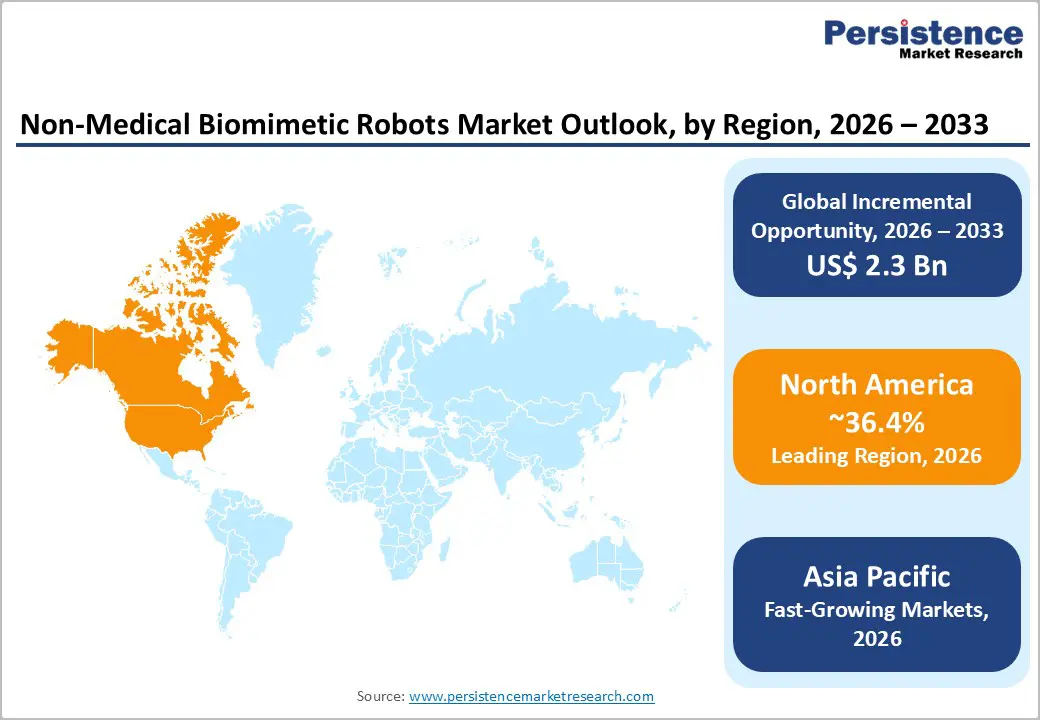
- Leading Region: North America dominates with 36.8% share in 2025, driven by DARPA R&D and defense initiatives.
- Fastest-Growing Region: Asia Pacific is the fastest-growing region with 34.5% share, supported by manufacturing investments and automation adoption.
- Leading Robot Type: Autonomous robots hold the top position, with a 65% share in 2025, due to their superior adaptability.
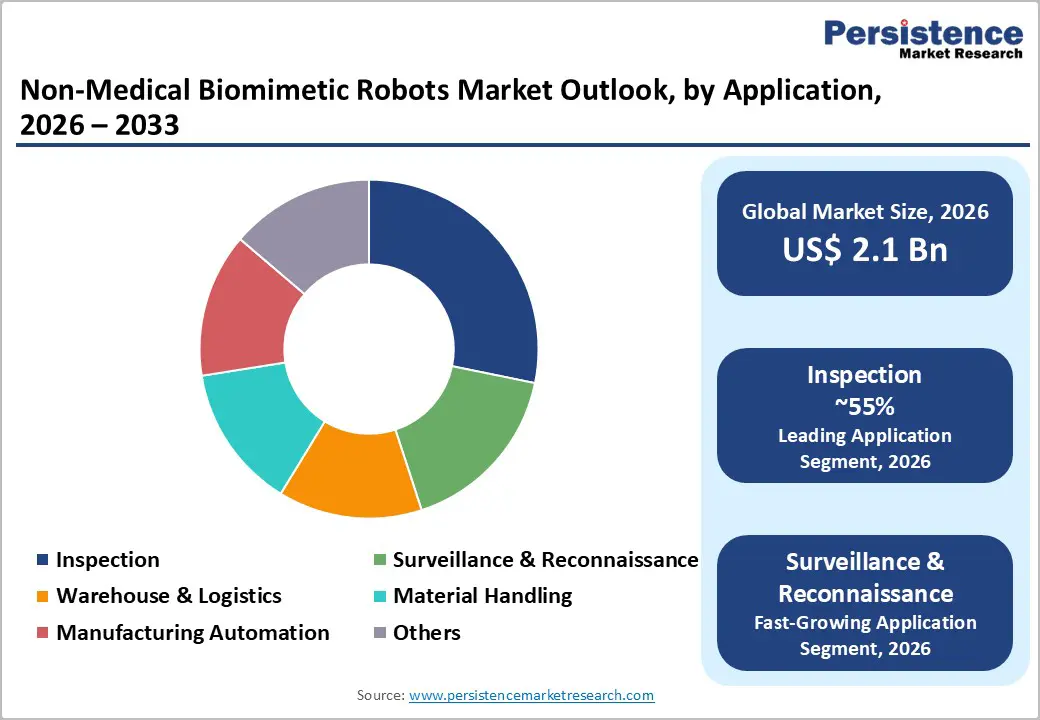
- Leading Application: Inspection applications account for 55% of the market in 2025, enhancing industrial efficiency and operational reliability.
- Key Opportunity: Defense surveillance is a high-potential segment with strong adoption driven by tactical needs, policy support, and rapid technological advancements.
| Key Insights | Details |
|---|---|
| Non-Medical Biomimetic Robots Size (2026E) | US$ 2.1 billion |
| Market Value Forecast (2033F) | US$ 10.1 billion |
| Projected Growth CAGR(2026 - 2033) | 25.1% |
| Historical Market Growth (2020 - 2025) | 24.8% |
Market Dynamics
Drivers - Advancements in Artificial Intelligence, Machine Learning, and Sensor Technologies
Rapid advancements in artificial intelligence, machine learning, and sensor integration are significantly driving the non-medical biomimetic robots market. AI-enabled perception systems, vision sensors, and real-time data processing allow robots to mimic biological decision-making and movement with greater accuracy. Brain-inspired control algorithms enhance balance, navigation, and adaptability in unstructured environments, enabling reliable performance across terrain types.
In parallel, innovations in soft robotics, smart materials, and bio-inspired actuators improve energy efficiency, flexibility, and durability. These technologies reduce mechanical complexity while enabling smoother, more natural locomotion. As a result, biomimetic robots demonstrate higher operational efficiency, lower failure rates, and expanded applicability in inspection, surveillance, and automation-driven industries.
Rising Demand from Defense, Security, and Industrial Automation Sectors
Growing demand from defense and industrial sectors is a major catalyst for the adoption of non-medical biomimetic robots. Defense organizations increasingly deploy bio-inspired robots for surveillance, reconnaissance, and mission-critical operations to minimize human risk in hostile or inaccessible environments. Their stealth, mobility, and adaptability make them well-suited for border security and intelligence-gathering tasks.
Similarly, industrial sectors are adopting biomimetic robots to enhance productivity and safety in hazardous operations, including pipeline inspection, facility monitoring, and material handling. These robots enable continuous operations with minimal downtime while reducing labor dependency. Strong government funding, defense programs, and industrial automation investments continue to reinforce long-term market growth.
Restraints -High Development, Engineering, and Manufacturing Cost Structure
High development and manufacturing costs remain a key restraint for the non-medical biomimetic robots market. Bio-inspired designs rely on advanced materials, such as soft actuators, smart polymers, and high-precision sensors, thereby significantly increasing production complexity and unit costs relative to conventional robots. In addition, complex system integration and custom hardware architectures require multidisciplinary engineering expertise, extending development cycles and limiting economies of scale.
These cost pressures restrict adoption primarily to defense agencies, large industrial players, and well-funded research institutions. Smaller manufacturers and commercial users face barriers to entry, slowing large-scale commercialization. As a result, price sensitivity and limited cost optimization continue to restrain broader market penetration.
Regulatory, Safety, and Ethical Uncertainties Across Applications
Regulatory and ethical challenges further constrain the growth of non-medical biomimetic robots. The absence of globally harmonized standards for autonomous operation, safety validation, and real-time decision-making creates approval delays, particularly in highly regulated regions. In defense and surveillance applications, concerns over privacy, data security, and autonomous action raise public and governmental scrutiny.
Ethical debates surrounding humanoid or animal-like robotic systems also contribute to resistance, especially in public spaces. These regulatory ambiguities increase compliance costs, slow deployment timelines, and create uncertainty for manufacturers, limiting near-term adoption despite strong technological potential.
Opportunity - Expanding Deployment in Defense Surveillance and Reconnaissance Systems
Defense surveillance represents a high-growth opportunity for non-medical biomimetic robot manufacturers, driven by increasing demand for stealthy, agile, and autonomous reconnaissance platforms. Bio-inspired aerial and ground robots offer superior mobility and reduced detectability compared to conventional systems, making them suitable for intelligence gathering and border monitoring. Government-backed innovation programs and defense-funded pilot projects continue to accelerate technology readiness and real-world deployment.
Strategic collaborations with research institutions and defense contractors enable faster commercialization and customization for mission-specific requirements. With sustained defense modernization efforts and rising investments in autonomous systems, biomimetic robots offer attractive high-margin opportunities for suppliers focusing on surveillance, reconnaissance, and tactical support applications.
Rising Adoption of Autonomous Robots in Mining and Infrastructure Monitoring
The growing need for automation in mining and infrastructure monitoring presents a significant market opportunity for biomimetic robots. Labor shortages, safety risks, and the complexity of operating in hazardous environments are driving demand for autonomous robotic systems capable of navigating confined, uneven, or underwater locations. Biomimetic designs enhance mobility and adaptability, making them ideal for inspection and maintenance tasks.
Large-scale public infrastructure investments and modernization initiatives further support the adoption of technologies across the utilities, transportation, and energy sectors. As governments and private operators prioritize worker safety and operational efficiency, biomimetic robots are increasingly viewed as reliable alternatives for continuous monitoring, unlocking new and sustainable revenue streams for market participants.
Category-wise Analysis
Robot Type Insights
Autonomous robots dominate the non-medical biomimetic robots market, accounting for an estimated 65% share in 2025, driven by their ability to operate independently in dynamic and unpredictable environments. Advanced AI-based navigation, perception, and decision-making systems allow these robots to outperform remote-controlled alternatives in efficiency, endurance, and precision, particularly in logistics, inspection, and defense operations where human intervention is limited or risky.
Looking ahead, soft and hybrid biomimetic robots are emerging as the fastest-growing robot type. Their flexible structures, bio-inspired actuation, and energy-efficient movement enable deployment in confined, delicate, or highly complex environments, expanding adoption across industrial automation, infrastructure monitoring, and environmental exploration applications.
Application Insights
Inspection applications lead the market with around 55% share in 2025, reflecting strong demand from utilities, oil & gas, mining, and infrastructure sectors. Biomimetic robots are increasingly used for pipeline inspection, structural assessment, and facility monitoring because they can access confined or hazardous spaces, thereby significantly reducing operational downtime and improving preventive maintenance outcomes.
Environmental monitoring and surveillance represent the fastest-growing application segment. Rising focus on ecosystem monitoring, border security, and asset protection is driving demand for agile, bio-inspired robots capable of long-duration autonomous missions across land, air, and underwater environments.
Industry Insights
The defense and military sector holds the leading position with approximately 45% market share in 2025, supported by the growing use of biomimetic robots for surveillance, reconnaissance, logistics support, and tactical missions. Animal-inspired mobility and stealth characteristics align well with defense requirements, reinforcing strong adoption through government-funded development and deployment programs.
Industrial and infrastructure end users are expected to witness the fastest growth over the forecast period. The increasing emphasis on automation, worker safety, and operational efficiency across the manufacturing, energy, and construction industries is accelerating the adoption of biomimetic robots for inspection, monitoring, and material handling.
Regional Insights
North America Non-Medical Biomimetic Robots Market Trends and Insights
North America remains a leading region, accounting for around 36.8% market share driven by strong defense, aerospace, and industrial adoption. The United States anchors regional leadership through extensive funding for biomimetic robotics under defense and federal research programs. Advanced R&D ecosystems, supported by institutions such as MIT and national laboratories, accelerate innovation in autonomous mobility, sensing, and adaptive control systems.
The region is also witnessing rapid commercialization across inspection, logistics, and infrastructure monitoring. Supportive regulatory frameworks for autonomous systems and drones enable real-world deployment, while early adoption by industrial and defense users positions North America as a key hub for innovation and revenue.
Europe Non-Medical Biomimetic Robots Market Trends and Insights
Europe represents a technologically advanced and regulation-driven market, with strong adoption across industrial automation, manufacturing, and logistics applications. Germany leads regional demand through Industry 4.0 initiatives that integrate biomimetic robotics into smart factories, while the UK focuses on warehouse automation and sustainable robotic solutions supported by public innovation programs.
Europe is projected to grow at a healthy CAGR of approximately 25.1%, supported by harmonized regulatory frameworks that emphasize safety, ethics, and data protection. Companies specializing in bio-inspired automation and soft robotics benefit from structured deployment standards, enabling steady expansion across industrial and commercial sectors.
Asia Pacific Non-Medical Biomimetic Robots Market Trends and Insights
Asia-Pacific dominates global demand, accounting for an estimated 34.5% market share, driven by large-scale automation investments in China, Japan, and South Korea. Strong manufacturing ecosystems, rapid adoption of robotics, and government-backed smart manufacturing programs support widespread deployment of biomimetic robots across industrial and infrastructure applications.
The region is also emerging as the fastest-growing innovation hub, supported by cost-efficient production, expanding mining and infrastructure projects, and rising use of autonomous systems. The increasing focus on domestic robotics development and export-oriented manufacturing further strengthens the Asia-Pacific’s long-term market leadership.
Competitive Landscape
The non-medical biomimetic robots market is highly fragmented, characterized by a mix of established robotics manufacturers, technology innovators, and research-driven organizations. Competition is largely driven by rapid advancements in artificial intelligence, bio-inspired design, and adaptive mobility. Market participants focus heavily on research and development to enhance autonomy, energy efficiency, and operational reliability, enabling differentiation through advanced locomotion systems and intelligent control architectures.
Strategic collaborations, defense contracts, and partnerships with academic institutions play a critical role in market expansion. Emerging business models increasingly emphasize service-based offerings, including subscription-driven robotic fleets and long-term maintenance contracts, allowing companies to improve recurring revenue and strengthen customer retention.
Key Developments:
- In August 2025, Boston Dynamics and Toyota Research Institute demonstrated the AI-powered Atlas robot, showcasing advanced capabilities for complex navigation, manipulation, and adaptive tasks, highlighting significant progress in autonomous biomimetic robotics for industrial and defense applications.
- In October 2024, MIT and Nanjing University introduced biomimetic olfactory chips for inspection robots, enabling enhanced chemical and environmental sensing in confined or hazardous spaces, marking a breakthrough in bio-inspired perception technologies for non-medical robotic applications.
- In 2024, DARPA advanced its soft robotics challenges for surveillance, promoting the development of energy-efficient, flexible robots capable of stealthy movement, autonomous reconnaissance, and improved adaptability in complex terrains for defense and security operations.
Companies Covered in Non-Medical Biomimetic Robots Market
- Boston Dynamics
- Festo AG & Co. KG
- ABB Ltd.
- KUKA AG
- FANUC Corporation
- Yaskawa Electric Corporation
- SoftBank Robotics
- 8. iRobot Corporation
- Hanson Robotics
- Agility Robotics
- ANYbotics
- Ghost Robotics
- AeroVironment, Inc.
- Bluefin Robotics (General Dynamics)
- Shadow Robot Company
Frequently Asked Questions
The non-medical biomimetic robots market is expected to reach US$ 2.1 billion in 2026.
Advancements in AI and defense needs for surveillance propel demand.
North America leads with 36.8% share in 2025, supported by U.S. R&D and defense programs.
Defense surveillance applications present high growth potential with strong policy support.
Boston Dynamics, Festo Group, Agility Robotics, and Essentra plc lead innovations.


