




- Nutraceuticals & Functional Foods
- Multivitamin Gummies Market
Multivitamin Gummies Market Size, Share, Growth, and Regional Forecast, 2026 to 2033
Multivitamin Gummies Market by Source (Plant Based, Animal Based), by Packaging Type (Bottle & Jars, Stand Up Pouches, Others), by Sales Channel (Modern Trade, Convenience Stores, Specialty Store, Drug Stores/ Pharmacies, Online Retail, Others), by Regional Analysis, 2026-2033

Multivitamin Gummies Market Size and Trend Analysis
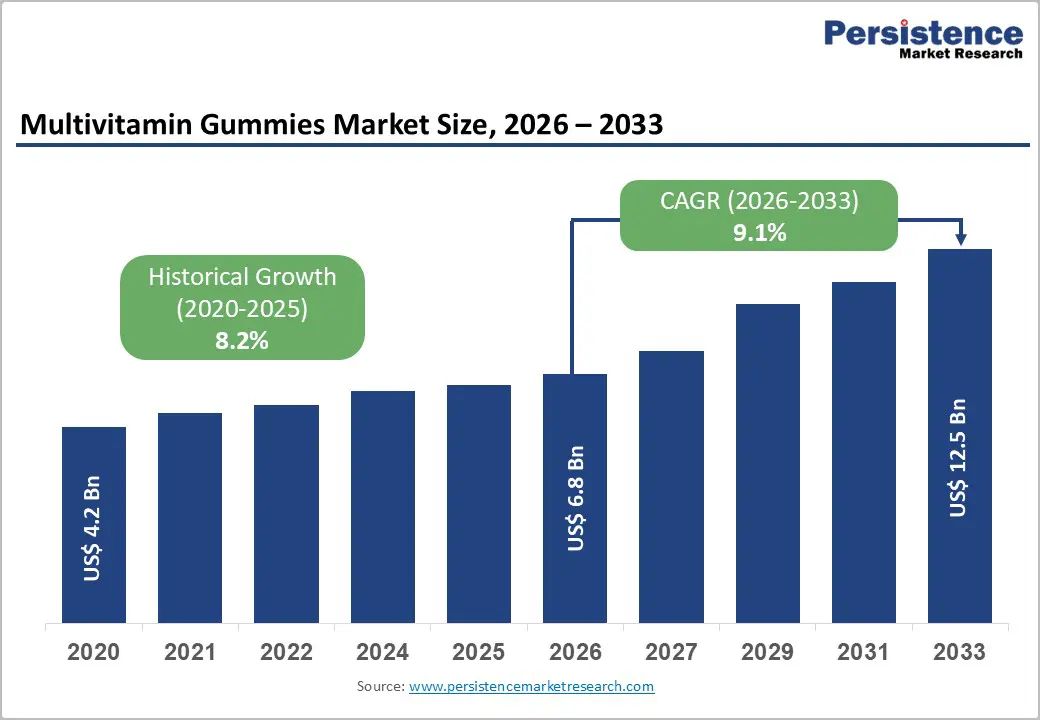
The global Multivitamin Gummies market size is expected to be valued at US$ 6.8 billion in 2026 and projected to reach US$ 12.5 billion by 2033, growing at a CAGR of 9.1% between 2026 and 2033
The expansion of the global Multivitamin Gummies Market is primarily driven by the "pill fatigue" phenomenon among adult consumers who seek more palatable and convenient alternatives to traditional tablets. As preventive healthcare becomes a lifestyle priority, the integration of essential nutrients into confectionary-like formats has bridged the gap between medical necessity and consumer enjoyment. Furthermore, innovations in pectin-based formulations and sugar-free profiles are attracting a broader demographic, including vegan and health-conscious shoppers, thereby accelerating market penetration across both developed and emerging economies.
Key Industry Highlights
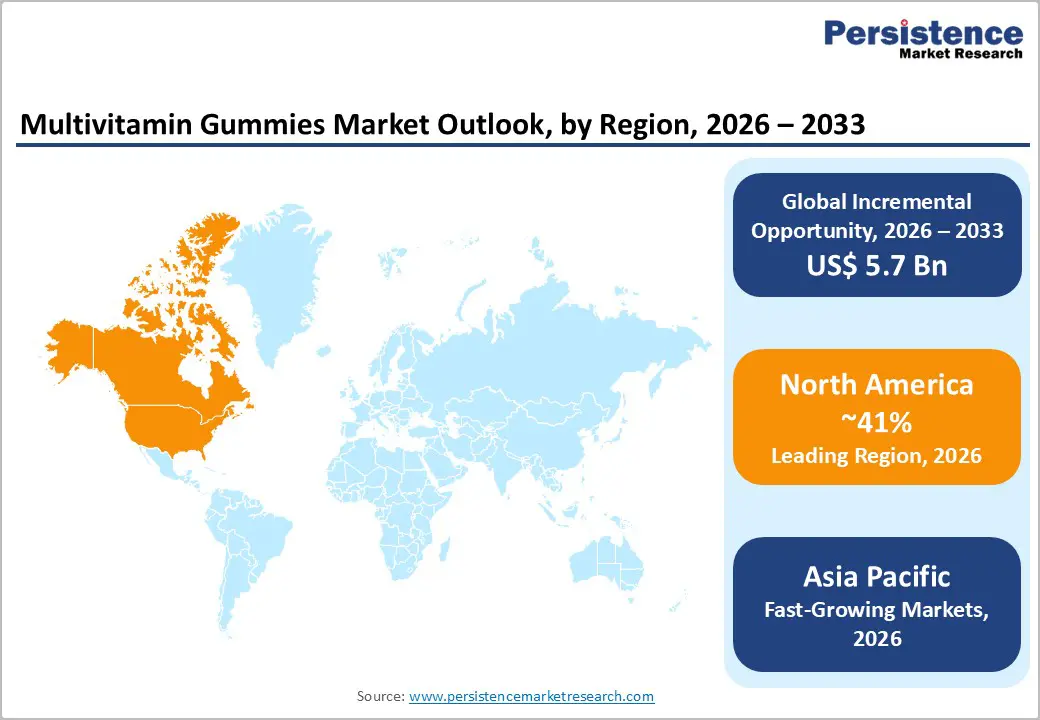
- Leading Region: North America, holding around 41% market share, supported by a mature supplement culture, strong brand presence, regulatory clarity under DSHEA, and high adoption of clean-label, beauty-from-within, and age-specific gummy formulations.
- Fastest-Growing Region: Asia Pacific, driven by urbanization, rising disposable incomes, nutricosmetics demand, aging populations, and rapid expansion of e-commerce platforms enabling deeper market penetration.
- Fastest-Growing Source Segment: Plant-Based Gummies, fueled by rising vegan and flexitarian populations, rejection of animal-derived gelatin, and improved functional performance of pectin-based matrices in warm climates.
- Market Drivers: Growing consumer aversion to pills and capsules is accelerating demand for chewable, sensory-friendly formats that combine convenience, taste, and daily wellness compliance.
- Opportunities: Development of benefit-specific and demographic-targeted gummies for sleep, beauty, prenatal, pediatric, and cognitive health, alongside personalization and tech-enabled nutrition platforms.
- Key Developments: In September 2025, DaVinci® Laboratories launched its first ADK Gummy Multivitamin; in July 2025, One A Day® introduced Kids Multi with Iron gummies; and in August 2025, Swisse Wellness expanded its pediatric portfolio with Little Swisse Kids Gummies.
| Key Insights | Details |
|---|---|
| Global Multivitamin Gummies Market Size (2026E) | US$ 6.8 Bn |
| Market Value Forecast (2033F) | US$ 12.5 Bn |
| Projected Growth (CAGR 2026 to 2033) | 9.1% |
| Historical Market Growth (CAGR 2020 to 2025) | 8.2% |
Market Dynamics
Driver – Rising Consumer Preference for Non-Traditional Delivery Formats and Pill Fatigue
The global shift toward sensory-driven health supplements is a primary catalyst for the Multivitamin Gummies Market. Modern consumers, particularly Millennials and Gen Z, are increasingly averse to the clinical experience of swallowing large, tasteless tablets or capsules. This "pill fatigue" has led to a surge in demand for chewable formats that offer a candy-like experience without compromising nutritional integrity. According to the Council for Responsible Nutrition (CRN), over 75% of U.S. adults take dietary supplements, with a growing percentage opting for gummies due to ease of consumption and the elimination of the need for water. The Multivitamin Gummies Market benefits from this behavioral shift, as major brands like Haleon and Bayer AG reformulate their flagship products into gummy versions to retain market share among younger, convenience-oriented demographics.
Restraints – Challenges in Nutrient Stability and Precise Dosage Formulation
One of the critical barriers for the Multivitamin Gummies Market is the inherent difficulty in maintaining ingredient stability within a gelatin or pectin matrix. Unlike compressed tablets, gummies are sensitive to heat and moisture, which can lead to the degradation of sensitive vitamins like Vitamin B12 and Vitamin C over time. This instability often forces manufacturers to "over-fortify" their recipes to ensure the label claim remains accurate until the expiration date. The U.S. Food and Drug Administration (FDA) and the European Food Safety Authority (EFSA) maintain strict guidelines on labeling accuracy, and discrepancies can lead to costly recalls or legal challenges. For instance, reports from independent testing labs like ConsumerLab have occasionally highlighted that certain gummy brands contain significantly more sugar or fewer vitamins than advertised, undermining consumer trust and restraining segment growth.
Opportunity – Expansion into Specialized and Functional Gummy Formulations for Specific Demographics
The Multivitamin Gummies Market is witnessing a significant opportunity in the development of "benefit-specific" products that go beyond general wellness. There is a burgeoning demand for gummies tailored for sleep support (containing Melatonin), beauty (infused with Collagen and Biotin), and cognitive health (incorporating Omega-3s and L-Theanine). According to the Global Organization for EPA and DHA Omega-3s (GOED), the inclusion of functional oils in chewable formats is a high-growth area. By targeting niche segments such as prenatal care or geriatric health, companies can command premium pricing. The trend toward personalized nutrition, where gummies are customized based on blood tests or lifestyle apps, represents a multi-billion dollar frontier for tech-integrated supplement brands, allowing them to differentiate themselves from generic mass-market offerings.
Category-wise Analysis
Source Analysis
The Plant Based source segment is emerging as a powerful force within the Multivitamin Gummies Market, reflecting the broader global transition toward veganism and ethical consumption. In 2025, this segment is gaining significant traction, with a market share approaching 38%, as consumers increasingly reject animal-derived gelatin in favor of plant-based thickeners like Pectin (derived from citrus fruits), Agar-Agar, and Carrageenan. Data from the Vegan Society suggests that the "flexitarian" population is expanding rapidly, driving the demand for products that are Non-GMO and free from bovine or porcine ingredients. This shift is not merely ethical but also functional, as Pectin-based gummies offer a higher melting point and better stability in warmer climates, making them a preferred choice for global distribution. Brands like Garden of Life (a Nestlé Health Science brand) are capitalizing on this by marketing high-quality, organic, and plant-based multivitamin gummies to health-conscious parents and adults.
Packaging Type Analysis
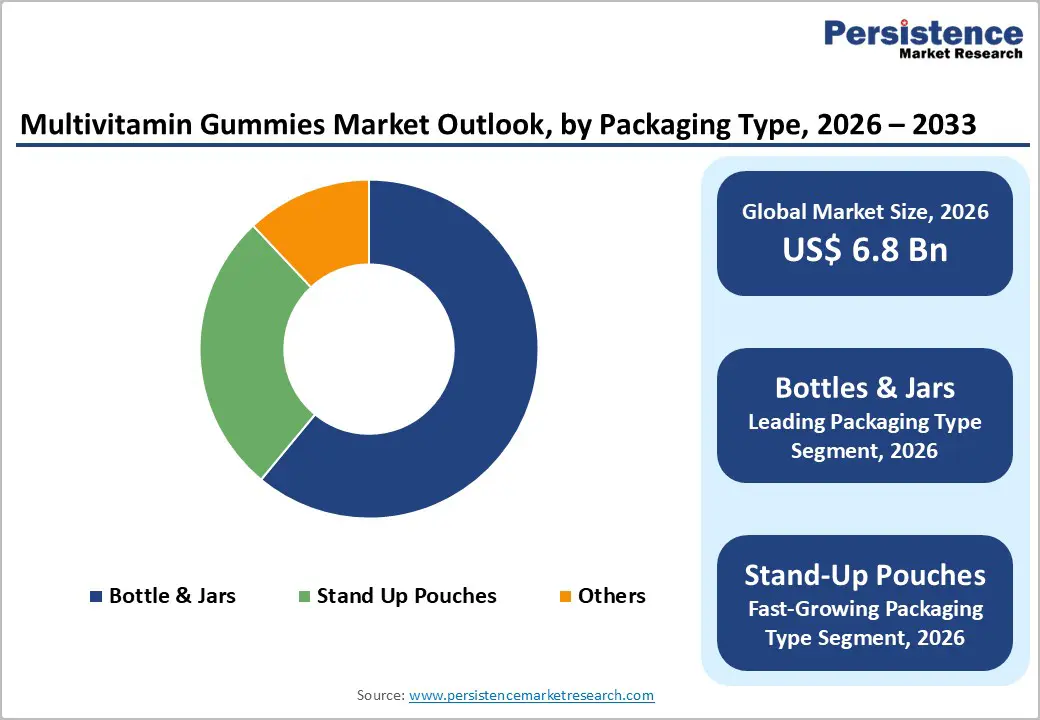
The Bottle & Jars segment remains the dominant packaging format in the Multivitamin Gummies Market, commanding a substantial 58% market share in 2025. The primary reason for this leadership is the superior protection these containers offer against moisture and oxidation, which are the main enemies of gummy stability. Rigorous standards set by the International Organization for Standardization (ISO) for food-grade packaging ensure that high-density polyethylene (HDPE) and PET bottles provide the necessary barrier properties to maintain the shelf life of the vitamins. Furthermore, Bottle & Jars are favored by retailers for their ease of stacking on shelves and by consumers for their child-resistant cap features, which are mandatory in many regions to prevent accidental over-consumption by children. The familiarity and perceived "medical-grade" safety of bottles continue to reinforce their dominant position in pharmacies and supermarkets alike.
Region-wise Insights
North America Multivitamin Gummies Market Trends and Insights
North America continues to be the largest market for multivitamin gummies, holding a commanding 41% market share in 2025. The United States leads this dominance due to a highly developed healthcare infrastructure and a culture that prioritizes proactive wellness. The presence of industry giants such as Church & Dwight Co., Inc. and Bayer AG ensures a constant stream of product innovation and aggressive marketing. Regulatory clarity provided by the Dietary Supplement Health and Education Act (DSHEA) of 1994 has created a stable environment for manufacturers to launch new products while maintaining safety standards.
Innovation in the U.S. market is currently focused on "clean label" transparency. Consumers are demanding gummies that are free from high-fructose corn syrup, synthetic dyes, and artificial sweeteners. Furthermore, the integration of Multivitamin Gummies into the "beauty from within" trend is a major driver in the North American region. The American Academy of Dermatology has noted an increasing consumer interest in how nutrition affects skin and hair health, leading to a surge in gummy multivitamins that specifically include ingredients like Lutein, Zeaxanthin, and Collagen.
Asia Pacific Multivitamin Gummies Market Trends and Insights
The Asia Pacific region is the fastest-growing market for multivitamin gummies, driven by rapid urbanization and an expanding middle class in China, India, and Japan. The region benefits from a massive manufacturing advantage, with countries like India and China being major global suppliers of raw vitamins and active pharmaceutical ingredients (APIs). The rise of "nutricosmetics" in East Asia—where vitamins are consumed for skin whitening and anti-aging has created a unique demand profile that significantly boosts the gummy segment.
In China, the "silver economy" (the aging population) is a significant demographic target. The China Food and Drug Administration (CFDA) has seen an increase in registrations for health supplements that cater to bone health and cognitive function for the elderly. Meanwhile, in India, the penetration of digital payment systems and e-commerce platforms like Flipkart and Amazon has allowed global brands to reach rural and semi-urban populations. The Ministry of Ayush in India is also promoting the integration of traditional Ayurvedic herbs into modern supplement formats, creating a lucrative "fusion" market for multivitamin gummies that include ingredients like Ashwagandha or Turmeric.
Market Competitive Landscape
The Multivitamin Gummies Market is currently a moderately fragmented landscape, though it is undergoing rapid consolidation as global consumer goods giants acquire successful niche brands. Large multinational corporations like Unilever PLC, Nestlé Health Science, and Haleon utilize their vast distribution networks and marketing budgets to maintain dominance. However, "born-digital" brands continue to emerge, leveraging social media and direct-to-consumer models to gain market share. Key differentiators in this market include flavor profile excellence, label transparency, and third-party certifications (such as USP or NSF). R&D trends are currently focused on improving "thermal stability" to prevent gummy clumping and the development of sugar-free matrices that maintain a satisfying "chew" without the use of artificial additives.
Key Developments:
- In September 2025, DaVinci® Laboratories entered the gummy supplements space with the launch of its first health-conscious ADK Gummy Multivitamin, signaling growing demand for clean-label, consumer-friendly vitamin delivery formats among wellness-focused adults.
- In August 2025, Swisse Wellness expanded its pediatric nutrition portfolio with the launch of Little Swisse Kids Gummies, formulated to support healthy growth and development, reinforcing the strong shift toward functional, age-specific gummy supplements in the global vitamins and supplements market.
- In July 2025, One A Day®, leveraging its 80+ year legacy in nutritional science, introduced One A Day® Kids Multi with Iron, a gummy multivitamin delivering 12 mg of iron per serving to address a key micronutrient gap in children’s diets while maintaining high palatability.
Companies Covered in Multivitamin Gummies Market
- Bayer AG
- Church & Dwight Co., Inc.
- Haleon
- Nestlé Health Science
- Otsuka Pharmaceutical
- Unilever PLC
- Reckitt Benckiser
- Life Science Nutritionals
- Pfizer Inc.
- Swisse
- Others
Frequently Asked Questions
The global Multivitamin Gummies market is projected to be valued at US$ 6.8 Bn in 2026.
Rising Consumer Preference for Non-Traditional Delivery Formats and Pill Fatigue is a key driver for market.
The Global Multivitamin Gummies market is poised to witness a CAGR of 9.1% between 2026 and 2033
Expansion into Specialized and Functional Gummy Formulations for Specific Demographics is key opportunity.
The market features industry giants like Bayer AG, Church & Dwight Co., Inc., Haleon, Nestlé Health Science, Otsuka Pharmaceutical, Unilever PLC, Reckitt Benckiser, and Others


